Recognition: 2 theorem links
· Lean TheoremScaling Symmetries and Conformal Relative Equilibria on Poisson Manifolds, with Applications to Lie--Poisson Systems
Pith reviewed 2026-05-12 01:49 UTC · model grok-4.3
The pith
A homogeneous Hamiltonian system admits a nontrivial conformal relative equilibrium if and only if its Lie algebra contains a hyperbolic element.
A machine-rendered reading of the paper's core claim, the machinery that carries it, and where it could break.
Core claim
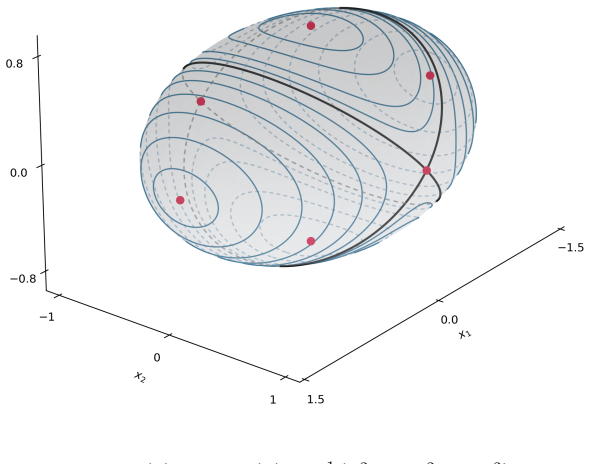
By introducing conformally Poisson actions and conformal momentum maps, the work shows that a homogeneous Hamiltonian system on the dual of a Lie algebra admits a nontrivial conformal relative equilibrium precisely when the Lie algebra contains a hyperbolic element. The same algebraic criterion produces a complete classification of such equilibria in three dimensions via the Bianchi types and demonstrates that they occur in the dynamics on so(2,1)* while being obstructed for the free rigid body on so(3)*.
What carries the argument
The hyperbolic element of the Lie algebra, which serves as the algebraic condition allowing the scaling symmetry to produce a conformal relative equilibrium through the conformal momentum map.
If this is right
- In three dimensions every possible case is settled by the Bianchi classification of Lie algebras.
- Nontrivial conformal relative equilibria exist for the Lie-Poisson equations on so(2,1)*.
- No such equilibria exist for the classical free rigid body on so(3)*.
- In the nondegenerate case the conditions reduce exactly to those already known for exact symplectic manifolds.
Where Pith is reading between the lines
- The same algebraic marker could be checked for any other Lie algebra to decide in advance whether conformal equilibria are possible in its dynamics.
- The obstruction found for so(3)* may indicate that certain conserved quantities in rigid-body motion prevent the conformal scaling from producing equilibria.
- The criterion offers a screening test that could be applied to higher-dimensional Lie algebras before attempting to integrate the equations.
Load-bearing premise
The Poisson manifold must be exact and the scaling symmetry must induce a conformally Poisson action.
What would settle it
A single counterexample consisting of a Lie algebra without hyperbolic elements that nevertheless supports a nontrivial conformal relative equilibrium in some homogeneous Hamiltonian system on its dual would refute the claimed equivalence.
Figures

read the original abstract
We investigate conformal relative equilibria for Hamiltonian systems on exact Poisson manifolds equipped with scaling symmetries. By introducing conformally Poisson actions and conformal momentum maps, we characterize these equilibria through an augmented Hamiltonian formulation; in the nondegenerate case, this recovers the conditions recently developed for the exact symplectic case. Specializing to Lie--Poisson manifolds, where the natural scaling action canonically provides an exact Poisson structure on the dual of any finite-dimensional Lie algebra, we establish a purely algebraic criterion: a homogeneous Hamiltonian system admits a nontrivial conformal relative equilibrium if and only if the underlying Lie algebra contains a hyperbolic element. This yields a complete classification in dimension three via the Bianchi classification. As a prominent application, we show that nontrivial conformal relative equilibria emerge in the dynamics on $\mathfrak{so}(2,1)^*$, but are strictly obstructed for the classical free rigid body on $\mathfrak{so}(3)^*$.
Editorial analysis
A structured set of objections, weighed in public.
Referee Report
Summary. The paper introduces conformally Poisson actions and conformal momentum maps on exact Poisson manifolds equipped with scaling symmetries. It characterizes conformal relative equilibria of homogeneous Hamiltonian systems via an augmented Hamiltonian whose critical points yield the equilibria. Specializing to Lie-Poisson manifolds, where the canonical scaling action supplies an exact Poisson structure, the authors prove that a nontrivial conformal relative equilibrium exists if and only if the underlying Lie algebra contains a hyperbolic element. This yields a complete classification in dimension three via the Bianchi types, with the explicit conclusion that such equilibria exist on so(2,1)* but are obstructed on so(3)*.
Significance. If the algebraic criterion holds, the result is significant: it supplies a parameter-free, purely algebraic test (based on the spectrum of the adjoint representation) that recovers the known symplectic conditions in the nondegenerate case. The three-dimensional classification and the contrasting statements for so(2,1)* versus so(3)* provide concrete, falsifiable predictions for Lie-Poisson dynamics. The framework extends reduction techniques to the conformal setting while remaining independent of the specific form of the homogeneous Hamiltonian.
major comments (1)
- [§4] §4 (algebraic criterion): the forward direction constructs an explicit point μ and conformal factor from a hyperbolic element X; it is not immediately clear from the derivation whether this construction automatically satisfies the equilibrium equations for every homogeneous Hamiltonian or whether the homogeneity degree must be fixed in advance. A short explicit verification for a generic homogeneous H would strengthen the claim that the criterion is independent of the particular H.
minor comments (2)
- [Abstract] The abstract refers to 'conditions recently developed for the exact symplectic case' without a citation; adding the reference would allow readers to verify the claimed recovery immediately.
- [Bianchi classification] A compact table summarizing the nine Bianchi types, their adjoint eigenvalue spectra, and the presence/absence of hyperbolic elements would make the three-dimensional classification more readable.
Simulated Author's Rebuttal
We thank the referee for the careful reading, positive evaluation of the significance, and recommendation for minor revision. We address the major comment below.
read point-by-point responses
-
Referee: [§4] §4 (algebraic criterion): the forward direction constructs an explicit point μ and conformal factor from a hyperbolic element X; it is not immediately clear from the derivation whether this construction automatically satisfies the equilibrium equations for every homogeneous Hamiltonian or whether the homogeneity degree must be fixed in advance. A short explicit verification for a generic homogeneous H would strengthen the claim that the criterion is independent of the particular H.
Authors: We thank the referee for highlighting this point. The forward direction of the algebraic criterion holds for an arbitrary homogeneous Hamiltonian H (of any fixed degree compatible with the scaling action), because the proof uses only the homogeneity of H to ensure that the Lie-Poisson vector field X_H satisfies the required scaling relation with the conformal factor induced by the hyperbolic element X; no further restriction on the specific form of H is imposed. The homogeneity degree is not prescribed in advance but is fixed by the given scaling symmetry on the Poisson manifold. To address the concern that this independence is not immediately transparent, we will add a short explicit verification for a generic homogeneous H in the revised version of §4, confirming that the constructed μ satisfies the conformal relative equilibrium equations independently of the particular choice of H. revision: yes
Circularity Check
No significant circularity
full rationale
The derivation proceeds from the definitions of exact Poisson manifolds, scaling symmetries, conformally Poisson actions, and conformal momentum maps to an augmented Hamiltonian whose critical points characterize the equilibria. The central iff criterion for Lie-Poisson systems is obtained by direct algebraic computation on the Lie algebra: a hyperbolic element produces an explicit equilibrium point and conformal factor, while any such equilibrium forces a hyperbolic element in the adjoint representation. The nondegenerate case is shown to recover prior symplectic conditions as a consistency check rather than an input assumption. The three-dimensional classification follows by inspecting the standard Bianchi types, and the so(2,1)* versus so(3)* contrast follows immediately from their adjoint spectra. No step reduces by construction to a fitted parameter, self-definition, or load-bearing self-citation chain; the argument is self-contained against external algebraic benchmarks.
Axiom & Free-Parameter Ledger
axioms (2)
- domain assumption The Poisson manifold is exact
- domain assumption The action is a conformally Poisson action
invented entities (2)
-
conformally Poisson action
no independent evidence
-
conformal momentum map
no independent evidence
Lean theorems connected to this paper
-
IndisputableMonolith/Foundation/AlexanderDuality.leanalexander_duality_circle_linking uncleara homogeneous Hamiltonian system admits a nontrivial conformal relative equilibrium if and only if the underlying Lie algebra contains a hyperbolic element... complete classification in dimension three via the Bianchi classification
Reference graph
Works this paper leans on
-
[1]
R. Abraham and J. E. Marsden.Foundations of mechanics. 364. American Mathematical Soc., 2008
work page 2008
-
[2]
V. I. Arnold and B. A. Khesin.Topological methods in hydrodynamics. Springer, 1998
work page 1998
-
[3]
V. I. Arnold.Mathematical methods of classical mechanics. Vol. 60. Springer, 1989
work page 1989
-
[4]
Sugli spazi a tre dimensioni che ammettono un gruppo continuo di movimenti
L. Bianchi. “Sugli spazi a tre dimensioni che ammettono un gruppo continuo di movimenti”. Memorie della Societa Italiana delle Scienze. detta dei XL.(3)11(1897), pp. 267–352
-
[5]
Bianchi.Lezioni sulla teoria dei gruppi continui finiti di trasformazioni
L. Bianchi.Lezioni sulla teoria dei gruppi continui finiti di trasformazioni. N. Zanichelli, 1928
work page 1928
-
[6]
Kirillov structures and reduction of Hamiltonian systems by scaling and standard symmetries
A. Bravetti, S. Grillo, J. Marrero, and E. Padr´ on. “Kirillov structures and reduction of Hamiltonian systems by scaling and standard symmetries”.Studies in Applied Mathematics 153.1 (2024), e12681
work page 2024
-
[7]
Scaling symmetries, contact reduction and Poincar´ e’s dream
A. Bravetti, C. Jackman, and D. Sloan. “Scaling symmetries, contact reduction and Poincar´ e’s dream”.Journal of Physics A: Mathematical and Theoretical56.43 (2023), p. 435203
work page 2023
-
[8]
A class of homogeneous cosmological models
G. F. Ellis and M. A. MacCallum. “A class of homogeneous cosmological models”.Commu- nications in Mathematical Physics12.2 (1969), pp. 108–141
work page 1969
-
[9]
D. D. Holm, T. Schmah, and C. Stoica.Geometric mechanics and symmetry: from finite to infinite dimensions. Vol. 12. Oxford University Press, 2009
work page 2009
-
[10]
L. D. Landau and E. M. Lifshitz.Mechanics: Course of Theoretical Physics, Volume 1. 3rd ed. Butterworth-Heinemann, 1976
work page 1976
-
[11]
Stability and drift of underwater vehicle dynamics: mechanical systems with rigid motion symmetry
N. E. Leonard and J. E. Marsden. “Stability and drift of underwater vehicle dynamics: mechanical systems with rigid motion symmetry”.Physica D: Nonlinear Phenomena105.1- 3 (1997), pp. 130–162. 30
work page 1997
-
[12]
The heavy top: a geometric treatment
D. Lewis, T. Ratiu, J. Simo, and J. E. Marsden. “The heavy top: a geometric treatment”. Nonlinearity5.1 (1992), pp. 1–48
work page 1992
-
[13]
J. E. Marsden.Lectures on mechanics. Vol. 174. Cambridge University Press, 1992
work page 1992
-
[14]
J. E. Marsden and T. S. Ratiu.Introduction to mechanics and symmetry: a basic exposition of classical mechanical systems. Vol. 17. Springer Science & Business Media, 2013
work page 2013
-
[15]
Conformal Relative Equilibria for Scaling Symmetries and Central Configurations
G. Rastelli and M. Santoprete. “Conformal Relative Equilibria for Scaling Symmetries and Central Configurations”.Journal of Nonlinear Science36.2 (2026), p. 35
work page 2026
-
[16]
The motion of the free n-dimensional rigid body
T. Ratiu. “The motion of the free n-dimensional rigid body”.Indiana University Mathematics Journal29.4 (1980), pp. 609–629
work page 1980
-
[17]
M. P. Ryan and L. C. Shepley.Homogeneous relativistic cosmologies. Princeton University Press, 2015
work page 2015
-
[18]
Saari.Collisions, rings, and other NewtonianN-body problems
D. Saari.Collisions, rings, and other NewtonianN-body problems. 104. American Mathe- matical Soc., 2005
work page 2005
-
[19]
Stability of relative equilibria. Part I: The reduced energy-momentum method
J. C. Simo, D. Lewis, and J. E. Marsden. “Stability of relative equilibria. Part I: The reduced energy-momentum method”.Archive for Rational Mechanics and Analysis115.1 (1991), pp. 15–59.doi:10.1007/BF01881678
-
[20]
The local structure of Poisson manifolds
A. Weinstein. “The local structure of Poisson manifolds”.Journal of Differential Geometry 18.3 (1983), pp. 523–557
work page 1983
-
[21]
Wintner.The Analytical Foundations of Celestial Mechanics
A. Wintner.The Analytical Foundations of Celestial Mechanics. Princeton University Press, 1941
work page 1941
-
[22]
Rattleback: A model of how geometric singular- ity induces dynamic chirality
Z. Yoshida, T. Tokieda, and P. J. Morrison. “Rattleback: A model of how geometric singular- ity induces dynamic chirality”.Physics Letters A381.34 (2017), pp. 2772–2777. Z. Yoshida, T. Tokieda, and P. J. Morrison. “Erratum to “Rattleback: A model of how geometric singu- larity induces dynamic chirality””.Physics Letters A382.44 (2018), p. 3230. 31
work page 2017
discussion (0)
Sign in with ORCID, Apple, or X to comment. Anyone can read and Pith papers without signing in.