Recognition: no theorem link
Semantics-Aware Communication:A Differentiated Allocation Perspective
Pith reviewed 2026-05-12 01:49 UTC · model grok-4.3
The pith
Differentiated resource allocation to semantically critical tasks guarantees their actuation reliability under severe computation constraints.
A machine-rendered reading of the paper's core claim, the machinery that carries it, and where it could break.
Core claim
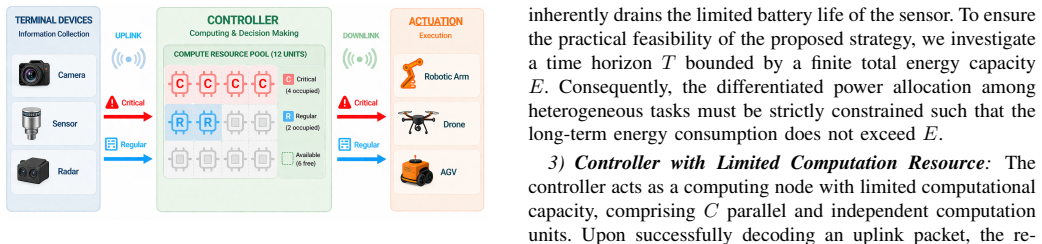
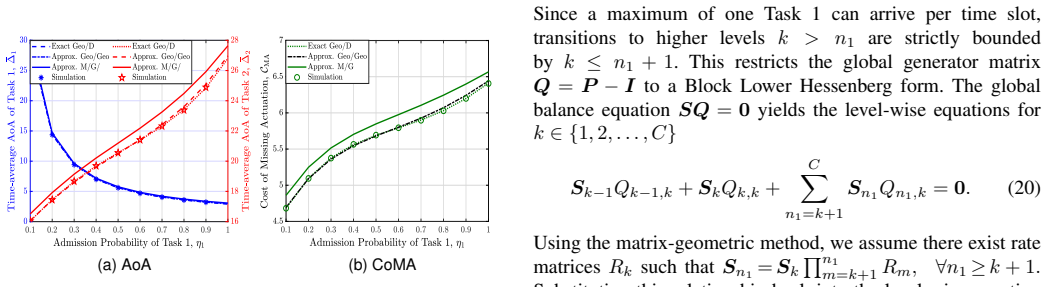
By categorizing sampled data into regular and critical tasks based on semantic states and applying differentiated resource allocation in a discrete-time multi-rate Geo/D/C/C queue model for the controller, the system achieves joint optimization of timeliness and reliability such that the actuation reliability of critical tasks is guaranteed in severely constrained environments, as characterized using task-aware AoA and CoMA metrics.
What carries the argument
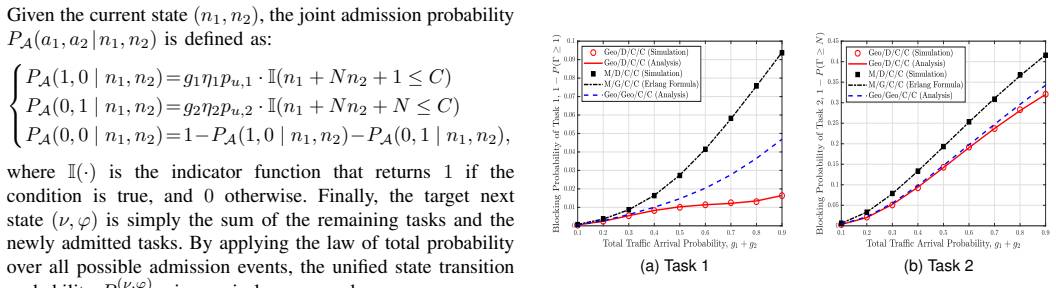
The discrete-time multi-rate Geo/D/C/C queue model that processes regular and critical tasks at different rates under semantic-state-based differentiated allocation.
If this is right
- Critical tasks maintain high actuation reliability despite overall resource constraints.
- Regular tasks absorb more delay so that critical ones stay protected.
- Timeliness and reliability are jointly optimized at the task level rather than uniformly.
- The approach works without requiring additional computation or communication resources.
Where Pith is reading between the lines
- The same semantic differentiation could improve priority handling in other resource-limited wireless systems such as sensor networks or edge IoT.
- Imperfect real-time classification would likely reduce the reliability gains for critical tasks.
- Adapting allocation thresholds dynamically to changing channel conditions might yield further performance improvements.
Load-bearing premise
Semantic states can be accurately and timely classified into regular versus critical tasks and the discrete-time multi-rate Geo/D/C/C queue model faithfully captures the joint computation and communication dynamics.
What would settle it
A real WNCS testbed experiment that replaces the idealized queue with measured hardware delays and introduces realistic errors in semantic task classification, then checks whether critical-task reliability still meets the predicted level under the same resource limits.
Figures

read the original abstract
We study the joint optimization of timeliness and reliability in semantics-aware Wireless Networked Control Systems (WNCS) under computation resource constraints. The sampled data are categorized into regular and critical tasks based on the semantic states, facilitating differentiated resource allocation. Task-aware Age of Actuation (AoA) and Cost of Missing Actuation (CoMA), are used to characterize the task-level freshness and the reliability penalty of missed actuations, respectively. By modeling the controller as a discrete-time multi-rate Geo/D/C/C queue, we evaluate the performance of regular and critical tasks, the latter imposing higher computational demands. Results confirm that differentiated resource allocation across heterogeneous tasks effectively guarantees the actuation reliability of critical tasks in severely constrained environments.
Editorial analysis
A structured set of objections, weighed in public.
Referee Report
Summary. The manuscript studies joint optimization of timeliness and reliability in semantics-aware Wireless Networked Control Systems (WNCS) under computation resource constraints. Sampled data are classified into regular and critical tasks based on semantic states to enable differentiated resource allocation. Task-aware Age of Actuation (AoA) and Cost of Missing Actuation (CoMA) metrics characterize freshness and the reliability penalty of missed actuations. The controller is modeled as a discrete-time multi-rate Geo/D/C/C queue with higher computational demands for critical tasks, and numerical results are presented to show that differentiated allocation guarantees actuation reliability for critical tasks in severely constrained environments.
Significance. If the results hold under the stated modeling assumptions, the work offers a concrete approach to prioritizing critical tasks via semantic differentiation in resource-limited WNCS, which could improve control performance without increasing overall resource budgets. The CoMA metric provides a task-specific way to quantify reliability penalties that may be useful beyond this setting.
major comments (2)
- [Modeling section] The central reliability guarantee rests on the discrete-time multi-rate Geo/D/C/C queue model (described in the modeling section) with deterministic service times for both task classes. No sensitivity analysis or replacement with stochastic service times drawn from measured computation traces is provided; if service times deviate from deterministic, the reported CoMA values for critical tasks no longer apply to realistic WNCS.
- [Evaluation section] The differentiated allocation scheme assumes perfect and timely semantic classification of states into regular versus critical tasks. The evaluation does not test robustness to classification error rates greater than zero; even modest misclassification would undermine the premise that critical-task CoMA remains low under severe constraints.
minor comments (2)
- [Abstract] The abstract introduces AoA and CoMA without first defining the underlying actuation model or the precise definition of 'missed actuation' used to compute CoMA.
- Notation for the multi-rate Geo/D/C/C parameters (arrival rates, service rates, and capacity C for each task class) should be collected in a single table for clarity.
Simulated Author's Rebuttal
We thank the referee for the constructive feedback on our manuscript. We address each major comment below and outline the revisions we will make to improve the modeling assumptions and evaluation robustness.
read point-by-point responses
-
Referee: [Modeling section] The central reliability guarantee rests on the discrete-time multi-rate Geo/D/C/C queue model (described in the modeling section) with deterministic service times for both task classes. No sensitivity analysis or replacement with stochastic service times drawn from measured computation traces is provided; if service times deviate from deterministic, the reported CoMA values for critical tasks no longer apply to realistic WNCS.
Authors: We acknowledge that the deterministic service time assumption simplifies the Geo/D/C/C model and limits direct applicability to variable real-world computation. While we lack access to measured WNCS computation traces, we will add a sensitivity analysis in the revised evaluation section by introducing stochastic service times (e.g., geometric distributions with varying coefficients of variation) and recomputing CoMA for critical tasks. This will demonstrate that the differentiated allocation benefits remain qualitatively robust under moderate variability, with quantitative bounds on performance degradation. revision: yes
-
Referee: [Evaluation section] The differentiated allocation scheme assumes perfect and timely semantic classification of states into regular versus critical tasks. The evaluation does not test robustness to classification error rates greater than zero; even modest misclassification would undermine the premise that critical-task CoMA remains low under severe constraints.
Authors: The current results establish baseline performance under ideal classification to isolate the effect of differentiated allocation. To address robustness, we will extend the numerical evaluation with additional simulations that inject classification error rates (5-20%) and report the resulting critical-task CoMA values. This will quantify the conditions under which the scheme maintains low CoMA and highlight the need for accurate semantic classifiers in practical deployments. revision: yes
Circularity Check
No significant circularity; modeling and evaluation are self-contained
full rationale
The provided abstract and context present a modeling framework (Geo/D/C/C queue for controller, semantic task classification into regular/critical) followed by performance evaluation of AoA and CoMA metrics under differentiated allocation. No equations, derivations, or self-citations are quoted that reduce a claimed result to its own inputs by construction. The results are described as model-based evaluations confirming reliability guarantees under constraints, not predictions forced by fitting or renaming. Assumptions (accurate classification, deterministic service) are stated explicitly as premises rather than derived. This matches the default expectation of a non-circular paper; the reader's abstract-only limitation prevents deeper inspection but yields no evidence of the enumerated circular patterns.
Axiom & Free-Parameter Ledger
Reference graph
Works this paper leans on
-
[1]
Age of Information: Foundations and Applications , author=. 2022 , publisher=
work page 2022
-
[2]
Age of information: A new metric for information freshness , author=. 2022 , publisher=
work page 2022
-
[3]
and Zhan, Wen and Wang, Xijun and Quek, Tony Q
Sun, Xinghua and Zhao, Fangming and Yang, Howard H. and Zhan, Wen and Wang, Xijun and Quek, Tony Q. S. , journal=. Optimizing Age of Information in. Sep. 2022 , volume=
work page 2022
-
[4]
Yates, Roy D. and Kaul, Sanjit K. , booktitle=. Status updates over unreliable multiaccess channels , year=
-
[5]
Real-time status: How often should one update? , year=
Kaul, Sanjit and Yates, Roy and Gruteser, Marco , booktitle=. Real-time status: How often should one update? , year=
-
[6]
and Arafa, Ahmed and Quek, Tony Q
Yang, Howard H. and Arafa, Ahmed and Quek, Tony Q. S. and Poor, H. Vincent , journal=. Jun. 2021 , volume=
work page 2021
-
[7]
and Xu, Chao and Wang, Xijun and Feng, Daquan and Quek, Tony Q
Yang, Howard H. and Xu, Chao and Wang, Xijun and Feng, Daquan and Quek, Tony Q. S. , journal=. May 2021 , volume=
work page 2021
-
[8]
and Song, Meiyan and Xu, Chao and Wang, Xijun and Quek, Tony Q
Yang, Howard H. and Song, Meiyan and Xu, Chao and Wang, Xijun and Quek, Tony Q. S. , journal=. Dec. 2023 , volume=
work page 2023
-
[9]
and Zhang, Meng and Pappas, Nikolaos , journal=
Yue, Zhiling and Yang, Howard H. and Zhang, Meng and Pappas, Nikolaos , journal=. May 2023 , volume=
work page 2023
-
[10]
Chen, He and Gu, Yifan and Liew, Soung-Chang , booktitle=. Jul. 2020 , volume=
work page 2020
-
[11]
Chen, Xingran and Gatsis, Konstantinos and Hassani, Hamed and Bidokhti, Shirin Saeedi , journal=. Jun. 2022 , volume=
work page 2022
-
[12]
Ahmetoglu, Mutlu and Yavascan, Orhan Tahir and Uysal, Elif , journal=. May 2022 , volume=
work page 2022
-
[13]
Moradian, Masoumeh and Dadlani, Aresh and Khonsari, Ahmad and Tabassum, Hina , journal=. May 2024 , volume=
work page 2024
-
[14]
and Pappas, Nikolaos and Quek, Tony Q
Yang, Howard H. and Pappas, Nikolaos and Quek, Tony Q. S. and Haenggi, Martin , booktitle=. Aug. 2023 , pages=
work page 2023
-
[15]
Jeffrey G. Andrews and Abhishek K. Gupta and Harpreet S. Dhillon , journal=. Oct. 2016 , volume=
work page 2016
-
[16]
and Song, Meiyan and Xu, Chao and Wang, Xijun and Quek, Tony Q
Yang, Howard H. and Song, Meiyan and Xu, Chao and Wang, Xijun and Quek, Tony Q. S. , journal=. Locally Adaptive Status Updating for Optimizing Age of Information in Poisson Networks , year=
-
[17]
and Shan, Hangguan and Lee, Jemin and Quek, Tony Q
Song, Meiyan and Yang, Howard H. and Shan, Hangguan and Lee, Jemin and Quek, Tony Q. S. , journal=. Age of Information in Wireless Networks: Spatiotemporal Analysis and Locally Adaptive Power Control , year=
-
[18]
Salimnejad, Mehrdad and Pappas, Nikolaos , TITLE =. Entropy , VOLUME =. 2022 , NUMBER =
work page 2022
-
[19]
and Zhang, Meng and Pappas, Nikolaos , journal=
Yue, Zhiling and Yang, Howard H. and Zhang, Meng and Pappas, Nikolaos , journal=. Age of Information Under Frame Slotted ALOHA-Based Status Updating Protocol , year=
-
[20]
Zhao, Fangming and Pappas, Nikolaos and Ma, Chuan and Sun, Xinghua and Quek, Tony Q. S. and Yang, Howard H. , journal=. Age-Threshold Slotted ALOHA for Optimizing Information Freshness in Mobile Networks , year=
-
[21]
GIL-PELAEZ, J. , title = ". Biometrika , volume =. 1951 , month =. doi:10.1093/biomet/38.3-4.481 , url =
-
[22]
Wang, Yuanjie and Haenggi, Martin and Tan, Zhenhui , journal=. Apr. 2018 , volume=
work page 2018
-
[23]
Sun, Yin and Uysal-Biyikoglu, Elif and Yates, Roy D. and Koksal, C. Emre and Shroff, Ness B. , journal=. Update or Wait: How to Keep Your Data Fresh , year=
-
[24]
Continuous univariate distributions, volume 2 , author=. 1995 , publisher=
work page 1995
-
[25]
Age-Gain-Dependent Random Access for Event-Driven Periodic Updating , year=
Zhu, Yuqing and Zhu, Yiwen and Gong, Aoyu and Lin, Yan and Lo, Yuan-Hsun and Zhang, Yijin , journal=. Age-Gain-Dependent Random Access for Event-Driven Periodic Updating , year=
- [26]
-
[27]
Jiang, Zhiyuan and Krishnamachari, Bhaskar and Zhou, Sheng and Niu, Zhisheng , booktitle=. Can Decentralized Status Update Achieve Universally Near-Optimal Age-of-Information in Wireless Multiaccess Channels? , year=
-
[28]
Yavascan, Orhan Tahir and Uysal, Elif , journal=. Mar. 2021 , volume=
work page 2021
-
[29]
Yavascan, Orhan Tahir and Ahmetoglu, Mutlu and Uysal, Elif , booktitle=. Aug. 2023 , volume=
work page 2023
-
[30]
Zhao, Fangming and Sun, Xinghua and Zhan, Wen and Wang, Xijun and Gong, Jie and Chen, Xiang , journal=. Sep. 2022 , volume=
work page 2022
-
[31]
Haenggi, Martin , journal=. Dec. 2016 , volume=
work page 2016
-
[32]
On the Age of Information in a CSMA Environment , year=
Maatouk, Ali and Assaad, Mohamad and Ephremides, Anthony , journal=. On the Age of Information in a CSMA Environment , year=
-
[33]
Fangming Zhao and Nikolaos Pappas and Meng Zhang and Howard H. Yang , title=. Available as ArXiv: 2412.01192 , year=
-
[34]
Chen, Zheng and Pappas, Nikolaos and Björnson, Emil and Larsson, Erik G. , journal=. Mar. 2021 , volume=
work page 2021
-
[35]
and Li, Yonghui and Quek, Tony Q
Feng, Yifan and Chen, Zhengchuan and Wang, Min and Tian, Zhong and Wu, Dapeng O. and Li, Yonghui and Quek, Tony Q. S. , journal=. Jul. 2024 , volume=
work page 2024
-
[36]
Kadota, Igor and Modiano, Eytan , booktitle=. Jul. 2021 , volume=
work page 2021
-
[37]
Anshan Yuan and Xinghua Sun , journal=. Mar. 2025 , url=
work page 2025
-
[38]
Cao, Jie and Zhu, Xu and Sun, Sumei and Wei, Zhongxiang and Jiang, Yufei and Wang, Jingjing and Lau, Vincent K.N. , journal=. Apr. 2023 , volume=
work page 2023
-
[39]
and Pappas, Nikolaos and Dhillon, Harpreet S
Abd-Elmagid, Mohamed A. and Pappas, Nikolaos and Dhillon, Harpreet S. , journal=. Dec. 2019 , volume=
work page 2019
-
[40]
Guo, Chongtao and Wang, Xijun and Liang, Le and Li, Geoffrey Ye , journal=. Nov. 2023 , volume=
work page 2023
-
[41]
Wang, Qian and Chen, He , journal=. Age of Information in Reservation Multi-Access Networks With Stochastic Arrivals: Analysis and Optimization , year=
-
[42]
Munari, Andrea , journal=. Modern Random Access: An Age of Information Perspective on Irregular Repetition Slotted ALOHA , year=
-
[43]
Movassaghi, Samaneh and Abolhasan, Mehran and Lipman, Justin and Smith, David and Jamalipour, Abbas , journal=. Jan. 2014 , volume=
work page 2014
-
[44]
Jin, Runze and Zhao, Fangming and Pappas, Nikolaos and Zhong, Yi and Yang, Howard H. , booktitle=. The Effect of Imperfect Feedback on Age-Threshold Slotted ALOHA , year=
-
[45]
Minimizing Age of Result in Multi-Task Networked Control Systems , year=
Qiu, Xiaoxing and Fu, Chenchen and Sun, Sujunjie and Du, Yuhan and Chau, Vincent and Wu, Weiwei and Luo, Junzhou and Han, Song , journal=. Minimizing Age of Result in Multi-Task Networked Control Systems , year=
-
[46]
Goal-Oriented Communication, Estimation, and Control Over Bidirectional Wireless Links , year=
Cao, Jie and Kurniawan, Ernest and Boonkajay, Amnart and Pappas, Nikolaos and Sun, Sumei and Popovski, Petar , journal=. Goal-Oriented Communication, Estimation, and Control Over Bidirectional Wireless Links , year=
-
[47]
A Novel Information Update Policy for Real-Time Wireless Feedback Control in IIoT , year=
Tong, Xin and Huang, Yufei and Chang, Bo and Chen, Zhi , journal=. A Novel Information Update Policy for Real-Time Wireless Feedback Control in IIoT , year=
-
[48]
and Soret, Beatriz and Jensen, Søren K
Chiariotti, Federico and Holm, Josefine and Kalør, Anders E. and Soret, Beatriz and Jensen, Søren K. and Pedersen, Torben B. and Popovski, Petar , journal=. Query Age of Information: Freshness in Pull-Based Communication , year=
-
[49]
Semantic Communications in Networked Systems: A Data Significance Perspective , year=
Uysal, Elif and Kaya, Onur and Ephremides, Anthony and Gross, James and Codreanu, Marian and Popovski, Petar and Assaad, Mohamad and Liva, Gianluigi and Munari, Andrea and Soret, Beatriz and Soleymani, Touraj and Johansson, Karl Henrik , journal=. Semantic Communications in Networked Systems: A Data Significance Perspective , year=
-
[50]
Yates, Roy D. and Kaul, Sanjit K. , journal=. The Age of Information: Real-Time Status Updating by Multiple Sources , year=
-
[51]
Ioannis D. Moscholios and Michael D. Logothetis , title =. Efficient Multirate Teletraffic Loss Models Beyond Erlang , pages =. Feb. 2019 , publisher =. doi:10.1002/9781119426974.ch1 , keywords =
-
[52]
Yates, Roy D. and Sun, Yin and Brown, D. Richard and Kaul, Sanjit K. and Modiano, Eytan and Ulukus, Sennur , journal=. Age of Information: An Introduction and Survey , year=
-
[53]
Age of Changed Information: Content-Aware Status Updating in the Internet of Things , year=
Wang, Xijun and Lin, Wenrui and Xu, Chao and Sun, Xinghua and Chen, Xiang , journal=. Age of Changed Information: Content-Aware Status Updating in the Internet of Things , year=
-
[54]
Age of Information for Actuation Update in Real-Time Wireless Control Systems , year=
Chang, Bo and Li, Liying and Zhao, Guodong and Meng, Zhen and Imran, Muhammad Ali and Chen, Zhi , booktitle=. Age of Information for Actuation Update in Real-Time Wireless Control Systems , year=
-
[55]
Li, Aimin and Wu, Shaohua and Sun, Sumei and Cao, Jie , journal=. Goal-Oriented Tensor: Beyond Age of Information Toward Semantics-Empowered Goal-Oriented Communications , year=
-
[56]
Thomas and Lou, Wenjing and Reed, Jeffrey H
Liu, Qingyu and Li, Chengzhang and Hou, Y. Thomas and Lou, Wenjing and Reed, Jeffrey H. and Kompella, Sastry , booktitle=. Ao2I: Minimizing Age of Outdated Information to Improve Freshness in Data Collection , year=
- [57]
-
[58]
Dong, Yunquan and Chen, Zhengchuan and Liu, Shanyun and Fan, Pingyi and Letaief, Khaled Ben , journal=. Age-Upon-Decisions Minimizing Scheduling in Internet of Things: To Be Random or To Be Deterministic? , year=
-
[59]
Zhao, Fangming and Pappas, Nikolaos and Zhang, Meng and Yang, Howard H. , journal=. Age of Information in Random Access Networks With Energy Harvesting , year=
-
[60]
and Han, Shuangfeng and Wang, Xiaoyun and Quek, Tony Q
Chen, Xiang and Guo, Zhiheng and Wang, Xijun and Feng, Chenyuan and Yang, Howard H. and Han, Shuangfeng and Wang, Xiaoyun and Quek, Tony Q. S. , journal=. Toward 6G Native-AI Network: Foundation Model-Based Cloud-Edge-End Collaboration Framework , year=
-
[61]
Zhou, Longyu and Leng, Supeng and Quek, Tony Q.S. , booktitle=. RANMirror: Digital Twins-Empowered Open RAN for 5G Application Scenarios , year=
-
[62]
and Chen, Binbin and Quek, Tony Q
Nguyen, Duong N. and Chen, Binbin and Quek, Tony Q. S. , booktitle=. Operation-aware Digital Twin for Improving Performance and Sustainability of AI-driven Radio Access Networks , year=
-
[63]
You, Chaoqun and He, Xingqiu and Sun, Yao and Feng, Gang and Quek, Tony Q. S. , booktitle=. GreenRAN: A Channel-Aware Green O-RAN Framework for NextG Mobile Systems , year=
-
[64]
Age of Actuation and Timeliness: Semantics in a Wireless Power Transfer System , year=
Nikkhah, Ali and Ephremides, Anthony and Pappas, Nikolaos , journal=. Age of Actuation and Timeliness: Semantics in a Wireless Power Transfer System , year=
-
[65]
Value of Communication in Goal-Oriented Semantic Communications: A Pareto Analysis , author=. Dec. 2025 , journal=
work page 2025
-
[66]
From Information Freshness to Semantics of Information and Goal-oriented Communications , author=. Dec. 2025 , journal=
work page 2025
-
[67]
Model Predictive Communication for Timely Status Updates in Low-Altitude Networks , author=. Apr. 2026 , journal=
work page 2026
-
[68]
S. Kaul, R. Yates, and M. Gruteser, ``Real-time status: How often should one update?,'' in Proc. IEEE INFOCOM, Orlando, FL, USA , pp. 2731--2735, Mar. 2012
work page 2012
-
[69]
R. D. Yates, Y. Sun, D. R. Brown, S. K. Kaul, E. Modiano, and S. Ulukus, ``Age of information: An introduction and survey,'' IEEE J. Sel. Areas in Commun. , vol. 39, no. 5, pp. 1183--1210, Mar. 2021
work page 2021
-
[70]
F. Zhao, N. Pappas, C. Ma, X. Sun, T. Q. S. Quek, and H. H. Yang, ``Age-threshold slotted aloha for optimizing information freshness in mobile networks,'' IEEE Trans. Wireless Commun. , vol. 23, no. 11, pp. 17236--17251, Nov. 2024
work page 2024
- [71]
-
[72]
A. Nikkhah, A. Ephremides, and N. Pappas, ``Age of actuation and timeliness: Semantics in a wireless power transfer system,'' IEEE Trans. Commun. , vol. 74, pp. 4789--4804, Feb. 2026
work page 2026
-
[73]
B. Li, J. Luo, T. Charalambous, and N. Pappas, ``Model predictive communication for timely status updates in low-altitude networks,'' ArXiv:2604.20610 , Apr. 2026
work page internal anchor Pith review Pith/arXiv arXiv 2026
-
[74]
X. Qiu, C. Fu, S. Sun, Y. Du, V. Chau, W. Wu, J. Luo, and S. Han, ``Minimizing age of result in multi-task networked control systems,'' IEEE J. Sel. Areas in Commun. , vol. 43, no. 9, pp. 3150--3166, Sept. 2025
work page 2025
-
[75]
F. Zhao, N. Pappas, M. Zhang, and H. H. Yang, ``Age of information in random access networks with energy harvesting,'' IEEE J. Sel. Areas in Commun. , vol. 43, no. 11, pp. 3813--3829, Nov. 2025
work page 2025
-
[76]
I. D. Moscholios and M. D. Logothetis, ``The erlang multirate loss model,'' in Efficient Multirate Teletraffic Loss Models Beyond Erlang , pp. 3--64, Wiley, Feb. 2019
work page 2019
discussion (0)
Sign in with ORCID, Apple, or X to comment. Anyone can read and Pith papers without signing in.