Recognition: unknown
Model Predictive Communication for Timely Status Updates in Low-Altitude Networks
Pith reviewed 2026-05-09 23:49 UTC · model grok-4.3
The pith
A model predictive communication framework for UAVs achieves up to six times less terrestrial channel occupation and 6 dB energy savings while meeting strict timeliness constraints.
A machine-rendered reading of the paper's core claim, the machinery that carries it, and where it could break.
Core claim
Within the MPComm framework enabled by advanced channel sensing, the constrained bi-objective optimization problem for minimizing energy consumption and terrestrial channel occupation subject to a timeliness constraint is solved via Pareto analysis and decomposed into a two-layer structure, where the outer layer selects optimal communication timing through graph search and the inner layer optimizes power and channel allocation for each interval using non-convex analysis that delivers asymptotic optimality, resulting in up to a six-fold reduction in terrestrial channel occupation and 6 dB energy savings compared to benchmarks.
What carries the argument
The two-layer decomposition of the bi-objective optimization, in which the outer layer determines communication timing via graph search on inner-layer solutions and the inner layer solves power and channel allocation with asymptotic optimality guarantees.
If this is right
- The framework extends directly to problem variants that include objective transformations and single-objective specializations.
- Optimal timing decisions reduce overall terrestrial channel occupation while satisfying the strict timeliness requirement.
- The inner-layer algorithm's asymptotic optimality guarantees near-optimal resource allocation for each communication interval.
- Numerical evaluation shows consistent six-fold channel-occupation reduction and 6 dB energy savings relative to benchmark schemes.
Where Pith is reading between the lines
- Longer prediction horizons could allow even lower average energy use by spreading transmissions over more favorable future intervals.
- Adding a feedback loop that corrects predictions with fresh measurements would make the method robust to sudden channel changes not captured in the open-loop plan.
- The same timing-plus-allocation split may apply to other mobile platforms that must share spectrum while delivering time-sensitive data.
Load-bearing premise
The channel conditions that the UAV will experience are largely predictable using advanced channel sensing techniques over the entire operation horizon.
What would settle it
A measurement campaign that compares achieved energy and channel-occupation reductions against the claimed levels when actual channel realizations deviate from the predicted trajectories by more than the sensing accuracy assumed in the model.
Figures




read the original abstract
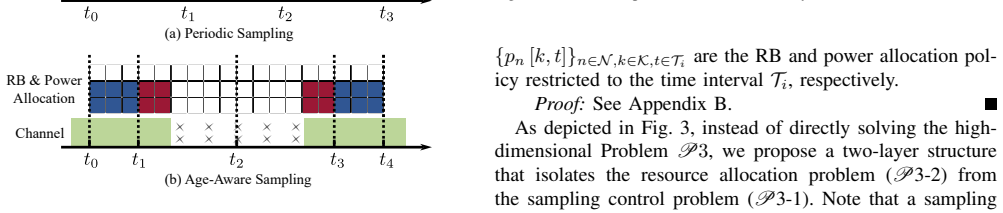
Timely information delivery in low-altitude networks is critical for many time-sensitive applications, such as unmanned aerial vehicle (UAV) navigation, inspection, and surveillance. The key challenge lies in balancing three competing factors: stringent data freshness requirements, UAV onboard energy consumption, and interference with terrestrial services. Addressing this challenge requires not only efficient power and channel allocation strategies but also effective communication timing over the entire operation horizon. In this work, we propose a model predictive communication (MPComm) framework, enabled by advanced channel sensing techniques, in which the channel conditions that the UAV will experience are largely predictable. Within this framework, we formulate a constrained bi-objective optimization problem to achieve a desired trade-off between energy consumption and terrestrial channel occupation, subject to a strict timeliness constraint. We solve this problem using Pareto analysis and show that the original non-convex, mixed-integer problem can be decomposed into a two-layer structure: the outer layer determines the optimal communication timing, while the inner layer determines the optimal power and channel allocation for each communication interval. An efficient algorithm for the inner problem is developed using non-convex analysis, with asymptotic optimality guarantees, while the outer problem is solved optimally via a simple graph search, with edges characterized by inner solutions. The proposed approach applies to a broad class of problem variants, including objective transformations and single-objective specializations. Numerical results demonstrate the efficiency of the proposed solution, achieving up to a six-fold reduction in terrestrial channel occupation and a 6dB energy saving compared to benchmark schemes.
Editorial analysis
A structured set of objections, weighed in public.
Referee Report
Summary. The paper proposes a Model Predictive Communication (MPComm) framework for timely status updates in low-altitude UAV networks. It formulates a constrained bi-objective optimization problem trading off UAV energy consumption against terrestrial channel occupation subject to a strict timeliness constraint. The non-convex mixed-integer problem is decomposed via Pareto analysis into an outer layer that selects communication timing intervals (solved exactly by graph search) and an inner layer that optimizes power and channel allocation for each interval (solved with a non-convex algorithm that carries asymptotic optimality guarantees). Numerical results report up to a six-fold reduction in terrestrial channel occupation and 6 dB energy savings versus benchmark schemes, under the enabling assumption that channel conditions are largely predictable over the full horizon via advanced sensing.
Significance. If the decomposition and guarantees hold under the stated assumptions, the work supplies a computationally tractable, theoretically supported method for joint timing and resource allocation in UAV status-update systems. The explicit asymptotic optimality result for the inner problem and the claim that the approach extends to objective transformations and single-objective cases are concrete strengths that could influence subsequent control and communication designs.
major comments (2)
- [Abstract] Abstract: The six-fold occupation reduction and 6 dB energy saving are derived under the assumption that “the channel conditions that the UAV will experience are largely predictable” over the entire operation horizon. No sensitivity analysis, bounded-error model, or robust reformulation is supplied; if prediction error is non-negligible, both the outer-layer graph-search decisions and the inner-layer allocations become suboptimal, rendering the reported gains invalid.
- [Inner problem analysis (section describing the non-convex algorithm)] The inner-layer non-convex solver is asserted to possess asymptotic optimality guarantees, yet the manuscript provides neither the precise statement of the limit (e.g., number of subcarriers or power levels tending to infinity) nor the key steps of the non-convex analysis that establish the guarantee. Because the outer layer’s edge weights are exactly the inner solutions, any gap in the inner guarantee directly undermines the optimality claim for the overall decomposition.
minor comments (1)
- [Abstract] The abstract states that the approach “applies to a broad class of problem variants” but does not list the specific transformations or specializations that preserve the decomposition; a short enumerated list would improve clarity.
Simulated Author's Rebuttal
We thank the referee for the constructive and detailed feedback. We address each major comment below and indicate the revisions planned for the manuscript.
read point-by-point responses
-
Referee: [Abstract] Abstract: The six-fold occupation reduction and 6 dB energy saving are derived under the assumption that “the channel conditions that the UAV will experience are largely predictable” over the entire operation horizon. No sensitivity analysis, bounded-error model, or robust reformulation is supplied; if prediction error is non-negligible, both the outer-layer graph-search decisions and the inner-layer allocations become suboptimal, rendering the reported gains invalid.
Authors: We agree that the reported gains are obtained under the assumption of largely predictable channels enabled by advanced sensing, as stated in the abstract and introduction. The manuscript does not provide sensitivity analysis or a robust reformulation for prediction errors. This is a valid limitation: non-negligible errors could indeed render the timing selections and allocations suboptimal. In the revised manuscript we will add a new subsection that includes a bounded-error sensitivity study, showing performance degradation as a function of prediction error variance, and we will qualify the numerical claims accordingly. revision: yes
-
Referee: [Inner problem analysis (section describing the non-convex algorithm)] The inner-layer non-convex solver is asserted to possess asymptotic optimality guarantees, yet the manuscript provides neither the precise statement of the limit (e.g., number of subcarriers or power levels tending to infinity) nor the key steps of the non-convex analysis that establish the guarantee. Because the outer layer’s edge weights are exactly the inner solutions, any gap in the inner guarantee directly undermines the optimality claim for the overall decomposition.
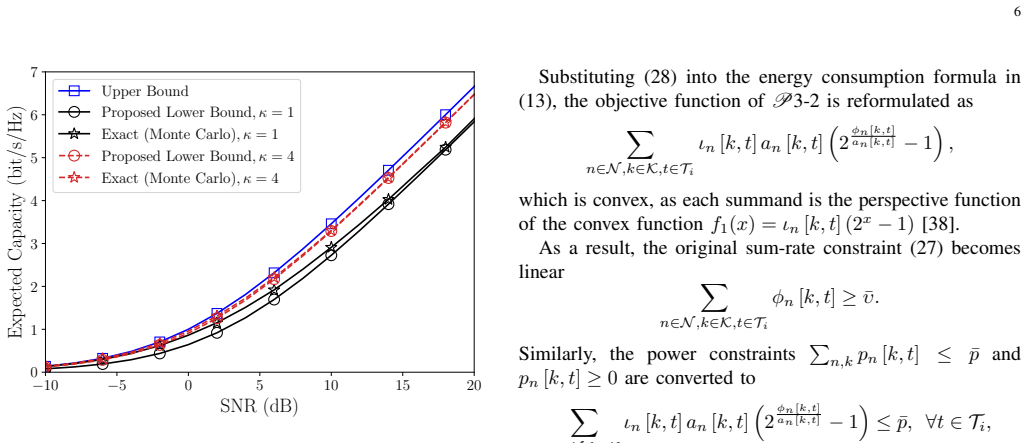
Authors: The inner algorithm relies on non-convex analysis whose asymptotic optimality holds as the number of subcarriers tends to infinity. We acknowledge that the current manuscript states the guarantee without explicitly defining the limiting regime or outlining the key analytical steps. Because the outer-layer graph-search weights are obtained from the inner solutions, this omission affects the strength of the overall optimality claim. In the revision we will insert the precise statement of the asymptotic result in the main text together with a high-level proof sketch (full details moved to an appendix) to substantiate the decomposition. revision: yes
Circularity Check
No significant circularity; derivation is self-contained
full rationale
The paper introduces the MPComm framework under the explicit assumption of predictable long-horizon channels via sensing techniques, then formulates a bi-objective optimization problem and decomposes it via Pareto analysis into an outer graph-search layer for timing and an inner non-convex solver for power/channel allocation with asymptotic optimality guarantees. All performance claims (six-fold occupation reduction, 6 dB energy saving) are supported by numerical benchmarking against independent external schemes rather than by re-deriving quantities from fitted parameters or self-citations internal to the paper. No load-bearing step reduces to a self-definition, fitted-input prediction, or self-citation chain; the chain remains externally falsifiable and mathematically derived from the stated problem structure.
Axiom & Free-Parameter Ledger
axioms (1)
- domain assumption Channel conditions that the UAV will experience are largely predictable using advanced channel sensing techniques over the operation horizon
Forward citations
Cited by 1 Pith paper
-
Semantics-Aware Communication:A Differentiated Allocation Perspective
Differentiated allocation using task-aware Age of Actuation and Cost of Missing Actuation improves critical-task reliability in computation-constrained semantics-aware WNCS.
Reference graph
Works this paper leans on
-
[1]
A comprehensive overview on 5G-and-beyond networks with UA Vs: From communications to sensing and intelligence,
Q. Wu, J. Xu, Y . Zeng, D. W. K. Ng, N. Al-Dhahir, R. Schober, and A. L. Swindlehurst, “A comprehensive overview on 5G-and-beyond networks with UA Vs: From communications to sensing and intelligence,”IEEE J. Sel. Areas Commun., vol. 39, no. 10, pp. 2912–2945, 2021
2021
-
[2]
Trustworthy intelligent networks for low-altitude economy,
M. Song, Y . Lin, J. Wang, G. Sun, C. Dong, N. Ma, D. Niyato, and P. Zhang, “Trustworthy intelligent networks for low-altitude economy,” IEEE Commun. Mag., vol. 63, no. 7, pp. 72–79, 2025
2025
-
[3]
Next generation intelligent low- altitude economy deployments: The O-RAN perspective,
A. S. Abdalla and V . Marojevic, “Next generation intelligent low- altitude economy deployments: The O-RAN perspective,”IEEE Wireless Commun., vol. 33, no. 1, pp. 20–28, 2026
2026
-
[4]
Joint optimization of user association, power control, and dynamic spectrum sharing for integrated aerial-terrestrial network,
A. S. Matar and X. Shen, “Joint optimization of user association, power control, and dynamic spectrum sharing for integrated aerial-terrestrial network,”IEEE J. Sel. Areas Commun., vol. 43, no. 1, pp. 396–409, 2025
2025
-
[5]
Joint optimization of transmit power and trajectory for UA V-enabled data collection with dynamic constraints,
H. Zhang, B. Li, Y . Rong, Y . Zeng, and R. Zhang, “Joint optimization of transmit power and trajectory for UA V-enabled data collection with dynamic constraints,”IEEE Trans. Commun., pp. 1–1, 2025
2025
-
[6]
Real-time status: How often should one update?
S. Kaul, R. Yates, and M. Gruteser, “Real-time status: How often should one update?” inProc. IEEE INFOCOM, 2012, pp. 2731–2735
2012
-
[7]
On the cost of consecutive estimation error: Significance-aware non-linear aging,
J. Luo and N. Pappas, “On the cost of consecutive estimation error: Significance-aware non-linear aging,”IEEE Trans. Inf. Theory, vol. 71, no. 10, pp. 7976–7989, 2025
2025
-
[8]
On the role of age and semantics of information in remote estimation of Markov sources,
J. Luo and N. Pappas, “On the role of age and semantics of information in remote estimation of Markov sources,”IEEE Trans. Commun., vol. 74, Apr. 2026
2026
-
[9]
From information freshness to semantics of information and goal-oriented communica- tions,
J. Luo, E. Delfani, M. Salimnejad, and N. Pappas, “From information freshness to semantics of information and goal-oriented communica- tions,”arXiv preprint arXiv:2512.12758, 2025
-
[10]
Predictive communica- tions for low-altitude networks,
J. Chen, B. Li, H. Sun, S. Cui, and N. Pappas, “Predictive communica- tions for low-altitude networks,”IEEE Internet Things Mag., pp. 1–8, 2026
2026
-
[11]
A distributed route network planning method with congestion pricing for drone delivery services in cities,
X. He, L. Li, Y . Mo, J. Huang, and S. J. Qin, “A distributed route network planning method with congestion pricing for drone delivery services in cities,”Transp. Res. Part C Emerg. Technol., vol. 160, p. 104536, 2024
2024
-
[12]
A tutorial on environment-aware communications via channel knowledge map for 6G,
Y . Zeng, J. Chen, J. Xu, D. Wu, X. Xu, S. Jin, X. Gao, D. Gesbert, S. Cui, and R. Zhang, “A tutorial on environment-aware communications via channel knowledge map for 6G,”IEEE Commun. Surveys Tuts., pp. 1–1, 2024
2024
-
[13]
Digital twin channel for 6G: Concepts, architectures and potential applications,
H. Wang, J. Zhang, G. Nie, L. Yu, Z. Yuan, T. Li, J. Wang, and G. Liu, “Digital twin channel for 6G: Concepts, architectures and potential applications,”IEEE Commun. Mag., vol. 63, no. 3, pp. 24–30, 2025
2025
-
[14]
Joint CFO-channel estimation over CFO-coherent SS burst sets for low-altitude radio mapping,
B. Li, H. Zhang, M. Jia, J. Chen, and N. Pappas, “Joint CFO-channel estimation over CFO-coherent SS burst sets for low-altitude radio mapping,” 2025. [Online]. Available: https://arxiv.org/abs/2512.01386
-
[15]
Large timescale optimization for communications over aerial ad hoc networks with predetermined trajectories,
B. Li and J. Chen, “Large timescale optimization for communications over aerial ad hoc networks with predetermined trajectories,”IEEE Trans. Commun., vol. 72, no. 10, pp. 6371–6385, 2024
2024
-
[16]
Radio map-assisted approach for interference-aware predictive UA V communications,
B. Li and J. Chen, “Radio map-assisted approach for interference-aware predictive UA V communications,”IEEE Trans. Wireless Commun., vol. 23, no. 11, pp. 16 725–16 741, 2024
2024
-
[17]
Model predictive control enabled UA V trajectory optimization and secure resource allocation,
Z. Li, C. Su, Z. Su, H. Peng, Y . Wang, W. Chen, and Q. Wu, “Model predictive control enabled UA V trajectory optimization and secure resource allocation,”IEEE Trans. Commun., vol. 73, no. 11, pp. 12 652–12 665, 2025
2025
-
[18]
Channel knowledge map-assisted dual-domain tracking and predictive beamforming for high-mobility wireless networks,
R. Du, Z. Wei, Z. Yang, L. Yang, Y . Zeng, D. W. K. Ng, and J. Yuan, “Channel knowledge map-assisted dual-domain tracking and predictive beamforming for high-mobility wireless networks,”IEEE Trans. Wireless Commun., vol. 25, pp. 10 968–10 985, 2026
2026
-
[19]
Channel knowledge map enabled low-altitude ISAC networks: Joint air corridor planning and base station deployment,
J. Li, Y . Chen, F. Liu, and J. Xu, “Channel knowledge map enabled low-altitude ISAC networks: Joint air corridor planning and base station deployment,”IEEE Wireless Commun. Lett., vol. 15, pp. 975–979, 2026. 17
2026
-
[20]
Radio map-assisted routing and predictive resource allocation over dynamic low-altitude networks,
B. Li and J. Chen, “Radio map-assisted routing and predictive resource allocation over dynamic low-altitude networks,”IEEE Trans. Wireless Commun., vol. 25, pp. 9955–9970, 2026
2026
-
[21]
Aerial-ground interference mitigation for cellular-connected UA V,
W. Mei and R. Zhang, “Aerial-ground interference mitigation for cellular-connected UA V,”IEEE Wireless Commun., vol. 28, no. 1, pp. 167–173, 2021
2021
-
[22]
Deep reinforce- ment learning for interference management in UA V-based 3D networks: Potentials and challenges,
M. Vaezi, X. Lin, H. Zhang, W. Saad, and H. V . Poor, “Deep reinforce- ment learning for interference management in UA V-based 3D networks: Potentials and challenges,”IEEE Commun. Mag., vol. 62, no. 2, pp. 134–140, 2024
2024
-
[23]
AoI-minimal trajectory planning and data collection in UA V-assisted wireless powered IoT networks,
H. Hu, K. Xiong, G. Qu, Q. Ni, P. Fan, and K. B. Letaief, “AoI-minimal trajectory planning and data collection in UA V-assisted wireless powered IoT networks,”IEEE Internet Things J., vol. 8, no. 2, pp. 1211–1223, 2021
2021
-
[24]
UA V-aided data collection for information freshness in wireless sensor networks,
J. Liu, P. Tong, X. Wang, B. Bai, and H. Dai, “UA V-aided data collection for information freshness in wireless sensor networks,”IEEE Trans. Wireless Commun., vol. 20, no. 4, pp. 2368–2382, 2021
2021
-
[25]
AoI-aware scheduling for air-ground collaborative mobile edge computing,
Z. Qin, Z. Wei, Y . Qu, F. Zhou, H. Wang, D. W. K. Ng, and C.-B. Chae, “AoI-aware scheduling for air-ground collaborative mobile edge computing,”IEEE Trans. Wireless Commun., vol. 22, no. 5, pp. 2989– 3005, 2023
2023
-
[26]
Hierarchical reinforcement learning-based joint trajectory planning and resource allocation in UA V-assisted IoT-sensor networks,
W. Yuan, S. Chen, H. He, Y . Hou, S. Chen, X. Tan, and J. Yang, “Hierarchical reinforcement learning-based joint trajectory planning and resource allocation in UA V-assisted IoT-sensor networks,”IEEE Trans. Commun., vol. 73, no. 12, pp. 14 517–14 533, 2025
2025
-
[27]
Deep reinforcement learning for AoI-aware trajectory and phase-shift design in IRS-assisted UA V data collection,
J. Tang, J. Liu, X. He, L. Xie, L. Qu, and H. Dai, “Deep reinforcement learning for AoI-aware trajectory and phase-shift design in IRS-assisted UA V data collection,”IEEE Trans. Wireless Commun., vol. 24, no. 12, pp. 10 613–10 628, 2025
2025
-
[28]
Joint trajectory planning and channel selection for AoI minimization in multi- UA V-assisted IoT networks,
Z. Lu, Q. Wu, Z. Jia, C. Fei, J. Zhang, F. Zhou, and K.-K. Wong, “Joint trajectory planning and channel selection for AoI minimization in multi- UA V-assisted IoT networks,”IEEE Trans. Wireless Commun., vol. 25, pp. 11 161–11 175, 2026
2026
-
[29]
Predictive control and communication co-design via two-way gaussian process regression and AoI-aware scheduling,
A. M. Girgis, J. Park, M. Bennis, and M. Debbah, “Predictive control and communication co-design via two-way gaussian process regression and AoI-aware scheduling,”IEEE Trans. Commun., vol. 69, no. 10, pp. 7077–7093, 2021
2021
-
[30]
On the spatio-temporal analysis and optimization of AoI in cell-free IIoT networks,
M. Song, H. Shan, Y . Cheng, W. Zhuang, X. Li, Q. Zhang, and X. He, “On the spatio-temporal analysis and optimization of AoI in cell-free IIoT networks,”IEEE Trans. Wireless Commun., vol. 23, no. 11, pp. 16 421–16 436, 2024
2024
-
[31]
Age of information in random access networks with energy harvesting,
F. Zhao, N. Pappas, M. Zhang, and H. H. Yang, “Age of information in random access networks with energy harvesting,”IEEE J. Sel. Areas Commun., vol. 43, no. 11, pp. 3813–3829, 2025
2025
-
[32]
AoI-aware online transmission optimization for wbans with unreliable information delivery,
S. Mu, Y . Lu, R. Jiang, W. Chen, B. Ai, and D. Niyato, “AoI-aware online transmission optimization for wbans with unreliable information delivery,”IEEE Trans. Wireless Commun., vol. 25, pp. 5622–5639, 2026
2026
-
[33]
The m-distribution: A general formula of intensity distribution of rapid fading,
M. Nakagami, “The m-distribution: A general formula of intensity distribution of rapid fading,” inStatistical Methods in Radio Wave Propagation, W. HOFFMAN, Ed. Pergamon, 1960, pp. 3–36
1960
-
[34]
Delay-Doppler alignment modulation for spatially sparse massive MIMO communication,
H. Lu and Y . Zeng, “Delay-Doppler alignment modulation for spatially sparse massive MIMO communication,”IEEE Trans. Wireless Commun., vol. 23, no. 6, pp. 6000–6014, 2024
2024
-
[35]
Real-time reconstruction of markov sources and remote actuation over wireless channels,
M. Salimnejad, M. Kountouris, and N. Pappas, “Real-time reconstruction of markov sources and remote actuation over wireless channels,”IEEE Trans. Commun., vol. 72, no. 5, pp. 2701–2715, 2024
2024
-
[36]
Miettinen,Nonlinear Multiobjective Optimization, 1st ed., ser
K. Miettinen,Nonlinear Multiobjective Optimization, 1st ed., ser. Inter- national Series in Operations Research & Management Science. New York, NY , USA: Springer, 1998, vol. 12
1998
-
[37]
Air-ground channel characterization for unmanned aircraft systems-part III: The suburban and near-urban envi- ronments,
D. W. Matolak and R. Sun, “Air-ground channel characterization for unmanned aircraft systems-part III: The suburban and near-urban envi- ronments,”IEEE Trans. Veh. Technol., vol. 66, no. 8, pp. 6607–6618, 2017
2017
-
[38]
Boyd and L
S. Boyd and L. Vandenberghe,Convex Optimization. Cambridge University Press, 2004
2004
-
[39]
CVX: Matlab software for disciplined convex programming, version 2.1,
M. Grant and S. Boyd, “CVX: Matlab software for disciplined convex programming, version 2.1,” https://cvxr.com/cvx, Mar. 2014
2014
-
[40]
R. K. Ahuja, T. L. Magnanti, and J. B. Orlin,Network Flows: Theory, Algorithms, and Applications. Prentice Hall, 1993
1993
-
[41]
Optimal power management in wireless control systems,
K. Gatsis, A. Ribeiro, and G. J. Pappas, “Optimal power management in wireless control systems,”IEEE Trans. Autom. Control, vol. 59, no. 6, pp. 1495–1510, 2014
2014
-
[42]
S. M. Ross,Introduction to probability models. Academic press, 2014
2014
-
[43]
Utility-based power allocation for multiclass wireless systems,
J.-W. Lee and J.-A. Kwon, “Utility-based power allocation for multiclass wireless systems,”IEEE Trans. Veh. Technol., vol. 58, no. 7, pp. 3813– 3819, 2009
2009
-
[44]
Goal-oriented semantic resource allocation with cumulative prospect theoretic agents,
S. Vaidanis, P. A. Stavrou, and M. Kountouris, “Goal-oriented semantic resource allocation with cumulative prospect theoretic agents,” inProc. IEEE Int. Conf. Commun., 2025, pp. 4154–4159
2025
-
[45]
Evolved universal terrestrial radio access (E-UTRA); further advance- ments for E-UTRA physical layer aspects,
“Evolved universal terrestrial radio access (E-UTRA); further advance- ments for E-UTRA physical layer aspects,” 3GPP, Tech. Rep. TR 36.814 (Release 9), Mar. 2017
2017
-
[46]
Mobile unmanned aerial vehicles (UA Vs) for energy-efficient internet of things communica- tions,
M. Mozaffari, W. Saad, M. Bennis, and M. Debbah, “Mobile unmanned aerial vehicles (UA Vs) for energy-efficient internet of things communica- tions,”IEEE Trans. Wireless Commun., vol. 16, no. 11, pp. 7574–7589, 2017
2017
-
[47]
Integral boundary points of convex polyhedra,
A. J. Hoffman and J. B. Kruskal, “Integral boundary points of convex polyhedra,” in50 Years of Integer Programming 1958-2008: From the Early Years to the State-of-the-Art. Springer, 2009, pp. 49–76
1958
-
[48]
An equivalent transformation of multi-objective optimization problems,
M. Zarepisheh and P. M. Pardalos, “An equivalent transformation of multi-objective optimization problems,”Annals of Operations Research, vol. 249, no. 1, pp. 5–15, 2017
2017
-
[49]
On image space transformations in multiob- jective optimization,
F. Neussel and O. Stein, “On image space transformations in multiob- jective optimization,”Optimization Online. Preprint, 2025
2025
-
[50]
Schr ¨oder,Ordered sets: An introduction
B. Schr ¨oder,Ordered sets: An introduction. Springer, 2016, vol. 328
2016
discussion (0)
Sign in with ORCID, Apple, or X to comment. Anyone can read and Pith papers without signing in.