Recognition: 2 theorem links
· Lean TheoremAn Overlapping Schwarz Space-Time Refinement Framework for Material Point Method
Pith reviewed 2026-05-12 01:50 UTC · model grok-4.3
The pith
An overlapping Schwarz framework enables local space-time refinement in the material point method while preserving accuracy and reducing computation time.
A machine-rendered reading of the paper's core claim, the machinery that carries it, and where it could break.
Core claim
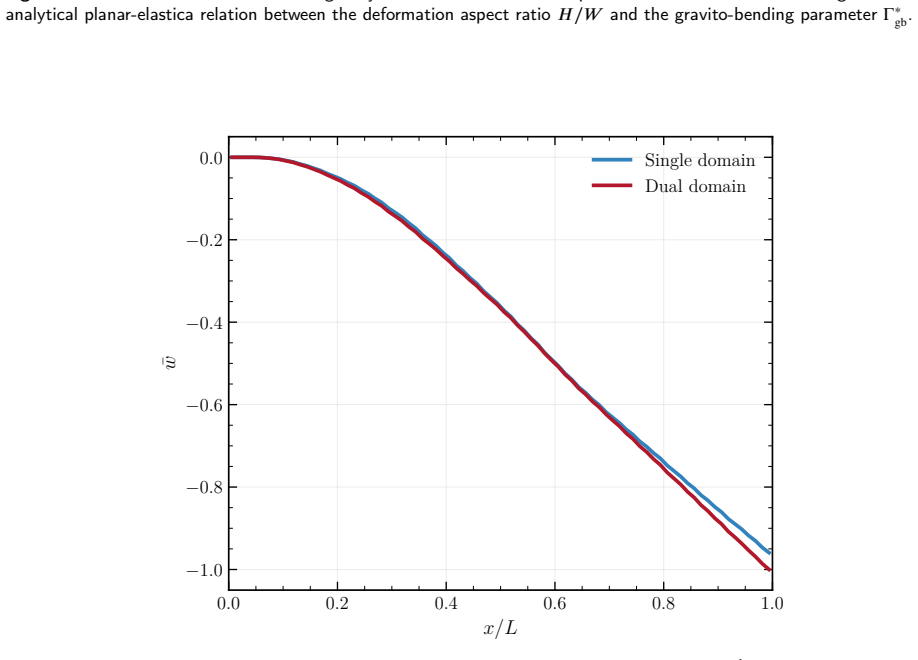
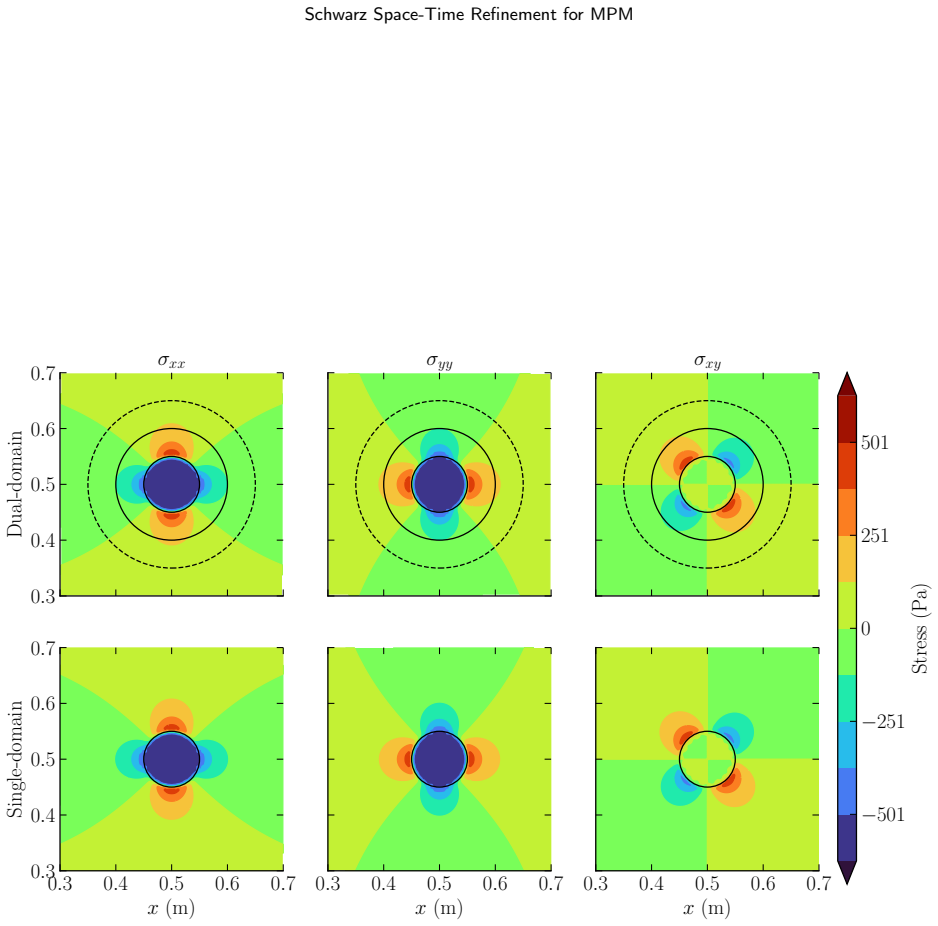
The central discovery is an overlapping Schwarz space-time refinement method for MPM that decomposes the domain into coarse and fine overlapping regions, applies heterogeneous resolutions, and couples them via MPM-specific Schwarz iterations with mass-weighted spatial transmission and temporal interpolation. This modular approach avoids altering basis functions or enforcing strong interface constraints, instead shifting complexity to interface operators in the alternating procedure. Benchmarks including cantilever beam, Hertzian contact, elastic inclusion, and 3D folding confirm that the method matches reference solutions with good convergence and achieves comparable or lower error than fine
What carries the argument
The overlapping Schwarz alternating procedure combined with mass-weighted spatial transmission and temporal interpolation for sub-cycling between non-matching grids.
Load-bearing premise
The Schwarz iteration with mass-weighted spatial transmission and temporal interpolation converges reliably without introducing artifacts in problems with strong nonlinearity, contact, and large geometric changes.
What would settle it
Running the inclusion or folding benchmark with higher nonlinearity or finer sub-cycling ratios and observing divergence of the Schwarz iterations or non-physical artifacts at the interfaces would falsify the claim of reliable convergence.
Figures






read the original abstract
We propose an overlapping Schwarz space-time refinement framework for the material point method (OS-MPM) to improve computational efficiency in problems with strongly localized deformation, contact, and large geometric nonlinearity. The method decomposes the domain into overlapping coarse and fine subdomains with heterogeneous spatial and temporal resolutions, while retaining standard MPM discretizations within each subdomain. Coarse-fine coupling is achieved through an MPM-specific Schwarz iteration combining mass-weighted spatial transmission and temporal interpolation for sub-cycling. In contrast to refinement strategies based on modified basis functions, transition kernels, or strongly enforced interface constraints, the proposed approach preserves the modular structure of standard MPM and shifts the coupling complexity to nonmatching-grid interface operators within the Schwarz alternating procedure. Numerical examples, including a gravity-driven cantilever beam, Hertzian contact, and an elastic inclusion problem, show that the method reproduces analytical or fine-resolution reference solutions with good accuracy and convergence behavior. In the inclusion benchmark, the proposed framework achieves comparable or slightly lower error than single-domain fine simulations at the finest tested resolutions, while reducing computational cost by up to 9.15 times. A three-dimensional folding example further demonstrates the generality of the framework. These results indicate that the proposed method provides an accurate, modular, and efficient route for local space-time refinement in MPM.
Editorial analysis
A structured set of objections, weighed in public.
Referee Report
Summary. The manuscript proposes an overlapping Schwarz space-time refinement framework (OS-MPM) for the Material Point Method. The domain is decomposed into overlapping coarse and fine subdomains with heterogeneous spatial and temporal resolutions. Coupling is achieved via an MPM-specific Schwarz iteration that employs mass-weighted spatial transmission and temporal interpolation for sub-cycling. The approach preserves standard MPM discretizations within each subdomain and shifts complexity to the interface operators. Numerical examples on a gravity-driven cantilever beam, Hertzian contact, an elastic inclusion problem, and a 3D folding case demonstrate reproduction of reference solutions with good accuracy and convergence; the inclusion benchmark reports comparable or slightly lower error than uniform fine-grid runs while achieving up to 9.15 times computational savings.
Significance. If the accuracy and efficiency claims hold under strictly matched local resolutions, the method offers a modular route to space-time refinement in MPM that avoids alterations to basis functions or strong interface constraints. This would be valuable for problems with localized nonlinearity, contact, and large deformations. The paper supplies concrete numerical demonstrations of convergence behavior and cost reduction, which are positive attributes.
major comments (2)
- [Inclusion benchmark] Inclusion benchmark (numerical examples section): The claim of comparable or slightly lower error relative to single-domain fine simulations at the finest resolutions is load-bearing for the efficiency argument. The manuscript must explicitly confirm that particle density per fine cell, overlap width, and final Schwarz residual are identical between the OS-MPM fine subdomain and the reference uniform fine run; otherwise the error comparison is not equivalent.
- [Method section] Schwarz iteration description (method section, around the coupling operator): For cases involving strong nonlinearity and contact (Hertzian contact and folding examples), the paper should report iteration counts and residual norms per time step to substantiate that the alternating procedure converges reliably without introducing artifacts or requiring problem-specific tuning.
minor comments (3)
- [Figures] Figure captions for the overlap regions (e.g., inclusion and folding figures) could more clearly indicate the overlap width and subdomain boundaries to aid reproducibility.
- [Method section] The temporal interpolation operator for sub-cycling is introduced without an explicit statement of its conservation properties or truncation error; a brief derivation or reference would improve clarity.
- [Numerical examples] A short table summarizing the Schwarz iteration tolerance, overlap size, and sub-cycling ratio used in each example would help readers assess robustness.
Simulated Author's Rebuttal
We thank the referee for the constructive comments. We address each major comment point by point below and will revise the manuscript to incorporate the requested clarifications and data.
read point-by-point responses
-
Referee: [Inclusion benchmark] Inclusion benchmark (numerical examples section): The claim of comparable or slightly lower error relative to single-domain fine simulations at the finest resolutions is load-bearing for the efficiency argument. The manuscript must explicitly confirm that particle density per fine cell, overlap width, and final Schwarz residual are identical between the OS-MPM fine subdomain and the reference uniform fine run; otherwise the error comparison is not equivalent.
Authors: We confirm that particle density per fine cell, overlap width, and the final Schwarz residual tolerance were set identically between the OS-MPM fine subdomain and the uniform fine-grid reference in the inclusion benchmark. This matching ensures the error comparison is equivalent. We will add an explicit statement in the revised numerical examples section to document these identical settings. revision: yes
-
Referee: [Method section] Schwarz iteration description (method section, around the coupling operator): For cases involving strong nonlinearity and contact (Hertzian contact and folding examples), the paper should report iteration counts and residual norms per time step to substantiate that the alternating procedure converges reliably without introducing artifacts or requiring problem-specific tuning.
Authors: We agree that reporting Schwarz iteration counts and residual norms per time step would better substantiate reliable convergence in the nonlinear and contact cases. In the revised manuscript we will add this information for the Hertzian contact and 3D folding examples, presented as tables or plots of iterations and residuals versus time step. revision: yes
Circularity Check
No circularity in OS-MPM framework construction or claims
full rationale
The paper introduces a new overlapping Schwarz iterative coupling for space-time refinement in MPM, using mass-weighted spatial transmission and temporal interpolation between coarse and fine subdomains while preserving standard MPM discretizations inside each. All load-bearing elements are algorithmic definitions and interface operators, not quantities defined in terms of themselves or fitted parameters renamed as predictions. Benchmark results (e.g., inclusion problem error and 9.15x cost reduction) are presented as empirical simulation outcomes rather than first-principles derivations that reduce to the inputs by construction. No self-citations, uniqueness theorems, or ansatzes imported from prior author work appear in the provided text, and the central claim remains an independent numerical validation of the proposed modular coupling.
Axiom & Free-Parameter Ledger
axioms (1)
- domain assumption Standard MPM discretizations can be retained independently inside each overlapping subdomain
Lean theorems connected to this paper
-
IndisputableMonolith/Cost/FunctionalEquation.leanwashburn_uniqueness_aczel unclear?
unclearRelation between the paper passage and the cited Recognition theorem.
mass-weighted spatial projection Π_S→B (Eq. 26) and temporal interpolation T_m (Eq. 27) inside multiplicative Schwarz iteration for heterogeneous-resolution MPM subdomains
-
IndisputableMonolith/Foundation/RealityFromDistinction.leanreality_from_one_distinction unclear?
unclearRelation between the paper passage and the cited Recognition theorem.
variational incremental potential E_h(x̂) minimization (Eq. 12) with Newton line-search for implicit MPM time stepping
What do these tags mean?
- matches
- The paper's claim is directly supported by a theorem in the formal canon.
- supports
- The theorem supports part of the paper's argument, but the paper may add assumptions or extra steps.
- extends
- The paper goes beyond the formal theorem; the theorem is a base layer rather than the whole result.
- uses
- The paper appears to rely on the theorem as machinery.
- contradicts
- The paper's claim conflicts with a theorem or certificate in the canon.
- unclear
- Pith found a possible connection, but the passage is too broad, indirect, or ambiguous to say the theorem truly supports the claim.
Reference graph
Works this paper leans on
-
[1]
The material-point method for granular materials
Bardenhagen, S., Brackbill, J., Sulsky, D., 2000. The material-point method for granular materials. Computer methods in applied mechanics and engineering 187, 529–541
work page 2000
-
[2]
Thegeneralizedinterpolationmaterialpointmethod
Bardenhagen,S.G.,Kober,E.M.,2004. Thegeneralizedinterpolationmaterialpointmethod. ComputerModelinginEngineering&Sciences 5, 477
work page 2004
-
[3]
A novel local grid refinement scheme for material point method
Barzoki, N.K., Sadeghirad, A., 2025. A novel local grid refinement scheme for material point method. Computational Particle Mechanics , 1–30
work page 2025
-
[4]
Ageneralfluid–sedimentmixturemodelandconstitutivetheoryvalidatedinmanyflowregimes
Baumgarten,A.S.,Kamrin,K.,2019. Ageneralfluid–sedimentmixturemodelandconstitutivetheoryvalidatedinmanyflowregimes. Journal of Fluid Mechanics 861, 721–764. Zhaofeng Luo, Minchen Li*, Yupeng Jiang* Page 15 of 27 Schwarz Space-Time Refinement for MPM
work page 2019
-
[5]
Formulation and application of a quasi-static material point method
Beuth, L., 2012. Formulation and application of a quasi-static material point method. Ph.D. thesis. Universität Stuttgart. Stuttgart, Germany. URL:http://dx.doi.org/10.18419/opus-419
-
[6]
Bickley, W.G., 1934. The heavy elastica. The London, Edinburgh, and Dublin Philosophical Magazine and Journal of Science 17, 603–622. doi:10.1080/14786443409462419
-
[7]
Cao, Y., Zhao, Y., Li, M., Yang, Y., Choo, J., Terzopoulos, D., Jiang, C., 2025. Unstructured moving least squares material point methods: a stablekernelapproachwithcontinuousgradientreconstructionongeneralunstructuredtessellations. ComputationalMechanics75,655–678
work page 2025
-
[8]
An unconditionally stable total lagrangian material point method for large deformation dynamics
Charlton, T.J., Coombs, C.M., Augarde, C.E., 2017. An unconditionally stable total lagrangian material point method for large deformation dynamics. Computer Methods in Applied Mechanics and Engineering 327, 111–129
work page 2017
-
[9]
Impositionofessentialboundaryconditionsinthematerial point method
Cortis,M.,Coombs,W.,Augarde,C.,Brown,M.,Brennan,A.,Robinson,S.,2018. Impositionofessentialboundaryconditionsinthematerial point method. International Journal for Numerical Methods in Engineering 113, 130–152
work page 2018
-
[10]
Material point method after 25 years: Theory, implementation, and applications
De Vaucorbeil, A., Nguyen, V.P., Sinaie, S., Wu, J.Y., 2020. Material point method after 25 years: Theory, implementation, and applications. Advances in applied mechanics 53, 185–398
work page 2020
-
[11]
The determination of the elastic field of an ellipsoidal inclusion, and related problems
Eshelby, J.D., 1957. The determination of the elastic field of an ellipsoidal inclusion, and related problems. Proceedings of the Royal Society of London. Series A 241, 376–396
work page 1957
-
[12]
Enhancement of the material point method using b-spline basis functions
Gan, Y., Sun, Z., Chen, Z., Zhang, X., Liu, Y., 2018. Enhancement of the material point method using b-spline basis functions. International Journal for numerical methods in engineering 113, 411–431
work page 2018
-
[13]
An adaptive generalized interpolation material point method for simulating elastoplastic materials
Gao, M., Tampubolon, A.P., Jiang, C., Sifakis, E., 2017. An adaptive generalized interpolation material point method for simulating elastoplastic materials. ACM Transactions on Graphics 36, 1–12
work page 2017
-
[14]
Guilkey, J.E., Weiss, J.A., 2003. Implicit time integration for the material point method: quantitative and algorithmic comparisons with the finite element method. International Journal for Numerical Methods in Engineering 57, 1323–1338. doi:10.1002/nme.713
-
[15]
Barrier-augmentedlagrangianforgpu-basedelastodynamiccontact
Guo,D.,Li,M.,Yang,Y.,Li,S.,Wang,G.,2024. Barrier-augmentedlagrangianforgpu-basedelastodynamiccontact. ACMTransactionson Graphics (TOG) 43, 1–17
work page 2024
-
[16]
A multi-resolution material point method based on penalty formulation
He, K.Y., Jin, Y.F., Zhou, X.W., Yin, Z.Y., Chen, X., 2025. A multi-resolution material point method based on penalty formulation. International Journal for Numerical and Analytical Methods in Geomechanics 49, 3839–3857
work page 2025
-
[17]
Hu,Z.,Zhang,Z.,Zhou,X.,Cui,X.,Ye,H.,Zhang,H.,Zheng,Y.,2023. Explicitphase-fieldmaterialpointmethodwiththeconvectedparticle domaininterpolationforimpact/contactfractureinelastoplasticgeomaterials. ComputerMethodsinAppliedMechanicsandEngineering405, 115851
work page 2023
-
[18]
Stiffgipc: Advancing gpu ipc for stiff affine-deformable simulation
Huang, K., Lu, X., Lin, H., Komura, T., Li, M., 2025. Stiffgipc: Advancing gpu ipc for stiff affine-deformable simulation. ACM Transactions on Graphics 44, 1–20
work page 2025
-
[19]
Contact algorithms for the material point method in impact and penetration simulation
Huang, P., Zhang, X., Ma, S., Huang, X., 2011. Contact algorithms for the material point method in impact and penetration simulation. International journal for numerical methods in engineering 85, 498–517
work page 2011
-
[20]
The affine particle-in-cell method
Jiang, C., Schroeder, C., Selle, A., Teran, J., Stomakhin, A., 2015. The affine particle-in-cell method. ACM Transactions on Graphics 34, 51:1–51:10. doi:10.1145/2766996
-
[21]
Jiang, C., Schroeder, C., Selle, A., Teran, J., Stomakhin, A., 2016. The material point method for simulating continuum materials, in: ACM SIGGRAPH 2016 Courses, Association for Computing Machinery, New York, NY, USA. pp. 1–52. doi:10.1145/2897826.2927346
-
[22]
Anangular momentumconserving affine-particle-in-cellmethod
Jiang,C., Schroeder,C., Teran,J., 2017. Anangular momentumconserving affine-particle-in-cellmethod. Journal ofComputationalPhysics 338, 137–164
work page 2017
-
[23]
A hybrid material-point spheropolygon-element method for solid and granular material interaction
Jiang, Y., Li, M., Jiang, C., Alonso-Marroquin, F., 2020. A hybrid material-point spheropolygon-element method for solid and granular material interaction. International Journal for Numerical Methods in Engineering 121, 3021–3047
work page 2020
-
[24]
Jiang, Y., Song, P., Choi, C.E., Choo, J., 2023. Erosion and transport of dry soil bed by collisional granular flow: Insights from a combined experimental–numerical investigation. Journal of Geophysical Research: Earth Surface 128, e2023JF007073
work page 2023
-
[25]
Jiang, Y., Zhang, C., Choi, C.E., 2024. Impact and erosion dynamics of inclusion-enriched dry granular flows on rigid barriers with basal clearance: Numerical insights from hybrid mp-dem simulations. Computers and Geotechnics 176, 106767
work page 2024
-
[26]
Hybrid continuum–discrete simulation of granular impact dynamics
Jiang, Y., Zhao, Y., Choi, C.E., Choo, J., 2022. Hybrid continuum–discrete simulation of granular impact dynamics. Acta Geotechnica 17, 5597–5612
work page 2022
-
[27]
Johnson, K.L., 1985. Contact Mechanics. Cambridge University Press, Cambridge
work page 1985
-
[28]
Kane, C., Marsden, J.E., Ortiz, M., West, M., 2000. Variational integrators and the newmark algorithm for conservative and dissipative mechanical systems. International Journal for numerical methods in engineering 49, 1295–1325
work page 2000
-
[29]
Fabricationofpracticaldeformabledisplays:advances and challenges
Kim,D.W.,Kim,S.W.,Lee,G.,Yoon,J.,Kim,S.,Hong,J.H.,Jo,S.C.,Jeong,U.,2023. Fabricationofpracticaldeformabledisplays:advances and challenges. Light: Science & Applications 12, 61
work page 2023
-
[30]
de Koster, P., Tielen, R., Wobbes, E., Möller, M., 2021. Extension of b-spline material point method for unstructured triangular grids using powell–sabin splines. Computational particle mechanics 8, 273–288
work page 2021
-
[31]
Decomposedoptimizationtimeintegratorforlarge-stepelastodynamics
Li,M.,Gao,M.,Langlois,T.,Jiang,C.,Kaufman,D.M.,2019. Decomposedoptimizationtimeintegratorforlarge-stepelastodynamics. ACM Transactions on Graphics (TOG) 38, 1–10
work page 2019
-
[32]
Energetically consistent inelasticity for optimization time integration
Li, X., Li, M., Jiang, C., 2022. Energetically consistent inelasticity for optimization time integration. ACM Transactions on Graphics (TOG) 41, 1–16
work page 2022
-
[33]
Lian, Y., Yang, P., Zhang, X., Zhang, F., Liu, Y., Huang, P., 2015. A mesh-grading material point method and its parallelization for problems with localized extreme deformation. Computer Methods in Applied Mechanics and Engineering 289, 291–315
work page 2015
-
[34]
Tied interface grid material point method for problems with localized extreme deformation
Lian, Y., Zhang, X., Zhang, F., Cui, X., 2014. Tied interface grid material point method for problems with localized extreme deformation. International Journal of Impact Engineering 70, 50–61
work page 2014
-
[35]
Revealing the role of forests in the mobility of geophysical flows
Liang, Z., Choi, C.E., Zhao, Y., Jiang, Y., Choo, J., 2023. Revealing the role of forests in the mobility of geophysical flows. Computers and Geotechnics 155, 105194. Zhaofeng Luo, Minchen Li*, Yupeng Jiang* Page 16 of 27 Schwarz Space-Time Refinement for MPM
work page 2023
-
[36]
Lions,P.L.,1988. OntheSchwarzalternatingmethod.I,in:Glowinski,R.,Golub,G.H.,Meurant,G.A.,Périaux,J.(Eds.),FirstInternational Symposium on Domain Decomposition Methods for Partial Differential Equations, SIAM, Philadelphia. pp. 1–42
work page 1988
-
[37]
On the Schwarz alternating method
Lions, P.L., 1990. On the Schwarz alternating method. III: A variant for nonoverlapping subdomains, in: Chan, T.F., Glowinski, R., Périaux, J., Widlund, O.B. (Eds.), Third International Symposium on Domain Decomposition Methods for Partial Differential Equations, SIAM, Philadelphia. pp. 202–223
work page 1990
-
[38]
Ma, J., Lu, H., Komanduri, R., 2006. Structured mesh refinement in generalized interpolation material point (gimp) method for simulation of dynamic problems. Computer Modeling in Engineering & Sciences 12, 213
work page 2006
-
[39]
Ma, J., Lu, H., Wang, B., Roy, S., Hornung, R., Wissink, A., Komanduri, R., 2005. Multiscale simulations using generalized interpolation material point (gimp) method and samrai parallel processing. Computer Modeling in Engineering & Sciences 8, 135
work page 2005
-
[40]
Comparison study of mpm and sph in modeling hypervelocity impact problems
Ma, S., Zhang, X., Qiu, X., 2009. Comparison study of mpm and sph in modeling hypervelocity impact problems. International journal of impact engineering 36, 272–282
work page 2009
-
[41]
Afundamentallynewcoupledapproachtocontactmechanicsviathedirichlet-neumann schwarz alternating method
Mota,A.,Koliesnikova,D.,Tezaur,I.,Hoy,J.,2025. Afundamentallynewcoupledapproachtocontactmechanicsviathedirichlet-neumann schwarz alternating method. International Journal for Numerical Methods in Engineering 126, e70039
work page 2025
-
[42]
The Schwarz alternating method in solid mechanics
Mota, A., Tezaur, I., Alleman, C., 2017. The Schwarz alternating method in solid mechanics. Comput. Methods Appl. Mech. Engrg. 319, 19–51
work page 2017
-
[43]
The schwarz alternating method for transient solid dynamics
Mota, A., Tezaur, I., Phlipot, G., 2022. The schwarz alternating method for transient solid dynamics. International Journal for Numerical Methods in Engineering 123, 5036–5071
work page 2022
-
[44]
Iga-mpm:theisogeometricmaterialpointmethod
Moutsanidis,G.,Long,C.C.,Bazilevs,Y.,2020. Iga-mpm:theisogeometricmaterialpointmethod. ComputerMethodsinAppliedMechanics and Engineering 372, 113346
work page 2020
-
[45]
Micromechanics of Defects in Solids
Mura, T., 2013. Micromechanics of Defects in Solids. Springer Science & Business Media
work page 2013
-
[46]
Nocedal, J., Wright, S.J., 2006. Numerical optimization. Springer
work page 2006
-
[47]
Sadeghirad,A.,Brannon,R.M.,Burghardt,J.,2011. Aconvectedparticledomaininterpolationtechniquetoextendapplicabilityofthematerial point method for problems involving massive deformations. International Journal for numerical methods in Engineering 86, 1435–1456
work page 2011
-
[48]
Üeber einen Grenzübergang durch alternirendes Verfahren
Schwarz, H.A., 1870. Üeber einen Grenzübergang durch alternirendes Verfahren. Vierteljahrsschrift der Naturforschenden Gesellschaft in Zürich 15, 272–286
-
[49]
Bending of a beam or wide strip
Shield, R.T., 1992. Bending of a beam or wide strip. Quarterly Journal of Mechanics and Applied Mathematics 45, 567–573
work page 1992
-
[50]
Singer, V., Teschemacher, T., Larese, A., Wüchner, R., Bletzinger, K.U., 2024. Lagrange multiplier imposition of non-conforming essential boundary conditions in implicit material point method. Computational Mechanics 73, 1311–1333
work page 2024
-
[51]
Evaluationofmaterialpointmethodforuseingeotechnics
Sołowski,W.,Sloan,S.,2015. Evaluationofmaterialpointmethodforuseingeotechnics. InternationalJournalforNumericalandAnalytical Methods in Geomechanics 39, 685–701
work page 2015
-
[52]
Analysis and reduction of quadrature errors in the material point method (mpm)
Steffen, M., Kirby, R.M., Berzins, M., 2008. Analysis and reduction of quadrature errors in the material point method (mpm). International journal for numerical methods in engineering 76, 922–948
work page 2008
-
[53]
Aparticlemethodforhistory-dependentmaterials
Sulsky,D.,Chen,Z.,Schreyer,H.L.,1994. Aparticlemethodforhistory-dependentmaterials. ComputerMethodsinAppliedMechanicsand Engineering 118, 179–196. doi:10.1016/0045-7825(94)90112-0
-
[54]
A local grid refinement scheme for b-spline material point method
Sun, Z., Gan, Y., Huang, Z., Zhou, X., 2020. A local grid refinement scheme for b-spline material point method. International Journal for Numerical Methods in Engineering 121, 2398–2417
work page 2020
-
[55]
Hierarchical, adaptive, material point method for dynamic energy release rate calculations
Tan, H., Nairn, J.A., 2002. Hierarchical, adaptive, material point method for dynamic energy release rate calculations. Computer Methods in Applied Mechanics and Engineering 191, 2123–2137
work page 2002
-
[56]
Domain decomposition methods-algorithms and theory
Toselli, A., Widlund, O., 2004. Domain decomposition methods-algorithms and theory. volume 34. Springer Science & Business Media
work page 2004
-
[57]
Hierarchical optimization time integration for cfl-rate mpm stepping
Wang, X., Li, M., Fang, Y., Zhang, X., Gao, M., Tang, M., Kaufman, D.M., Jiang, C., 2020. Hierarchical optimization time integration for cfl-rate mpm stepping. ACM Transactions on Graphics (TOG) 39, 1–16
work page 2020
-
[58]
The material point method in large strain engineering problems
Więckowski, Z., 2004. The material point method in large strain engineering problems. Computer methods in applied mechanics and engineering 193, 4417–4438
work page 2004
-
[59]
Distillationofthematerialpointmethodcellcrossingerrorleadingtoanovelquadrature-based c 0 remedy
Wilson,P.,Wüchner,R.,Fernando,D.,2021. Distillationofthematerialpointmethodcellcrossingerrorleadingtoanovelquadrature-based c 0 remedy. International Journal for Numerical Methods in Engineering 122, 1513–1537
work page 2021
-
[60]
Woo, S.I., Salgado, R., 2018. Simulation of penetration of a foundation element in tresca soil using the generalized interpolation material point method (gimp). Computers and geotechnics 94, 106–117
work page 2018
-
[61]
Xiao,M.,Liu,C.,Sun,W.,2021. Dp-mpm:Domainpartitioningmaterialpointmethodforevolvingmulti-bodythermal–mechanicalcontacts during dynamic fracture and fragmentation. Computer Methods in Applied Mechanics and Engineering 385, 114063
work page 2021
-
[62]
Materialpointmethodenhancedbymodifiedgradientofshapefunction
Zhang,D.Z.,Ma,X.,Giguere,P.T.,2011. Materialpointmethodenhancedbymodifiedgradientofshapefunction. JournalofComputational Physics 230, 6379–6398
work page 2011
-
[63]
Truncatedhierarchical b-spline material pointmethod for large deformation geotechnical problems
Zhang, K., Shen,S.L., Zhou, A., Balzani,D., 2021. Truncatedhierarchical b-spline material pointmethod for large deformation geotechnical problems. Computers and Geotechnics 134, 104097
work page 2021
-
[64]
Zhao,Y.,Choo,J.,Jiang,Y.,Li,L.,2023. Coupledmaterialpointandlevelsetmethodsforsimulatingsoilsinteractingwithrigidobjectswith complex geometry. Computers and Geotechnics 163, 105708
work page 2023
-
[65]
Intrinsically flexible displays: key materials and devices
Zhao, Z., Liu, K., Liu, Y., Guo, Y., Liu, Y., 2022. Intrinsically flexible displays: key materials and devices. National Science Review 9, nwac090. Zhaofeng Luo, Minchen Li*, Yupeng Jiang* Page 17 of 27 Schwarz Space-Time Refinement for MPM 𝜕𝜕Ω2⋂Ω1 𝜕𝜕Ω1⋂Ω2 Ω1⋂Ω2 Ω1 Ω2 Figure 1:Illustration of overlapping subdomains. Boundar y grid selection Back gr ound g...
work page 2022
discussion (0)
Sign in with ORCID, Apple, or X to comment. Anyone can read and Pith papers without signing in.