Recognition: no theorem link
Emergent Semantic Role Understanding in Language Models
Pith reviewed 2026-05-12 01:50 UTC · model grok-4.3
The pith
Semantic role understanding emerges in language models from pre-training, shifting to distributed representations at larger scales.
A machine-rendered reading of the paper's core claim, the machinery that carries it, and where it could break.
Core claim
Semantic role structure emerges from language modeling objectives, but its internal implementation shifts toward more distributed representations as model scale increases. By using linear probes on frozen models, the study reveals that pre-training encodes much of the necessary information for identifying semantic roles, although complete mastery still benefits from task-specific adaptation.
What carries the argument
Linear probes applied to frozen representations from decoder-only transformer language models, measuring the extractability of semantic role labels.
If this is right
- Pre-training encodes substantial semantic role information without task-specific supervision.
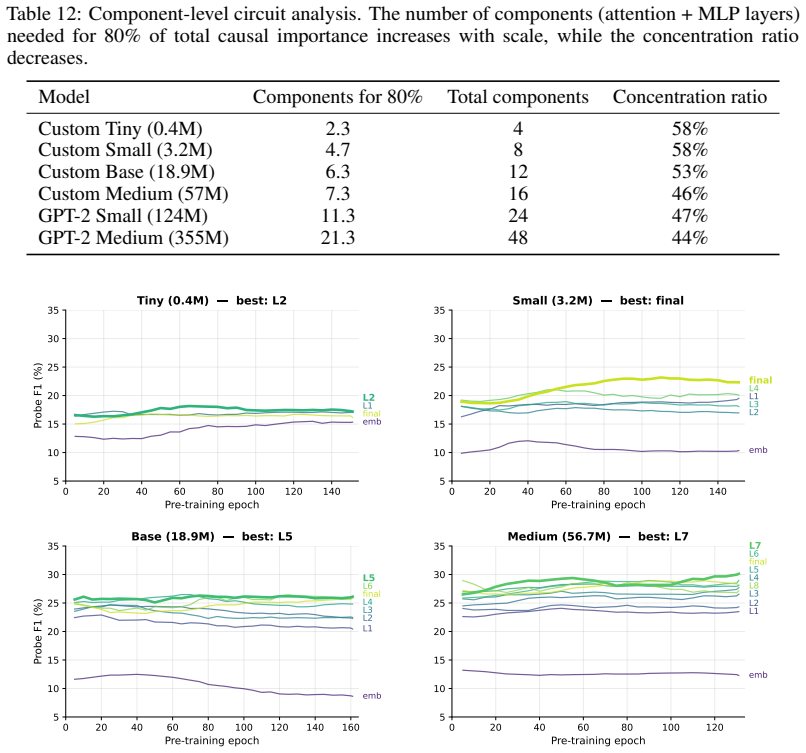
- Semantic role extraction accuracy improves with increasing model scale.
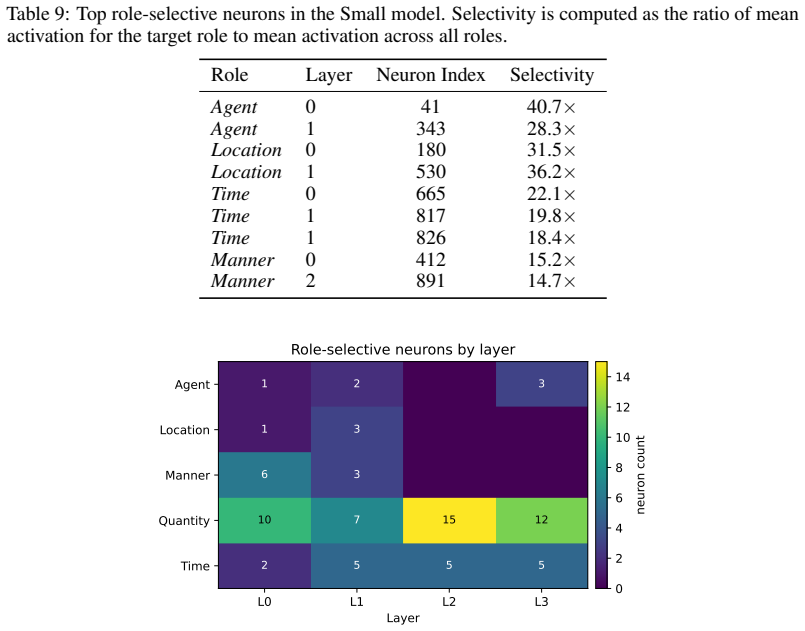
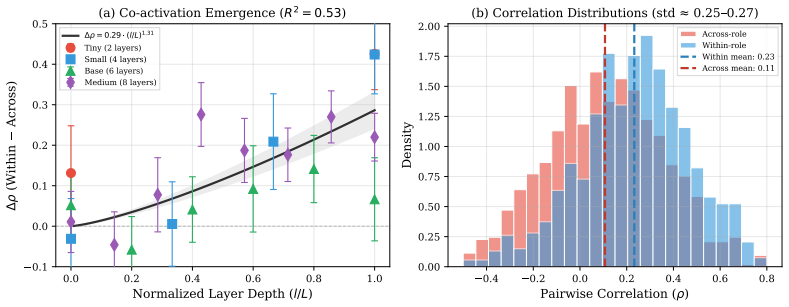
- The internal representation of semantic roles becomes more distributed rather than localized in larger models.
- Fine-tuning can still enhance performance beyond what pre-training provides alone.
Where Pith is reading between the lines
- Other syntactic or semantic features might exhibit similar scale-dependent shifts in encoding style.
- Interpretability techniques may need adaptation for very large models where information is highly distributed.
- This suggests that scaling laws could apply not just to performance but to the geometry of learned linguistic structures.
Load-bearing premise
That the accuracy of linear probes on frozen model layers directly measures the semantic role information present from pre-training without the probes creating new structure.
What would settle it
Finding that semantic role information in large models is localized in specific layers or neurons, rather than distributed, or that small models show equally distributed encoding would challenge the claim of a scale-dependent shift.
Figures




read the original abstract
Understanding how linguistic structure emerges in language models is central to interpreting what these systems learn from data and how much supervision they truly require. In particular, semantic role understanding ("who did what to whom") is a core component of meaning representation, yet it remains unclear whether it arises from pre-training alone or depends on task-specific fine-tuning. We study whether semantic role understanding emerges during language model pre-training or requires task-specific fine-tuning. We freeze decoder-only transformers and train linear probes to extract semantic roles, using performance to infer whether role information is already encoded in pre-training or learned during adaptation. Across model scales, we find that frozen representations contain substantial semantic role information, with performance improving but not fully matching fine-tuned models. This indicates partial but incomplete emergence from pre-training alone. We show that semantic role structure emerges from language modeling objectives, but its internal implementation shifts toward more distributed representations as model scale increases.
Editorial analysis
A structured set of objections, weighed in public.
Referee Report
Summary. The paper examines whether semantic role understanding emerges in decoder-only language models solely from pre-training. It freezes model representations across scales and trains linear probes to decode semantic roles (who-did-what-to-whom), comparing probe accuracy against fine-tuned baselines. Results indicate substantial role information is linearly decodable from frozen pre-trained representations, with accuracy improving as scale increases yet remaining below fully fine-tuned performance; the authors conclude that semantic role structure emerges from language modeling objectives but shifts toward more distributed internal representations with larger models.
Significance. If substantiated with appropriate controls and metrics, the work would provide useful empirical evidence on the limits of unsupervised emergence of core linguistic structure in LMs, particularly the partial nature of semantic role encoding and its scale dependence. The probe-based methodology on frozen decoder-only models is a standard tool for such questions and could inform debates on what pre-training actually captures versus what requires task-specific adaptation.
major comments (2)
- [Abstract / §3] Abstract and §3 (results on scale dependence): The claim that 'its internal implementation shifts toward more distributed representations as model scale increases' is not directly supported by the reported linear probe accuracies alone. Improved linear decodability with scale could reflect stronger, more redundant, or higher-dimensional encodings without necessarily indicating a change in distributedness; no explicit metric (e.g., effective dimensionality, sparsity measures, unit ablation, or linear-vs-nonlinear probe comparisons) is described to isolate this shift.
- [Abstract / Methods] Abstract and methods: The central inference that linear probe performance on frozen representations indicates semantic role information 'already encoded' during pre-training lacks reported controls for probe capacity, random baselines, or statistical significance testing. Without these, it remains possible that probes introduce or amplify structure rather than purely extract pre-existing encodings, weakening the emergence claim.
minor comments (1)
- [Abstract] The abstract provides no numerical performance values, exact model scales tested, or dataset details for the semantic role probing task, making it difficult to assess the magnitude of the reported improvements.
Simulated Author's Rebuttal
We thank the referee for their constructive comments on our work examining the emergence of semantic role understanding in pre-trained decoder-only language models. We address each major comment below and indicate revisions to be made in the next version of the manuscript.
read point-by-point responses
-
Referee: [Abstract / §3] Abstract and §3 (results on scale dependence): The claim that 'its internal implementation shifts toward more distributed representations as model scale increases' is not directly supported by the reported linear probe accuracies alone. Improved linear decodability with scale could reflect stronger, more redundant, or higher-dimensional encodings without necessarily indicating a change in distributedness; no explicit metric (e.g., effective dimensionality, sparsity measures, unit ablation, or linear-vs-nonlinear probe comparisons) is described to isolate this shift.
Authors: We agree that linear probe accuracy improvements with scale do not by themselves isolate a shift toward more distributed representations, as they could alternatively reflect stronger or more redundant encodings. The manuscript's claim draws from the observed pattern of increasing linear decodability alongside the partial gap to fine-tuned performance, but we acknowledge the need for a more direct metric. In the revised manuscript we will qualify the statement in the abstract and §3 and add analyses of effective dimensionality of the probed subspaces (via participation ratio) together with linear-versus-nonlinear probe comparisons to better characterize any representational shift. revision: yes
-
Referee: [Abstract / Methods] Abstract and methods: The central inference that linear probe performance on frozen representations indicates semantic role information 'already encoded' during pre-training lacks reported controls for probe capacity, random baselines, or statistical significance testing. Without these, it remains possible that probes introduce or amplify structure rather than purely extract pre-existing encodings, weakening the emergence claim.
Authors: We accept that explicit controls are necessary to support the inference of pre-existing encodings. The current manuscript relies on the standard linear-probe methodology and the gap between frozen and fine-tuned performance, but does not report the requested baselines. In the revised version we will add (i) random-label and random-feature baselines, (ii) statistical significance testing across multiple seeds, and (iii) a brief discussion of probe capacity relative to hidden dimension. These additions will clarify that the reported accuracies reflect information present in the frozen pre-trained representations. revision: yes
Circularity Check
No circularity in empirical probe-based claims of semantic role emergence
full rationale
The paper reports an empirical study: decoder-only transformers are frozen, linear probes are trained to extract semantic roles from their representations, and accuracy is measured across scales and compared to fine-tuned baselines. The provided text contains no equations, no derivations, and no self-citations invoked as load-bearing premises. Claims that semantic role structure 'emerges from language modeling objectives' and 'shifts toward more distributed representations' are interpretive conclusions drawn from the observed probe performance patterns, not reductions by construction to fitted parameters or self-referential definitions. No step matches any of the enumerated circularity patterns; the analysis is self-contained against external benchmarks (probe accuracy on held-out data).
Axiom & Free-Parameter Ledger
axioms (1)
- domain assumption Linear probes can extract semantic role information if it is present in the model's representations
Reference graph
Works this paper leans on
-
[1]
Transformer Feed-Forward Layers Are Key-Value Memories , author=. Proceedings of the 2021 Conference on Empirical Methods in Natural Language Processing (EMNLP'21) , year=
work page 2021
-
[2]
Interpretability in the Wild: A Circuit for Indirect Object Identification in
Wang, Kevin and Variengien, Alexandre and Conmy, Arthur and Shlegeris, Buck and Steinhardt, Jacob , booktitle=. Interpretability in the Wild: A Circuit for Indirect Object Identification in
-
[3]
Proceedings of the 37th Conference on Neural Information Processing Systems (NeurIPS'23) , year=
Towards Automated Circuit Discovery for Mechanistic Interpretability , author=. Proceedings of the 37th Conference on Neural Information Processing Systems (NeurIPS'23) , year=
-
[4]
Proceedings of the 34th Conference on Neural Information Processing Systems (NeurIPS'20) , year=
Language Models are Few-Shot Learners , author=. Proceedings of the 34th Conference on Neural Information Processing Systems (NeurIPS'20) , year=
-
[5]
Synthesis Lectures on Human Language Technologies , volume=
Semantic Role Labeling , author=. Synthesis Lectures on Human Language Technologies , volume=. 2010 , publisher=
work page 2010
-
[6]
Question-Answer Driven Semantic Role Labeling: Using Natural Language to Annotate Natural Language , author=. Proceedings of the 2015 Conference on Empirical Methods in Natural Language Processing (EMNLP'15) , year=
work page 2015
-
[7]
Shi, Peng and Lin, Jimmy , journal=. Simple
-
[8]
Transactions on Machine Learning Research , year=
Emergent Abilities of Large Language Models , author=. Transactions on Machine Learning Research , year=
-
[9]
Proceedings of the 37th Conference on Neural Information Processing Systems (NeurIPS'23) , year=
Are Emergent Abilities of Large Language Models a Mirage? , author=. Proceedings of the 37th Conference on Neural Information Processing Systems (NeurIPS'23) , year=
-
[10]
Computational Linguistics , volume=
Probing Classifiers: Promises, Shortcomings, and Advances , author=. Computational Linguistics , volume=. 2022 , publisher=
work page 2022
-
[11]
Designing and Interpreting Probes with Control Tasks , author=. Proceedings of the 2019 Conference on Empirical Methods in Natural Language Processing (EMNLP'19) , year=
work page 2019
-
[12]
Proceedings of the 2024 Conference on Language Modeling (COLM'24) , year=
Predicting Emergent Capabilities by Fine-tuning , author=. Proceedings of the 2024 Conference on Language Modeling (COLM'24) , year=
work page 2024
-
[13]
A Structural Probe for Finding Syntax in Word Representations , author=. Proceedings of the 2019 Conference of the North American Chapter of the Association for Computational Linguistics (NAACL'19) , year=
work page 2019
-
[14]
Tenney, Ian and Das, Dipanjan and Pavlick, Ellie , booktitle=
-
[15]
Language Models are Unsupervised Multitask Learners , author=. OpenAI Blog , volume=
-
[16]
Pointer Sentinel Mixture Models
Pointer Sentinel Mixture Models , author=. arXiv preprint arXiv:1609.07843 , year=
work page internal anchor Pith review Pith/arXiv arXiv
-
[17]
Transactions of the Association for Computational Linguistics , volume=
Natural Questions: A Benchmark for Question Answering Research , author=. Transactions of the Association for Computational Linguistics , volume=
-
[18]
Proceedings of the 36th International Conference on Machine Learning (ICML'19) , year=
Similarity of Neural Network Representations Revisited , author=. Proceedings of the 36th International Conference on Machine Learning (ICML'19) , year=
-
[19]
Proceedings of the 7th International Conference on Learning Representations (ICLR'19) , year=
Decoupled Weight Decay Regularization , author=. Proceedings of the 7th International Conference on Learning Representations (ICLR'19) , year=
-
[20]
FitzGerald, Nicholas and Michael, Julian and He, Luheng and Zettlemoyer, Luke , booktitle=. Large-Scale
-
[21]
Nature Communications , volume=
A power law describes the magnitude of adaptation in neural populations of primary visual cortex , author=. Nature Communications , volume=
-
[22]
Physical Review Research , volume=
Zeroth, First, and Second Order Phase Transitions in Deep Neural Networks , author=. Physical Review Research , volume=
-
[23]
Training Compute-Optimal Large Language Models
Training Compute-Optimal Large Language Models , author=. arXiv preprint arXiv:2203.15556 , year=
work page internal anchor Pith review Pith/arXiv arXiv
-
[24]
Proceedings of the 12th International Conference on Learning Representations (ICLR'24) , year=
Language Models Represent Space and Time , author=. Proceedings of the 12th International Conference on Learning Representations (ICLR'24) , year=
-
[25]
van der Maaten, Laurens and Hinton, Geoffrey , journal=. Visualizing Data using t-
-
[26]
Devlin, Jacob and Chang, Ming-Wei and Lee, Kenton and Toutanova, Kristina , booktitle=
-
[27]
Deep Contextualized Word Representations , author=. Proceedings of the 2018 Conference of the North American Chapter of the Association for Computational Linguistics (NAACL'18) , year=
work page 2018
-
[28]
Proceedings of the 30th Conference on Neural Information Processing Systems (NeurIPS'17) , year=
Attention Is All You Need , author=. Proceedings of the 30th Conference on Neural Information Processing Systems (NeurIPS'17) , year=
-
[29]
Advances in Neural Information Processing Systems 26 (NeurIPS'13) , year=
Distributed Representations of Words and Phrases and their Compositionality , author=. Advances in Neural Information Processing Systems 26 (NeurIPS'13) , year=
-
[30]
Pennington, Jeffrey and Socher, Richard and Manning, Christopher D , booktitle=
- [31]
- [32]
- [33]
-
[34]
Linguistic Knowledge and Transferability of Contextual Representations , author=. Proceedings of the 2019 Conference of the North American Chapter of the Association for Computational Linguistics (NAACL'19) , year=
work page 2019
-
[35]
Probing Pretrained Language Models for Lexical Semantics , author=. Proceedings of the 2020 Conference on Empirical Methods in Natural Language Processing (EMNLP'20) , year=
work page 2020
-
[36]
Deep Semantic Role Labeling: What Works and What's Next , author=. Proceedings of the 55th Annual Meeting of the Association for Computational Linguistics (ACL'17) , year=
-
[37]
Encoding Sentences with Graph Convolutional Networks for Semantic Role Labeling , author=. Proceedings of the 2017 Conference on Empirical Methods in Natural Language Processing (EMNLP'17) , year=
work page 2017
-
[38]
End-to-end Learning of Semantic Role Labeling Using Recurrent Neural Networks , author=. Proceedings of the 53rd Annual Meeting of the Association for Computational Linguistics (ACL'15) , year=
-
[39]
Neural Semantic Role Labeling with Dependency Path Embeddings , author=. Proceedings of the 54th Annual Meeting of the Association for Computational Linguistics (ACL'16) , year=
-
[40]
Linguistically-Informed Self-Attention for Semantic Role Labeling , author=. Proceedings of the 2018 Conference on Empirical Methods in Natural Language Processing (EMNLP'18) , year=
work page 2018
-
[41]
Transformer Circuits Thread , year=
Toy Models of Superposition , author=. Transformer Circuits Thread , year=
-
[42]
Transformer Circuits Thread , year=
Towards Monosemanticity: Decomposing Language Models With Dictionary Learning , author=. Transformer Circuits Thread , year=
-
[43]
Proceedings of the 12th International Conference on Learning Representations (ICLR'24) , year=
Sparse Autoencoders Find Highly Interpretable Features in Language Models , author=. Proceedings of the 12th International Conference on Learning Representations (ICLR'24) , year=
-
[44]
Scaling Monosemanticity: Extracting Interpretable Features from
Templeton, Adly and Conerly, Tom and Marcus, Jonathan and others , journal=. Scaling Monosemanticity: Extracting Interpretable Features from. 2024 , note=
work page 2024
-
[45]
Transformer Circuits Thread , year=
In-context Learning and Induction Heads , author=. Transformer Circuits Thread , year=
-
[46]
Progress measures for grokking via mechanistic interpretability
Progress measures for grokking via mechanistic interpretability , author=. arXiv preprint arXiv:2301.05217 , year=
work page internal anchor Pith review arXiv
-
[47]
Universal Language Model Fine-tuning for Text Classification , author=. Proceedings of the 56th Annual Meeting of the Association for Computational Linguistics (ACL'18) , year=
-
[48]
Transfer Learning in Natural Language Processing , author=. Proceedings of the 2019 Conference of the North American Chapter of the Association for Computational Linguistics (NAACL'19): Tutorial Abstracts , year=
work page 2019
-
[49]
arXiv preprint arXiv:2202.07785 , year=
Predictability and Surprise in Large Generative Models , author=. arXiv preprint arXiv:2202.07785 , year=
-
[50]
Scaling Laws for Neural Language Models
Scaling Laws for Neural Language Models , author=. arXiv preprint arXiv:2001.08361 , year=
work page internal anchor Pith review Pith/arXiv arXiv 2001
-
[51]
Computational Linguistics , volume=
Automatic Labeling of Semantic Roles , author=. Computational Linguistics , volume=
-
[52]
Semantic Role Labeling using Different Syntactic Views , author=. Proceedings of the 43rd Annual Meeting of the Association for Computational Linguistics (ACL'05) , year=
-
[53]
Dissecting Contextual Word Embeddings: Architecture and Representation , author=. Proceedings of the 2018 Conference on Empirical Methods in Natural Language Processing (EMNLP'18) , year=
work page 2018
-
[54]
Proceedings of the 40th International Conference on Machine Learning (ICML'23) , year=
Pythia: A Suite for Analyzing Large Language Models Across Training and Scaling , author=. Proceedings of the 40th International Conference on Machine Learning (ICML'23) , year=
-
[55]
Gao, Leo and Biderman, Stella and Black, Sid and Golding, Laurence and Hoppe, Travis and Foster, Charles and Phang, Jason and He, Horace and Thite, Anish and Nabeshima, Noa and others , journal=. The
discussion (0)
Sign in with ORCID, Apple, or X to comment. Anyone can read and Pith papers without signing in.