Recognition: 1 theorem link
· Lean TheoremMagnetization alignment in spin-transfer-torque magnetic random-access memory
Pith reviewed 2026-05-12 03:11 UTC · model grok-4.3
The pith
Introducing asymmetry between the synthetic antiferromagnet layers reduces the interlayer coupling strength required to stabilize antiparallel states in 30 nm p-STT-MRAM nanopillars.
A machine-rendered reading of the paper's core claim, the machinery that carries it, and where it could break.
Core claim
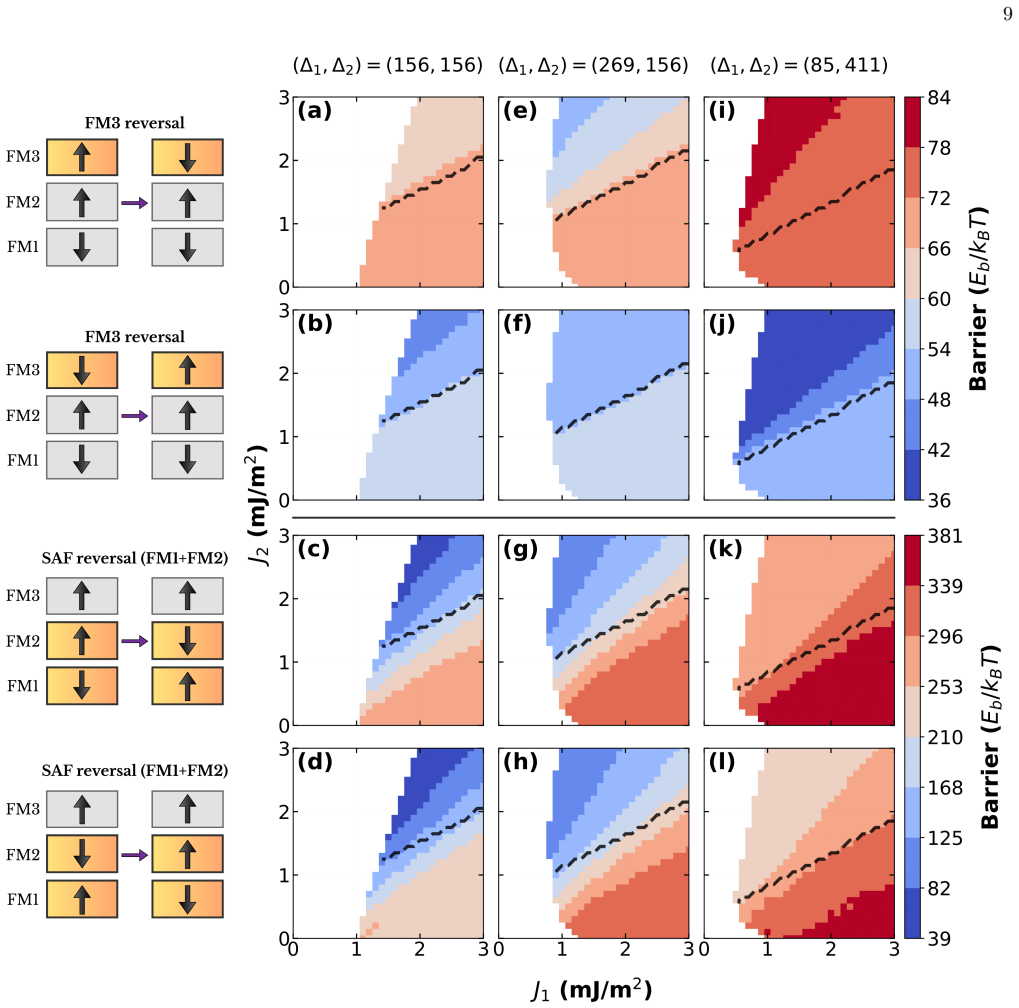
Phase diagrams show that introducing asymmetry between the SAF layers in saturation magnetization, anisotropy, and thickness reduces the coupling strength required to stabilize antiparallel SAF states and suppress competing configurations. Minimum-energy path calculations show that, for noncollinear antiparallel SAF states, increasing SAF asymmetry can raise SAF reversal barriers while lowering the free-layer barrier; this trade-off is absent for collinear antiparallel SAF states. Stray fields also significantly modify both SAF and free-layer energy barriers.
What carries the argument
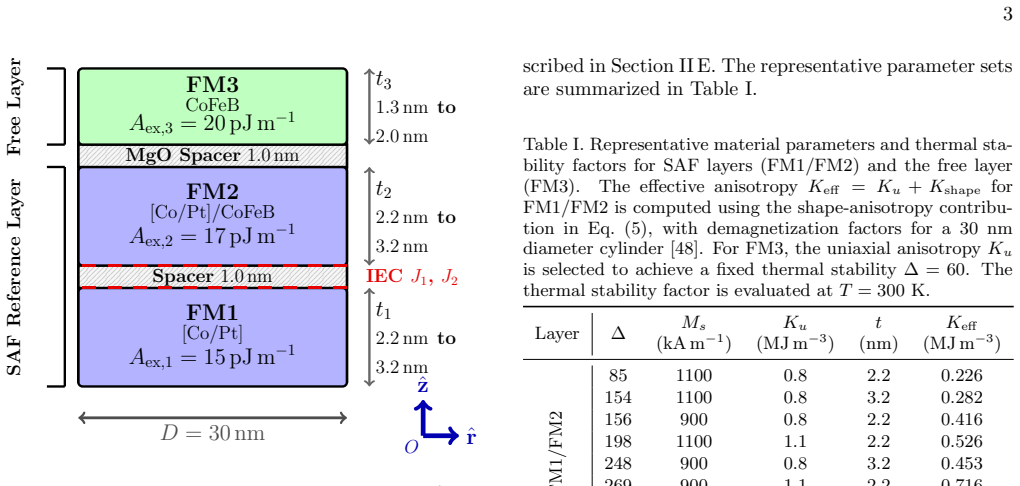
Micromagnetic phase diagrams and minimum-energy path calculations performed on 30 nm-diameter three-layer nanopillars as functions of bilinear and biquadratic interlayer exchange coupling.
Load-bearing premise
The micromagnetic model with experimentally motivated parameters fully captures the equilibrium states and reversal paths in real 30 nm nanopillars without significant unaccounted effects such as defects, edge roughness, or temperature fluctuations.
What would settle it
Experimental fabrication of 30 nm p-STT-MRAM nanopillars with controlled SAF asymmetry and measurement of the coupling strengths at which antiparallel states stabilize, or observation of the predicted changes in reversal barriers.
Figures


read the original abstract
Reliable operation of perpendicular spin-transfer-torque magnetic random-access memory (p-STT-MRAM) requires control of magnetic alignment within the synthetic antiferromagnet (SAF) reference layer. At nanopillar dimensions, however, devices can exhibit magnetic states that are absent in extended thin films. We present a systematic micromagnetic study of 30 nm-diameter three-layer p-STT-MRAM nanopillars using experimentally motivated material parameters, and map equilibrium states as functions of bilinear and biquadratic interlayer exchange coupling. Phase diagrams show that introducing asymmetry between the SAF layers in saturation magnetization, anisotropy, and thickness reduces the coupling strength required to stabilize antiparallel SAF states and suppress competing configurations. Minimum-energy path calculations show that, for noncollinear antiparallel SAF states, increasing SAF asymmetry can raise SAF reversal barriers while lowering the free-layer barrier; this trade-off is absent for collinear antiparallel SAF states. Stray fields also significantly modify both SAF and free-layer energy barriers. To support the design of p-STT-MRAM devices with either collinear or noncollinear antiparallel SAF reference states, we publicly release the simulation dataset covering 4374 distinct device configurations.
Editorial analysis
A structured set of objections, weighed in public.
Referee Report
Summary. The manuscript presents a micromagnetic simulation study of 30 nm-diameter perpendicular STT-MRAM nanopillars. It maps equilibrium magnetic states as functions of bilinear and biquadratic interlayer exchange coupling strengths in the synthetic antiferromagnet (SAF) reference layer, both with and without asymmetries in saturation magnetization, anisotropy, and thickness between the SAF layers. Phase diagrams identify regions where antiparallel SAF states are stabilized and competing configurations suppressed. Minimum-energy path (MEP) calculations quantify reversal barriers, showing that asymmetry raises SAF barriers while lowering the free-layer barrier for noncollinear antiparallel states (but not for collinear states), with stray fields further modifying both barriers. A public dataset of 4374 configurations is released to support device design.
Significance. If the simulation results hold, the work provides actionable design guidelines for stabilizing antiparallel SAF states in nanoscale p-STT-MRAM, a key requirement for reliable operation. The differential barrier trade-off between noncollinear and collinear configurations, the role of asymmetry in lowering required coupling strengths, and the public release of the full dataset are strengths that enable reproducibility and further modeling. The use of experimentally motivated parameters grounds the study in realistic regimes.
major comments (2)
- [Methods] Methods (implied section on simulation setup): Convergence checks with respect to mesh discretization and time-step size are not reported for the 30 nm nanopillars. Given that the central claims rest on equilibrium phase diagrams and MEP barrier heights, which are sensitive to spatial discretization in micromagnetic models, this omission leaves open the possibility of numerical artifacts affecting the reported stabilization thresholds and barrier trends.
- [MEP calculations] Results on MEP calculations: The claim that asymmetry raises SAF reversal barriers while lowering the free-layer barrier is specific to noncollinear antiparallel states and absent for collinear ones. However, the quantitative barrier values (in energy units) and the precise definition of the reaction coordinate in the MEP are not cross-checked against an independent method (e.g., nudged elastic band with different spring constants), which is load-bearing for the reported trade-off.
minor comments (2)
- [Figures] Figure captions for the phase diagrams should explicitly state the fixed values of all other parameters (e.g., exchange stiffness, damping) when varying bilinear/biquadratic coupling and asymmetries.
- [Abstract and Results] The abstract states that stray fields 'significantly modify' barriers; a supplementary table or plot quantifying the barrier change (with vs. without stray-field term) would strengthen this statement.
Simulated Author's Rebuttal
We thank the referee for their thorough review and constructive feedback on our manuscript. We address the major comments point by point below and have incorporated revisions to enhance the methodological transparency and clarity of our results.
read point-by-point responses
-
Referee: [Methods] Methods (implied section on simulation setup): Convergence checks with respect to mesh discretization and time-step size are not reported for the 30 nm nanopillars. Given that the central claims rest on equilibrium phase diagrams and MEP barrier heights, which are sensitive to spatial discretization in micromagnetic models, this omission leaves open the possibility of numerical artifacts affecting the reported stabilization thresholds and barrier trends.
Authors: We agree with the referee that explicit reporting of convergence checks is important for validating the micromagnetic results. Although convergence with respect to mesh discretization (cell sizes of 1 nm and finer) and time-step sizes was verified during the simulations to ensure stable equilibrium states and accurate energy barriers, these details were not included in the original manuscript. In the revised version, we will add a dedicated subsection in the Methods section describing the convergence tests performed for the 30 nm nanopillars, including the criteria used and confirmation that the phase diagrams and barrier heights are converged. revision: yes
-
Referee: [MEP calculations] Results on MEP calculations: The claim that asymmetry raises SAF reversal barriers while lowering the free-layer barrier is specific to noncollinear antiparallel states and absent for collinear ones. However, the quantitative barrier values (in energy units) and the precise definition of the reaction coordinate in the MEP are not cross-checked against an independent method (e.g., nudged elastic band with different spring constants), which is load-bearing for the reported trade-off.
Authors: We thank the referee for highlighting this aspect of the MEP analysis. The minimum energy paths were obtained using the standard implementation in our micromagnetic code, where the reaction coordinate is the cumulative geodesic distance along the spin configuration path. The barrier heights are expressed in units of k_B T (with k_B T ≈ 4.14 × 10^{-21} J at 300 K). While we did not perform an explicit cross-validation with alternative spring constants or independent codes, the observed trends in barrier modifications due to asymmetry are consistent across the extensive dataset of 4374 configurations. To address the concern, we will expand the description of the MEP method in the revised manuscript, including the precise definition of the reaction coordinate and the reported energy values, and note the robustness of the results. A full independent cross-check would require additional computational resources but could be considered if deemed essential. revision: partial
Circularity Check
No significant circularity in forward micromagnetic simulations
full rationale
The paper conducts forward micromagnetic simulations to produce phase diagrams of equilibrium states versus bilinear/biquadratic coupling and minimum-energy path barrier calculations as functions of SAF asymmetry parameters. These outcomes are computed directly from the model inputs (experimentally motivated material parameters, varied coupling strengths, and layer properties) rather than being fitted to or defined in terms of the reported results. No equations reduce to their own outputs by construction, no predictions are statistically forced from subsets of the same data, and no load-bearing self-citations or uniqueness theorems are invoked. The public release of the 4374-configuration dataset further supports external verification, confirming the derivation chain is self-contained and non-circular.
Axiom & Free-Parameter Ledger
free parameters (2)
- bilinear and biquadratic interlayer exchange coupling strengths
- saturation magnetization, anisotropy, and thickness values for asymmetric SAF layers
axioms (1)
- domain assumption The micromagnetic model accurately represents equilibrium magnetic states and minimum-energy reversal paths in 30 nm p-STT-MRAM nanopillars
Lean theorems connected to this paper
-
IndisputableMonolith/Foundation/AbsoluteFloorClosure.leanreality_from_one_distinction unclearPhase diagrams show that introducing asymmetry between the SAF layers in saturation magnetization, anisotropy, and thickness reduces the coupling strength required to stabilize antiparallel SAF states
Reference graph
Works this paper leans on
-
[1]
J. C. Slonczewski, Current-driven excitation of magnetic multilayers, Journal of Magnetism and Magnetic Materi- als159, L1 (1996)
work page 1996
-
[2]
L. Berger, Emission of spin waves by a magnetic multi- layer traversed by a current, Physical Review B54, 9353 (1996), publisher: American Physical Society
work page 1996
-
[3]
A. V. Khvalkovskiy, D. Apalkov, S. Watts, R. Chepulskii, R. S. Beach, A. Ong, X. Tang, A. Driskill-Smith, W. H. Butler, P. B. Visscher, D. Lottis, E. Chen, V. Nikitin, and M. Krounbi, Basic principles of STT-MRAM cell oper- ation in memory arrays, Journal of Physics D: Applied Physics46, 074001 (2013)
work page 2013
-
[4]
N. D. Rizzo, D. Houssameddine, J. Janesky, R. Whig, F. B. Mancoff, M. L. Schneider, M. DeHerrera, J. J. Sun, K. Nagel, S. Deshpande, H.-J. Chia, S. M. Alam, T. An- dre, S. Aggarwal, and J. M. Slaughter, A Fully Func- tional 64 Mb DDR3 ST-MRAM Built on 90 nm CMOS Technology, IEEE Transactions on Magnetics49, 4441 (2013)
work page 2013
-
[5]
S.-W. Chung, T. Kishi, J. W. Park, M. Yoshikawa, K. S. Park, T. Nagase, K. Sunouchi, H. Kanaya, G. C. Kim, K. Noma, M. S. Lee, A. Yamamoto, K. M. Rho, K. Tsuchida, S. J. Chung, J. Y. Yi, H. S. Kim, Y. Chun, H. Oyamatsu, and S. J. Hong, 4Gbit density STT- MRAM using perpendicular MTJ realized with compact cell structure, in2016 IEEE International Electron ...
work page 2016
-
[6]
A. D. Kent and D. C. Worledge, A new spin on magnetic memories, Nature nanotechnology10, 187 (2015)
work page 2015
-
[7]
D. C. Worledge, Write-error-rate of Spin-Transfer-Torque MRAM (Invited), in2023 IEEE International Reliability Physics Symposium (IRPS)(2023) pp. 1–4
work page 2023
-
[8]
P. F. Carcia, A. D. Meinhaldt, and A. Suna, Perpen- dicular magnetic anisotropy in Pd/Co thin film layered structures, Applied Physics Letters47, 178 (1985)
work page 1985
-
[9]
E. E. Fullerton and J. R. Childress, Spintronics, Mag- netoresistive Heads, and the Emergence of the Digital World, Proceedings of the IEEE104, 1787 (2016)
work page 2016
-
[10]
D. Apalkov, B. Dieny, and J. M. Slaughter, Magnetore- sistive Random Access Memory, Proceedings of the IEEE 104, 1796 (2016)
work page 2016
- [11]
-
[12]
P. Gr¨ unberg, R. Schreiber, Y. Pang, M. B. Brodsky, and H. Sowers, Layered Magnetic Structures: Evidence for Antiferromagnetic Coupling of Fe Layers across Cr In- terlayers, Physical Review Letters57, 2442 (1986)
work page 1986
-
[13]
S. S. Parkin, Systematic variation of the strength and oscillation period of indirect magnetic exchange coupling through the 3d, 4d, and 5d transition metals, Phys- ical Review Letters67, 10.1103/PhysRevLett.67.3598 (1991)
-
[14]
K. Winther, Z. R. Nunn, J. Lisik, S. Arapan, D. Legut, F. Schulz, E. Goering, T. Mckinnon, S. Myrtle, and E. Girt, Antiferromagnetic coupling across nonmagnetic transition-metal films alloyed with ferromagnetic ele- ments, Physical Review Applied22, 024058 (2024), pub- lisher: American Physical Society
work page 2024
-
[15]
T. McKinnon, B. Heinrich, and E. Girt, Thermally ro- bust synthetic antiferromagnetic fixed layers containing FeCoB for use in STT-MRAM devices, Journal of Mag- netism and Magnetic Materials546, 168646 (2022)
work page 2022
-
[16]
Z. R. Nunn, C. Abert, D. Suess, and E. Girt, Control of the noncollinear interlayer exchange coupling, Science Advances6, 10.1126/sciadv.abd8861 (2020)
- [17]
-
[18]
Z. R. Nunn, J. Lisik, P. Omelchenko, S. Koraltan, C. Abert, D. Suess, and E. Girt, Controlling the angle between magnetic moments of Co layers in Co|RuCo|Co, Journal of Applied Physics133, 123901 (2023)
work page 2023
- [19]
-
[20]
G. Lertzman-Lepofsky, A. Terko, S. Koraltan, D. Suess, E. Girt, and C. Abert, Energy landscape of noncollinear exchange coupled magnetic multilayers, Physical Review B109, 224421 (2024)
work page 2024
- [21]
-
[22]
M. Stiles, Interlayer Exchange Coupling, inUltrathin Magnetic Structures III: Fundamentals of Nanomag- netism, edited by J. A. C. Bland and B. Heinrich (Springer, Berlin, Heidelberg, 2005) pp. 99–142
work page 2005
- [23]
-
[24]
C. Abert, Micromagnetics and spintronics: Models and numerical methods, The European Physical Journal B 92, 120 (2019)
work page 2019
- [25]
- [26]
-
[27]
D. Fredkin and T. Koehler, Hybrid method for comput- ing demagnetizing fields, IEEE Transactions on Magnet- ics26, 415 (1990)
work page 1990
-
[28]
T. Young Lee, D. Su Son, S. Ho Lim, and S.-R. Lee, High post-annealing stability in [Pt/Co] multilayers, Journal of Applied Physics113, 216102 (2013)
work page 2013
-
[29]
T. Devolder, J.-V. Kim, L. Nistor, R. Sousa, B. Rod- macq, and B. Di´ eny, Exchange stiffness in ultrathin per- pendicularly magnetized CoFeB layers determined using the spectroscopy of electrically excited spin waves, Jour- nal of Applied Physics120, 183902 (2016)
work page 2016
-
[30]
C. Eyrich, A. Zamani, W. Huttema, M. Arora, D. Har- rison, F. Rashidi, D. Broun, B. Heinrich, O. Mryasov, M. Ahlberg, O. Karis, P. E. J¨ onsson, M. From, X. Zhu, and E. Girt, Effects of substitution on the exchange stiff- ness and magnetization of Co films, Physical Review B 90, 235408 (2014), publisher: American Physical Society
work page 2014
-
[31]
T. Y. Lee, Y. Chan Won, D. Su Son, S. Ho Lim, and S.-R. Lee, Effects of Co layer thickness and anneal- ing temperature on the magnetic properties of inverted [Pt/Co] multilayers, Journal of Applied Physics114, 10.1063/1.4829024 (2013), publisher: AIP Publishing
-
[32]
S. T. Lim, M. Tran, J. W. Chenchen, J. F. Ying, and G. Han, Effect of different seed layers with vary- ing Co and Pt thicknesses on the magnetic properties of Co/Pt multilayers, Journal of Applied Physics117, 10.1063/1.4916295 (2015), publisher: AIP Publishing
-
[33]
K. Yakushiji, A. Sugihara, A. Fukushima, H. Kubota, and S. Yuasa, Very strong antiferromagnetic interlayer exchange coupling with iridium spacer layer for perpen- dicular magnetic tunnel junctions, Applied Physics Let- ters110, 092406 (2017)
work page 2017
-
[34]
H. Sato, E. C. I. Enobio, M. Yamanouchi, S. Ikeda, S. Fukami, S. Kanai, F. Matsukura, and H. Ohno, Properties of magnetic tunnel junctions with a MgO/CoFeB/Ta/CoFeB/MgO recording structure down to junction diameter of 11 nm, Applied Physics Letters 105, 062403 (2014)
work page 2014
-
[35]
Y. Tomczak, T. Lin, J. Swerts, S. Couet, S. Mertens, E. Liu, W. Kim, K. Sankaran, G. Pourtois, D. Tsve- tanova, L. Souriau, S. Van Elshocht, G. S. Kar, and A. Furnemont, Influence of the Reference Layer Compo- sition on the Back-End-of-Line Compatibility of Co/Ni- Based Perpendicular Magnetic Tunnel Junction Stacks, IEEE Transactions on Magnetics52, 1 (2016)
work page 2016
-
[36]
K. Yakushiji, H. Kubota, A. Fukushima, and S. Yuasa, Perpendicular magnetic tunnel junction with enhanced anisotropy obtained by utilizing an Ir/Co interface, Ap- plied Physics Express9, 013003 (2015), publisher: IOP Publishing
work page 2015
- [37]
-
[38]
M. Bersweiler, H. Sato, and H. Ohno, Magnetic and Free- Layer Properties of MgO/(Co)FeB/MgO Structures: De- pendence on CoFeB Composition, IEEE Magnetics Let- ters8, 1 (2017)
work page 2017
-
[39]
J. M. Iwata-Harms, G. Jan, S. Serrano-Guisan, L. Thomas, H. Liu, J. Zhu, Y.-J. Lee, S. Le, R.-Y. Tong, S. Patel, V. Sundar, D. Shen, Y. Yang, R. He, J. Haq, Z. Teng, V. Lam, P. Liu, Y.-J. Wang, T. Zhong, H. Fukuzawa, and P.-K. Wang, Ultrathin perpendicular magnetic anisotropy CoFeB free layers for highly efficient, high speed writing in spin-transfer-torq...
work page 2019
-
[40]
T. Devolder, L. Bianchini, K. Miura, K. Ito, J.-V. Kim, P. Crozat, V. Morin, A. Helmer, C. Chappert, S. Ikeda, and H. Ohno, Spin-torque switching window, thermal stability, and material parameters of MgO tunnel junc- tions, Applied Physics Letters98, 162502 (2011)
work page 2011
-
[41]
H. Sato, M. Yamanouchi, S. Ikeda, S. Fukami, F. Mat- sukura, and H. Ohno, Perpendicular-anisotropy CoFeB-MgO magnetic tunnel junctions with a MgO/CoFeB/Ta/CoFeB/MgO recording structure, Applied Physics Letters101, 022414 (2012)
work page 2012
-
[42]
T. S. Santos, G. Mihajlovi´ c, N. Smith, J.-L. Li, M. Carey, J. A. Katine, and B. D. Terris, Ultrathin perpendicular free layers for lowering the switching current in STT- MRAM, Journal of Applied Physics128, 113904 (2020)
work page 2020
- [43]
-
[44]
M. Choi, R. Carpenter, M. Gama Monteiro, S. Van Beek, J. Kim, and S. Couet, Measurement of the activation volume in magnetic random access memory, Journal of Applied Physics133, 073901 (2023)
work page 2023
-
[45]
S.-E. Lee, Y. Takemura, and J.-G. Park, Effect of double MgO tunneling barrier on thermal stability and TMR ratio for perpendicular MTJ spin-valve with tungsten layers, Applied Physics Letters109, 10.1063/1.4967172 (2016), publisher: AIP Publishing
-
[46]
J. M. Iwata-Harms, G. Jan, H. Liu, S. Serrano-Guisan, J. Zhu, L. Thomas, R.-Y. Tong, V. Sundar, and P.- K. Wang, High-temperature thermal stability driven by magnetization dilution in CoFeB free layers for spin- transfer-torque magnetic random access memory, Scien- tific Reports8, 14409 (2018), publisher: Nature Publish- ing Group
work page 2018
-
[47]
L. Lang, Y. Jiang, C. Wang, and Y. Dong, Effect of recording layer thickness on reducing switching current in double MgO/CoFeB interfaces pMTJ, Journal of Ap- plied Physics137, 113901 (2025)
work page 2025
-
[48]
R. I. Joseph, Ballistic demagnetizing factor in uniformly magnetized cylinders, Journal of Applied Physics37, 4639 (1966)
work page 1966
-
[49]
D. Weller and A. Moser, Thermal effect limits in ultrahigh-density magnetic recording, IEEE Transactions on Magnetics35, 4423 (1999)
work page 1999
-
[50]
A. Hubert and R. Sch¨ afer,Magnetic Domains: The Analysis of Magnetic Microstructures(Springer Sci- ence & Business Media, 1998) google-Books-ID: 1BLB- WbPXrUgC
work page 1998
-
[51]
W. E, W. Ren, and E. Vanden-Eijnden, Simplified and improved string method for computing the minimum energy paths in barrier-crossing events, The Journal of Chemical Physics126, 164103 (2007)
work page 2007
-
[52]
H. J. Richter, E. Girt, and H. Zhou, Simplified analysis of two-layer antiferromagnetically coupled media, Applied Physics Letters80, 2529 (2002)
work page 2002
-
[53]
Y. Liu, J. Yu, and H. Zhong, Strong antiferromagnetic interlayer exchange coupling in [Co/Pt]6/Ru/[Co/Pt]4 structures with perpendicular magnetic anisotropy, Jour- nal of Magnetism and Magnetic Materials473, 381 (2019). 13
work page 2019
-
[54]
T. Nakano, M. Oogane, and Y. Ando, Annealing effect on interlayer exchange coupling in perpendicularly mag- netized synthetic antiferromagnetic structure based on Co/Pd multilayers with ultrathin Ru spacer, Japanese Journal of Applied Physics57, 073001 (2018), publisher: IOP Publishing
work page 2018
-
[55]
R. Sbiaa, Magnetization switching by spin-torque effect in off-aligned structure with perpendicular anisotropy, Journal of Physics D: Applied Physics46, 395001 (2013)
work page 2013
-
[56]
A. Terko, Dataset for Magnetization alignment in spin- transfer torque magnetic random-access memory (2026)
work page 2026
discussion (0)
Sign in with ORCID, Apple, or X to comment. Anyone can read and Pith papers without signing in.