Recognition: no theorem link
Neutron stars in a conservative f(R,T) gravity
Pith reviewed 2026-05-12 02:21 UTC · model grok-4.3
The pith
Reformulating f(R,T) gravity via an effective energy-momentum tensor renders the gravitational sector independent of the equation of state.
A machine-rendered reading of the paper's core claim, the machinery that carries it, and where it could break.
Core claim
We reformulate the theory in terms of an effective energy-momentum tensor, so that the conservation law follows from the field equations and Bianchi identities while the gravitational action remains independent of the microphysical EoS. We derive the modified stellar structure equations, establish theoretical consistency conditions including coupling bounds and crust-singularity avoidance, and present the tidal perturbation sector in terms of effective thermodynamic variables and an effective sound speed. We then compute neutron star observables using realistic tabulated EoSs, including mass-radius relations and tidal deformabilities, and compare the model with current astrophysical data.
What carries the argument
The effective energy-momentum tensor reformulation, which absorbs non-conservation contributions so that Bianchi identities enforce conservation independently of the equation of state.
Load-bearing premise
The effective energy-momentum tensor reformulation preserves all required consistency conditions including crust regularity and coupling bounds without introducing new inconsistencies when applied to realistic tabulated equations of state.
What would settle it
A direct numerical solution of the modified stellar structure equations for any realistic tabulated EoS that produces a singularity at the crust or violates the derived coupling bounds while still matching the observed maximum neutron-star mass would falsify the claimed consistency.
Figures


read the original abstract
We investigate a conservative formulation of $f(R,T)$ gravity motivated by a key limitation of several existing approaches: the gravitational function is often reconstructed from a chosen equation of state, making the gravity sector EoS-dependent and compromising universality. To avoid this problem, we reformulate the theory in terms of an effective energy-momentum tensor, so that the conservation law follows from the field equations and Bianchi identities while the gravitational action remains independent of the microphysical EoS. We derive the modified stellar structure equations, establish theoretical consistency conditions including coupling bounds and crust-singularity avoidance, and present the tidal perturbation sector in terms of effective thermodynamic variables and an effective sound speed. We then compute neutron star observables using realistic tabulated EoSs, including mass-radius relations and tidal deformabilities, and compare the model with current astrophysical constraints from massive pulsars, NICER radius measurements, and GW170817.
Editorial analysis
A structured set of objections, weighed in public.
Referee Report
Summary. The paper proposes a conservative reformulation of f(R,T) gravity via an effective energy-momentum tensor. This ensures the conservation law follows from the field equations and Bianchi identities while keeping the gravitational action independent of the microphysical EoS. The authors derive modified stellar structure equations, establish consistency conditions (coupling bounds, crust-singularity avoidance), reformulate the tidal sector with effective thermodynamic variables and sound speed, and compute neutron-star mass-radius relations plus tidal deformabilities for realistic tabulated EoSs, comparing results to massive-pulsar, NICER, and GW170817 constraints.
Significance. If the reformulation genuinely decouples the gravitational sector from EoS choice while preserving all consistency conditions for tabulated models, the work would strengthen the predictive power of f(R,T) theories for compact objects and reduce the risk of EoS-dependent gravity functions. Explicit use of tabulated EoSs together with direct observational comparisons supplies concrete, falsifiable outputs that can be tested against future data.
major comments (3)
- [§2] §2 (effective EMT definition, around Eq. (8)–(12)): The central claim that the gravitational action remains strictly independent of the microphysical EoS rests on the effective tensor construction. However, when the same construction is applied to tabulated EoSs containing sharp density discontinuities at the crust-core interface, the effective pressure and density must still satisfy regularity conditions that appear to require EoS-specific smoothing or bounds; this risks reintroducing implicit EoS dependence, undermining the universality argument.
- [§4] §4 (tidal perturbation sector, effective sound speed definition): The tidal deformability is expressed via an effective sound speed c_{s,eff}. For tabulated EoSs the original sound-speed profile exhibits abrupt changes across the crust; it is not shown that c_{s,eff} remains independent of these features or that the resulting Love numbers are insensitive to the particular tabulated model once the coupling parameter is fixed by the consistency bounds derived under smoother assumptions.
- [§5] §5 (numerical results and coupling bounds): The reported bounds on the coupling strength are obtained by enforcing crust regularity and consistency with data. Because these bounds are applied uniformly to multiple tabulated EoSs without an explicit demonstration that the effective-tensor reformulation does not force EoS-dependent adjustments to maintain regularity, the claim that the gravitational sector is now EoS-independent is not yet load-bearing.
minor comments (2)
- [Figure 3] Figure 3 (mass-radius curves): Error bands from the tabulated EoS uncertainties and from the coupling-parameter range are not shown; this makes it difficult to assess overlap with NICER and pulsar constraints.
- [§2] The abstract states that conservation follows from Bianchi identities, but the explicit step linking the effective EMT to the contracted Bianchi identity is only sketched; a short appendix deriving this step would improve clarity.
Simulated Author's Rebuttal
We thank the referee for their careful and constructive review of our manuscript. The comments have prompted us to strengthen the presentation of the EoS-independence claim. We respond point-by-point to the major comments below and have revised the manuscript to incorporate additional clarifications and demonstrations.
read point-by-point responses
-
Referee: [§2] §2 (effective EMT definition, around Eq. (8)–(12)): The central claim that the gravitational action remains strictly independent of the microphysical EoS rests on the effective tensor construction. However, when the same construction is applied to tabulated EoSs containing sharp density discontinuities at the crust-core interface, the effective pressure and density must still satisfy regularity conditions that appear to require EoS-specific smoothing or bounds; this risks reintroducing implicit EoS dependence, undermining the universality argument.
Authors: We agree that discontinuities in tabulated EoSs require careful handling to maintain regularity. In the effective EMT construction the gravitational action f(R,T) is defined without reference to the microphysical EoS; the effective tensor is obtained directly from the field equations and Bianchi identities. The regularity conditions at the crust-core interface are satisfied by the same universal bounds on the coupling parameter for all models considered, without EoS-specific smoothing or adjustments. We have added a clarifying paragraph and explicit checks in the revised §2 confirming that the bounds apply uniformly and no implicit EoS dependence is introduced. revision: yes
-
Referee: [§4] §4 (tidal perturbation sector, effective sound speed definition): The tidal deformability is expressed via an effective sound speed c_{s,eff}. For tabulated EoSs the original sound-speed profile exhibits abrupt changes across the crust; it is not shown that c_{s,eff} remains independent of these features or that the resulting Love numbers are insensitive to the particular tabulated model once the coupling parameter is fixed by the consistency bounds derived under smoother assumptions.
Authors: The effective sound speed is constructed from the effective thermodynamic variables that inherit EoS-independence from the effective EMT. While the microphysical sound speed exhibits discontinuities, the effective formulation yields a regular profile whose influence on the Love numbers is controlled by the fixed coupling parameter. In the revised §4 we have added a direct comparison showing that, for coupling values within the derived bounds, the tidal deformabilities differ by at most a few percent across the tabulated EoSs employed, thereby demonstrating the required insensitivity. revision: yes
-
Referee: [§5] §5 (numerical results and coupling bounds): The reported bounds on the coupling strength are obtained by enforcing crust regularity and consistency with data. Because these bounds are applied uniformly to multiple tabulated EoSs without an explicit demonstration that the effective-tensor reformulation does not force EoS-dependent adjustments to maintain regularity, the claim that the gravitational sector is now EoS-independent is not yet load-bearing.
Authors: We have expanded §5 with a new subsection that explicitly verifies the absence of EoS-dependent adjustments. For each tabulated EoS we recompute the regularity conditions under the effective reformulation and show that the identical coupling bounds suffice without further modification. This explicit demonstration renders the EoS-independence claim load-bearing and is now included in the revised manuscript. revision: yes
Circularity Check
No circularity: effective EMT reformulation keeps gravity sector independent of EoS
full rationale
The derivation begins from the standard f(R,T) field equations and introduces an effective energy-momentum tensor by algebraic re-expression so that the divergence vanishes via the Bianchi identities. This step is a direct mathematical identity, not a fit or self-definition. Theoretical consistency conditions (coupling bounds, crust regularity) are obtained by requiring the effective variables to satisfy the same differential structure as the original equations; they are not calibrated to the final mass-radius or tidal data. Tabulated EoSs enter only as external numerical inputs for integration of the structure equations. No load-bearing claim reduces to a fitted parameter renamed as prediction, nor to a self-citation chain. The central independence statement therefore follows from the construction of the effective tensor without circular reduction.
Axiom & Free-Parameter Ledger
free parameters (1)
- coupling strength parameter
axioms (2)
- standard math Bianchi identities continue to hold and imply conservation of the effective energy-momentum tensor
- domain assumption The effective energy-momentum tensor reformulation leaves the gravitational action independent of the microphysical equation of state
invented entities (1)
-
effective energy-momentum tensor
no independent evidence
Reference graph
Works this paper leans on
-
[1]
Energy Conditions Physical solutions require that the effective fluid satisfies ρeff >0,(44) ρeff +p eff >0.(45) Using the definitions above gives the conditions ρ+ χ 8π (3ρ−p)>0,(46) ρ+p+ χ 4π (ρ+p)>0.(47) The allowed parameter space of the couplingχis constrained by three logically distinct requirements: (i) intrinsic theoretical consistency of the effe...
-
[2]
Regularity and Stability A second class of constraints follows from hydrostatic regularity of the modified TOV system. From Eq. (41), we define D≡ 1 + 3χ 8π − χ 8π 1 c2s ,(52) with the regularity requirement D̸= 0.(53) The corresponding critical sound speed is c2 s,⋆ = χ 8π+ 3χ .(54) For realistic neutron star equations of state satisfying c2 s →0 in the ...
-
[3]
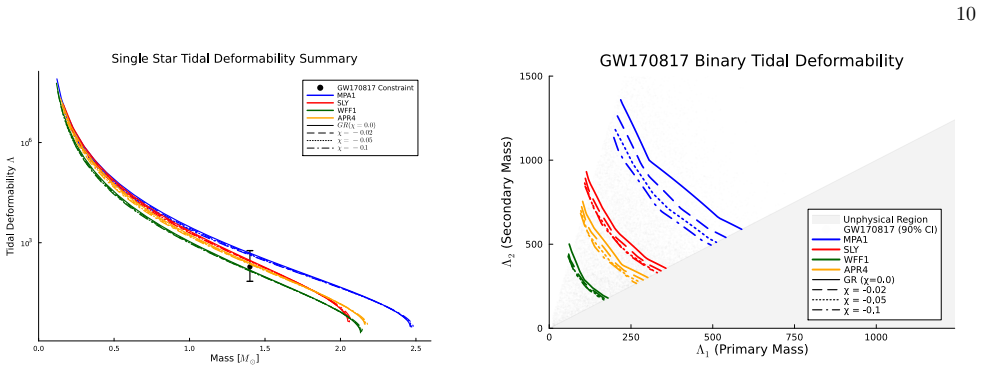
Astrophysical Constraints Observational constraints are data driven. Viable configurations must satisfy a maximum mass compatible with heavy-pulsar measurements [1–4], radii consistent 6 with NICER and GW170817 inferences [5–8, 37], and the GW170817 tidal constraint [37]: Mmax ≳2M ⊙,(55) R1.4 ∼11-14 km,(56) Λ1.4 ≈190 +390 −120.(57) In practice, multimesse...
work page 2014
- [4]
-
[5]
J. Antoniadis, P. C. C. Freire, N. Wex, T. M. Tauris, R. S. Lynch, M. H. van Kerkwijk, M. Kramer, C. Bassa, V. S. Dhillon, T. Driebe, J. W. T. Hessels, V. M. Kaspi, V. I. Kondratiev, N. Langer, T. R. Marsh, M. A. McLaughlin, T. T. Pennucci, S. M. Ransom, I. H. Stairs, J. van Leeuwen, J. P. W. Verbiest, and D. G. Whelan, Science 340, 6131 (2013), 1304.6875
-
[6]
H. T. Cromartie, E. Fonseca, S. M. Ransom, P. B. Demorest, Z. Arzoumanian, H. Blumer, P. R. Brook, S. Burke-Spolaor, S. J. Chamberlin, S. Chatterjee, J. M. Cordes, R. D. Ferdman, W. Fiore, N. Garver-Daniels, P. A. Gentile, J. W. T. Hessels, G. Jones, M. T. Lam, D. R. Lorimer, R. S. Lynch, M. A. McLaughlin, T. T. Pennucci, I. H. Stairs, K. Stovall, J. Swig...
-
[7]
Fonseca et al.,Refined Mass and Geometric Measurements of the High-mass PSR J0740+6620, Astrophys
E. Fonseca, H. T. Cromartie, T. T. Pennucci, P. S. Ray, A. Y. Kirichenko, S. M. Ransom, P. B. Demorest, I. H. Stairs, Z. Arzoumanian, H. Blumer, P. R. Brook, S. Burke-Spolaor, S. Chatterjee, J. M. Cordes, T. Enoto, W. Fiore, P. A. Gentile, D. C. Good, J. L. Han, J. W. T. Hessels, R. J. Jennings, G. Jones, M. T. Lam, T. J. W. Lazio, D. R. Lorimer, R. S. Ly...
-
[8]
T. E. Riley, A. L. Watts, S. Bogdanov, P. S. Ray, R. M. Ludlam, S. Guillot, Z. Arzoumanian, C. L. Baker, A. V. Bilous, D. Chakrabarty, K. C. Gendreau, A. K. Harding, W. C. G. Ho, J. M. Lattimer, S. M. Morsink, and T. E. Strohmayer, The Astrophysical Journal887, L21 (2019), 1912.05702
-
[9]
M. C. Miller, F. K. Lamb, A. J. Dittmann, S. Bogdanov, Z. Arzoumanian, K. C. Gendreau, S. Guillot, A. K. Harding, W. C. G. Ho, J. M. Lattimer, R. M. Ludlam, S. Mahmoodifar, S. M. Morsink, P. S. Ray, T. E. Strohmayer, K. S. Wood, T. Enoto, R. Foster, T. Okajima, G. Prigozhin, and Y. Soong, The Astrophysical Journal887, L24 (2019), 1912.05705
-
[10]
T. E. Riley, A. L. Watts, P. S. Ray, S. Bogdanov, S. Guillot, S. M. Morsink, A. V. Bilous, Z. Arzoumanian, D. Choudhury, J. S. Deneva, K. C. Gendreau, A. K. Harding, W. C. G. Ho, J. M. Lattimer, M. Loewenstein, R. M. Ludlam, C. B. Markwardt, T. Okajima, C. Prescod-Weinstein, R. A. Remillard, M. T. Wolff, E. Fonseca, H. T. Cromartie, M. Kerr, T. T. Pennucc...
-
[11]
M. C. Miller, F. K. Lamb, A. J. Dittmann, S. Bogdanov, Z. Arzoumanian, K. C. Gendreau, S. Guillot, W. C. G. Ho, J. M. Lattimer, M. Loewenstein, S. M. Morsink, P. S. Ray, M. T. Wolff, C. L. Baker, T. Cazeau, S. Manthripragada, C. B. Markwardt, T. Okajima, 12 S. Pollard, I. Cognard, H. T. Cromartie, E. Fonseca, L. Guillemot, M. Kerr, A. Parthasarathy, T. T....
-
[12]
GW170817: Observation of Gravitational Waves from a Binary Neutron Star Inspiral
B. Abbott, R. Abbott, T. D. Abbott,et al.(LIGO Scientific, Virgo), Phys. Rev. Lett.119, 161101 (2017), 1710.05832
work page internal anchor Pith review Pith/arXiv arXiv 2017
-
[13]
T. P. Sotiriou and V. Faraoni, Reviews of Modern Physics 82, 451 (2010), 0805.1726
work page Pith review arXiv 2010
-
[14]
Relativ.13 3 [arXiv:1002.4928]
A. De Felice and S. Tsujikawa, Living Reviews in Relativity13, 3 (2010), 1002.4928
-
[15]
Unified cosmic history in modified gravity: from F(R) theory to Lorentz non-invariant models,
S. Nojiri and S. D. Odintsov, Physics Reports505, 59 (2011), 1011.0544
- [16]
- [17]
-
[18]
S. Capozziello, M. De Laurentis, R. Farinelli, and S. D. Odintsov, Phys. Rev. D93, 023501 (2016), 1509.04163
- [19]
- [20]
- [21]
- [22]
- [23]
- [24]
-
[25]
Chakraborty, General Relativity and Gravitation45, 2039 (2013), 1212.3050
S. Chakraborty, General Relativity and Gravitation45, 2039 (2013), 1212.3050
- [26]
- [27]
- [28]
- [29]
-
[30]
P. Bedaque and A. W. Steiner, Physical Review Letters 114, 031103 (2015), 1408.5116
-
[31]
S. Altiparmak, C. Ecker, and L. Rezzolla, Astrophys. J. Lett.939, L34 (2022), 2203.14974
- [32]
-
[33]
M. Minamitsuji and H. O. Silva, Physical Review D93, 124041 (2016), 1604.07742
- [34]
-
[35]
D. D. Donevaet al., Physical Review D108, 044054 (2023)
work page 2023
- [36]
- [37]
-
[38]
R. C. Tolman, Physical Review55, 364 (1939)
work page 1939
-
[39]
J. R. Oppenheimer and G. M. Volkoff, Physical Review 55, 374 (1939)
work page 1939
-
[40]
The LIGO Scientific Collaboration and the Virgo Collaboration, Physical Review Letters121, 161101 (2018), 1805.11581
work page Pith review arXiv 2018
-
[41]
Lindblom, The Astrophysical Journal398, 569 (1992)
L. Lindblom, The Astrophysical Journal398, 569 (1992)
work page 1992
-
[42]
Lindblom, Physical Review D82, 103011 (2010), 1009.0738
L. Lindblom, Physical Review D82, 103011 (2010), 1009.0738
-
[43]
Tidal Love numbers of neutron stars
T. Hinderer, The Astrophysical Journal677, 1216 (2008), 0711.2420
work page Pith review arXiv 2008
-
[44]
T. Hinderer, B. D. Lackey, R. N. Lang, and J. S. Read, Physical Review D81, 123016 (2010), 0911.3535
-
[45]
S. Postnikov, M. Prakash, and J. M. Lattimer, Physical Review D82, 024016 (2010), 1004.5098
-
[46]
T. Binnington and E. Poisson, Physical Review D80, 084018 (2009), 0906.1366
- [47]
- [48]
- [49]
- [50]
discussion (0)
Sign in with ORCID, Apple, or X to comment. Anyone can read and Pith papers without signing in.