Recognition: 2 theorem links
· Lean TheoremMem-W: Latent Memory-Native GUI Agents
Pith reviewed 2026-05-12 04:21 UTC · model grok-4.3
The pith
GUI agents improve long-horizon navigation by compressing trajectories into latent memory tokens woven directly into their embedding sequence.
A machine-rendered reading of the paper's core claim, the machinery that carries it, and where it could break.
Core claim
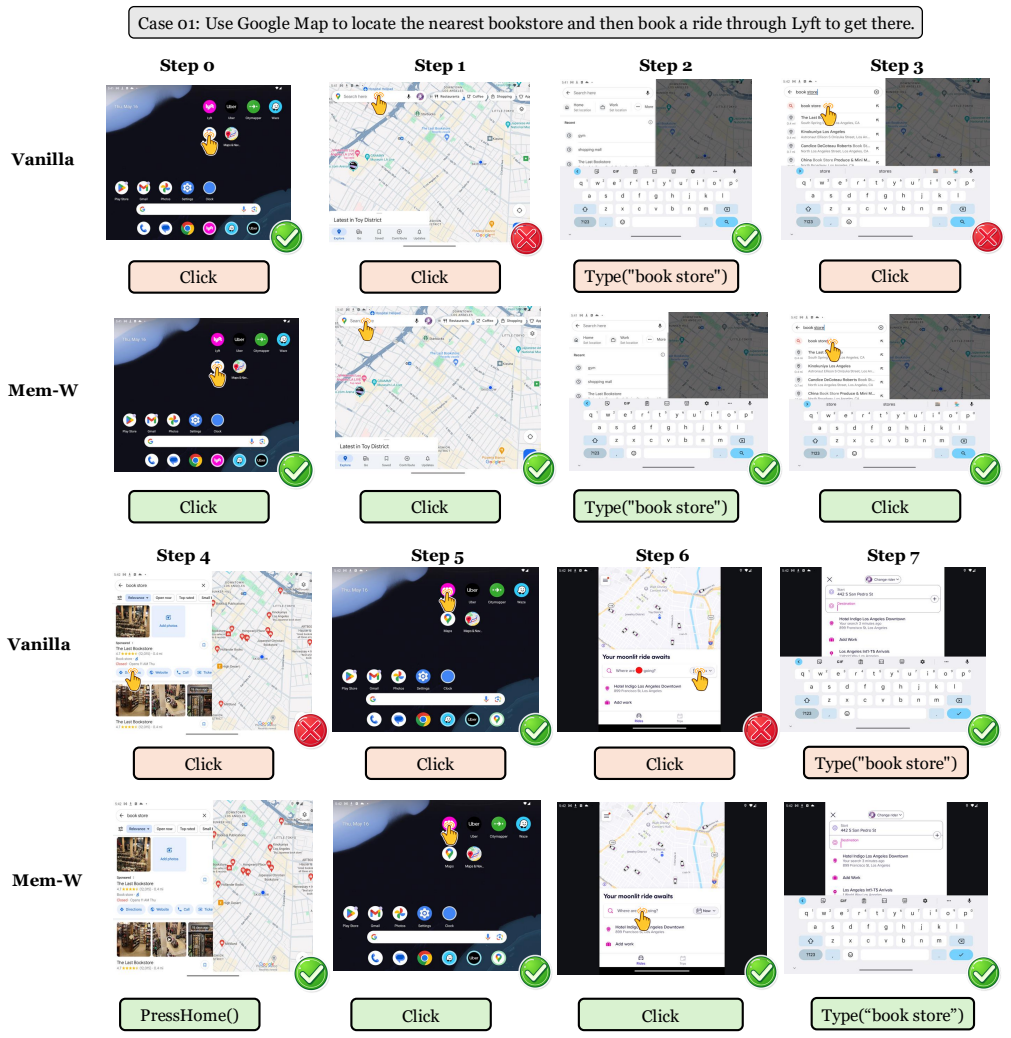
Mem-W is a series of GUI agents that integrate memory as part of the continuous latent context by using a shared trajectory-to-latent compressor to convert historical trajectories and in-session segments into memory tokens. These tokens are combined with the current GUI observation and local context into a single embedding sequence that the policy processes directly. The agents are trained with self-distillation and outcome-aware supervision to preserve decision-relevant state while filtering noise. On four web and mobile navigation benchmarks the approach yields consistent gains across diverse backbones and memory-enhanced baselines, reaching improvements of up to 30 points.
What carries the argument
The shared trajectory-to-latent compressor that produces compact memory tokens from experiential and working memory and weaves them into the agent's continuous embedding sequence.
If this is right
- Mem-W raises performance on web and mobile navigation benchmarks for multiple agent backbones and existing memory methods.
- Gains reach up to 30 points when memory is handled as native latent tokens rather than external records.
- The agent can read past successes, failures, and unfinished progress through the same machine-native embedding interface.
- Latent-context-native memory provides a scalable route to longer-horizon GUI control without symbolic memory layers.
Where Pith is reading between the lines
- The method may reduce the need for separate retrieval or summarization modules in agent designs.
- Outcome-aware compression could transfer to other long-sequence decision domains such as robotic manipulation or multi-turn dialogue.
- The same compressor architecture might support incremental memory growth without retraining the full policy from scratch.
- If the tokens remain compact across very long histories, the approach could enable agents to operate over sessions spanning hundreds of steps.
Load-bearing premise
The shared compressor together with self-distillation and outcome-aware supervision can reliably keep decision-relevant information from past trajectories while removing noise.
What would settle it
An ablation on the four navigation benchmarks in which removing the latent memory tokens or the outcome-aware supervision produces no gain or a performance drop relative to the non-Mem-W baselines would show the central claim does not hold.
Figures




read the original abstract
GUI agents are beginning to operate the web, mobile, and desktop as interactive worlds, where successful control depends on carrying forward visual, procedural, and task-level evidence beyond the fleeting present screen. Yet most agents still treat memory as an external, human-readable artifact: histories are summarized, categorized, retrieved, and reinserted as text or structured records before being encoded again by the policy. This creates a mismatch between the representational form in which experience is stored and the latent embedding sequence over which modern GUI policies actually act. We introduce Mem-W, a series of latent-memory-native GUI agents that treat memory as part of the agent's continuous context rather than as an auxiliary symbolic scaffold. Mem-W weaves both historical trajectories (as experiential memory) and in-session segments (as working memory) into compact memory tokens through a shared trajectory-to-latent compressor. These tokens are woven with the current GUI observation and local context into one continuous embedding sequence, allowing the agent to read successes, failures, and unfinished progress through the same machine-native interface. Mem-W is trained with self-distillation and outcome-aware supervision to preserve decision-relevant state while filtering memory toward evidence that truly supports task success. Across four web and mobile navigation benchmarks, Mem-W consistently improves diverse backbones and memory-enhanced baselines, with gains of up to $+30.0$, suggesting that latent-context-native memory can serve as a scalable foundation for long-horizon GUI agency.
Editorial analysis
A structured set of objections, weighed in public.
Referee Report
Summary. The manuscript introduces Mem-W, a family of GUI agents that treat memory as native latent context tokens rather than external symbolic artifacts. A shared trajectory-to-latent compressor encodes both historical trajectories (experiential memory) and in-session segments (working memory) into compact continuous tokens; these are concatenated with the current GUI observation and local context to form a single embedding sequence. Training combines self-distillation with outcome-aware supervision to retain decision-relevant state while suppressing noise. Experiments across four web and mobile navigation benchmarks report consistent gains over diverse backbones and prior memory-enhanced baselines, reaching up to +30.0 points.
Significance. If the reported gains are robust, the work offers a principled alternative to symbolic memory pipelines for long-horizon GUI agents by aligning memory representation with the latent interface used by modern policies. The consistent improvements across backbones, together with the provision of architecture diagrams, training objectives, ablation tables, and memory-token probing results, constitute a concrete, falsifiable advance that could serve as a foundation for scalable latent-memory designs.
major comments (2)
- [§4.3, Table 2] §4.3 and Table 2: the largest reported gain (+30.0) is shown only for a single backbone on one benchmark; without per-seed standard deviations or a statistical test against the strongest memory-enhanced baseline, it is difficult to judge whether the improvement is reliable or driven by a favorable seed.
- [§3.2, Eq. (3)] §3.2, Eq. (3): the outcome-aware supervision term weights tokens by task success, yet the paper does not report an ablation that isolates this term from plain self-distillation; the central claim that the compressor 'filters noise while preserving decision-relevant state' therefore rests on an unseparated training objective.
minor comments (3)
- [Abstract] The abstract states performance gains but omits any mention of the number of runs, statistical tests, or exact baseline definitions; a one-sentence clarification would improve readability.
- [Figure 1] Notation for memory tokens (M) and working-memory tokens (W) is introduced without an explicit legend in Figure 1; adding a short caption note would prevent reader confusion.
- [§2] The related-work section cites several symbolic memory agents but does not discuss recent latent-memory or context-compression methods from the LLM literature; a brief paragraph would strengthen positioning.
Simulated Author's Rebuttal
We thank the referee for the constructive feedback and the positive overall assessment of our work on latent-memory-native GUI agents. We address each major comment below and outline the revisions we will make to strengthen the manuscript.
read point-by-point responses
-
Referee: [§4.3, Table 2] §4.3 and Table 2: the largest reported gain (+30.0) is shown only for a single backbone on one benchmark; without per-seed standard deviations or a statistical test against the strongest memory-enhanced baseline, it is difficult to judge whether the improvement is reliable or driven by a favorable seed.
Authors: We agree that the peak gain of +30.0 is reported for one backbone-benchmark pair and that additional statistical detail would improve interpretability. Table 2 already shows consistent gains across four benchmarks and multiple backbones, but we did not include per-seed standard deviations or formal statistical tests in the original submission. In the revised manuscript we will add per-seed standard deviations for all primary results and include a statistical comparison (paired t-test) against the strongest memory-enhanced baseline to quantify reliability. revision: yes
-
Referee: [§3.2, Eq. (3)] §3.2, Eq. (3): the outcome-aware supervision term weights tokens by task success, yet the paper does not report an ablation that isolates this term from plain self-distillation; the central claim that the compressor 'filters noise while preserving decision-relevant state' therefore rests on an unseparated training objective.
Authors: We appreciate this observation. The outcome-aware term is motivated by the desire to emphasize decision-relevant tokens from successful trajectories, yet the manuscript does not isolate its contribution from self-distillation alone. To directly address the concern, we will add an ablation study in the revised version that trains the compressor with self-distillation only versus the full objective and reports the resulting differences in downstream agent performance and memory-token quality metrics. revision: yes
Circularity Check
No significant circularity detected
full rationale
The paper presents Mem-W as an architectural innovation that integrates historical trajectories and in-session segments into continuous latent memory tokens via a shared compressor, trained with self-distillation and outcome-aware supervision. Its central claims rest on empirical performance gains across four independent web and mobile navigation benchmarks rather than any mathematical derivation, fitted parameter renamed as prediction, or self-referential definition. No equations, uniqueness theorems, or load-bearing self-citations are invoked that would reduce the reported results to the inputs by construction; the method is offered as a design choice whose value is measured externally.
Axiom & Free-Parameter Ledger
invented entities (1)
-
memory tokens
no independent evidence
Lean theorems connected to this paper
-
IndisputableMonolith/Foundation/RealityFromDistinction.leanreality_from_one_distinction unclearMem-W weaves both historical trajectories (as experiential memory) and in-session segments (as working memory) into compact memory tokens through a shared trajectory-to-latent compressor... trained with self-distillation and outcome-aware supervision
-
IndisputableMonolith/Cost/FunctionalEquation.leanwashburn_uniqueness_aczel unclearThe compressor... projects both retrieved historical trajectories and online episode prefixes into a unified latent space
Reference graph
Works this paper leans on
-
[1]
URL https://arxiv.org/abs/2402.14740. Shuai Bai, Yuxuan Cai, Ruizhe Chen, Keqin Chen, Xionghui Chen, Zesen Cheng, Lianghao Deng, Wei Ding, Chang Gao, Chunjiang Ge, Wenbin Ge, Zhifang Guo, Qidong Huang, Jie Huang, Fei Huang, Binyuan Hui, Shutong Jiang, Zhaohai Li, Mingsheng Li, Mei Li, Kaixin Li, Zicheng Lin, Junyang Lin, Xuejing Liu, Jiawei Liu, Chenglong...
work page internal anchor Pith review arXiv 2025
-
[2]
Weihua Cheng, Junming Liu, Yifei Sun, Botian Shi, Yirong Chen, and Ding Wang
URL https://arxiv.org/abs/2505.16782. Weihua Cheng, Junming Liu, Yifei Sun, Botian Shi, Yirong Chen, and Ding Wang. Mga: Memory-driven gui agent for observation-centric interaction, 2026. URL https://arxiv.org/abs/2510.24168. Xiang Deng, Yu Gu, Boyuan Zheng, Shijie Chen, Sam Stevens, Boshi Wang, Huan Sun, and Yu Su. Mind2web: Towards a generalist agent fo...
-
[3]
URL https://arxiv.org/abs/2507.01006. Yu Wang, Dmitry Krotov, Yuanzhe Hu, Yifan Gao, Wangchunshu Zhou, Julian McAuley, Dan Gutfreund, Rogerio Feris, and Zexue He. M+: Extending memoryllm with scalable long-term memory, 2025a. URL https://arxiv.org/ abs/2502.00592. Yu Wang, Xinshuang Liu, Xiusi Chen, Sean O’Brien, Junda Wu, and Julian McAuley. Self-updatab...
work page internal anchor Pith review Pith/arXiv arXiv 2024
-
[4]
Analyze the current state of the page, including numerical labels on web elements
-
[5]
Think through what needs to be done
-
[6]
Determine the appropriate action to take
-
[7]
Output the action in structured JSON format that can be parsed directly. WORKFLOW GUIDELINES: - If your previous action is type, then you must click related pages or scroll pages to find the information you need. - When you need to search for information, directly type your search query, then click the search button. - After clicking an element, if you ne...
-
[8]
To input text, no need to click the textbox first. Directly type the content. After typing, the system automatically hits the ENTER key
-
[9]
Do not type content into a button
Distinguish between textboxes and search buttons. Do not type content into a button
-
[10]
Execute only one action per iteration
-
[11]
Strictly avoid repeating the same action if the webpage remains unchanged
-
[12]
For complex tasks involving multiple questions or steps, select "stop" only at the very end
-
[13]
Make sure all task requirements are satisfied before stopping. WEB BROWSING GUIDELINES:
-
[14]
Do not interact with useless web elements such as Login, Sign-in, or donation buttons
-
[15]
Visiting video websites is allowed, but the agent should not play videos
-
[16]
Pay attention to filter and sorting functions, which can help solve conditions such as highest, cheapest, lowest, or earliest
-
[17]
EXAMPLE WORKFLOW: {experience_memory} 24 Available actions: {tools_section} CRITICAL REQUIREMENTS:
Pay attention to images and visual elements on the page. EXAMPLE WORKFLOW: {experience_memory} 24 Available actions: {tools_section} CRITICAL REQUIREMENTS:
-
[18]
Never describe actions in plain text
Always use function calling. Never describe actions in plain text
-
[19]
Provide clear reasoning in the reasoning parameter of each function call
-
[20]
Be specific in descriptions to identify the correct elements
-
[21]
Use proper JSON format for all function arguments
-
[22]
Only execute one action at a time
-
[23]
If an action fails, try a different approach or element
-
[24]
For click and type actions, set a valid element_id corresponding to the numerical label of the target item
-
[25]
For click and type actions, set valid coordinates in the format "<point>x1 y1</point>"
-
[26]
Use simple search terms when searching for information
-
[27]
If the current page has no results, adjust the search term and try again. CURRENT WEBPAGE OBSERVATION: [Current webpage screenshot is provided as an image input.] [Generated page description:] {page_description} FINAL PER-STEP TASK REMINDER: **Current task:** {current_task} IMPORTANT REMINDERS: - Please specify the number label of the item you want to int...
discussion (0)
Sign in with ORCID, Apple, or X to comment. Anyone can read and Pith papers without signing in.