Recognition: 2 theorem links
· Lean TheoremRAwR: Role-Aware Rewiring via Approximate Equitable Partition
Pith reviewed 2026-05-12 04:30 UTC · model grok-4.3
The pith
RAwR rewires input graphs with quotient graphs from approximate equitable partitions so nodes of identical structural role exchange signals directly.
A machine-rendered reading of the paper's core claim, the machinery that carries it, and where it could break.
Core claim
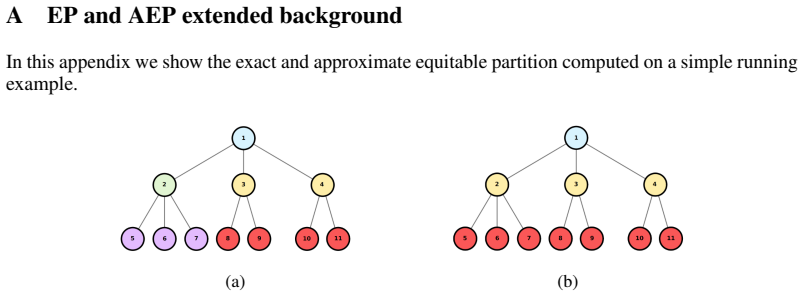
RAwR augments any input graph by the quotient graph of an approximate equitable partition obtained from Weisfeiler-Leman coloring; nodes that receive the same color thereby become directly connected, accelerating message passing between structurally equivalent vertices and reducing the graph's effective resistance. Because the partition can be coarsened at will, the method recovers conventional master-node rewiring as a special case. An exact analysis of linear GNNs in a teacher-student setting shows that the lift in spectral signal propagation is governed by the chosen partition and yields the Spectral Role Lift metric for selecting the partition that maximises downstream accuracy.
What carries the argument
Approximate equitable partition obtained from Weisfeiler-Leman coloring, used to construct the quotient graph that is added to the original adjacency matrix for rewiring.
If this is right
- Message passing between structurally equivalent nodes becomes a single hop instead of a path that must traverse bottlenecks.
- The total effective resistance of the augmented graph is strictly smaller than that of the input graph.
- The same rewiring procedure yields competitive or state-of-the-art accuracy on homophilic, heterophilic and synthetic long-range datasets.
- The Spectral Role Lift score can be computed once per graph to choose the partition granularity that maximises expected predictive gain.
Where Pith is reading between the lines
- If structural-role equivalence reliably proxies task-relevant similarity, the same construction could be applied to any message-passing architecture beyond GNNs.
- One could measure whether the reduction in effective resistance achieved by RAwR correlates with the size of the longest shortest path that must be traversed by label information.
- The controllable coarsening parameter offers a knob that might be tuned per layer or per task rather than once per graph.
- The approach suggests that explicit role discovery may be more sample-efficient than learning long-range dependencies purely through deeper or more expressive layers.
Load-bearing premise
Nodes that receive identical colors under Weisfeiler-Leman coloring are exactly the nodes whose direct connection will most improve accuracy on the downstream prediction task.
What would settle it
A long-range node-classification benchmark on which the rewiring level that maximises the Spectral Role Lift metric fails to produce the highest accuracy, or on which any role-matched quotient edges degrade performance relative to the unmodified graph.
Figures


read the original abstract
While Graph Neural Networks (GNNs) have demonstrated significant efficacy in node classification tasks, where predictions rely on local neighborhood information, the performance of GNNs often drops when prediction tasks depend on long-range interactions. These limitations are attributed to phenomena such as oversquashing, where structural bottlenecks restrict signal propagation across the network topology. To address this challenge, we introduce RAwR, a computationally efficient rewiring framework that augments the input graph with a quotient graph derived from equitable partitions. This approach facilitates accelerated communication between nodes that share identical structural roles, as identified by the Weisfeiler-Leman graph coloring, and thereby reduces the total effective resistance of the system. Furthermore, by employing an approximate definition of the equitable partition, RAwR enables a controllable reduction of the quotient graph, which, in its most condensed state, recovers the conventional Master Node rewiring technique. Empirical evaluations across a diverse suite of benchmarks -- including homophilic, heterophilic, and synthetic long-range datasets -- demonstrate that RAwR achieves state-of-the-art results. Our contribution is further supported by an analytical investigation using a teacher-student model of linear GNNs, which elucidates the theoretical foundations of role-based rewiring. This analysis leads to the formulation of Spectral Role Lift (SRL), a metric designed to identify the optimal approximate equitable partition for maximizing predictive performance.
Editorial analysis
A structured set of objections, weighed in public.
Referee Report
Summary. The paper proposes RAwR, a rewiring method that augments input graphs with a quotient graph derived from approximate equitable partitions (via Weisfeiler-Leman coloring) to connect nodes sharing structural roles, thereby reducing effective resistance and improving long-range signal flow in GNNs for node classification. It recovers master-node rewiring in the fully condensed case, introduces the Spectral Role Lift (SRL) metric from a linear teacher-student GNN analysis to select the optimal approximation level, and reports SOTA empirical results on homophilic, heterophilic, and synthetic long-range benchmarks.
Significance. If the structural-role premise holds beyond the linear setting, RAwR would offer an efficient, controllable alternative to existing rewiring techniques for mitigating oversquashing, with the linear analysis providing a clean derivation of the SRL selection criterion and the method's generalization of master-node augmentation as a strength.
major comments (2)
- [Theoretical Foundations / Abstract] Abstract and Theoretical Foundations: the optimality claim for equitable-partition rewiring rests on the teacher-student linear GNN model that derives SRL, yet all reported experiments deploy nonlinear GNNs; the manuscript must demonstrate (or bound) whether the alignment between WL-derived role classes and task-optimal long-range edges survives nonlinearity and feature-label misalignment, as this is load-bearing for both the SOTA claim and the theoretical grounding.
- [Empirical Evaluation] Empirical Evaluation section: the SOTA results are presented without explicit confirmation that hyperparameter search, data splits, and baseline implementations were fixed before seeing test performance; given the free parameter (approximation level) and the SRL metric derived from the same modeling assumptions, an ablation showing that SRL-selected partitions outperform random or degree-based alternatives on the nonlinear models is required to substantiate the central claim.
minor comments (2)
- [Method] Notation for the approximate equitable partition and the quotient-graph construction should be introduced with a small illustrative example (e.g., a 4-node path graph) to clarify how the controllable reduction works.
- [Method] The effective-resistance reduction argument is stated qualitatively; a short lemma relating the added quotient edges to the change in total effective resistance (even under the linear approximation) would strengthen the motivation.
Simulated Author's Rebuttal
We thank the referee for their constructive comments on our manuscript. We address each major comment below with point-by-point responses and indicate the revisions we will make to strengthen the paper.
read point-by-point responses
-
Referee: Abstract and Theoretical Foundations: the optimality claim for equitable-partition rewiring rests on the teacher-student linear GNN model that derives SRL, yet all reported experiments deploy nonlinear GNNs; the manuscript must demonstrate (or bound) whether the alignment between WL-derived role classes and task-optimal long-range edges survives nonlinearity and feature-label misalignment, as this is load-bearing for both the SOTA claim and the theoretical grounding.
Authors: We agree that the derivation of SRL and the optimality analysis are performed under the linear teacher-student GNN model. The role classes are obtained from the Weisfeiler-Leman coloring of the graph structure, which is independent of model nonlinearity and feature-label alignment. In the linear setting we prove that role-based augmentation reduces effective resistance and improves long-range propagation. For nonlinear GNNs the same structural augmentation empirically yields consistent gains across homophilic, heterophilic, and long-range benchmarks, indicating that the benefit is not confined to the linear case. We will revise the manuscript to include an expanded discussion of this generalization, together with a new experiment that applies the identical SRL selection procedure to linear GNNs on the same datasets, thereby bridging the theoretical and empirical regimes. A rigorous bound that holds for arbitrary nonlinear activations and arbitrary feature-label misalignment would require substantial additional theoretical development that lies outside the present scope. revision: partial
-
Referee: Empirical Evaluation section: the SOTA results are presented without explicit confirmation that hyperparameter search, data splits, and baseline implementations were fixed before seeing test performance; given the free parameter (approximation level) and the SRL metric derived from the same modeling assumptions, an ablation showing that SRL-selected partitions outperform random or degree-based alternatives on the nonlinear models is required to substantiate the central claim.
Authors: All hyperparameter grids, data splits, and baseline code were finalized before any test-set evaluation, consistent with standard practice. We will add an explicit statement to this effect in the revised Experimental Evaluation section. In addition, we will include a new ablation study that compares SRL-selected approximation levels against both random partition selections and degree-based rewiring baselines, all evaluated with the same nonlinear GNN architectures on the reported benchmarks. This ablation will directly demonstrate that the SRL-guided choice remains advantageous even when the downstream model is nonlinear. revision: yes
- A rigorous theoretical bound establishing that WL-derived role alignment remains optimal for arbitrary nonlinear GNNs and arbitrary feature-label misalignment
Circularity Check
No significant circularity in derivation chain
full rationale
The paper motivates RAwR via equitable partitions from Weisfeiler-Leman coloring and supports the approach with an analytical teacher-student model of linear GNNs that yields the SRL metric for selecting the approximation level. This theoretical step elucidates why role-based rewiring can reduce effective resistance and improve signal flow within the linear model, but the metric is a derived heuristic rather than a self-referential fit or redefinition of the target performance. Empirical SOTA results are reported independently on external homophilic, heterophilic, and synthetic long-range benchmarks using standard (nonlinear) GNNs, providing falsifiable validation outside the linear teacher-student setting. No load-bearing step reduces by construction to its own inputs, self-citations, or fitted parameters; the central claims remain self-contained against the reported experiments.
Axiom & Free-Parameter Ledger
free parameters (1)
- approximation level for equitable partition
axioms (1)
- domain assumption Nodes with the same Weisfeiler-Leman color share structural roles that are relevant for the downstream node-classification task
invented entities (1)
-
Spectral Role Lift (SRL)
no independent evidence
Lean theorems connected to this paper
-
IndisputableMonolith/Foundation/AbsoluteFloorClosure.leanabsolute_floor_iff_bare_distinguishability unclear?
unclearRelation between the paper passage and the cited Recognition theorem.
RAwR augments the input graph with a quotient graph derived from equitable partitions... Spectral Role Lift (SRL)
-
IndisputableMonolith/Cost/FunctionalEquation.leanwashburn_uniqueness_aczel unclear?
unclearRelation between the paper passage and the cited Recognition theorem.
reduces the total effective resistance of the system
What do these tags mean?
- matches
- The paper's claim is directly supported by a theorem in the formal canon.
- supports
- The theorem supports part of the paper's argument, but the paper may add assumptions or extra steps.
- extends
- The paper goes beyond the formal theorem; the theorem is a base layer rather than the whole result.
- uses
- The paper appears to rely on the theorem as machinery.
- contradicts
- The paper's claim conflicts with a theorem or certificate in the canon.
- unclear
- Pith found a possible connection, but the passage is too broad, indirect, or ambiguous to say the theorem truly supports the claim.
Reference graph
Works this paper leans on
-
[1]
Journal of Complex Networks , volume =
Peel, Leto , title =. Journal of Complex Networks , volume =. 2014 , month =. doi:10.1093/comnet/cnu043 , url =
-
[2]
International Conference on Learning Representations (ICLR) , year=
On the bottleneck of graph neural networks and its practical implications , author=. International Conference on Learning Representations (ICLR) , year=
-
[3]
IEEE transactions on neural networks , volume=
The graph neural network model , author=. IEEE transactions on neural networks , volume=. 2008 , publisher=
work page 2008
-
[4]
Convergence of gradient based training for linear Graph Neural Networks , author=. 2025 , eprint=
work page 2025
-
[5]
Kipf, Thomas N. and Welling, Max , title =. International Conference on Learning Representations (ICLR) , year =
-
[6]
Graph Attention Networks , booktitle =
-
[7]
International Conference on Learning Representations (ICLR) , year =
Xu, Keyulu and Hu, Weihua and Leskovec, Jure and Jegelka, Stefanie , title =. International Conference on Learning Representations (ICLR) , year =
-
[8]
Zhou, Jie and Cui, Ganqu and Hu, Shengding and Zhang, Zhengyan and Yang, Cheng and Liu, Zhiyuan and Wang, Lifeng and Li, Changcheng and Sun, Maosong , title =. AI Open , volume =
-
[9]
Gilmer, Justin and Schoenholz, Samuel S. and Riley, Patrick F. and Vinyals, Oriol and Dahl, George E. , title =. Proceedings of the 34th International Conference on Machine Learning (ICML) , pages =
-
[10]
International Conference on Learning Representations (ICLR) , year =
Oono, Kenta and Suzuki, Taiji , title =. International Conference on Learning Representations (ICLR) , year =
-
[11]
Konstantin and Bronstein, Michael M
Rusch, T. Konstantin and Bronstein, Michael M. and Mishra, Siddhartha , title =. 2023 , note =
work page 2023
-
[12]
2022 IEEE International Conference on Data Mining (ICDM) , pages =
Yan, Yujun and Hashemi, Milad and Swersky, Kevin and Yang, Yaoqing and Koutra, Danai , title =. 2022 IEEE International Conference on Data Mining (ICDM) , pages =
work page 2022
-
[13]
International Conference on Learning Representations (ICLR) , year =
Zhao, Lingxiao and Akoglu, Leman , title =. International Conference on Learning Representations (ICLR) , year =
-
[14]
and Dong, Xiaowen and Bronstein, Michael M
Topping, James and Di Giovanni, Filippo and Chamberlain, Benjamin P. and Dong, Xiaowen and Bronstein, Michael M. , title =. International Conference on Learning Representations (ICLR) , year =
-
[15]
Proceedings of the 40th International Conference on Machine Learning (ICML) , series =
Black, Mitchell and Wan, Zhengchao and Nayyeri, Amir and Wang, Yusu , title =. Proceedings of the 40th International Conference on Machine Learning (ICML) , series =
-
[16]
IEEE Transactions on Knowledge and Data Engineering , volume =
Bi, Wendong and Du, Lun and Fu, Qiang and Wang, Yanlin and Han, Shi and Zhang, Dongmei , title =. IEEE Transactions on Knowledge and Data Engineering , volume =
-
[17]
Data Mining and Knowledge Discovery , volume =
Chan, Hau and Akoglu, Leman , title =. Data Mining and Knowledge Discovery , volume =
-
[18]
IEEE Transactions on Knowledge and Data Engineering , volume =
Freitas, Scott and Yang, Diyi and Kumar, Srijan and Tong, Hanghang and Chau, Duen Horng , title =. IEEE Transactions on Knowledge and Data Engineering , volume =
-
[19]
SIGKDD Explorations , volume =
Ding, Kaize and Xu, Zhe and Tong, Hanghang and Liu, Huan , title =. SIGKDD Explorations , volume =
- [20]
-
[21]
Proceedings of the 40th International Conference on Machine Learning (ICML) , series =
Cai, Chen and Hy, Truong Son and Yu, Rose and Wang, Yusu , title =. Proceedings of the 40th International Conference on Machine Learning (ICML) , series =
-
[22]
Attali, Hugo and Buscaldi, Davide and Pernelle, Nathalie , title =. 2024 , eprint =
work page 2024
-
[23]
Scholkemper, M. and Schaub, M. T. , title =. Advances in Neural Information Processing Systems (NeurIPS) , year =
-
[24]
Squillace, G. and Tribastone, M. and Tschaikowski, M. and Vandin, A. , title =. Applied Network Science , volume =
-
[25]
Squillace, G. and Tribastone, M. and Tschaikowski, M. and Vandin, A. , title =. Proceedings of the 2024 IEEE International Conference on Data Mining (ICDM) , year =
work page 2024
-
[26]
Scalable Network Embedding with Approximate Equitable Partitions , year=
Squillace, Giuseppe and Tribastone, Mirco and Tschaikowski, Max and Vandin, Andrea , journal=. Scalable Network Embedding with Approximate Equitable Partitions , year=
-
[27]
Tognazzi, S. and Tribastone, M. and Tschaikowski, M. and Vandin, A. , title =. Leveraging Applications of Formal Methods, Verification and Validation. Distributed Systems , series =
-
[28]
Salha, Guillaume and Limnios, Stratis and Hennequin, Renaud and Tran, Viet-Anh and Vazirgiannis, Michalis , title =. Proceedings of the 28th ACM International Conference on Information and Knowledge Management (CIKM) , pages =. 2019 , address =
work page 2019
-
[29]
Advances in Neural Information Processing Systems , volume =
Zhang, Muhan and Chen, Yixin , title =. Advances in Neural Information Processing Systems , volume =
- [30]
-
[31]
Journal of Systems and Software , volume =
Papadimitriou, Alexis and Symeonidis, Panagiotis and Manolopoulos, Yannis , title =. Journal of Systems and Software , volume =
-
[32]
Wang, Peng and Xu, Baowen and Wu, Yu and Zhou, Xiaoyu , title =. 2014 , eprint =
work page 2014
-
[33]
Neural Link Prediction with Walk Pooling , year =
Pan, Lihua and Shi, Chao and Dokmani. Neural Link Prediction with Walk Pooling , year =. 2110.04375 , archivePrefix=
- [34]
-
[35]
Yang, Zhilin and Ding, Ming and Zhou, Chuxu and Yang, Hongxia and Zhou, Jie and Tang, Jiawei , title =. Proceedings of the 26th ACM SIGKDD International Conference on Knowledge Discovery and Data Mining (KDD) , pages =
-
[36]
Geom-GCN: Geometric Graph Convolutional Networks , year =
Pei, Hongbin and Wei, Bingzhe and Chang, Kevin Chen. Geom-GCN: Geometric Graph Convolutional Networks , year =. 2002.05287 , archivePrefix=
-
[37]
Advances in Neural Information Processing Systems (NeurIPS) , year =
Qian, Chendi and Manolache, Andrei and Morris, Christopher and Niepert, Mathias , title =. Advances in Neural Information Processing Systems (NeurIPS) , year =
-
[38]
Graph and semigroup homomorphisms on networks of relations , author=. Social Networks , volume=. 1983 , publisher=
work page 1983
-
[39]
Sociological methodology , pages=
Notions of position in social network analysis , author=. Sociological methodology , pages=. 1992 , publisher=
work page 1992
-
[40]
The Journal of mathematical sociology , volume=
Structural equivalence of individuals in social networks , author=. The Journal of mathematical sociology , volume=. 1971 , publisher=
work page 1971
-
[41]
Linear Algebra and its Applications , volume=
Compact graphs and equitable partitions , author=. Linear Algebra and its Applications , volume=. 1997 , publisher=
work page 1997
-
[42]
Exact colorations of graphs and digraphs , author=. Social networks , volume=. 1996 , publisher=
work page 1996
-
[43]
Proceedings of the First Learning on Graphs Conference , pages =
Expander Graph Propagation , author =. Proceedings of the First Learning on Graphs Conference , pages =. 2022 , editor =
work page 2022
-
[44]
Proceedings of the Third Learning on Graphs Conference , pages =
Cayley Graph Propagation , author =. Proceedings of the Third Learning on Graphs Conference , pages =. 2025 , editor =
work page 2025
-
[45]
Weisfeiler and Lehman Go Cellular:
Bodnar, Cristian and Frasca, Fabrizio and Otter, Nina and Wang, Yuguang and Li. Weisfeiler and Lehman Go Cellular:. Advances in Neural Information Processing Systems , volume =
-
[46]
Weisfeiler and Lehman Go Topological: Message Passing Simplicial Networks , booktitle =
Bodnar, Cristian and Frasca, Fabrizio and Wang, Yuguang and Otter, Nina and Mont. Weisfeiler and Lehman Go Topological: Message Passing Simplicial Networks , booktitle =. 2021 , publisher =
work page 2021
-
[47]
Fey, Matthias and Yuen, Jan-Gin and Weichert, Frank , title =. 2020 , eprint =
work page 2020
-
[48]
Advances in Neural Information Processing Systems , volume =
Morris, Christopher and Rattan, Gaurav and Mutzel, Petra , title =. Advances in Neural Information Processing Systems , volume =
-
[49]
and Lenssen, Jan Eric and Rattan, Gaurav and Grohe, Martin , title =
Morris, Christopher and Ritzert, Martin and Fey, Matthias and Hamilton, William L. and Lenssen, Jan Eric and Rattan, Gaurav and Grohe, Martin , title =. Proceedings of the AAAI Conference on Artificial Intelligence , volume =
-
[50]
Stachenfeld, Kimberly and Godwin, Jonathan and Battaglia, Peter , title =. 2020 , eprint =
work page 2020
-
[51]
2-hop Neighbor Class Similarity (2NCS): A graph structural metric indicative of graph neural network performance , author=. 2022 , eprint=
work page 2022
-
[52]
Role Equivalence Attention for Label Propagation in Graph Neural Networks
Park, Hogun and Neville, Jennifer. Role Equivalence Attention for Label Propagation in Graph Neural Networks. Advances in Knowledge Discovery and Data Mining. 2020
work page 2020
-
[53]
Henderson, Keith and Gallagher, Brian and Eliassi-Rad, Tina and Tong, Hanghang and Basu, Sugato and Akoglu, Leman and Koutra, Danai and Faloutsos, Christos and Li, Lei , title =. Proceedings of the 18th ACM SIGKDD International Conference on Knowledge Discovery and Data Mining , pages =. 2012 , isbn =. doi:10.1145/2339530.2339723 , abstract =
-
[54]
Proceedings of the 31st ACM International Conference on Information & Knowledge Management , pages =
Cui, Hejie and Lu, Zijie and Li, Pan and Yang, Carl , title =. Proceedings of the 31st ACM International Conference on Information & Knowledge Management , pages =. 2022 , isbn =. doi:10.1145/3511808.3557661 , abstract =
-
[55]
Klaus Glashoff and Michael M. Bronstein , title =. CoRR , volume =. 2013 , url =. 1305.2135 , timestamp =
-
[56]
International Conference on Machine Learning , pages=
Revisiting over-smoothing and over-squashing using ollivier-ricci curvature , author=. International Conference on Machine Learning , pages=. 2023 , organization=
work page 2023
-
[57]
International Conference on Learning Representations , year=
FoSR: First-order spectral rewiring for addressing oversquashing in GNNs , author=. International Conference on Learning Representations , year=
-
[58]
The Thirteenth International Conference on Learning Representations , year=
Joint Graph Rewiring and Feature Denoising via Spectral Resonance , author=. The Thirteenth International Conference on Learning Representations , year=
-
[59]
Dynamic Triangulation-Based Graph Rewiring for Graph Neural Networks , author=. Proceedings of the 34th ACM International Conference on Information and Knowledge Management , pages=
-
[60]
Forty-first International Conference on Machine Learning , year=
Delaunay graph: Addressing over-squashing and over-smoothing using delaunay triangulation , author=. Forty-first International Conference on Machine Learning , year=
-
[61]
Celia Rubio-Madrigal and Adarsh Jamadandi and Rebekka Burkholz , booktitle=. 2025 , url=
work page 2025
-
[62]
Forty-second International Conference on Machine Learning Position Paper Track , year=
Position: Graph Learning Will Lose Relevance Due To Poor Benchmarks , author=. Forty-second International Conference on Machine Learning Position Paper Track , year=
-
[63]
Long Range Graph Benchmark , author=. Thirty-sixth Conference on Neural Information Processing Systems Datasets and Benchmarks Track , year=
-
[64]
The Fourteenth International Conference on Learning Representations , year=
Towards Quantifying Long-Range Interactions in Graph Machine Learning: a Large Graph Dataset and a Measurement , author=. The Fourteenth International Conference on Learning Representations , year=
-
[65]
The Fourteenth International Conference on Learning Representations , year=
Can You Hear Me Now? A Benchmark for Long-Range Graph Propagation , author=. The Fourteenth International Conference on Learning Representations , year=
- [66]
discussion (0)
Sign in with ORCID, Apple, or X to comment. Anyone can read and Pith papers without signing in.