Recognition: no theorem link
Proximal Path-Specific Inference
Pith reviewed 2026-05-12 05:05 UTC · model grok-4.3
The pith
Proximal confounding bridge functions enable four nonparametric strategies to identify path-specific effects despite unmeasured confounding.
A machine-rendered reading of the paper's core claim, the machinery that carries it, and where it could break.
Core claim
Using proximal confounding bridge functions, we develop four nonparametric identification strategies for the path-specific effect. We further derive the efficient influence function and propose a quadruply robust, locally efficient estimator that achieves sqrt(n)-consistency and asymptotic normality even when machine learning estimators for nuisance functions converge at slower rates.
What carries the argument
Proximal confounding bridge functions that link observed proxy variables to unmeasured confounders among treatment, recanting witness, mediator, and outcome, thereby enabling nonparametric identification of the path-specific effect.
If this is right
- The path-specific effect remains identified without requiring the usual no-unmeasured-confounding assumptions on the treatment, recanting witness, mediator, and outcome.
- The quadruply robust estimator protects against misspecification in up to three of the four nuisance functions while retaining local efficiency.
- The proximal debiased machine learning procedure permits high-dimensional nuisance estimation without sacrificing sqrt(n) consistency.
- The same framework applies directly to the CDC WONDER Natality data for estimating the effect of prenatal care on preterm birth through preeclampsia independent of maternal smoking.
Where Pith is reading between the lines
- The same bridge-function approach could be adapted to other longitudinal or survival mediation settings where recanting witnesses appear.
- If valid proxies are routinely collected in observational studies, path-specific estimates could become feasible in many fields that currently rely on stronger no-confounding assumptions.
- Methods for empirically checking or selecting among candidate bridge functions would strengthen practical use of these identification strategies.
Load-bearing premise
Valid proximal confounding bridge functions exist that accurately connect the observed proxies to the unmeasured confounding relationships.
What would settle it
A simulation or real-data analysis in which the bridge functions are misspecified while all other model assumptions hold, producing a biased path-specific effect estimate that fails to converge at the sqrt(n) rate.
Figures
read the original abstract
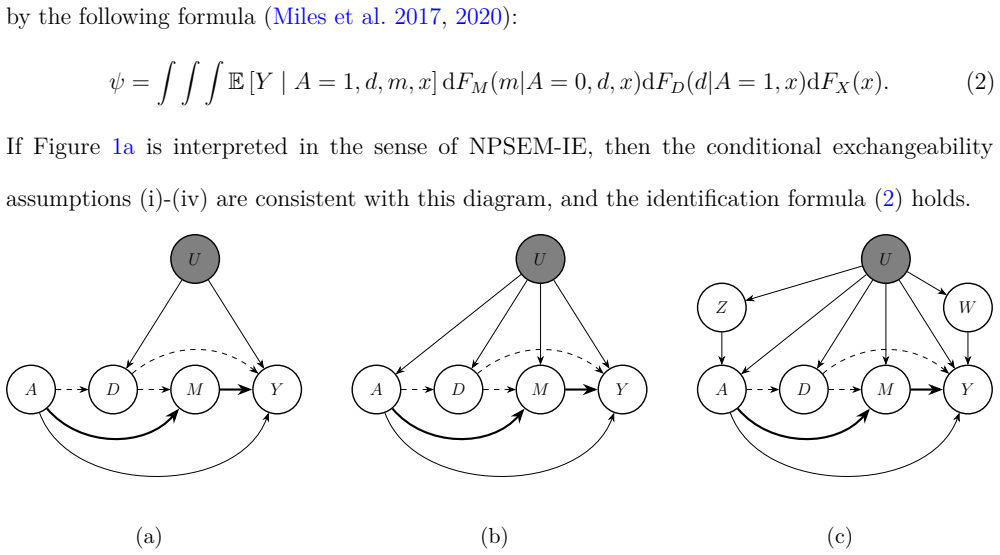
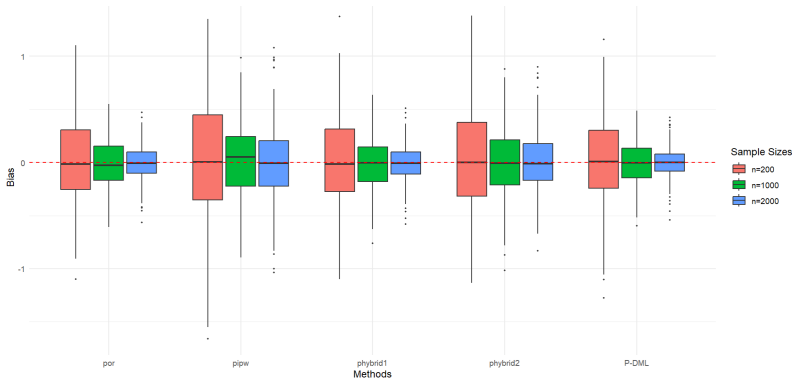
Causal mediation analysis has been extended to estimate path-specific effects with multiple intermediate variables, isolating treatment effects through a mediator of interest while excluding pathways through its ancestors. Such analyses address bias from recanting witnesses, i.e., treatment-induced mediator-outcome confounders. However, existing methods typically rely on stringent assumptions precluding general unmeasured confounding, which are often violated in practice. In this paper, we relax these restrictions by leveraging observed covariates as proxy variables to accommodate unmeasured confounding among the treatment, recanting witness, mediator, and outcome. Using proximal confounding bridge functions, we develop four nonparametric identification strategies for the path-specific effect. We further derive the efficient influence function and propose a quadruply robust, locally efficient estimator. To handle high-dimensional nuisance parameters, we propose a proximal debiased machine learning approach. We theoretically guarantee that our estimator achieves $\sqrt{n}$-consistency and asymptotic normality even when machine learning estimators for nuisance functions converge at slower rates. Our approaches are validated via semiparametric and nonparametric simulations and an application to the CDC WONDER Natality study, estimating the path-specific effect of prenatal care on preterm birth through preeclampsia, independent of maternal smoking during pregnancy.
Editorial analysis
A structured set of objections, weighed in public.
Referee Report
Summary. The paper extends causal mediation analysis to path-specific effects under unmeasured confounding among treatment, recanting witness, mediator, and outcome. It uses observed covariates as proxies to define proximal confounding bridge functions, develops four nonparametric identification strategies for the path-specific effect, derives the efficient influence function, and proposes a quadruply robust locally efficient estimator. The estimator is shown to achieve sqrt(n)-consistency and asymptotic normality under slow nuisance convergence rates via proximal debiased machine learning. Validation includes semiparametric and nonparametric simulations plus an application to the CDC WONDER Natality data estimating the effect of prenatal care on preterm birth through preeclampsia independent of maternal smoking.
Significance. If the proximal identification strategies and completeness conditions hold, the work would meaningfully advance causal mediation methods by relaxing standard no-unmeasured-confounding assumptions in the presence of recanting witnesses. The quadruply robust property, derivation of the efficient influence function, and theoretical guarantees for machine-learning nuisance estimators represent clear strengths, as does the combination of identification, estimation, and real-data application. These elements could support broader use in observational studies where proxy variables are available.
major comments (2)
- [§3] §3 (Identification strategies): The four nonparametric identification results for the path-specific effect are stated to hold via solutions to Fredholm integral equations of the first kind for the proximal confounding bridge functions. However, the manuscript provides no explicit statement or verification of the completeness conditions on the proxy variables that ensure unique existence of these bridges; without this, the identification claims cannot be confirmed to hold in general.
- [§4] §4 (Efficient influence function and estimator): The derivation of the EIF and the quadruply robust estimator is presented as achieving local efficiency and sqrt(n)-consistency even under slower nuisance rates. The text does not include the explicit bridge-function assumptions or data-exclusion rules needed to bridge the observed proxies to the latent confounding structure; this gap is load-bearing because the robustness and rate results collapse if the proxies are insufficiently rich.
minor comments (2)
- [Abstract] The abstract and introduction could more clearly distinguish the four identification strategies (e.g., by labeling them explicitly as Strategy 1–4) to aid reader navigation.
- [Simulations] Simulation sections would benefit from reporting the specific proxy dimensions and completeness diagnostics used to satisfy the bridge-function conditions.
Simulated Author's Rebuttal
We thank the referee for the positive evaluation of our work's significance and for the constructive major comments. We address each point below and have revised the manuscript to incorporate the requested clarifications.
read point-by-point responses
-
Referee: [§3] §3 (Identification strategies): The four nonparametric identification results for the path-specific effect are stated to hold via solutions to Fredholm integral equations of the first kind for the proximal confounding bridge functions. However, the manuscript provides no explicit statement or verification of the completeness conditions on the proxy variables that ensure unique existence of these bridges; without this, the identification claims cannot be confirmed to hold in general.
Authors: We agree that an explicit statement of the completeness conditions is necessary to rigorously establish the unique existence of the proximal confounding bridge functions. In the revised manuscript, we have added a dedicated paragraph in Section 3 stating the completeness conditions on the proxy variables (specifically, that the conditional distributions of the proxies given the latent confounders are sufficiently rich to ensure injectivity of the relevant integral operators). We also include a brief verification referencing standard results from the proximal causal inference literature (e.g., on Fredholm equations of the first kind) to confirm that the four nonparametric identification strategies hold under these conditions. This addition does not change the identification results but makes their foundational assumptions transparent. revision: yes
-
Referee: [§4] §4 (Efficient influence function and estimator): The derivation of the EIF and the quadruply robust estimator is presented as achieving local efficiency and sqrt(n)-consistency even under slower nuisance rates. The text does not include the explicit bridge-function assumptions or data-exclusion rules needed to bridge the observed proxies to the latent confounding structure; this gap is load-bearing because the robustness and rate results collapse if the proxies are insufficiently rich.
Authors: We appreciate this observation, as the bridge-function assumptions and data-exclusion rules are indeed essential for the validity of the EIF derivation, quadruply robust property, and rate results. In the revised Section 4, we have inserted a new subsection that explicitly lists the bridge-function assumptions (including existence, uniqueness, and boundedness conditions) and the data-exclusion restrictions that permit the observed proxies to identify the latent confounding structure. These clarifications directly support the local efficiency and sqrt(n)-consistency claims under the proximal debiased machine learning framework, ensuring the results are properly conditioned on sufficiently rich proxies. revision: yes
Circularity Check
No circularity: derivation extends external proximal inference framework without self-referential reduction
full rationale
The paper's identification strategies, EIF derivation, and quadruply robust estimator are constructed from the standard proximal confounding bridge function framework (solutions to Fredholm integral equations under completeness conditions on proxies) drawn from the existing proximal causal inference literature. These steps do not reduce the path-specific effect or its estimator to a fitted quantity by construction, nor do they rely on self-citations for uniqueness or ansatz. The quadruply robust property follows directly from the EIF structure under the stated nonparametric identification assumptions, which remain externally falsifiable via proxy richness and are not internally redefined. Simulations and the Natality application serve as validation rather than circular confirmation.
Axiom & Free-Parameter Ledger
axioms (1)
- domain assumption Existence of proximal confounding bridge functions linking observed proxies to unmeasured confounders among treatment, recanting witness, mediator, and outcome
invented entities (1)
-
proximal confounding bridge functions
no independent evidence
Reference graph
Works this paper leans on
-
[1]
Proximal Inference for Indirect and Intervening Effects in Population Interventions
Avin, C., Shpitser, I. & Pearl, J. (2005), ‘Identifiability of path-specific effects’,IJCAI International Joint Conference on Artificial Intelligencepp. 357–363. Bai, Y., Cui, Y. & Sun, B. (2025), ‘Proximal inference on population intervention indirect effect’, arXiv preprint arXiv:2504.11848. Belloni, A. & Chernozhukov, V. (2013), ‘Least squares after mo...
work page internal anchor Pith review Pith/arXiv arXiv 2005
-
[2]
Chen, X. & White, H. (1999), ‘Improved rates and asymptotic normality for nonparametric neural network estimators’,IEEE Transactions on Information Theory45(2), 682–691. 30 Chernozhukov, V., Chetverikov, D., Demirer, M., Duflo, E., Hansen, C., Newey, W. & Robins, J. (2018), ‘Double/debiased machine learning for treatment and structural parameters’,The Eco...
-
[3]
Imai, K., Keele, L. & Yamamoto, T. (2010), ‘Identification, inference and sensitivity analysis for causal mediation effects’,Statistical Science25(1), 51–71. Kallus, N., Mao, X. & Uehara, M. (2021), ‘Causal inference under unmeasured confounding with negative controls: A minimax learning approach’,arXiv preprint arXiv:2103.14029. Kennedy, E. H. (2024), ‘S...
-
[4]
Robins, J.M.&Richardson, T.S.(2010), ‘Alternativegraphicalcausalmodelsandtheidentification of direct effects’,Causality and psychopathology: Finding the determinants of disorders and their cures84, 103–158. Rubin, D. B. (1974), ‘Estimating causal effects of treatments in randomized and nonrandomized studies.’,Journal of Educational Psychology66(5),
work page 2010
-
[5]
Schick, A. (1986), ‘On Asymptotically Efficient Estimation in Semiparametric Models’,The Annals of Statistics14(3), 1139 –
work page 1986
-
[6]
Shan, J., Wang, T., Li, W. & Ai, C. (2025), ‘Nonparametric estimation of path-specific effects in the presence of nonignorable missing covariates’,Scandinavian Journal of Statistics52(4), 1556–
work page 2025
-
[7]
Shen, T. & Cui, Y. (2023), ‘Optimal treatment regimes for proximal causal learning’,Advances in Neural Information Processing Systems36, 47735–47748. Shi, X., Li, K. Q., Yu, M., Miao, W., Kuchibhotla, A. K., Hu, M. & Tchetgen Tchetgen, E. (2026), ‘Theory for identification and inference with synthetic controls: a proximal causal inference framework’,Journ...
work page 2023
-
[8]
Tchetgen Tchetgen, E. J. & VanderWeele, T. J. (2014), ‘Identification of natural direct effects when a confounder of the mediator is directly affected by exposure’,Epidemiology25(2), 282–291. Tchetgen Tchetgen, E. J., Ying, A., Cui, Y., Shi, X. & Miao, W. (2020), ‘An introduction to proximal causal learning’,arXiv preprint arXiv:2009.10982. Tsiatis, A. A....
discussion (0)
Sign in with ORCID, Apple, or X to comment. Anyone can read and Pith papers without signing in.