Recognition: 2 theorem links
· Lean TheoremNot All Thoughts Need HBM: Semantics-Aware Memory Hierarchy for LLM Reasoning
Pith reviewed 2026-05-12 05:23 UTC · model grok-4.3
The pith
LLM reasoning accuracy depends only on the fraction of tokens permanently evicted, not on how many remain in GPU HBM.
A machine-rendered reading of the paper's core claim, the machinery that carries it, and where it could break.
Core claim
The authors formalize zero-approximation-error offloading, in which tokens outside HBM contribute exactly the same attention terms as if they had never left. Under this condition, a controlled 3x3 grid of HBM occupancy versus eviction ratio demonstrates that performance is governed solely by the permanent eviction ratio. At 3 percent eviction the hierarchy recovers 91 percent of full-cache accuracy on GSM8K and 71 percent on MATH-500; at 14B scale it matches the uncompressed baseline while using half the HBM.
What carries the argument
A semantics-aware four-tier memory hierarchy (HBM, DDR, compressed storage, evicted) driven by cumulative attention scoring, with exact on-demand prefetching that guarantees identical numerical results to in-HBM residency.
If this is right
- Only 3 percent permanent eviction retains 91 percent of full-cache GSM8K accuracy and 71 percent on MATH-500.
- At 14B scale the method matches baseline accuracy while halving HBM occupancy.
- A real GPU-CPU prototype incurs 5-7 percent transfer overhead.
- The same budget yields 0-32 percent accuracy under the prior SOTA eviction method R-KV.
Where Pith is reading between the lines
- The same eviction-versus-offload distinction could be tested on non-reasoning tasks where long contexts also strain memory.
- Combining the hierarchy with existing quantization or sparsity methods might yield further HBM reductions without additional eviction.
- Production systems could allocate saved HBM to larger batch sizes or longer context windows while keeping the same eviction budget.
Load-bearing premise
That cumulative attention scores can identify tokens whose removal never changes the reasoning trajectory, and that prefetching those tokens from CPU or compressed storage always arrives in time with full precision and no bandwidth penalty.
What would settle it
Repeat the 3x3 grid experiment but replace exact prefetching with delayed or approximated tokens; if accuracy then varies with HBM size instead of eviction ratio alone, the central claim is false.
Figures




read the original abstract
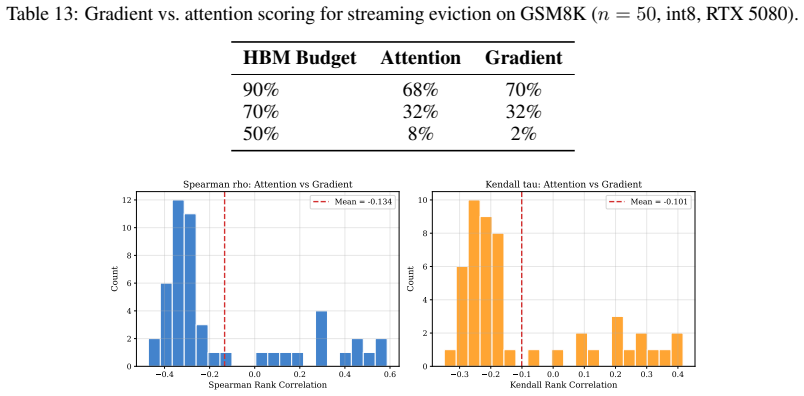
Reasoning LLMs produce thousands of chain-of-thought tokens whose KV cache must reside in scarce GPU HBM. The dominant response -- permanently evicting low-importance tokens -- is catastrophic for reasoning: accuracy collapses to 0-2.5% when half the cache is removed. We ask a different question: must every token live in HBM, or can some live elsewhere? We introduce a semantics-aware memory hierarchy that sorts tokens into four tiers -- HBM, DDR, compressed, and evicted -- using cumulative attention scoring. Low-importance tokens are moved to CPU memory rather than destroyed; before each attention step they are prefetched back at full precision, contributing exactly the same terms as if they had never left the GPU. We formalize this as zero-approximation-error offloading and derive our central finding: accuracy depends solely on how many tokens are permanently discarded (the eviction ratio), not on how many remain in HBM. A controlled 3x3 grid over HBM and eviction ratios confirms this across three model scales (7B-32B) and four benchmarks. With only 3% eviction, the hierarchy retains 91% of full-cache accuracy on GSM8K and 71% on MATH-500 (n=200); at 14B scale it matches the uncompressed baseline (90% vs. 86%) while halving HBM occupancy. A head-to-head reproduction of R-KV -- the current SOTA eviction method -- on our setup achieves only 0-32% at comparable budgets. A system prototype with real GPU-CPU data movement shows that the price of this preservation is modest -- 5-7% transfer overhead -- and scaling analysis projects 2-48 GB HBM savings at production batch sizes.
Editorial analysis
A structured set of objections, weighed in public.
Referee Report
Summary. The paper proposes a semantics-aware four-tier memory hierarchy (HBM, DDR, compressed, evicted) for KV caches in LLM chain-of-thought reasoning. Tokens are ranked by cumulative attention scores; low-importance tokens are offloaded rather than evicted and prefetched back at full precision before each attention step, yielding zero-approximation-error offloading. The central empirical claim is that final accuracy is determined exclusively by the permanent eviction ratio and is invariant to HBM occupancy for non-evicted tokens; this is tested via a controlled 3x3 grid over HBM and eviction ratios on 7B–32B models across GSM8K, MATH-500 and two other benchmarks, with a head-to-head reproduction of R-KV and a GPU-CPU prototype reporting 5–7% overhead.
Significance. If the zero-error prefetch and the eviction-ratio invariance hold, the work offers a practical route to large HBM savings (projected 2–48 GB at production batches) while preserving reasoning accuracy that collapses under pure eviction. The explicit 3x3 isolation of the eviction ratio, the external R-KV baseline, and the working prototype constitute concrete strengths that move the field beyond eviction-only heuristics.
major comments (1)
- [3x3 grid experiment] § on the 3x3 grid (and associated methods): the invariance claim is load-bearing and rests on the grid varying HBM occupancy while holding cumulative-attention tier thresholds fixed. The manuscript must state the precise HBM occupancy percentages and eviction ratios for each of the nine cells and confirm that the four-tier thresholds were not re-tuned per cell; without these values the isolation of eviction ratio as the sole determinant cannot be fully verified.
minor comments (2)
- [Abstract and results] The abstract reports 91% retention at 3% eviction on GSM8K and 71% on MATH-500 (n=200); the main text should tabulate the corresponding full-cache baselines and all three model scales for direct comparison.
- [System prototype] The prototype section states 5–7% transfer overhead; a per-layer or per-batch-size breakdown, together with the exact prefetch timing window relative to attention, would clarify whether the zero-error assumption holds under realistic bandwidth constraints.
Simulated Author's Rebuttal
We thank the referee for the positive evaluation and the constructive comment on the 3x3 grid experiment. We address the point below and will revise the manuscript accordingly.
read point-by-point responses
-
Referee: [3x3 grid experiment] § on the 3x3 grid (and associated methods): the invariance claim is load-bearing and rests on the grid varying HBM occupancy while holding cumulative-attention tier thresholds fixed. The manuscript must state the precise HBM occupancy percentages and eviction ratios for each of the nine cells and confirm that the four-tier thresholds were not re-tuned per cell; without these values the isolation of eviction ratio as the sole determinant cannot be fully verified.
Authors: We agree that explicit numerical values are required for independent verification of the invariance result. In the revised manuscript we will insert a table (or expanded methods paragraph) that lists the exact HBM occupancy percentages and eviction ratios used for each of the nine cells. The cumulative-attention tier thresholds were held strictly fixed across the entire grid; token ranking and tier assignment follow the same sorted cumulative-attention procedure and fixed ratio cut-offs in every cell, with no per-cell re-tuning of thresholds. Consequently, the only controlled variables are HBM occupancy and the permanent eviction ratio, directly supporting the claim that accuracy depends solely on the latter. revision: yes
Circularity Check
No significant circularity identified
full rationale
The paper's central claim that accuracy depends solely on the permanent eviction ratio (and is invariant to HBM occupancy for non-evicted tokens) is established by an explicit 3x3 experimental grid that independently varies both quantities while holding cumulative-attention tiering fixed, across three model scales and four benchmarks. This is further supported by a real-system prototype measuring 5-7% transfer overhead and by direct reproduction of the external R-KV baseline. The zero-approximation-error offloading is realized through actual GPU-CPU prefetching rather than assumed by definition, and no load-bearing step reduces to a self-referential equation, fitted input renamed as prediction, or self-citation chain; the derivation remains self-contained against the reported empirical controls.
Axiom & Free-Parameter Ledger
free parameters (1)
- cumulative attention scoring thresholds for HBM/DDR/compressed/evicted tiers
axioms (1)
- domain assumption Prefetching offloaded tokens back to GPU at full precision produces identical attention outputs and model behavior as if the tokens had remained in HBM throughout
Lean theorems connected to this paper
-
IndisputableMonolith/Cost/FunctionalEquation.leanwashburn_uniqueness_aczel unclear?
unclearRelation between the paper passage and the cited Recognition theorem.
We formalize this as zero-approximation-error offloading and derive our central finding: accuracy depends solely on how many tokens are permanently discarded (the eviction ratio), not on how many remain in HBM.
-
IndisputableMonolith/Foundation/RealityFromDistinction.leanreality_from_one_distinction unclear?
unclearRelation between the paper passage and the cited Recognition theorem.
A controlled 3×3 grid over HBM and eviction ratios confirms this across three model scales (7B–32B) and four benchmarks.
What do these tags mean?
- matches
- The paper's claim is directly supported by a theorem in the formal canon.
- supports
- The theorem supports part of the paper's argument, but the paper may add assumptions or extra steps.
- extends
- The paper goes beyond the formal theorem; the theorem is a base layer rather than the whole result.
- uses
- The paper appears to rely on the theorem as machinery.
- contradicts
- The paper's claim conflicts with a theorem or certificate in the canon.
- unclear
- Pith found a possible connection, but the passage is too broad, indirect, or ambiguous to say the theorem truly supports the claim.
Reference graph
Works this paper leans on
-
[1]
PyramidKV: Dynamic KV Cache Compression based on Pyramidal Information Funneling
Zefan Cai, Yichi Zhang, Bofei Gao, Yuliang Liu, Tianyu Liu, Keming Lu, Wayne Xiong, Yue Dong, Baobao Chang, Junjie Hu, and Wen Xiao. Pyramidkv: Dynamic kv cache compression based on pyramidal information funneling. arXiv preprint arXiv:2406.02069, 2024
work page internal anchor Pith review arXiv 2024
-
[2]
R-KV: Redundancy-aware kv cache compression for reasoning models
Xiaoxin Cai, Yijun Xu, Haotian Chen, Yiqi Gu, Siyuan Huang, and Hongxia Xu. R-KV: Redundancy-aware kv cache compression for reasoning models. In NeurIPS, 2025
work page 2025
-
[3]
Think you have Solved Question Answering? Try ARC, the AI2 Reasoning Challenge
Peter Clark, Isaac Cowhey, Oren Etzioni, Tushar Khot, Ashish Sabharwal, Carissa Schoenick, and Oyvind Tafjord. Think you have solved question answering? Try ARC, the AI2 reasoning challenge. arXiv preprint arXiv:1803.05457, 2018
work page internal anchor Pith review Pith/arXiv arXiv 2018
-
[4]
Training Verifiers to Solve Math Word Problems
Karl Cobbe, Vineet Kosaraju, Mohammad Bavarian, Mark Chen, Heewoo Jun, Lukasz Kaiser, Matthias Plappert, Jerry Tworek, Jacob Hilton, Reiichiro Nakano, Christopher Hesse, and John Schulman. Training verifiers to solve math word problems. arXiv preprint arXiv:2110.14168, 2021
work page internal anchor Pith review Pith/arXiv arXiv 2021
-
[5]
DeepSeek-R1: Incentivizing Reasoning Capability in LLMs via Reinforcement Learning
DeepSeek-AI. DeepSeek-R1: Incentivizing reasoning capability in LLMs via reinforcement learning. arXiv preprint arXiv:2501.12948, 2025
work page internal anchor Pith review Pith/arXiv arXiv 2025
-
[6]
Measuring mathematical problem solving with the MATH dataset
Dan Hendrycks, Collin Burns, Saurav Kadavath, Akul Arora, Steven Basart, Eric Tang, Dawn Song, and Jacob Steinhardt. Measuring mathematical problem solving with the MATH dataset. In NeurIPS, 2021
work page 2021
-
[7]
GEAR: An efficient kv cache compression recipe for near-lossless generative inference of LLM
Hao Kang, Qingru Zhang, Souvik Kundu, Geonhwa Jeong, Zaoxing Liu, Tushar Krishna, and Tuo Zhao. GEAR: An efficient kv cache compression recipe for near-lossless generative inference of LLM. In NeurIPS, 2024
work page 2024
-
[8]
InfiniGen: Efficient generative inference of large language models with dynamic kv cache management
Wonbeom Lee, Jungi Lee, Junghwan Seo, and Hwisoo Sim. InfiniGen: Efficient generative inference of large language models with dynamic kv cache management. In OSDI, 2024
work page 2024
-
[9]
ArkVale: Efficient generative LLM inference with recallable key-value eviction
Renze Li, Shi Chen, Jian Li, Chenguang Wang, and Zhaozhuo Xu. ArkVale: Efficient generative LLM inference with recallable key-value eviction. arXiv preprint arXiv:2404.14484, 2024
-
[10]
SnapKV: LLM knows what you are looking for before generation
Yuhong Li, Yingbing Huang, Bowen Yang, Bharat Venkitesh, Acyr Locatelli, Hanchen Ye, Tianle Cai, Patrick Lewis, and Deming Chen. SnapKV: LLM knows what you are looking for before generation. In NeurIPS, 2024
work page 2024
-
[11]
MiniCache: KV cache compression in depth dimension for large language models
Akide Liu, Jing Zhao, Nan Lu, Kai Dang, Shuang Chen, Chenghao Yan, Hai-Tao Xie, Zhi-Hong Wu, and Jian Gao. MiniCache: KV cache compression in depth dimension for large language models. In NeurIPS, 2024
work page 2024
-
[12]
Zichang Liu, Aashiq Desai, Fangshuo Liao, Weitao Wang, Victor Xie, Zhaozhuo Xu, Anastasios Kyrillidis, and Anshumali Shrivastava. ScissorHands: Exploiting the persistence of importance hypothesis for LLM kv cache compression at test time. In NeurIPS, 2024
work page 2024
-
[13]
KIVI: A tuning-free asymmetric 2bit quantization for kv cache
Zirui Liu, Jiayi Yuan, Hongye Jin, Shaochen Zhong, Zhaozhuo Xu, Vladimir Braverman, Beidi Chen, and Xia Hu. KIVI: A tuning-free asymmetric 2bit quantization for kv cache. In ICML, 2024
work page 2024
-
[14]
TriAttention: Efficient Long Reasoning with Trigonometric KV Compression
Weian Mao, Yifei Xu, Xinlei Huang, Jiachen Chen, and Wenqiang Zhang. TriAttention: Efficient long reasoning with trigonometric kv compression. arXiv preprint arXiv:2604.04921, 2026
work page internal anchor Pith review Pith/arXiv arXiv 2026
- [15]
-
[16]
Zhiyuan Park, Jinhyuk Song, Sangmin Bae, and Joonhyuk Lee. Attention score is not all you need for token importance indicator in kv cache reduction: Value also matters. In EMNLP, 2024
work page 2024
-
[17]
Headinfer: Memory-efficient llm inference by head-wise offloading
Cheng Sun, Xinlei Huang, Yuanbo Chang, Yifan Gao, Zhi Wang, and Hai Luo. HeadInfer: Memory-efficient LLM inference by head-wise offloading. arXiv preprint arXiv:2502.12574, 2025
-
[18]
Ke Tang, Ziteng Wu, Yi Xu, Yilong Zhan, Chengruidong Li, and Xuming Chen. ScoutAttention: Small kernels with large effective receptive fields for efficient kv cache offloading. arXiv preprint arXiv:2502.17606, 2026
-
[19]
Hold onto that thought: Assessing kv cache compression on reasoning
Sam Weston, Alice Chen, and Parth Shah. Hold onto that thought: Assessing kv cache compression on reasoning. arXiv preprint arXiv:2512.12008, 2025
-
[20]
Efficient streaming language models with attention sinks
Guangxuan Xiao, Yuandong Tian, Beidi Chen, Song Han, and Mike Lewis. Efficient streaming language models with attention sinks. In ICLR, 2024
work page 2024
-
[21]
Memory operations in large language models: A survey
Keqin Xu, Huanqi Zhang, Lu Hou, Lifeng Shang, Xin Jiang, and Qun Liu. ThinKV: Thought-adaptive kv cache compression for reasoning models. arXiv preprint arXiv:2505.00675, 2025
-
[22]
H2O: Heavy-hitter oracle for efficient generative inference of large language models
Zhenyu Zhang, Ying Sheng, Tianyi Zhou, Tianlong Chen, Lianmin Zheng, Ruisi Cai, Zhao Song, Yuandong Tian, Christopher R \'e , Clark Barrett, Zhangyang Wang, and Beidi Chen. H2O: Heavy-hitter oracle for efficient generative inference of large language models. In NeurIPS, 2023
work page 2023
discussion (0)
Sign in with ORCID, Apple, or X to comment. Anyone can read and Pith papers without signing in.