Recognition: no theorem link
Governing AI-Assisted Security Operations: A Design Science Framework for Operational Decision Support
Pith reviewed 2026-05-12 03:58 UTC · model grok-4.3
The pith
AI-assisted security operations must be governed as an engineering capability before they are scaled as automation.
A machine-rendered reading of the paper's core claim, the machinery that carries it, and where it could break.
Core claim
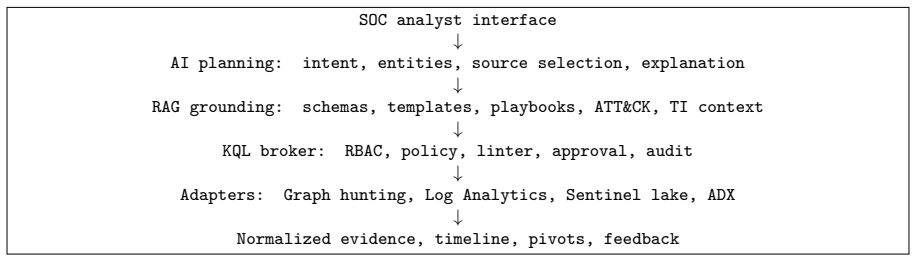
Using design science research, the study develops a governed AI query-broker artifact that separates AI planning from operational execution through schema-grounded retrieval, approved templates, policy validation, read-only adapters, normalized outputs, auditable agent traces, and engineering review board gates. The contribution is a management framework for governing AI-assisted operational decision support in high-risk digital infrastructure by specifying design propositions, role accountability, maturity stages, quality gates, evaluation criteria, and evidence boundaries.
What carries the argument
The governed AI query-broker artifact that separates AI planning from operational execution using schema-grounded retrieval, approved templates, policy validation, read-only adapters, normalized outputs, auditable agent traces, and engineering review board gates.
If this is right
- Design propositions and role accountability mappings can be used to structure oversight of AI in other high-risk operational domains.
- Maturity stages provide a sequence for organizations to move from initial pilots to scaled use while maintaining defined quality gates.
- Evaluation criteria and evidence boundaries give measurable standards for auditing AI-assisted decisions and tracing accountability.
- The separation of planning from execution limits the blast radius of any single AI-generated action.
Where Pith is reading between the lines
- The same broker pattern could be tested in non-security domains such as financial compliance queries where auditability is also required.
- Organizations could run controlled experiments comparing decision quality and risk metrics with and without the review board gates.
- The framework implies that regulatory requirements for AI in critical infrastructure might be met by embedding these evidence boundaries rather than by restricting AI use outright.
- Similar artifacts might reduce the need for constant human review of every AI output once the gates are shown to hold in practice.
Load-bearing premise
The proposed design elements of the query-broker artifact will effectively mitigate privacy, cost, performance, and decision-quality risks when applied in real operational settings.
What would settle it
Deploy the query-broker in a live security operations center, generate AI-assisted queries over a fixed period, and check whether unauthorized sensitive data exposure, uncontrolled costs, or untraceable decisions still occur at rates above baseline.
Figures
read the original abstract
Engineering managers increasingly must decide how to introduce generative artificial intelligence (AI), retrieval-augmented generation, and coding agents into high-risk operational functions without weakening accountability, privacy, cost discipline, or auditability. The central message of this study is that AI-assisted operational decision support should be managed as a governed engineering capability before it is scaled as automation. Security operations centers (SOCs) provide a suitable setting because they combine privileged telemetry, specialist expertise, software repositories, cloud services, and evidence-sensitive decisions. This study uses Kusto Query Language (KQL) and Microsoft Azure security capabilities as a bounded technical instantiation of that broader engineering management problem. KQL is read-only in ordinary query use, but read-only does not mean risk-free: AI-assisted queries can still create privacy, cost, performance, schema-validity, and decision-quality risks through broad scans, sensitive-field exposure, stale intelligence, and misleading interpretations. Using design science research, the study develops a governed AI query-broker artifact that separates AI planning from operational execution through schema-grounded retrieval, approved templates, policy validation, read-only adapters, normalized outputs, auditable agent traces, and engineering review board gates. The contribution is not a new KQL technique, security product, or detection algorithm. Rather, the study contributes a management framework for governing AI-assisted operational decision support in high-risk digital infrastructure by specifying design propositions, role accountability, maturity stages, quality gates, evaluation criteria, and evidence boundaries.
Editorial analysis
A structured set of objections, weighed in public.
Referee Report
Summary. The paper claims to develop, using design science research, a governed AI query-broker artifact for AI-assisted operational decision support in security operations centers (SOCs) using KQL and Azure. This artifact separates AI planning from execution via schema-grounded retrieval, approved templates, policy validation, read-only adapters, auditable traces, and engineering review board gates. The main contribution is a management framework specifying design propositions, role accountability, maturity stages, quality gates, evaluation criteria, and evidence boundaries to govern AI use and mitigate associated risks in high-risk digital infrastructure.
Significance. Should the proposed mechanisms prove effective in practice, the framework would represent a significant step toward responsible integration of generative AI into security operations by prioritizing governance, accountability, and risk mitigation. It addresses a timely issue in engineering management of AI in critical infrastructure. The design science approach allows for a structured proposal of the artifact, though its impact depends on future validation.
major comments (2)
- Abstract: The central claim that the query-broker artifact mitigates privacy, cost, performance, and decision-quality risks through schema-grounded retrieval, approved templates, policy validation, read-only adapters, auditable traces, and engineering review board gates is unsupported by evaluation results, case studies, empirical evidence, threat models, failure-mode analysis, prototype implementation, or pilot metrics. The mechanisms remain at a conceptual level without demonstrated risk reduction in operational settings.
- Design Science Framework (full text): The design propositions, maturity stages, quality gates, and evaluation criteria are constructed internally by the authors without grounding in external benchmarks, prior validated models, or independent data, creating circularity where the artifact defines its own success criteria rather than being tested against real-world outcomes.
minor comments (1)
- Abstract: The explicit statement that the contribution is a management framework (not a new KQL technique or detection algorithm) is helpful, but the manuscript would benefit from a dedicated comparison subsection to related governance frameworks in AI ethics or security operations management.
Simulated Author's Rebuttal
We thank the referee for the constructive feedback and for recognizing the timeliness of governing AI in security operations. We address each major comment below, clarifying the scope of our design science contribution while committing to revisions that strengthen the manuscript without overstating its current empirical basis.
read point-by-point responses
-
Referee: Abstract: The central claim that the query-broker artifact mitigates privacy, cost, performance, and decision-quality risks through schema-grounded retrieval, approved templates, policy validation, read-only adapters, auditable traces, and engineering review board gates is unsupported by evaluation results, case studies, empirical evidence, threat models, failure-mode analysis, prototype implementation, or pilot metrics. The mechanisms remain at a conceptual level without demonstrated risk reduction in operational settings.
Authors: We agree that the manuscript presents a design science proposal rather than an empirically validated implementation, and the abstract's phrasing of risk mitigation should be qualified to reflect this. The contribution lies in specifying the governed artifact and management framework through design propositions; empirical demonstration of risk reduction is outside the current scope but is explicitly bounded in the paper. In revision we will (1) temper the abstract language to emphasize 'proposed mechanisms for risk mitigation' and (2) add a dedicated subsection on 'Evaluation Boundaries and Planned Validation' that outlines threat models, failure-mode analysis, and pilot metrics as future work. This addresses the concern directly while preserving the design science character of the work. revision: partial
-
Referee: Design Science Framework (full text): The design propositions, maturity stages, quality gates, and evaluation criteria are constructed internally by the authors without grounding in external benchmarks, prior validated models, or independent data, creating circularity where the artifact defines its own success criteria rather than being tested against real-world outcomes.
Authors: The design propositions and criteria are explicitly derived from established design science methodology (Hevner et al.) and draw upon prior validated models in AI governance, cybersecurity risk frameworks (NIST AI RMF), and SOC operational literature. Nevertheless, we accept that additional explicit linkages would reduce any appearance of circularity. In revision we will insert a new table mapping each design proposition and quality gate to specific external benchmarks and literature sources, and we will expand the 'Related Work' section to highlight these connections. This will demonstrate grounding beyond internal construction while retaining the novel synthesis of the query-broker artifact. revision: yes
Circularity Check
No circularity detected in design-science framework proposal
full rationale
The paper applies design science to construct and describe a management framework (query-broker artifact, design propositions, maturity stages, quality gates, evaluation criteria, and evidence boundaries) for governing AI-assisted SOC operations. No equations, fitted parameters, predictions, or self-citations appear in the text that reduce any claim to its own inputs by construction. The listed mechanisms and criteria are presented as the direct output of the design process itself rather than derived from or validated against external benchmarks in a manner that creates circularity. This is a standard, self-contained conceptual contribution and does not match any of the enumerated circularity patterns.
Axiom & Free-Parameter Ledger
axioms (2)
- domain assumption AI-assisted queries create privacy, cost, performance, schema-validity, and decision-quality risks even when read-only.
- domain assumption Design science research is an appropriate method for developing a governed AI query-broker artifact.
invented entities (2)
-
Governed AI query-broker artifact
no independent evidence
-
Engineering review board gates
no independent evidence
Reference graph
Works this paper leans on
-
[1]
Microsoft, “security: runHuntingQuery,” Microsoft Graph REST API documentation, 2025. Accessed: May 1, 2026. [Online]. Available:https://learn.microsoft.com/en-us/graph/ api/security-security-runhuntingquery?view=graph-rest-1.0
work page 2025
-
[2]
Kusto Query Language overview,
Microsoft, “Kusto Query Language overview,” Microsoft Learn, 2025. Accessed: May 1, 2026. [Online]. Available: https://learn.microsoft.com/en-us/kusto/query/?view= microsoft-fabric
work page 2025
-
[3]
Overview: Advanced hunting in Microsoft Defender XDR,
Microsoft, “Overview: Advanced hunting in Microsoft Defender XDR,” Microsoft Learn,
- [4]
-
[5]
Azure Monitor Log Analytics API overview,
Microsoft, “Azure Monitor Log Analytics API overview,” Microsoft Learn, 2026. Accessed: May 1, 2026. [Online]. Available:https://learn.microsoft.com/en-us/azure/azure-monitor/ logs/api/overview
work page 2026
-
[6]
Run KQL queries on the Microsoft Sentinel data lake using APIs,
Microsoft, “Run KQL queries on the Microsoft Sentinel data lake using APIs,” Microsoft Learn,
- [7]
-
[8]
Microsoft, “Kusto API overview,” Microsoft Learn, 2026. Accessed: May 1, 2026. [Online]. Available:https://learn.microsoft.com/en-us/kusto/api/?view=microsoft-fabric
work page 2026
-
[9]
Design science in information systems research,
A. R. Hevner, S. T. March, J. Park, and S. Ram, “Design science in information systems research,”MIS Quarterly, vol. 28, no. 1, pp. 75–105, 2004, doi: 10.2307/25148625
-
[10]
A design science research methodology for information systems research,
K. Peffers, T. Tuunanen, M. A. Rothenberger, and S. Chatterjee, “A design science research methodology for information systems research,”Journal of Management Information Systems, vol. 24, no. 3, pp. 45–77, 2007, doi: 10.2753/MIS0742-1222240302
-
[11]
S. Raisch and S. Krakowski, “Artificial intelligence and management: The automation- augmentation paradox,”Academy of Management Review, vol. 46, no. 1, pp. 192–210, 2021, doi: 10.5465/amr.2018.0072
-
[12]
Managing artificial intelligence,
N. Berente, B. Gu, J. Recker, and R. Santhanam, “Managing artificial intelligence,”MIS Quarterly, vol. 45, no. 3, pp. 1433–1450, 2021, doi: 10.25300/MISQ/2021/16274. 25
-
[13]
Understanding digital transformation: A review and a research agenda,
G. Vial, “Understanding digital transformation: A review and a research agenda,”Journal of Strategic Information Systems, vol. 28, no. 2, pp. 118–144, 2019, doi: 10.1016/j.jsis.2019.01.003
-
[14]
Digital business strategy: Toward a next generation of insights,
A. Bharadwaj, O. A. El Sawy, P. A. Pavlou, and N. Venkatraman, “Digital business strategy: Toward a next generation of insights,”MIS Quarterly, vol. 37, no. 2, pp. 471–482, 2013, doi: 10.25300/MISQ/2013/37:2.3
-
[15]
D. J. Teece, “Explicating dynamic capabilities: The nature and microfoundations of sustainable enterprise performance,”Strategic Management Journal, vol. 28, no. 13, pp. 1319–1350, 2007, doi: 10.1002/smj.640
-
[16]
M. H. Jarrahi, “Artificial intelligence and the future of work: Human-AI symbiosis in or- ganizational decision making,”Business Horizons, vol. 61, no. 4, pp. 577–586, 2018, doi: 10.1016/j.bushor.2018.03.007
-
[17]
Working and organizing in the age of the learn- ing algorithm,
S. Faraj, S. Pachidi, and K. Sayegh, “Working and organizing in the age of the learn- ing algorithm,”Information and Organization, vol. 28, no. 1, pp. 62–70, 2018, doi: 10.1016/j.infoandorg.2018.02.005
-
[18]
Digital innovation management: Reinventing innovation management research in a digital world,
S. Nambisan, K. Lyytinen, A. Majchrzak, and M. Song, “Digital innovation management: Reinventing innovation management research in a digital world,”MIS Quarterly, vol. 41, no. 1, pp. 223–238, 2017, doi: 10.25300/MISQ/2017/41:1.03
-
[19]
From use to effective use: Arepresentation theory perspective,
A. Burton-Jones and C. Grange, “From use to effective use: Arepresentation theory perspective,” Information Systems Research, vol. 24, no. 3, pp. 632–658, 2013, doi: 10.1287/isre.1120.0444
-
[20]
The third hand: IT-enabled competitive advantage in turbulence through improvisational capabilities,
P. A. Pavlou and O. A. El Sawy, “The third hand: IT-enabled competitive advantage in turbulence through improvisational capabilities,”Information Systems Research, vol. 21, no. 3, pp. 443–471, 2010, doi: 10.1287/isre.1100.0280
-
[21]
Artificial intelligence risk management framework (AI RMF 1.0), NIST AI 100-1
National Institute of Standards and Technology, “Artificial Intelligence Risk Management Framework (AI RMF 1.0),” NIST AI 100-1, 2023, doi: 10.6028/NIST.AI.100-1
-
[22]
Bennett, Kori 5 Inkpen, Jaime Teevan, Ruth Kikin-Gil, and Eric Horvitz
S. Amershiet al., “Guidelines for human-AI interaction,” inProc. CHI Conf. Human Factors in Computing Systems, 2019, pp. 1–13, doi: 10.1145/3290605.3300233
-
[23]
Designing transparency for effective human-AI collaboration,
M. Vössing, N. Kühl, M. Lind, and G. Satzger, “Designing transparency for effective human-AI collaboration,”Information Systems Frontiers, vol. 24, pp. 877–895, 2022, doi: 10.1007/s10796- 022-10284-3
-
[24]
I. Ismail, R. Kurnia, and F. Widyatama, “Enhancing security operations center: Wazuh security event response with retrieval-augmented-generation-driven copilot,”Sensors, vol. 25, no. 3, p. 870, 2025, doi: 10.3390/s25030870
-
[25]
S. Sai, U. Yashvardhan, V. Chamola, and B. K. Sikdar, “Generative AI for cyber security: Analyzing the potential of ChatGPT, DALL-E, and other models for enhancing the security space,”IEEE Access, vol. 12, pp. 53497–53516, 2024, doi: 10.1109/ACCESS.2024.3385107
-
[26]
Matched and mismatched SOCs: A qualitative study on security operations center issues,
F. B. Kokulu, A. Soneji, T. Bao, Y. Shoshitaishvili, Z. Zhao, A. Doupé, and G.-J. Ahn, “Matched and mismatched SOCs: A qualitative study on security operations center issues,” in Proc. ACM SIGSAC Conf. Computer and Communications Security, 2019, pp. 1955–1970, doi: 10.1145/3319535.3354239. 26
-
[27]
Design science research contributions: Finding a balance between artifact and theory,
R. Baskerville, A. Baiyere, S. Gregor, A. R. Hevner, and M. Rossi, “Design science research contributions: Finding a balance between artifact and theory,”Journal of the Association for Information Systems, vol. 19, no. 5, pp. 358–376, 2018, doi: 10.17705/1jais.00495
-
[28]
FEDS: A framework for evaluation in design science research,
J. Venable, J. Pries-Heje, and R. Baskerville, “FEDS: A framework for evaluation in design science research,”European Journal of Information Systems, vol. 25, no. 1, pp. 77–89, 2016, doi: 10.1057/ejis.2014.36
-
[29]
Transparency in design science research,
A. R. Hevner, J. Parsons, A. B. Brendel, R. Lukyanenko, V. Tiefenbeck, M. C. Tremblay, and J. vom Brocke, “Transparency in design science research,”Decision Support Systems, vol. 182, Art. no. 114236, 2024, doi: 10.1016/j.dss.2024.114236
-
[30]
Reliability in design science research,
V. C. Storey, R. L. Baskerville, and M. Kaul, “Reliability in design science research,”Information Systems Journal, vol. 35, no. 3, pp. 984–1014, 2025, doi: 10.1111/isj.12564
-
[31]
K. R. Larsen, R. Lukyanenko, R. M. Mueller, V. C. Storey, J. Parsons, D. VanderMeer, and D. S. Hovorka, “Validity in design science,”MIS Quarterly, vol. 49, no. 4, pp. 1267–1294, 2025, doi: 10.25300/MISQ/2024/18064
-
[32]
Best practices for Kusto Query Language queries,
Microsoft, “Best practices for Kusto Query Language queries,” Microsoft Learn, 2026. Ac- cessed: May 1, 2026. [Online]. Available: https://learn.microsoft.com/en-us/kusto/ query/best-practices?view=microsoft-fabric
work page 2026
-
[33]
Threat intelligence in Microsoft Sentinel,
Microsoft, “Threat intelligence in Microsoft Sentinel,” Microsoft Learn, 2025. Accessed: May 1, 2026. [Online]. Available:https://learn.microsoft.com/en-us/azure/sentinel/ understand-threat-intelligence
work page 2025
-
[34]
Secure Software Development Framework (SSDF) Version 1.1,
National Institute of Standards and Technology, “Secure Software Development Framework (SSDF) Version 1.1,” NIST SP 800-218, 2022, doi: 10.6028/NIST.SP.800-218
-
[35]
Software Assurance Maturity Model,
OWASP Foundation, “Software Assurance Maturity Model,” OWASP SAMM Project, 2026. Accessed: May 1, 2026. [Online]. Available:https://owaspsamm.org/
work page 2026
-
[36]
Cumulated gain-based evaluation of IR techniques,
K. Järvelin and J. Kekäläinen, “Cumulated gain-based evaluation of IR techniques,”ACM Trans- actions on Information Systems, vol. 20, no. 4, pp. 422–446, 2002, doi: 10.1145/582415.582418
-
[37]
An introduction to ROC analysis,
T. Fawcett, “An introduction to ROC analysis,”Pattern Recognition Letters, vol. 27, no. 8, pp. 861–874, 2006, doi: 10.1016/j.patrec.2005.10.010
-
[38]
The relationship between precision-recall and ROC curves,
J. Davis and M. Goadrich, “The relationship between precision-recall and ROC curves,” in Proc. 23rd Int. Conf. Machine Learning, 2006, pp. 233–240, doi: 10.1145/1143844.1143874
-
[39]
On calibration of modern neural networks,
C. Guo, G. Pleiss, Y. Sun, and K. Q. Weinberger, “On calibration of modern neural networks,” inProc. 34th Int. Conf. Machine Learning, PMLR, vol. 70, 2017, pp. 1321–1330
work page 2017
-
[40]
OWASP Top 10 for Large Language Model Applications,
OWASP Foundation, “OWASP Top 10 for Large Language Model Applications,” OWASP GenAI Security Project, 2026. Accessed: May 1, 2026. [Online]. Available:https://genai. owasp.org/llm-top-10/
work page 2026
-
[41]
Incident Response Recommendations and Considerations for Cybersecurity Risk Management,
National Institute of Standards and Technology, “Incident Response Recommendations and Considerations for Cybersecurity Risk Management,” NIST SP 800-61 Rev. 3, 2025, doi: 10.6028/NIST.SP.800-61r3. 27
-
[42]
Explanation in artificial intelligence: Insights from the social sciences , shorttitle =
T. Miller, “Explanation in artificial intelligence: Insights from the social sciences,”Artificial Intelligence, vol. 267, pp. 1–38, 2019, doi: 10.1016/j.artint.2018.07.007
-
[43]
A. Baird and L. M. Maruping, “The next generation of research on IS use: A theoretical framework of delegation to and from agentic IS artifacts,”MIS Quarterly, vol. 45, no. 1, pp. 315–341, 2021, doi: 10.25300/MISQ/2021/15882
-
[44]
Algorithms at work: The new contested terrain of control,
K. C. Kellogg, M. A. Valentine, and A. Christin, “Algorithms at work: The new contested terrain of control,”Academy of Management Annals, vol. 14, no. 1, pp. 366–410, 2020, doi: 10.5465/annals.2018.0174
-
[45]
Positioning and presenting design science research for maximum impact,
S. Gregor and A. R. Hevner, “Positioning and presenting design science research for maximum impact,”MIS Quarterly, vol. 37, no. 2, pp. 337–355, 2013, doi: 10.25300/MISQ/2013/37.2.01. Author Biographies Elyson De La Cruz is a cybersecurity and information technology executive with over 20 years of experience in enterprise technology leadership, cyber defen...
discussion (0)
Sign in with ORCID, Apple, or X to comment. Anyone can read and Pith papers without signing in.