Recognition: no theorem link
The comaximal graph of a finite-dimensional Lie algebra
Pith reviewed 2026-05-12 04:42 UTC · model grok-4.3
The pith
The comaximal graph of sl_2(F_q) is connected and non-planar, with a large clique from nonsplit semisimple lines and Borel subalgebras.
A machine-rendered reading of the paper's core claim, the machinery that carries it, and where it could break.
Core claim
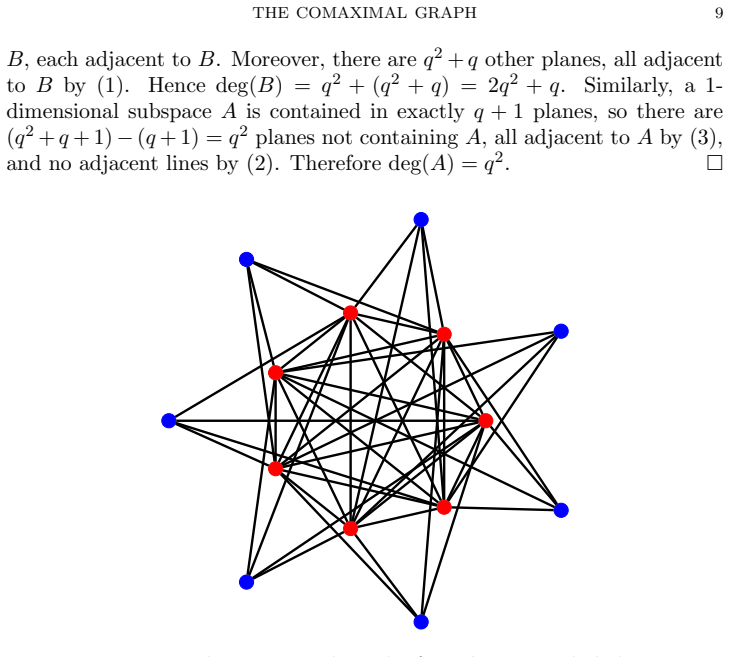
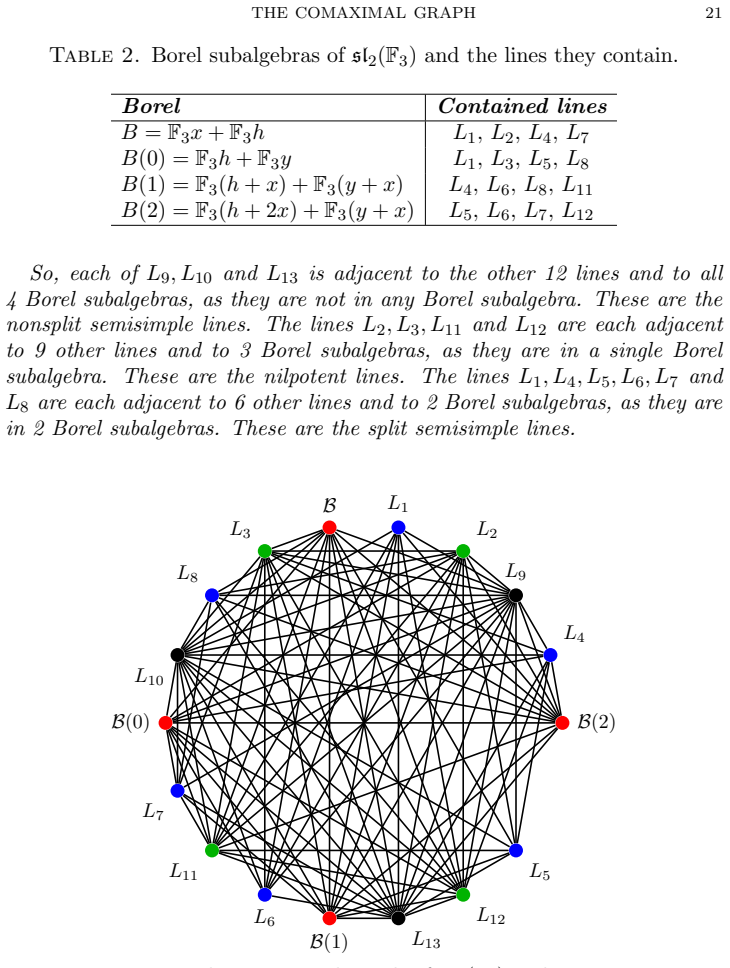
The comaximal graph Γ(L) for L ≅ sl_2(F_q) is connected and non-planar. It contains a large clique formed by the nonsplit semisimple lines together with the Borel subalgebras, while the nilpotent and split semisimple lines have restricted adjacency governed by their containment in Borel subalgebras. Explicit values are given for the degree sequence, clique number, chromatic number, domination number, diameter, and radius.
What carries the argument
The comaximal graph Γ(L), whose vertices are the nontrivial proper Lie subalgebras of L and with adjacency between A and B precisely when the subalgebra generated by A and B equals L.
If this is right
- For every Lie algebra of dimension at most three over F_q the structure of Γ(L) is determined by the derived algebra and the action of ad x.
- In the case L ≅ sl_2(F_q) the graph contains a clique whose size is fixed by the number of nonsplit semisimple lines together with the Borel subalgebras.
- The diameter and radius of Γ(L) for sl_2(F_q) are finite and can be read off from the containment relations among nilpotent and split lines.
- Nilpotent and split semisimple lines are adjacent only when they lie in a common Borel subalgebra.
Where Pith is reading between the lines
- The same adjacency relation could be applied to subalgebras of other algebraic structures to obtain analogous connectivity and planarity results.
- Non-planarity for sl_2 suggests that subalgebra-generation graphs of simple Lie algebras will generally require crossings when drawn in the plane.
- Higher-dimensional simple Lie algebras may admit similar clique descriptions built from parabolic subalgebras and root-space lines.
Load-bearing premise
The classification for dimensions at most three depends on a complete enumeration of all Lie algebra structures over F_q in those dimensions together with the definition of adjacency via generated subalgebra equaling L.
What would settle it
An explicit listing of all proper subalgebras of one concrete three-dimensional Lie algebra over a small finite field such as F_2, followed by a check that the pairs generating the whole algebra do not produce the graph claimed in the classification.
Figures


read the original abstract
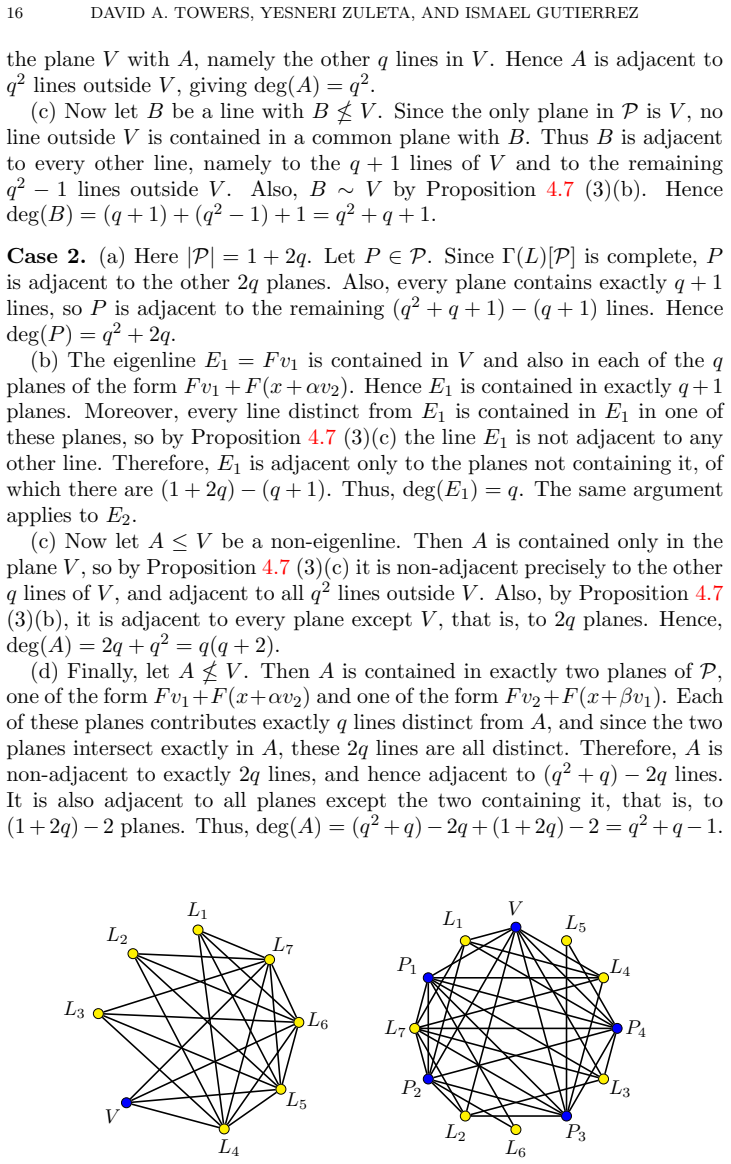
In this paper, we introduce the comaximal graph $\Gamma(L)$ of a finite-dimensional Lie algebra $L$, whose vertices are the nontrivial proper Lie subalgebras of $L$ over a field $\mathbb{F}$, and two vertices $A$ and $B$ are adjacent if and only if $\langle A, B\rangle =L$. We establish general structural properties, including a characterization of isolated vertices via the Frattini subalgebra and a criterion for completeness in terms of $\mu$-algebras. We classify $\Gamma(L)$ for all Lie algebras of dimension at most three over a finite field $\mathbb{F}_q$, providing an explicit description in each case. The resulting graphs exhibit a rich range of behaviors, depending on the structure of the derived algebra and the action of $\operatorname{ad}x$. For $L\cong \mathfrak{sl}_2(\mathbb{F}_q)$, we determine several graph invariants, including the degree sequence, clique number, chromatic number, domination number, diameter, and radius, and show that $\Gamma(L)$ is connected and non-planar. The graph contains a large clique formed by the nonsplit semisimple lines together with the Borel subalgebras, while the nilpotent and split semisimple lines have a more restricted adjacency structure governed by their containment in Borel subalgebras.
Editorial analysis
A structured set of objections, weighed in public.
Referee Report
Summary. The paper defines the comaximal graph Γ(L) of a finite-dimensional Lie algebra L over a field F, with vertices the nontrivial proper subalgebras of L and an edge between A and B precisely when the subalgebra they generate equals L. General structural results are proved, including a characterization of isolated vertices in terms of the Frattini subalgebra and a criterion for the graph to be complete when L is a μ-algebra. The manuscript then classifies Γ(L) completely for every Lie algebra of dimension at most 3 over a finite field F_q, describing the resulting graphs case-by-case according to the structure of the derived algebra and the action of ad x. For L ≅ sl_2(F_q) the paper computes the degree sequence, clique number, chromatic number, domination number, diameter and radius, and proves that Γ(L) is connected and non-planar, with a distinguished clique consisting of the nonsplit semisimple lines together with the Borel subalgebras.
Significance. If the low-dimensional classification is exhaustive, the work supplies a new combinatorial invariant that directly encodes the generation properties of subalgebras. The explicit invariants obtained for sl_2(F_q) illustrate how Lie-algebraic features (semisimplicity, nilpotency, Borel containment) translate into concrete graph-theoretic quantities, and the absence of fitted parameters or self-referential constructions strengthens the internal coherence of the approach. The results could serve as a foundation for further study of subalgebra lattices via graph theory, provided the enumeration of isomorphism classes is verified against the literature.
major comments (1)
- [Classification for dimension at most three] The classification of Γ(L) for all Lie algebras of dimension ≤3 over F_q (the central claim of the paper) rests on an asserted exhaustive list of all isomorphism classes of such algebras. No reference is supplied to standard tables of low-dimensional Lie algebras over finite fields, nor is any verification method (computational or otherwise) described that would confirm all non-split extensions and characteristic-p phenomena have been included. Any omitted structure would render the corresponding graph description incomplete.
minor comments (2)
- [Abstract] Notation for the base field alternates between F and F_q in the abstract and early sections; a single consistent symbol should be adopted from the outset.
- The explicit formulas or tables for the degree sequence, clique number, etc., of Γ(sl_2(F_q)) would benefit from a compact summary table that also records the dependence on q and characteristic.
Simulated Author's Rebuttal
We thank the referee for their careful reading of the manuscript and for highlighting an important point about the presentation of the low-dimensional classification. We address the major comment below and commit to revisions that will strengthen the exposition.
read point-by-point responses
-
Referee: The classification of Γ(L) for all Lie algebras of dimension ≤3 over F_q (the central claim of the paper) rests on an asserted exhaustive list of all isomorphism classes of such algebras. No reference is supplied to standard tables of low-dimensional Lie algebras over finite fields, nor is any verification method (computational or otherwise) described that would confirm all non-split extensions and characteristic-p phenomena have been included. Any omitted structure would render the corresponding graph description incomplete.
Authors: We agree that the absence of an explicit reference and a brief verification outline is a presentational shortcoming. In the revised manuscript we will insert a short subsection (or paragraph in the introduction to the classification) that cites the standard literature on the classification of Lie algebras of dimension at most three over finite fields and outlines the exhaustive case division we employed: the possible dimensions of the derived algebra L' (0, 1, 2 or 3) together with the possible actions of ad x for x ∉ L', including all split and non-split extensions and the characteristic-dependent phenomena that arise in the Jordan canonical forms or nilpotency indices. Because the dimension is small, these cases are completely determined by the structure theory of Lie algebras; the added reference and outline will make the completeness of the list transparent to the reader. revision: yes
Circularity Check
No circularity: direct definition and case-by-case classification
full rationale
The paper defines Γ(L) explicitly via subalgebras and the generation condition <A,B>=L with no parameters, no fitted quantities, and no equations that reduce outputs to inputs by construction. Classification for dim≤3 enumerates isomorphism classes of Lie algebras (a standard external enumeration) and computes adjacency and invariants directly for each; this is falsifiable against independent lists of low-dimensional Lie algebras over F_q and does not rely on self-citation chains or ansatzes smuggled from prior work. No load-bearing step collapses to a self-definition or renamed fit.
Axiom & Free-Parameter Ledger
axioms (1)
- standard math A Lie algebra is a vector space equipped with a bilinear, skew-symmetric bracket satisfying the Jacobi identity
invented entities (1)
-
Comaximal graph Γ(L)
no independent evidence
Reference graph
Works this paper leans on
-
[1]
G. M. Benkart and J.M. Osborn, Rank one Lie algebras, Annals of Mathematics,119 (1984), 437–463
work page 1984
-
[2]
J. M. Bois, Generators of simple Lie algebras in arbitrary characteristics, Mathema- tische Zeitschrift 262 (2009), 715–741
work page 2009
-
[3]
Borel, Linear Algebraic Groups, W.A
A. Borel, Linear Algebraic Groups, W.A. Benjamin, Inc. 1969
work page 1969
- [4]
-
[5]
D. B. West. Introduction to Graph Theory, Prentice Hall, 2001
work page 2001
-
[6]
J. A. Bondy and U. S. R. Murty. Graph Theory, Springer, 2008
work page 2008
-
[7]
Angsuman Das, Subspace Sum Graph of a Vector Space. arXiv:1702.08245, 2017
-
[8]
R. Venkatasalam and S. Chelliah, A note on subspace sum graph of vector spaces. AKCE International Journal of Graphs and Combinatorics, 18(3) (2021), 186–190. THE COMAXIMAL GRAPH 25
work page 2021
-
[9]
B. A. Wani, A. Altaf, S. Pirzada, and T. A. Chishti, Direct sum graph of the subspaces of a finite-dimensional vector space over finite fields, Discrete Mathematics, Algorithms and Applications 17 (5), (2025)
work page 2025
-
[10]
J. E. Humphreys, Introduction to Lie algebras and representation theory, Springer- Verlag, New York, Heidelberg, Berlin, 1972
work page 1972
-
[11]
Available at https://www.sagemath.org
The Sage Developers, SageMath, the Sage Mathematics Software System, Version 9.0, 2020. Available at https://www.sagemath.org
work page 2020
-
[12]
H. Strade and R. Farnsteiner,Modular Lie Algebras and their Representations, Marcel Dekker, New York, 1988
work page 1988
- [13]
-
[14]
D.A. Towers, I. Gutierrez, and L. Fernandez, The Solvable Graph of a finite- dimensional Lie Algebra, Ricerche di Matematica. Advance online publication, 2026. https://doi.org/10.1007/s11587-026-01093-w
-
[15]
Towers, Lie algebras all of whose maximal subalgebras have codimension one, Proc
D.A. Towers, Lie algebras all of whose maximal subalgebras have codimension one, Proc. Edinburgh Math. Soc. 24 (1981), 217–219
work page 1981
-
[16]
Varea, Supersimple and upper semimodular Lie algebras, Comm
V.R. Varea, Supersimple and upper semimodular Lie algebras, Comm. Alg. 23(6) (1995), 2323-2330. Lancaster University, School of Mathematical Sciences, Lancaster, LA1 4YF, UK Email address:d.towers@lancaster.ac.uk Universidad del Norte, Departamento de Matem´aticas y Estad´ıstica, Km 5 via a Puerto Colombia, Barranquilla, Colombia. Email address:zuletay@un...
work page 1995
discussion (0)
Sign in with ORCID, Apple, or X to comment. Anyone can read and Pith papers without signing in.