Recognition: no theorem link
Flip of lattices
Pith reviewed 2026-05-12 04:08 UTC · model grok-4.3
The pith
Flips on posets that map lattices to lattices produce only semidistributive lattices.
A machine-rendered reading of the paper's core claim, the machinery that carries it, and where it could break.
Core claim
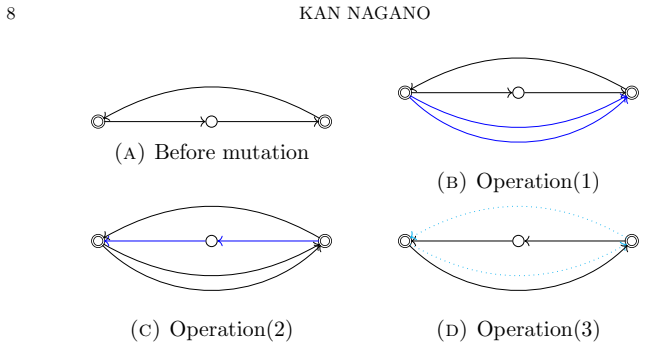
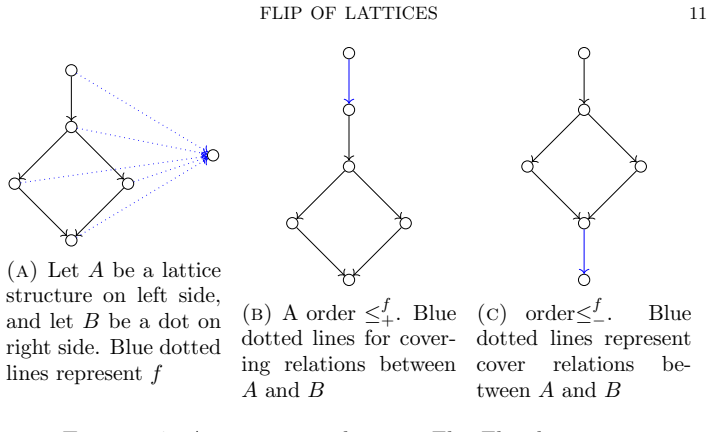
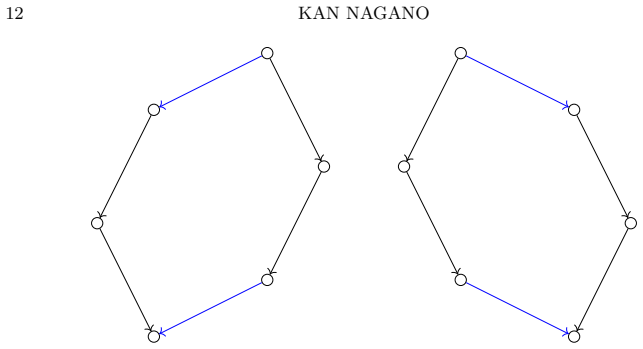
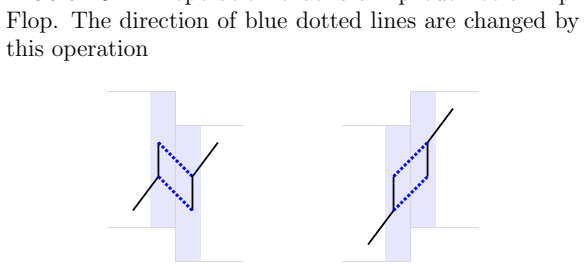
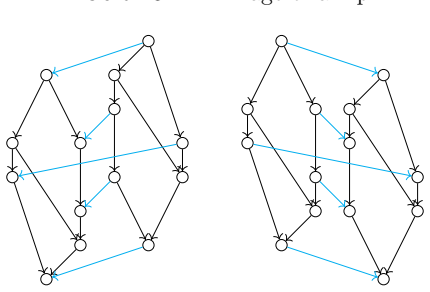
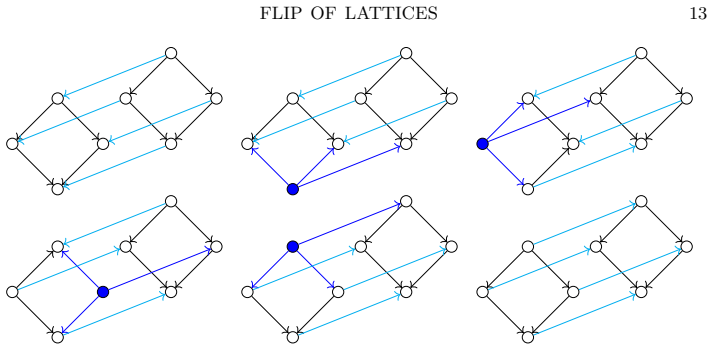
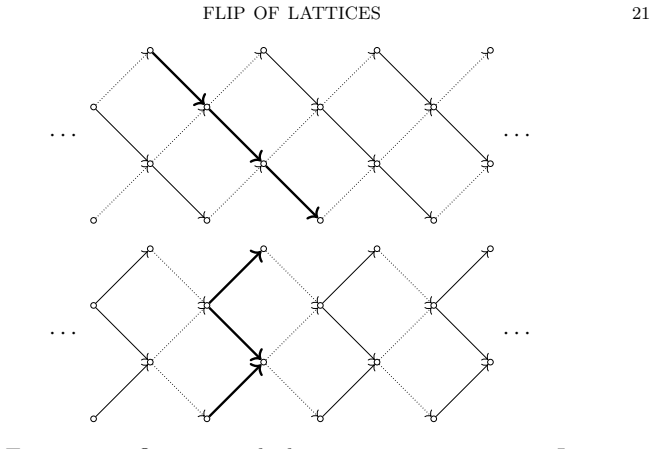
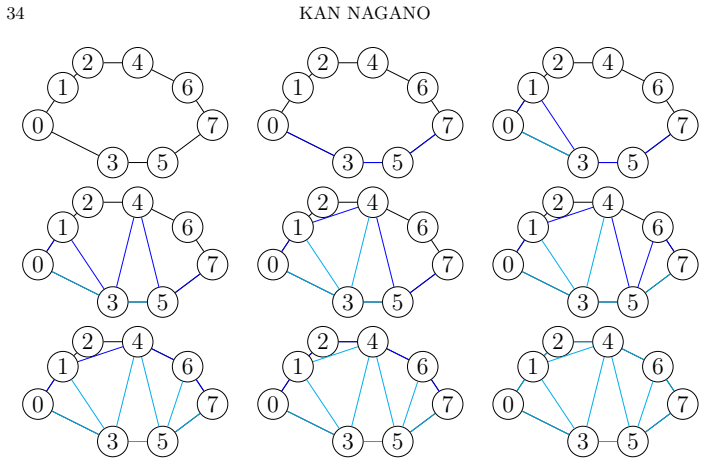
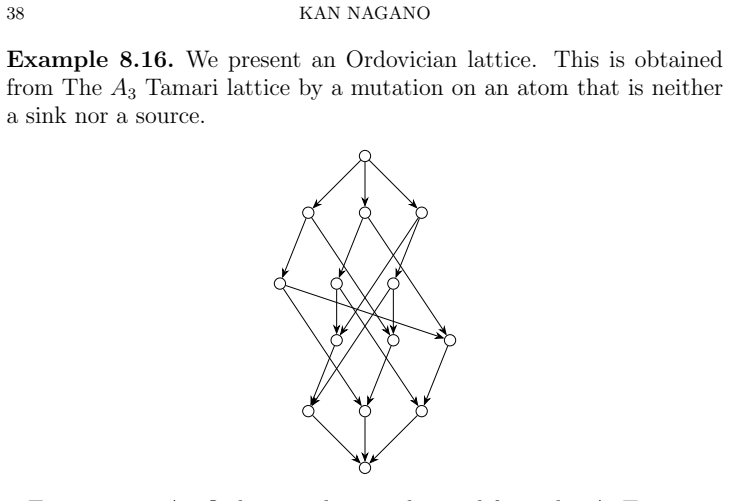
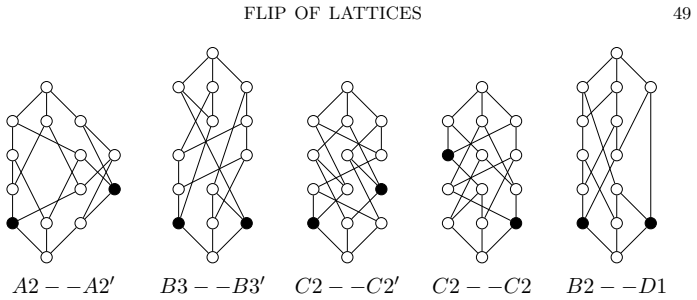
We introduce the flip operation on arbitrary posets. A mutation is defined to be a flip that maps a lattice to a lattice. We give a necessary and sufficient combinatorial condition for a flip to be a mutation. We prove that every mutable lattice is semidistributive. We show that type-A and type-B Cambrian lattices are locally mutable and that Cambrian lattices associated with finite-type Coxeter quivers of different orientations are related by sequences of mutations. We define Ordovician lattices as those obtained from Cambrian lattices by iterated mutations.
What carries the argument
The flip operation on a poset, which qualifies as a mutation exactly when it sends a lattice to another lattice and thereby allows the definition of mutable and locally mutable lattices.
If this is right
- Every mutable lattice is semidistributive.
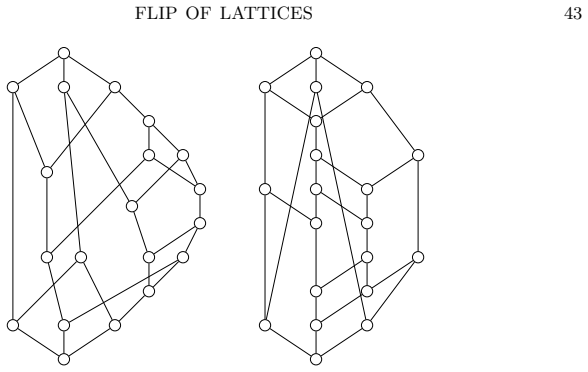
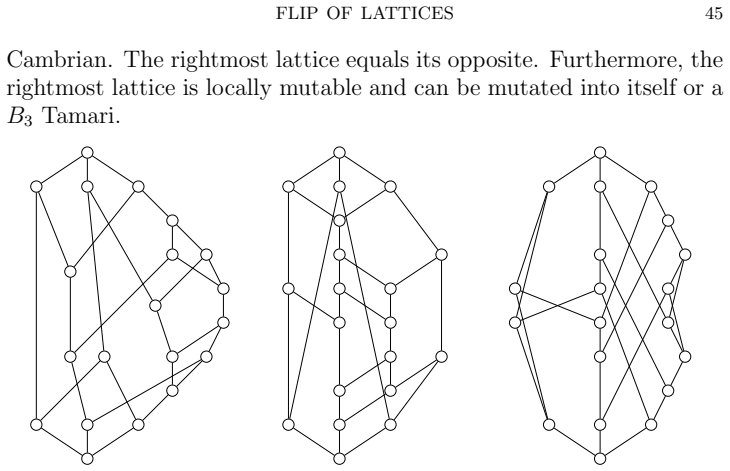
- Type-A and type-B Cambrian lattices are locally mutable under the flip operation.
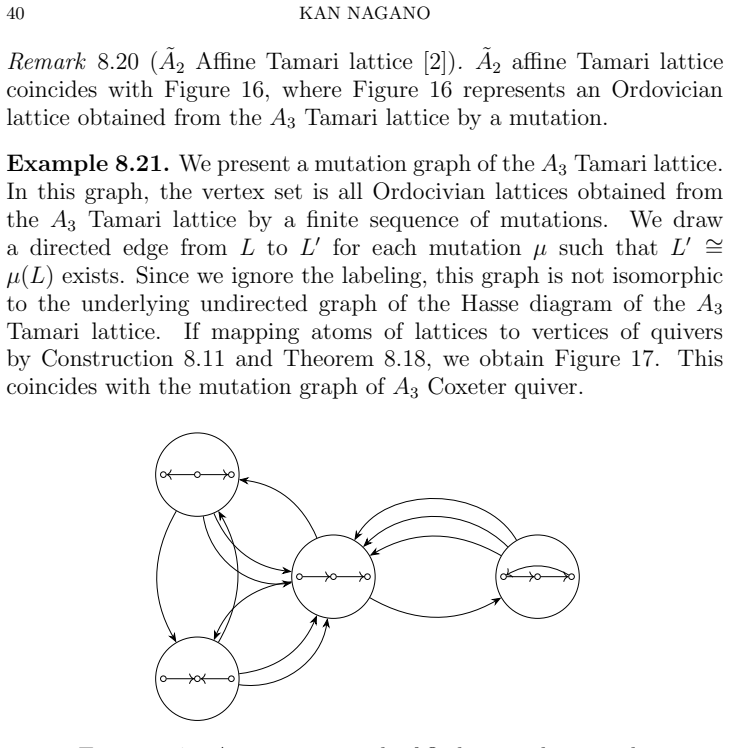
- Cambrian lattices arising from different orientations of finite-type Coxeter quivers are connected by finite sequences of mutations.
- Ordovician lattices form the class obtained by applying iterated mutations to Cambrian lattices.
Where Pith is reading between the lines
- The conjectured compatibility between this mutation and cluster-algebra mutations would give a direct combinatorial link between poset flips and quiver mutations.
- Ordovician lattices may possess additional uniform properties, such as controlled join-irreducible elements or rank functions, inherited from the mutation process.
- The family of locally mutable lattices could be used to generate and classify further examples of semidistributive lattices through explicit combinatorial constructions.
Load-bearing premise
The flip operation is well-defined and composable on arbitrary posets so that the condition for being a mutation can be verified by direct combinatorial checks without extra external data.
What would settle it
An explicit example of a lattice that admits a flip satisfying the given combinatorial mutation condition yet fails to be semidistributive, or a flip on a known lattice that produces a non-lattice structure.
Figures




read the original abstract
In this paper, we introduce a new combinatorial operation, called a flip, on arbitrary partially ordered sets. We define a mutation to be a flip that maps a lattice to a lattice. We study properties of flips, and give a necessary and sufficient condition for a flip to be a mutation. We introduce locally mutable lattices and mutable lattices in terms of flips, and prove that mutable lattices are semidistributive. We show that type-A and type-B Cambrian lattices are locally mutable, and those associated with the finite-type Coxeter quivers with different orientations are related also by the sequence of mutations. Finally we introduce a new class of lattices, called Ordovician lattices, as the lattices obtained from Cambrian lattices by iterated mutations. We provide conjectures on the structure of Ordovician lattices and on the compatibility between our mutation and the mutation in the theory of cluster algebras.
Editorial analysis
A structured set of objections, weighed in public.
Referee Report
Summary. The manuscript introduces a flip operation on arbitrary posets, defines a mutation as a flip that maps a lattice to a lattice, provides a necessary and sufficient condition for a flip to be a mutation, proves that mutable lattices are semidistributive, shows that type-A and type-B Cambrian lattices are locally mutable and that those associated with finite-type Coxeter quivers of different orientations are related by sequences of mutations, and defines Ordovician lattices as those obtained from Cambrian lattices by iterated mutations, along with conjectures on their structure and compatibility with cluster-algebra mutations.
Significance. If the flip is intrinsically well-defined from the order relation alone and the necessary-and-sufficient mutation condition holds combinatorially, the result that mutable lattices are semidistributive would give a new order-theoretic characterization with potential applications to Cambrian lattices and cluster combinatorics. The construction of Ordovician lattices via iterated mutations and the conjectural links to cluster-algebra mutations add interest, but their value depends on the robustness of the core definitions.
major comments (3)
- [Definition of flip and mutation condition] Definition of the flip (early sections): the claim that the flip is well-defined and composable on arbitrary posets using only the order relation must be verified explicitly; if the operation tacitly relies on labels, embeddings, or choices not recoverable from the poset alone, the necessary-and-sufficient condition for mutations cannot be checked purely combinatorially and the implication 'mutable implies semidistributive' fails to hold in general.
- [Proof of semidistributivity] Proof that mutable lattices are semidistributive: the derivation uses the mutation condition to establish semidistributivity; the argument should be checked for completeness on edge cases where a flip maps a lattice to a non-lattice or where composability fails, as these are load-bearing for the central claim.
- [Cambrian lattices and mutations] Cambrian lattice claims: the statements that type-A and type-B Cambrian lattices are locally mutable and that different orientations are related by mutation sequences require explicit constructions or verification that the flips satisfy the necessary-and-sufficient condition in these concrete cases.
minor comments (2)
- [Terminology and definitions] Notation for 'locally mutable' versus 'mutable' should be used consistently when defining the new classes of lattices.
- [Conjectures] The conjectures on Ordovician lattices and cluster-algebra compatibility would benefit from at least one additional concrete example or partial result to illustrate the claims.
Simulated Author's Rebuttal
We thank the referee for the careful reading and constructive feedback. We address each major comment below, clarifying the combinatorial nature of our definitions and indicating revisions to enhance explicitness.
read point-by-point responses
-
Referee: [Definition of flip and mutation condition] Definition of the flip (early sections): the claim that the flip is well-defined and composable on arbitrary posets using only the order relation must be verified explicitly; if the operation tacitly relies on labels, embeddings, or choices not recoverable from the poset alone, the necessary-and-sufficient condition for mutations cannot be checked purely combinatorially and the implication 'mutable implies semidistributive' fails to hold in general.
Authors: The flip is defined in Section 2 solely from the poset order: for a poset P, the flip at an element x replaces the principal ideal and filter generated by x with their order-duals while preserving all other relations, using only covering relations and the partial order to determine the new comparabilities. No labels, embeddings, or external choices are involved. We will insert an explicit lemma (new Lemma 2.3) proving well-definedness and composability for arbitrary posets, allowing the mutation condition to be checked combinatorially. revision: partial
-
Referee: [Proof of semidistributivity] Proof that mutable lattices are semidistributive: the derivation uses the mutation condition to establish semidistributivity; the argument should be checked for completeness on edge cases where a flip maps a lattice to a non-lattice or where composability fails, as these are load-bearing for the central claim.
Authors: Theorem 3.1 derives semidistributivity from the necessary-and-sufficient mutation condition (Theorem 2.5), which by definition requires the image to be a lattice; non-mutating flips are excluded from consideration. Composability is ensured by the local-mutability hypothesis. We will add a short paragraph after the proof explicitly addressing the excluded edge cases (flips that fail to produce lattices) and confirming that the semidistributivity implication holds precisely when the mutation condition is satisfied. revision: partial
-
Referee: [Cambrian lattices and mutations] Cambrian lattice claims: the statements that type-A and type-B Cambrian lattices are locally mutable and that different orientations are related by mutation sequences require explicit constructions or verification that the flips satisfy the necessary-and-sufficient condition in these concrete cases.
Authors: Sections 4 and 5 already supply explicit flip constructions for type-A and type-B Cambrian lattices (via their labeling by almost-positive roots and covering relations) together with direct verification that each flip meets the mutation condition of Theorem 2.5. For distinct orientations of finite-type Coxeter quivers we list the explicit mutation sequences and verify each step. We will expand these verifications with additional small-case tables and a general inductive argument in the revised version. revision: partial
Circularity Check
No significant circularity; derivation is self-contained from new definitions
full rationale
The paper defines a flip operation on arbitrary posets, defines mutation as a flip preserving the lattice property, introduces locally mutable and mutable lattices via these operations, and proves semidistributivity directly from the necessary-and-sufficient combinatorial condition on flips. Cambrian lattices are shown locally mutable by explicit verification, and Ordovician lattices are defined as iterated mutations. No self-citations, fitted parameters renamed as predictions, ansatzes smuggled via prior work, or reductions of the central claims to their own inputs by construction appear. The load-bearing steps (well-definedness of flip, the nec+suff mutation criterion, and the semidistributivity proof) are presented as combinatorial verifications internal to the new framework, making the derivation independent of external fitted data or self-referential loops.
Axiom & Free-Parameter Ledger
axioms (1)
- standard math Standard axioms and properties of partially ordered sets and lattices (e.g., reflexivity, antisymmetry, transitivity, existence of meets and joins where required).
invented entities (2)
-
Flip operation
no independent evidence
-
Ordovician lattices
no independent evidence
Reference graph
Works this paper leans on
- [1]
-
[2]
Grant Barkley and Colin Defant.The affine tamari lattice.preprint. arXiv:2502.07198, 2025
-
[3]
Emily Barnard, Emily Gunawan, Emily Meehan, and Ralf Schiffler.Cambrian combinatorics on quiver representations (typeA). Adv. in Appl. Math., Vol. 143, pp. Paper No. 102428, 37, 2023
work page 2023
-
[4]
Arkady Berenstein, Sergey Fomin, and Andrei Zelevinsky.Cluster algebras. III. Upper bounds and double Bruhat cells. Duke Math. J., Vol. 126, No. 1, pp. 1–52, 2005
work page 2005
-
[5]
Brian Davey and Hilary Priestley.Introduction to Lattices and Order.Cam- bridge University Press, 2 edition, 2002. 312pp
work page 2002
-
[6]
Laurent Demonet, Osamu Iyama, Nathan Reading, Idun Reiten, and Hugh Thomas.Lattice theory of torsion classes: beyondτ-tilting theory. Trans. Amer. Math. Soc. Ser. B, Vol. 10, pp. 542–612, 2023
work page 2023
-
[7]
Harm Derksen, Jerzy Weyman, and Andrei Zelevinsky.Quivers with potentials and their representations. I. Mutations. Selecta Math. (N.S.), Vol. 14, No. 1, pp. 59–119, 2008
work page 2008
-
[8]
Matthew Dyer.On the weak order of Coxeter groups. Canad. J. Math., Vol. 71, No. 2, pp. 299–336, 2019
work page 2019
-
[9]
Rei Inoue, Tsukasa Ishibashi and Hironori Oya.Cluster realizations of Weyl groups and higher Teichm¨ uller theory. Selecta Math. (N.S.), Vol. 27, No. 3, Paper No. 37, 84 pp, 2021
work page 2021
-
[10]
Sergey Fomin and Andrei Zelevinsky.Cluster algebras. I. Foundations. J. Amer. Math. Soc., Vol. 15, No. 2, pp. 497–529, 2002
work page 2002
-
[11]
Sergey Fomin and Andrei Zelevinsky.Cluster algebras. II. Finite type classifi- cation. Invent. Math., Vol. 154, No. 1, pp. 63–121, 2003
work page 2003
-
[12]
Sergey Fomin and Andrei Zelevinsky.Cluster algebras. IV. Coefficients. Com- pos. Math., Vol. 143, No. 1, pp. 112–164, 2007
work page 2007
-
[13]
Cambridge University Press, 1990
James Humphreys.Reflection Groups and Coxeter Groups.Cambridge Studies in Advanced Mathematics. Cambridge University Press, 1990. 220pp
work page 1990
- [14]
-
[15]
Nathan Reading.Cambrian lattices. Adv. Math., Vol. 205, No. 2, pp. 313–353, 2006
work page 2006
-
[16]
Nathan Reading.Lattice theory of the poset of regions.In:Lattice theory: special topics and applications. Vol. 2.Birkh¨auser/Springer, Cham, 2016, pp. 399–487
work page 2016
-
[17]
Nathan Reading and David Speyer.Cambrian fans.In:J.Eur. Math. Soc. (JEMS), 11.2 (2009), pp. 407–447. FLIP OF LATTICES 51
work page 2009
-
[18]
Nathan Reading, David Speyer, and Hugh Thomas.The fundamental theorem of finite semidistributive lattices. Selecta Math. (N.S.), Vol. 27, No. 4, pp. Paper No. 59, 53, 2021
work page 2021
-
[19]
Dov Tamari.The algebra of bracketings and their enumeration. Nieuw Arch. Wisk. (3), Vol. 10, pp. 131–146, 1962
work page 1962
-
[20]
Kyoritsu Shuppan Co., Ltd., 2009
Tsurane Iwamura.Sokuron. Kyoritsu Shuppan Co., Ltd., 2009. 162pp. Reprint. Originally published: Tsurane Iwamura, Kyoritsu Shuppan Co., Ltd., 1965
work page 2009
discussion (0)
Sign in with ORCID, Apple, or X to comment. Anyone can read and Pith papers without signing in.