Recognition: 2 theorem links
· Lean TheoremSymmetric Sudoku-Type Games from Perfect Codes
Pith reviewed 2026-05-12 03:54 UTC · model grok-4.3
The pith
Lee-distance and diameter perfect codes tile grids to define symmetric Sudoku-type games.
A machine-rendered reading of the paper's core claim, the machinery that carries it, and where it could break.
Core claim
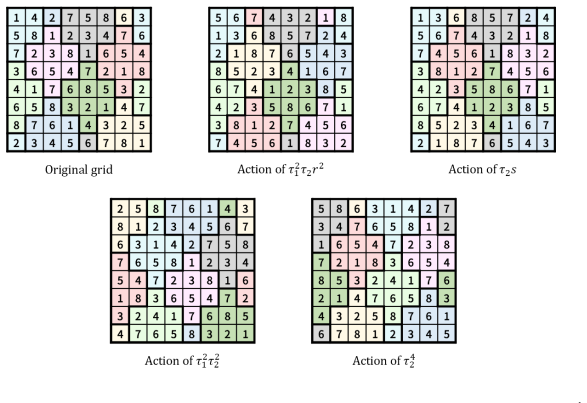
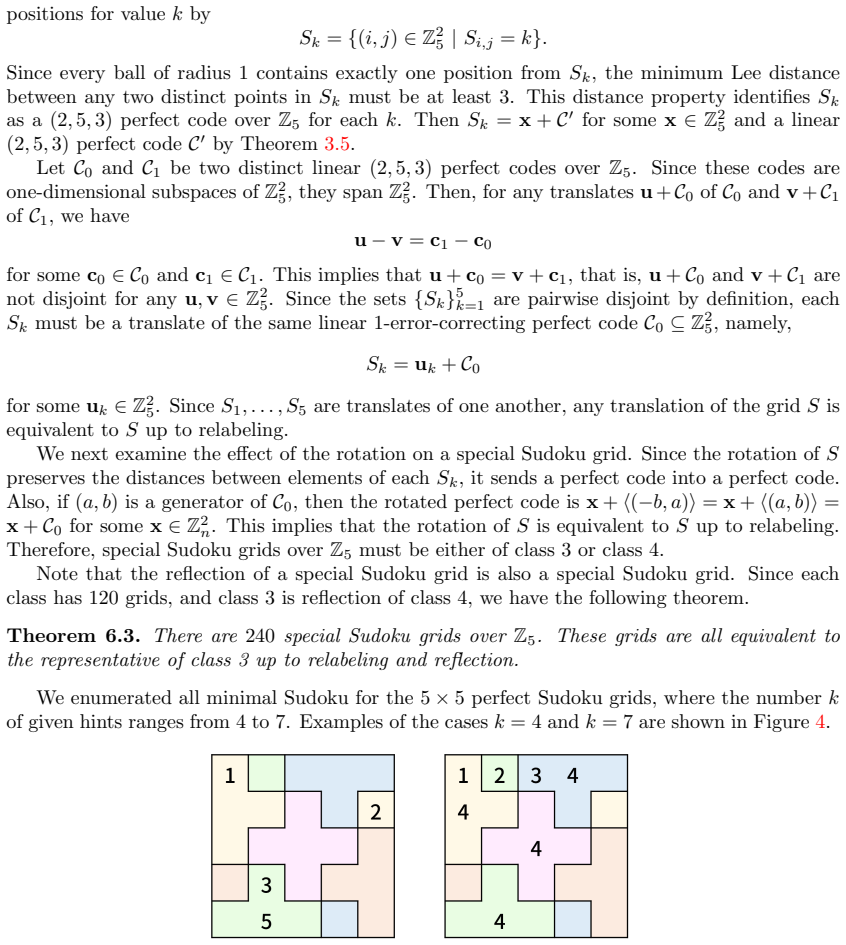
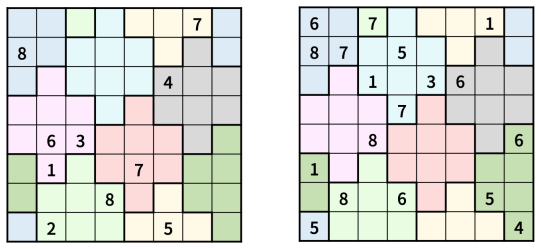
The tiling property of Lee-distance perfect codes and diameter perfect codes can be used to define the subgrid constraints of Sudoku-type games that inherit the symmetric properties of Sudoku, with complete enumeration yielding 17 inequivalent 5x5 solutions and 232735 and 304014 inequivalent 8x8 solutions for the two variants.
What carries the argument
Tiling property of perfect codes in the Lee metric and diameter metric that partitions the grid into subgrids for the puzzle constraints.
If this is right
- The constructed games are valid Latin squares with the added block constraints.
- There exist thousands of distinct symmetric Sudoku puzzles on these small grids.
- The 5x5 versions can be solved at varying difficulty levels by human-like algorithms.
Where Pith is reading between the lines
- This construction could extend to other grid sizes where perfect codes exist in the respective metrics.
- The symmetry might allow for efficient generation of new puzzle instances without manual design.
Load-bearing premise
The subgrids induced by the perfect-code tilings automatically satisfy the global Latin-square condition without additional verification or adjustment.
What would settle it
An explicit grid generated from one of these perfect-code tilings in which a row or column contains repeated symbols would show the construction does not always produce valid games.
Figures




read the original abstract
This paper presents a novel construction method for symmetric Sudoku-type games based on Lee distance perfect codes and diameter perfect codes. The proposed method utilizes the tiling property of these codes to define the structure of the subgrid constraints of Sudoku-type games. In this way, our games inherit the symmetric properties of Sudoku. We provide a detailed analysis of two small cases: a $5 \times 5$ Sudoku in $\mathbb{Z}_5^2$, and an $8 \times 8$ Sudoku in $\mathbb{Z}_8^2$. By defining equivalence relations via rigid motions, we provide a complete enumeration of valid grids, identifying 17 inequivalent solutions for $5\times 5$ Sudoku. For two different types of $8\times 8$ Sudoku, we characterize 232,735 and 304,014 inequivalent solutions, respectively. Furthermore, to verify practical playability, we implement a human-like solver that assesses the difficulty of the generated games. The analysis confirms that our $5\times5$ Sudoku games offer a balanced distribution of difficulty levels, ranging from Easy to Hard, making them a viable alternative to traditional $9 \times 9$ Sudoku.
Editorial analysis
A structured set of objections, weighed in public.
Referee Report
Summary. The paper proposes a construction of symmetric Sudoku-type games by using the tiling properties of Lee-distance perfect codes and diameter perfect codes to define subgrid (block) constraints in Z_5^2 and Z_8^2. It performs complete enumerations of valid grids under equivalence by rigid motions, reporting 17 inequivalent 5x5 solutions and 232735/304014 inequivalent solutions for the two 8x8 variants, and implements a human-like solver to classify the difficulty of generated puzzles.
Significance. If the enumerated grids are confirmed to be Latin squares satisfying both the row/column uniqueness and the code-derived block constraints, the work supplies a mathematically structured family of Sudoku variants together with concrete combinatorial counts and playability data. The explicit enumerations and solver-based difficulty assessment constitute verifiable contributions that could support further study of code-based designs in combinatorial puzzle theory.
major comments (2)
- [construction section (Section 2)] The central construction (detailed in the section on the method using perfect-code tilings) asserts that the induced subgrids automatically yield Sudoku-type games inheriting symmetric properties. However, no explicit argument or verification is given that each row and each column intersects the subgrids so that the block uniqueness propagates to enforce exactly one occurrence of each symbol per row and per column. This verification is load-bearing for the validity of the reported solution counts and the claim that the games are Sudoku-type.
- [enumeration results (Section 4)] In the enumeration results for the 8x8 cases (Section 4), the counts 232735 and 304014 inequivalent solutions are presented without an accompanying description of how the rigid-motion equivalence classes were computed or whether an independent post-enumeration check confirmed that all listed grids satisfy the global Latin-square condition in addition to the block constraints.
minor comments (3)
- [Abstract] The abstract refers to 'a balanced distribution of difficulty levels' for the 5x5 games but does not include even summary percentages or a reference to the table or figure that supports this statement.
- [preliminaries] Notation for the Lee-distance and diameter perfect codes, as well as the precise definition of the induced subgrids, would benefit from an additional sentence or two of clarification or a pointer to standard references in coding theory.
- [solver implementation] The description of the human-like solver would be improved by the inclusion of pseudocode or a short algorithmic outline to aid reproducibility of the difficulty assessment.
Simulated Author's Rebuttal
We thank the referee for the careful reading and constructive comments on our manuscript. We address each major comment point by point below and will revise the paper accordingly to improve clarity and completeness.
read point-by-point responses
-
Referee: [construction section (Section 2)] The central construction (detailed in the section on the method using perfect-code tilings) asserts that the induced subgrids automatically yield Sudoku-type games inheriting symmetric properties. However, no explicit argument or verification is given that each row and each column intersects the subgrids so that the block uniqueness propagates to enforce exactly one occurrence of each symbol per row and per column. This verification is load-bearing for the validity of the reported solution counts and the claim that the games are Sudoku-type.
Authors: We appreciate the referee drawing attention to this aspect of the construction. The perfect codes (Lee-distance and diameter) induce a tiling of Z_n^2 whose blocks are the cosets of the code; because the underlying space is an abelian group and the codes are subgroups or have regular translational symmetry, each row (fixed second coordinate) and each column (fixed first coordinate) intersects every block in precisely one cell. Consequently, the uniqueness of symbols within each block automatically enforces the Latin-square condition on rows and columns. We acknowledge that this implication was left implicit rather than stated as a short lemma. In the revised version we will insert an explicit verification paragraph (or lemma) in Section 2 that derives the row/column uniqueness directly from the tiling property. revision: yes
-
Referee: [enumeration results (Section 4)] In the enumeration results for the 8x8 cases (Section 4), the counts 232735 and 304014 inequivalent solutions are presented without an accompanying description of how the rigid-motion equivalence classes were computed or whether an independent post-enumeration check confirmed that all listed grids satisfy the global Latin-square condition in addition to the block constraints.
Authors: We agree that the enumeration section would benefit from additional methodological transparency. The grids were generated by a depth-first backtracking search that enforces the block constraints at each step; during generation we also maintained running checks that each row and column contained distinct symbols, thereby guaranteeing the Latin-square property by construction. Equivalence classes under the dihedral group of rigid motions were computed by generating the full orbit of each representative and using a canonical labeling (lexicographically smallest grid in the orbit) to deduplicate. We will add a concise subsection to Section 4 describing the backtracking procedure, the orbit computation, and the built-in Latin-square verification. revision: yes
Circularity Check
No circularity: construction from known code tilings with independent computational enumeration
full rationale
The paper constructs the Sudoku-type games by directly applying the established tiling properties of Lee-distance perfect codes and diameter perfect codes to partition the grid into subgrids that define the block constraints. It then computationally enumerates all grids satisfying the full set of Sudoku rules (including row/column uniqueness) under these partitions, yielding the reported counts of inequivalent solutions, and separately implements a solver to assess difficulty. No derivation step reduces by construction to its own inputs, no parameters are fitted and relabeled as predictions, and no load-bearing uniqueness theorem or ansatz is justified solely via self-citation. The central results are independent outputs of the enumeration process rather than tautological restatements of the code tilings.
Axiom & Free-Parameter Ledger
axioms (1)
- domain assumption Perfect codes in the Lee metric and diameter metric tile the space Z_n^2 such that the tiles can serve as Sudoku subgrids while preserving the Latin-square property.
Lean theorems connected to this paper
-
IndisputableMonolith/Cost/FunctionalEquation.leanwashburn_uniqueness_aczel unclearThe palette grid I_C … for each (x,y) in B_t(c_i) the entry … is set to i. … S_I is orthogonal to the palette grid I_C.
-
IndisputableMonolith/Foundation/AlexanderDuality.leanalexander_duality_circle_linking unclearTheorem 3.5 … linear t-error-correcting perfect code … generator matrix G=[1 2t+1]
Reference graph
Works this paper leans on
-
[1]
R. A. Bailey, P. J. Cameron, and R. Connelly. Sudoku, gerechte designs, resolutions, affine space, spreads, reguli, and Hamming codes. The American Mathematical Monthly, 115(5), 383-404. (2008)
work page 2008
-
[2]
A. E. Brouwer. Sudoku games and how to solve them. European Mathematical Society Newsletter, 66, 13-17. (2007)
work page 2007
-
[3]
P. J. Cameron, and J. H. Van Lint.Graph theory, Coding Theory and Block Designs(Vol. 19). Cambridge University Press. (1975) 22
work page 1975
- [4]
-
[5]
J. P. Delahaye. The science behind Sudoku. Scientific American, 294(6), 80-87. (2006)
work page 2006
- [6]
-
[7]
Etzion.Perfect Codes and Related Structures
T. Etzion.Perfect Codes and Related Structures. World Scientific Publishing. (2022)
work page 2022
-
[8]
T. Etzion, and A. Vardy. On perfect codes and tilings: Problems and solutions. SIAM Journal on Discrete Mathematics, 11(2), 205-223. (1998)
work page 1998
-
[9]
B. Felgenhauer, and F. Jarvis. Mathematics of Sudoku I. Mathematical Spectrum, 39(1), 15-22. (2006)
work page 2006
-
[10]
S.W. Golomb and L.R. Welch. Perfect codes in the Lee Metric and the Packing of Polyno- mials. SIAM Journal on Applied Mathematics, 18(2), 302-317. (1970)
work page 1970
-
[11]
M. G¨ uzeltepe and O. Heden. Perfect Mannheim, Lipschitz and Hurwitz weight codes. Math- ematical Communications 19(2), 253-276. (2014)
work page 2014
-
[12]
A.S. Hedayat, N.J.A. Sloane and J. Stufken.Orthogonal Arrays: Theory and Applications. Springer, New York, 1999
work page 1999
-
[13]
W. C. Huffman, and V. Pless.Fundamentals of Error-Correcting Codes. Cambridge univer- sity press. (2010)
work page 2010
-
[14]
J.-L. Kim, and J.-H. Baek. Perfect Sudoku. [Online]. Available:https://cicagolab. pythonanywhere.com
-
[15]
D. S. Krotov. Projective tilings and full-rank perfect codes. Designs, Codes and Cryptogra- phy, 91(10), 3293-3303. (2023)
work page 2023
- [16]
-
[17]
W. Lyu, D. Yin, Y. Zhang, and J. Deng. A reliable data hiding scheme using jigsaw Su- doku. 2018 International Conference on Network, Communication, Computer Engineering. Atlantis Press, 805-812. (2018)
work page 2018
-
[18]
G. McGuire, B. Tugemann, G. Civario. There is no 16-clue Sudoku: Solving the Sudoku minimum number of clues problem via hitting set enumeration. Experimental Mathematics, 23(2), 190-217. (2014)
work page 2014
-
[19]
U. Mushrraf and F. Zullo. On perfect symmetric rank-metric codes. Archiv der Mathematik, 125(3), 259-271. (2025)
work page 2025
- [20]
-
[21]
E. Russell, and F. Jarvis. Mathematics of Sudoku II. Mathematical Spectrum, 39(2), 54-58. (2006)
work page 2006
-
[22]
C. E. Shannon. A mathematical theory of communication. The Bell System Technical Jour- nal 27(3), 379-423. (1948) 23
work page 1948
-
[23]
T. Yato, and T. Seta. Complexity and completeness of finding another solution and its application to games. IEICE transactions on fundamentals of electronics, communications and computer sciences, 86(5), 1052-1060. (2003) 24
work page 2003
discussion (0)
Sign in with ORCID, Apple, or X to comment. Anyone can read and Pith papers without signing in.