Recognition: 2 theorem links
· Lean TheoremSpin-flavor entanglement in Λ_b to Λ D and weak phase extraction
Pith reviewed 2026-05-12 02:45 UTC · model grok-4.3
The pith
A spin-flavor entanglement in Lambda_b to Lambda D decays extracts the CKM weak phase gamma with uncertainty scaling as one over the Wootters concurrence.
A machine-rendered reading of the paper's core claim, the machinery that carries it, and where it could break.
Core claim
In Lambda_b to Lambda D decays, the correlation between Lambda spin and the neutral D flavor states (D zero, anti-D zero, D1, D2) forms a spin-flavor entangled system. The entanglement information resides in the decay rates and Lee-Yang parameters of these four modes. This structure supplies a new method to determine the weak phase gamma whose uncertainty scales as sigma gamma proportional to one over the Wootters concurrence C.
What carries the argument
The spin-flavor entanglement structure defined by the correlation between Lambda spin and neutral D flavor states, with its information content stored in the decay rates and Lee-Yang parameters of the four modes, which connects to gamma extraction through the Wootters concurrence.
If this is right
- The four neutral D modes together determine both the amount of entanglement and the value of gamma.
- Higher concurrence directly yields smaller experimental uncertainty on gamma.
- The method relies on the same set of observables for both entanglement quantification and phase extraction.
- This baryonic channel provides an independent route to gamma that does not rely on charged B meson decays.
Where Pith is reading between the lines
- If the concurrence can be measured separately, it could serve as an internal consistency check on the extracted gamma value.
- Analogous spin-flavor correlations may appear in other heavy baryon decays and could be used to probe CP violation in those systems.
- Existing LHCb data on Lambda_b production could be reanalyzed to search for the predicted entanglement pattern in the D modes.
Load-bearing premise
The decay rates and Lee-Yang parameters extracted from the four neutral D modes can be obtained without dominant backgrounds, final-state interactions, or systematics that would invalidate the direct scaling between concurrence and gamma uncertainty.
What would settle it
A measurement of the four decay modes in which the observed uncertainty on gamma fails to follow the predicted inverse scaling with the concurrence computed from the same rates and parameters, or in which the four-mode observables prove inconsistent with the expected entangled structure.
Figures
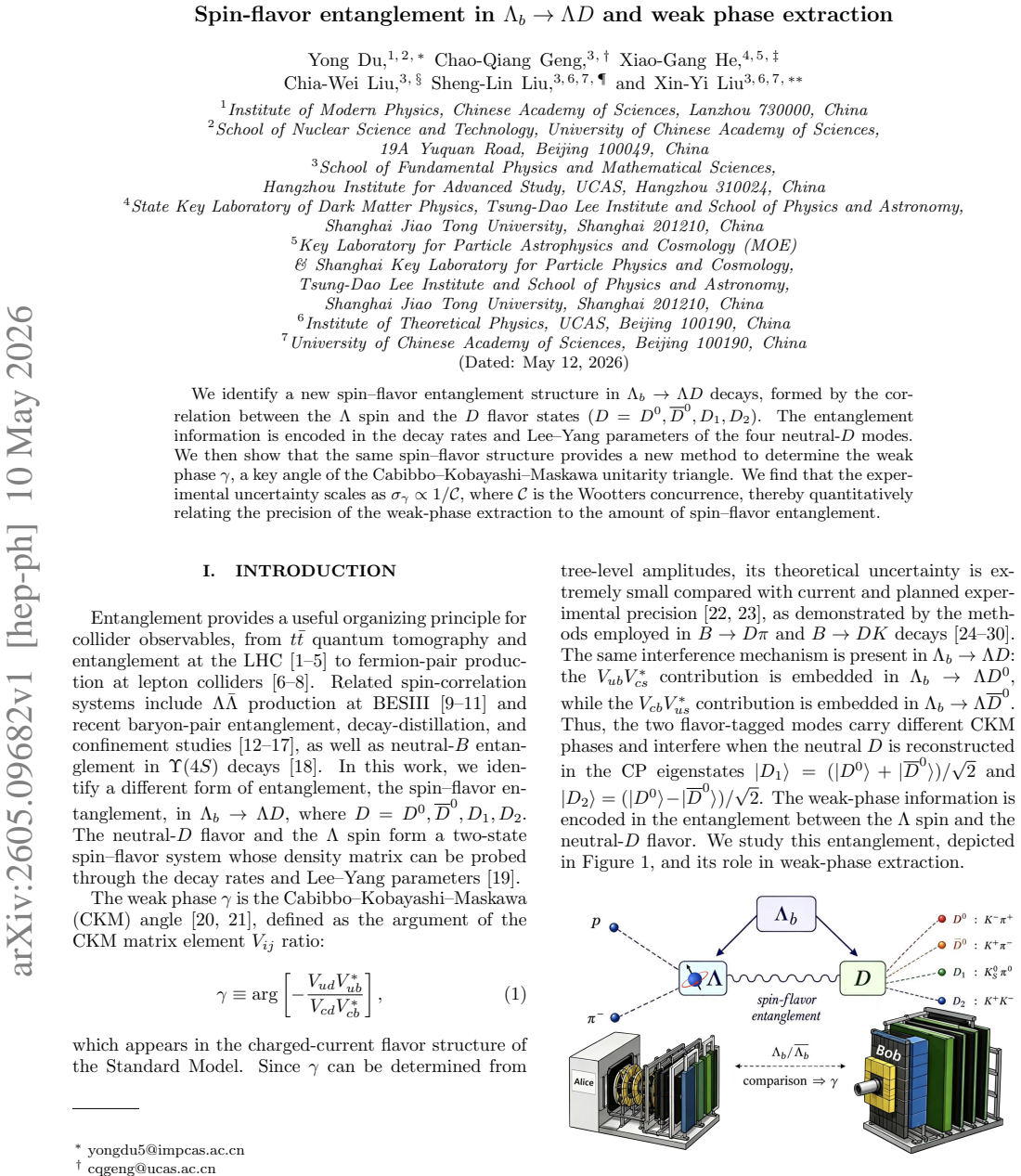


read the original abstract
We identify a new spin-flavor entanglement structure in $\Lambda_b\to\Lambda D$ decays, formed by the correlation between the $\Lambda$ spin and the $D$ flavor states ($D=D^0,\overline D^0,D_1,D_2$). The entanglement information is encoded in the decay rates and Lee-Yang parameters of the four neutral-$D$ modes. We then show that the same spin-flavor structure provides a new method to determine the weak phase $\gamma$, a key angle of the Cabibbo-Kobayashi-Maskawa unitarity triangle. We find that the experimental uncertainty scales as $\sigma_\gamma\propto 1/{\cal C}$, where ${\cal C}$ is the Wootters concurrence, thereby quantitatively relating the precision of the weak-phase extraction to the amount of spin-flavor entanglement.
Editorial analysis
A structured set of objections, weighed in public.
Referee Report
Summary. The paper identifies a spin-flavor entanglement structure in Λ_b → Λ D decays, with the Λ spin and D flavor (D^0, D-bar^0, D1, D2) treated as qubits. The entanglement is encoded in the decay rates and Lee-Yang parameters of the four neutral-D modes. The same structure is used to extract the CKM weak phase γ, with the experimental uncertainty shown to scale as σ_γ ∝ 1/C where C is the Wootters concurrence.
Significance. If the central derivation holds, the work establishes a quantitative link between a quantum-information measure (concurrence) and the precision of a fundamental CKM parameter extraction. The explicit scaling relation σ_γ ∝ 1/C is a concrete, falsifiable prediction that could guide experimental priorities at LHCb or Belle II if backgrounds and systematics permit a clean measurement of C. The approach is novel in applying two-qubit entanglement to b-hadron decays and merits attention if the observables for C and γ are demonstrably independent.
minor comments (3)
- Abstract and §2: the states D1 and D2 are introduced without explicit definition (e.g., whether they are CP eigenstates, mass eigenstates, or specific resonances); a one-sentence clarification is needed for readers outside the immediate subfield.
- The scaling relation σ_γ ∝ 1/C is stated as a central result; a short appendix or paragraph deriving the proportionality (including how the Fisher information or covariance matrix enters) would make the claim self-contained and easier to verify.
- Notation: the symbol C is used for concurrence while the same letter sometimes appears in decay amplitudes; a distinct symbol or explicit reminder in each section would prevent confusion.
Simulated Author's Rebuttal
We thank the referee for the positive assessment of our manuscript and for recommending minor revision. The referee's summary accurately reflects the central results on spin-flavor entanglement in Λ_b → Λ D decays and the resulting scaling of the uncertainty on γ with the Wootters concurrence.
Circularity Check
No significant circularity detected
full rationale
The paper's derivation begins with the Λ_b → Λ D decay amplitudes, from which the four neutral-D mode rates and Lee-Yang parameters are computed; these observables are shown to encode a spin-flavor entangled state whose Wootters concurrence C is extracted. A separate step then uses the same amplitudes to construct an estimator for the weak phase γ and derives the scaling σ_γ ∝ 1/C as a direct consequence of the two-qubit structure and the sensitivity of the interference terms to γ. This scaling is a mathematical relation obtained from the amplitude parametrization rather than a redefinition or statistical tautology in which γ or C is fitted and then relabeled as a prediction. No self-definitional step, fitted-input prediction, or load-bearing self-citation is present; the central claim (new extraction method whose precision is quantitatively tied to entanglement) retains independent content from the underlying decay dynamics. The analysis is therefore self-contained against external benchmarks.
Axiom & Free-Parameter Ledger
axioms (2)
- domain assumption Weak decays are governed by the standard CKM matrix with well-defined weak and strong phases
- standard math Wootters concurrence is the appropriate entanglement monotone for the spin-flavor state in this decay
Lean theorems connected to this paper
-
IndisputableMonolith/Cost/FunctionalEquation.leanwashburn_uniqueness_aczel unclearWe find that the experimental uncertainty scales as σ_γ ∝ 1/C, where C is the Wootters concurrence
-
IndisputableMonolith/Foundation/AlexanderDuality.leanalexander_duality_circle_linking unclearspin–flavor entanglement structure in Λ_b→ΛD decays
Reference graph
Works this paper leans on
-
[1]
Spin-flavor entanglement in $\Lambda_b \to \Lambda D$ and weak phase extraction
The weak-phase information is encoded in the entanglement between the Λ spin and the neutral-Dflavor. We study this entanglement, depicted in Figure 1, and its role in weak-phase extraction. Figure 1: Schematic plot for spin–flavor entanglement in Λb →ΛD, where Alice measures the spin and Bob the flavor. arXiv:2605.09682v1 [hep-ph] 10 May 2026 2 II. SPIN–...
work page internal anchor Pith review Pith/arXiv arXiv 2026
-
[2]
Y. Afik and J. R. M. de Nova, Eur. Phys. J. Plus136, 907 (2021), arXiv:2003.02280
-
[3]
Aadet al.(ATLAS Collaboration), Nature633, 542 (2024), arXiv:2311.07288
G. Aadet al.(ATLAS Collaboration), Nature633, 542 (2024), arXiv:2311.07288
-
[4]
Hayrapetyanet al.(CMS Collaboration), Rept
A. Hayrapetyanet al.(CMS Collaboration), Rept. Prog. Phys.87, 117801 (2024), arXiv:2406.03976
- [5]
- [6]
-
[7]
Y. J. Fang, A. Bhoonah, K. Cheng, T. Han, Y. Liu and H. Zhang, arXiv:2604.11887
work page internal anchor Pith review Pith/arXiv arXiv
-
[8]
K. Cheng and B. Yan, Phys. Rev. Lett.135, 1 (2025) arXiv:2501.03321
- [9]
-
[10]
Ablikimet al.(BESIII), Nature Phys.15, 631 (2019), arXiv:1808.08917 [hep-ex]
M. Ablikimet al.(BESIII Collaboration), Nature Phys. 15, 631 (2019), arXiv:1808.08917
-
[11]
E. Perotti, G. F¨ aldt, A. Kupsc, S. Leupold, and J. J. Song, Phys. Rev. D99, 056008 (2019), arXiv:1809.04038
- [12]
- [13]
- [14]
- [15]
- [16]
- [17]
- [18]
-
[19]
Goet al.(Belle Collaboration), Phys
A. Goet al.(Belle Collaboration), Phys. Rev. Lett.99, 131802 (2007), arXiv:quant-ph/0702267
-
[20]
T. D. Lee and C. N. Yang, Phys. Rev.108, 1645 (1957)
work page 1957
- [21]
- [22]
-
[23]
Navaset al.(Particle Data Group), Phys
S. Navaset al.(Particle Data Group), Phys. Rev. D110, 030001 (2024)
work page 2024
- [24]
- [25]
- [26]
- [27]
- [28]
- [29]
-
[30]
R. Aaijet al.(LHCb Collaboration), JHEP12, 141 (2021), arXiv:2110.02350
-
[31]
Adachiet al.(Belle and Belle II Collaborations), JHEP 10, 143 (2024), arXiv:2404.12817
I. Adachiet al.(Belle and Belle II Collaborations), JHEP 10, 143 (2024), arXiv:2404.12817
-
[32]
Weak decays beyond leading logarithms,
G. Buchalla, A. J. Buras and M. E. Lautenbacher, Rev. Mod. Phys.68, 1125 (1996), arXiv:hep-ph/9512380
- [33]
- [34]
-
[35]
W. K. Wootters, Phys. Rev. Lett.80, 2245 (1998)
work page 1998
-
[36]
Aaijet al.(LHCb Collaboration), Phys
R. Aaijet al.(LHCb Collaboration), Phys. Rev. Lett. 118, 052002 (2017); Erratum: Phys. Rev. Lett.119, 169901 (2017), arXiv:1612.05140
-
[37]
Vecchi (LHCb Collaboration), EPJ Web Conf.192, 00024 (2018)
S. Vecchi (LHCb Collaboration), EPJ Web Conf.192, 00024 (2018)
work page 2018
-
[38]
Aaijet al.(LHCb Collaboration), Phys
R. Aaijet al.(LHCb Collaboration), Phys. Rev. D100, 031102 (2019), arXiv:1902.06794
-
[39]
Z. Rui, Z. T. Zou, Y. Li and Y. Li, arXiv:2604.17877
work page internal anchor Pith review Pith/arXiv arXiv
- [40]
-
[41]
D. Buskulicet al.[ALEPH], Phys. Lett. B365, 437-447 (1996)
work page 1996
-
[42]
G. Abbiendiet al.[OPAL], Phys. Lett. B444, 539-554 (1998) arXiv:hep-ex/9808006
- [43]
- [44]
-
[45]
Aaijet al.[LHCb], JHEP06, 110 (2020) arXiv:2004.10563
R. Aaijet al.[LHCb], JHEP06, 110 (2020) arXiv:2004.10563
- [46]
- [47]
-
[48]
S. A. Abel, M. Dittmar, and H. K. Dreiner, Phys. Lett. B280, 304 (1992)
work page 1992
-
[49]
J. F. Clauser, M. A. Horne, A. Shimony, and R. A. Holt, Phys. Rev. Lett.23, 880 (1969)
work page 1969
-
[50]
R. Horodecki, P. Horodecki, and M. Horodecki, Phys. Lett. A200, 340 (1995). 7 Appendix A: Eigenstate decomposition Before turning to the state decomposition, we recall the quark-level Hamiltonian used in the main text: Heff = GF√ 2 VcbV ∗ us C1Q(c) 1 +C 2Q(c) 2 + VubV ∗ cs VcbV ∗us e−iγ C1Q(u) 1 +C 2Q(u) 2 + h.c. .(A1) With color indicesα, β, the four-qua...
work page 1995
-
[51]
It should be emphasized that|ψ Jz , ⃗ s,⃗k⟩ is not itself an eigenstate ofJ z
Momentum eigenstates For a Λb state with fixedJ z, the final state is projected onto momentum eigenstates as |ψJz , ⃗ s,⃗k⟩= ˆO⃗k,⃗ sHef f|Λb, Jz⟩,(A4) with the projector ˆO⃗k,⃗ s= X D |⃗k, ⃗ s; ΛD⟩⟨⃗k, ⃗ s; ΛD|.(A5) Here⃗ sdenotes the spin of Λ, and the state|ψJz , ⃗ s,⃗k⟩has not been normalized. It should be emphasized that|ψ Jz , ⃗ s,⃗k⟩ is not itself ...
-
[52]
Angular momentum eigenstates Let ⃗k=| ⃗k|(sinθcosϕ,sinθsinϕ,cosθ), where (θ, ϕ) are the spherical coordinates of the Λ momentum. The helicity angular-momentum eigenstates are defined by |Jz, λ; ΛD⟩= 1 2π Z dΩ| ⃗k, λ; ΛD⟩e iJzϕd1/2 Jzλ(θ).(A14) Hereλis the helicity of Λ. The helicity basis is related to the spin basis by |⃗k, λ=±1/2; ΛD⟩=| ⃗k, ⃗ s=±ˆk; ΛD⟩...
discussion (0)
Sign in with ORCID, Apple, or X to comment. Anyone can read and Pith papers without signing in.