Recognition: 2 theorem links
· Lean TheoremConFixGS: Learning to Fix Feedforward 3D Gaussian Splatting with Confidence-Aware Diffusion Priors in Driving Scenes
Pith reviewed 2026-05-12 03:31 UTC · model grok-4.3
The pith
ConFixGS repairs feedforward 3D Gaussian Splatting in driving scenes by validating diffusion enhancements against support-view consistency.
A machine-rendered reading of the paper's core claim, the machinery that carries it, and where it could break.
Core claim
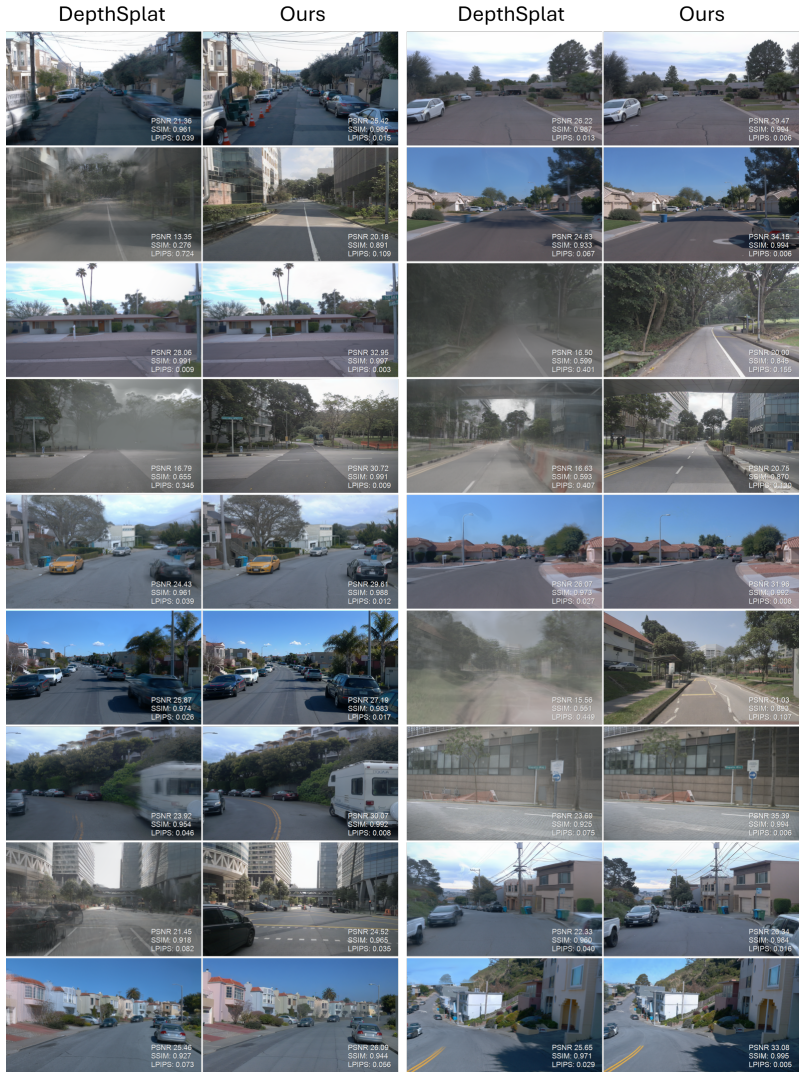
ConFixGS begins with a pretrained feedforward 3DGS model, produces diffusion-enhanced local pseudo-targets, and validates them through reprojection-based cross-checking against support views to build dense confidence maps. The maps then guide refinement so that reliable details from the priors are kept while hallucinated or inconsistent evidence is suppressed. On Waymo, nuScenes, and KITTI this yields improved novel view synthesis with PSNR gains of up to 3.68 dB and FID reduced by nearly half.
What carries the argument
The confidence-aware fusion pipeline that creates diffusion-enhanced pseudo-targets and filters them via reprojection cross-checking to produce dense maps that control refinement.
If this is right
- Feedforward 3DGS models become usable for challenging sparse-view driving reconstructions without per-scene optimization.
- Diffusion priors can be safely integrated into geometric reconstruction pipelines when filtered by view-consistency checks.
- Novel view synthesis quality improves measurably on standard autonomous-driving benchmarks.
- The same confidence-guided principle can be applied to other generative priors beyond diffusion.
Where Pith is reading between the lines
- The approach may generalize to indoor or handheld sparse-view settings if the cross-checking remains robust to different motion patterns.
- Reducing hallucinations in this way could lower the camera density required for acceptable 3D driving maps.
- If the refinement step is made efficient, the method could support online map updates from vehicle fleets.
Load-bearing premise
Reprojection cross-checking against support views can reliably separate useful diffusion-enhanced details from hallucinated or inconsistent content in trajectory-based sparse-view driving scenes.
What would settle it
Running the refinement step without the confidence maps and measuring whether PSNR on held-out novel views drops below the reported gains or whether visual artifacts increase in regions the maps previously down-weighted.
Figures




read the original abstract
Feedforward 3D Gaussian Splatting (3DGS) often struggles in trajectory-based sparse-view driving scenes. Existing Gaussian repair methods mainly target optimization-based 3DGS, while diffusion-based repair is typically restricted to iterative refinement near observed viewpoints, leaving feedforward 3DGS repair underexplored. We propose ConFixGS, a plug-and-play method that learns to fix feedforward 3DGS with confidence-aware diffusion priors. Starting from a pretrained feedforward model, ConFixGS generates diffusion-enhanced local pseudo-targets and validates them through reprojection-based cross-checking against support views. The resulting dense confidence maps guide refinement, enhancing reliable details while suppressing hallucinated or inconsistent evidence. On Waymo, nuScenes, and KITTI, ConFixGS improves challenging novel view synthesis, with PSNR gains of up to 3.68 dB and FID reduced by nearly half. Our results highlight confidence-aware fusion of generative priors and support-view consistency as a key principle for robust feedforward 3D driving scene reconstruction.
Editorial analysis
A structured set of objections, weighed in public.
Referee Report
Summary. The manuscript introduces ConFixGS, a plug-and-play refinement method for feedforward 3D Gaussian Splatting in trajectory-based sparse-view driving scenes. It generates diffusion-enhanced local pseudo-targets from pretrained diffusion models and validates them via reprojection-based cross-checking against support views to produce dense confidence maps. These maps then guide refinement of the initial 3DGS output, aiming to retain reliable details while suppressing hallucinations. The authors report quantitative gains on Waymo, nuScenes, and KITTI, with PSNR improvements up to 3.68 dB and FID reduced by nearly half for novel view synthesis.
Significance. If the confidence-aware filtering step proves reliable, the work would offer a practical advance for feedforward 3D reconstruction in autonomous driving by integrating generative priors without per-scene optimization. The focus on geometric consistency checks to control diffusion outputs addresses a relevant limitation in sparse-view settings and could influence hybrid reconstruction pipelines. The reported metrics indicate potential utility, though the absence of supporting implementation details and targeted validation limits immediate assessment of broader impact.
major comments (1)
- [Method (confidence map generation and refinement)] The core claim rests on the reprojection cross-checking step (described in the method overview and confidence map generation) reliably distinguishing useful diffusion-enhanced content from hallucinations. In the low-parallax, near-collinear trajectory regimes of the evaluated datasets, this check may fail to expose geometrically coherent but incorrect syntheses (e.g., fabricated lane markings or foliage) that reproject consistently across the limited support views. This is load-bearing for the reported PSNR/FID gains, as high-confidence erroneous regions would be incorporated into the refined 3DGS. The manuscript provides no dedicated analysis, ablation on baseline distance, or controlled hallucination tests to substantiate the filtering efficacy.
minor comments (2)
- [Abstract] The abstract states concrete PSNR and FID numbers without specifying the exact baseline feedforward model, dataset splits, or comparison methods used to compute the 'up to 3.68 dB' gain.
- [Method and Experiments] No implementation details, diffusion model architecture, or training procedure for the confidence predictor are provided, which hinders reproducibility of the plug-and-play claim.
Simulated Author's Rebuttal
We thank the referee for the constructive feedback. We address the major comment below and will incorporate additional validation in the revised manuscript.
read point-by-point responses
-
Referee: [Method (confidence map generation and refinement)] The core claim rests on the reprojection cross-checking step (described in the method overview and confidence map generation) reliably distinguishing useful diffusion-enhanced content from hallucinations. In the low-parallax, near-collinear trajectory regimes of the evaluated datasets, this check may fail to expose geometrically coherent but incorrect syntheses (e.g., fabricated lane markings or foliage) that reproject consistently across the limited support views. This is load-bearing for the reported PSNR/FID gains, as high-confidence erroneous regions would be incorporated into the refined 3DGS. The manuscript provides no dedicated analysis, ablation on baseline distance, or controlled hallucination tests to substantiate the filtering efficacy.
Authors: We agree that the reliability of the reprojection-based cross-checking is central to our approach, particularly in the challenging low-parallax conditions typical of driving trajectories. While our experiments on Waymo, nuScenes, and KITTI demonstrate consistent improvements in PSNR and FID, indicating that the confidence maps effectively filter hallucinations in practice, we acknowledge the lack of targeted ablations. In the revision, we will add an analysis of the confidence map generation, including ablations varying the baseline distance between support views and controlled tests using synthetic hallucinations to validate the filtering efficacy. This will strengthen the evidence for the method's robustness. revision: yes
Circularity Check
No circularity in derivation; method is externally grounded
full rationale
The paper presents ConFixGS as a plug-and-play refinement pipeline that starts from an independently pretrained feedforward 3DGS model, applies an external diffusion prior to generate pseudo-targets, and uses geometric reprojection against support views to produce confidence maps. No equations, fitted parameters, or self-referential definitions appear in the abstract or description; the central claims rest on the empirical performance of these independent components rather than any reduction of outputs to inputs by construction. The approach is self-contained against external benchmarks and does not invoke load-bearing self-citations or ansatzes.
Axiom & Free-Parameter Ledger
Lean theorems connected to this paper
-
IndisputableMonolith/Cost/FunctionalEquation.leanwashburn_uniqueness_aczel unclearWe define the discrepancy between the pseudo-target and the consensus as en(p) = 1/3 Σ |I∗n(p,c) - Īreproj(p,c)|. Support-validated pixel-wise confidence score ˜wn(p) = exp(-en(p)² / 2σ²e) if V(p)≠∅ …
-
IndisputableMonolith/Foundation/AlexanderDuality.leanalexander_duality_circle_linking unclearThe resulting confidence maps guide a global 3DGS repair … modulating both photometric supervision and densification
Reference graph
Works this paper leans on
-
[1]
Hongyu Zhou, Longzhong Lin, Jiabao Wang, Yichong Lu, Dongfeng Bai, Bingbing Liu, Yue Wang, Andreas Geiger, and Yiyi Liao. Hugsim: A real-time, photo-realistic and closed-loop simulator for autonomous driving.IEEE Transactions on Pattern Analysis and Machine Intelligence, 2025
work page 2025
-
[2]
Pseudo-simulation for autonomous driving
Wei Cao, Marcel Hallgarten, Tianyu Li, Daniel Dauner, Xunjiang Gu, Caojun Wang, Yakov Miron, Marco Aiello, Hongyang Li, Igor Gilitschenski, Boris Ivanovic, Marco Pavone, Andreas Geiger, and Kashyap Chitta. Pseudo-simulation for autonomous driving. InConference on Robot Learning (CoRL), 2025
work page 2025
-
[3]
BridgeSim: Unveiling the OL-CL Gap in End-to-End Autonomous Driving
Seth Z Zhao, Luobin Wang, Hongwei Ruan, Yuxin Bao, Yilan Chen, Ziyang Leng, Abhijit Ravichandran, Honglin He, Zewei Zhou, Xu Han, et al. Bridgesim: Unveiling the ol-cl gap in end-to-end autonomous driving.arXiv preprint arXiv:2604.10856, 2026
work page internal anchor Pith review Pith/arXiv arXiv 2026
-
[4]
Bernhard Kerbl, Georgios Kopanas, Thomas Leimkühler, and George Drettakis. 3d gaussian splatting for real-time radiance field rendering.ACM Transactions on Graphics, 42(4), July 2023
work page 2023
-
[5]
pixelsplat: 3d gaussian splats from image pairs for scalable generalizable 3d reconstruction
David Charatan, Sizhe Li, Andrea Tagliasacchi, and Vincent Sitzmann. pixelsplat: 3d gaussian splats from image pairs for scalable generalizable 3d reconstruction. InCVPR, 2024
work page 2024
-
[6]
Mvsplat: Efficient 3d gaussian splatting from sparse multi-view images
Yuedong Chen, Haofei Xu, Chuanxia Zheng, Bohan Zhuang, Marc Pollefeys, Andreas Geiger, Tat-Jen Cham, and Jianfei Cai. Mvsplat: Efficient 3d gaussian splatting from sparse multi-view images. InEuropean conference on computer vision, pages 370–386. Springer, 2024
work page 2024
-
[7]
Yunsong Wang, Tianxin Huang, Hanlin Chen, and Gim Hee Lee. Freesplat: Generalizable 3d gaussian splatting towards free view synthesis of indoor scenes.Advances in Neural Information Processing Systems, 37:107326–107349, 2024
work page 2024
-
[8]
PF3plat: Pose-free feed-forward 3d gaussian splatting for novel view synthesis
Sunghwan Hong, Jaewoo Jung, Heeseong Shin, Jisang Han, Jiaolong Yang, Chong Luo, and Seungryong Kim. PF3plat: Pose-free feed-forward 3d gaussian splatting for novel view synthesis. InForty-second International Conference on Machine Learning, 2025
work page 2025
-
[9]
arXiv preprint arXiv:2410.24207 (2024)
Botao Ye, Sifei Liu, Haofei Xu, Xueting Li, Marc Pollefeys, Ming-Hsuan Yang, and Songyou Peng. No pose, no problem: Surprisingly simple 3d gaussian splats from sparse unposed images.arXiv preprint arXiv:2410.24207, 2024
-
[10]
latentsplat: Autoencoding variational gaussians for fast generalizable 3d reconstruction
Christopher Wewer, Kevin Raj, Eddy Ilg, Bernt Schiele, and Jan Eric Lenssen. latentsplat: Autoencoding variational gaussians for fast generalizable 3d reconstruction. InEuropean conference on computer vision, pages 456–473. Springer, 2024
work page 2024
-
[11]
Brandon Smart, Chuanxia Zheng, Iro Laina, and Victor Adrian Prisacariu. Splatt3r: Zero-shot gaussian splatting from uncalibrated image pairs.arXiv preprint arXiv:2408.13912, 2024
-
[12]
Botao Ye, Boqi Chen, Haofei Xu, Daniel Barath, and Marc Pollefeys. Yonosplat: You only need one model for feedforward 3d gaussian splatting.arXiv preprint arXiv:2511.07321, 2025
-
[13]
Qirui Hou, Wenzhang Sun, Chang Zeng, Chunfeng Wang, Hao Li, and Jianxun Cui. Driv- ingscene: A multi-task online feed-forward 3d gaussian splatting method for dynamic driving scenes. InICASSP 2026-2026 IEEE International Conference on Acoustics, Speech and Signal Processing (ICASSP), pages 10287–10291. IEEE, 2026
work page 2026
-
[14]
EnerGS: Energy-Based Gaussian Splatting with Partial Geometric Priors
Rui Song, Tianhui Cai, Markus Gross, Yun Zhang, Walter Zimmer, Zhiyu Huang, Olaf Wysocki, and Jiaqi Ma. Energs: Energy-based gaussian splatting with partial geometric priors. arXiv preprint arXiv:2604.26238, 2026
work page internal anchor Pith review Pith/arXiv arXiv 2026
-
[15]
Junhong Lin, Kangli Wang, Shunzhou Wang, Songlin Fan, Ge Li, and Wei Gao. Vgd: Visual geometry gaussian splatting for feed-forward surround-view driving reconstruction.arXiv preprint arXiv:2510.19578, 2025
-
[16]
Ggs: Gener- alizable gaussian splatting for lane switching in autonomous driving
Huasong Han, Kaixuan Zhou, Xiaoxiao Long, Yusen Wang, and Chunxia Xiao. Ggs: Gener- alizable gaussian splatting for lane switching in autonomous driving. InProceedings of the AAAI Conference on Artificial Intelligence, volume 39, pages 3329–3337, 2025. 10
work page 2025
-
[17]
Difix3d+: Improving 3d reconstructions with single-step diffusion models
Jay Zhangjie Wu, Yuxuan Zhang, Haithem Turki, Xuanchi Ren, Jun Gao, Mike Zheng Shou, Sanja Fidler, Zan Gojcic, and Huan Ling. Difix3d+: Improving 3d reconstructions with single-step diffusion models. InProceedings of the IEEE/CVF Conference on Computer Vision and Pattern Recognition, pages 26024–26035, 2025
work page 2025
-
[18]
Xi Liu, Chaoyi Zhou, and Siyu Huang. 3dgs-enhancer: Enhancing unbounded 3d gaussian splatting with view-consistent 2d diffusion priors.Advances in Neural Information Processing Systems, 37:133305–133327, 2024
work page 2024
-
[19]
Zhaorui Wang, Yi Gu, Deming Zhou, and Renjing Xu. Fixinggs: Enhancing 3d gaussian splatting via training-free score distillation.arXiv preprint arXiv:2509.18759, 2025
-
[20]
Jiaxin Wei, Stefan Leutenegger, and Simon Schaefer. Gsfix3d: Diffusion-guided repair of novel views in gaussian splatting.arXiv preprint arXiv:2508.14717, 2025
-
[21]
arXiv preprint arXiv:2508.09667 , year=
Xingyilang Yin, Qi Zhang, Jiahao Chang, Ying Feng, Qingnan Fan, Xi Yang, Chi-Man Pun, Huaqi Zhang, and Xiaodong Cun. Gsfixer: Improving 3d gaussian splatting with reference- guided video diffusion priors.arXiv preprint arXiv:2508.09667, 2025
-
[22]
Ri3d: Few-shot gaussian splatting with repair and inpainting diffusion priors
Avinash Paliwal, Xilong Zhou, Wei Ye, Jinhui Xiong, Rakesh Ranjan, and Nima Khademi Kalantari. Ri3d: Few-shot gaussian splatting with repair and inpainting diffusion priors. In Proceedings of the IEEE/CVF International Conference on Computer Vision, pages 25094– 25103, 2025
work page 2025
-
[23]
Hanyang Yu, Xiaoxiao Long, and Ping Tan. Lm-gaussian: Boost sparse-view 3d gaussian splatting with large model priors.arXiv preprint arXiv:2409.03456, 2024
-
[24]
Streetcrafter: Street view synthesis with controllable video diffusion models
Yunzhi Yan, Zhen Xu, Haotong Lin, Haian Jin, Haoyu Guo, Yida Wang, Kun Zhan, Xianpeng Lang, Hujun Bao, Xiaowei Zhou, et al. Streetcrafter: Street view synthesis with controllable video diffusion models. InProceedings of the Computer Vision and Pattern Recognition Conference, pages 822–832, 2025
work page 2025
-
[25]
Junyoung Seo, Kazumi Fukuda, Takashi Shibuya, Takuya Narihira, Naoki Murata, Shoukang Hu, Chieh-Hsin Lai, Seungryong Kim, and Yuki Mitsufuji. Genwarp: Single image to novel views with semantic-preserving generative warping.Advances in Neural Information Processing Systems, 37:80220–80243, 2024
work page 2024
-
[26]
Multidiff: Consistent novel view synthesis from a single im- age
Norman Müller, Katja Schwarz, Barbara Rössle, Lorenzo Porzi, Samuel Rota Bulo, Matthias Nießner, and Peter Kontschieder. Multidiff: Consistent novel view synthesis from a single im- age. InProceedings of the IEEE/CVF Conference on Computer Vision and Pattern Recognition, pages 10258–10268, 2024
work page 2024
-
[27]
Zeyu Yang, Zijie Pan, Yuankun Yang, Xiatian Zhu, and Li Zhang. Driving view synthesis on free-form trajectories with generative prior.arXiv preprint arXiv:2412.01717, 2024
-
[28]
Freesim: Toward free-viewpoint camera simulation in driving scenes
Lue Fan, Hao Zhang, Qitai Wang, Hongsheng Li, and Zhaoxiang Zhang. Freesim: Toward free-viewpoint camera simulation in driving scenes. InProceedings of the Computer Vision and Pattern Recognition Conference, pages 12004–12014, 2025
work page 2025
-
[29]
Freevs: Generative view synthesis on free driving trajectory.arXiv preprint arXiv:2410.18079, 2024
Qitai Wang, Lue Fan, Yuqi Wang, Yuntao Chen, and Zhaoxiang Zhang. Freevs: Generative view synthesis on free driving trajectory.arXiv preprint arXiv:2410.18079, 2024
-
[30]
Nerf: Representing scenes as neural radiance fields for view synthesis
Ben Mildenhall, Pratul P Srinivasan, Matthew Tancik, Jonathan T Barron, Ravi Ramamoor- thi, and Ren Ng. Nerf: Representing scenes as neural radiance fields for view synthesis. Communications of the ACM, 65(1):99–106, 2021
work page 2021
-
[31]
Mip-nerf: A multiscale representation for anti-aliasing neural radiance fields
Jonathan T Barron, Ben Mildenhall, Matthew Tancik, Peter Hedman, Ricardo Martin-Brualla, and Pratul P Srinivasan. Mip-nerf: A multiscale representation for anti-aliasing neural radiance fields. InProceedings of the IEEE/CVF international conference on computer vision, pages 5855–5864, 2021
work page 2021
-
[32]
Nerf++: Analyzing and improving neural radiance fields.arXiv preprint arXiv:2010.07492, 2020
Kai Zhang, Gernot Riegler, Noah Snavely, and Vladlen Koltun. Nerf++: Analyzing and improving neural radiance fields.arXiv preprint arXiv:2010.07492, 2020. 11
-
[33]
Mip-nerf 360: Unbounded anti-aliased neural radiance fields
Jonathan T Barron, Ben Mildenhall, Dor Verbin, Pratul P Srinivasan, and Peter Hedman. Mip-nerf 360: Unbounded anti-aliased neural radiance fields. InProceedings of the IEEE/CVF conference on computer vision and pattern recognition, pages 5470–5479, 2022
work page 2022
-
[34]
Mip-splatting: Alias-free 3d gaussian splatting
Zehao Yu, Anpei Chen, Binbin Huang, Torsten Sattler, and Andreas Geiger. Mip-splatting: Alias-free 3d gaussian splatting. InProceedings of the IEEE/CVF conference on computer vision and pattern recognition, pages 19447–19456, 2024
work page 2024
-
[35]
Scaffold-gs: Structured 3d gaussians for view-adaptive rendering
Tao Lu, Mulin Yu, Linning Xu, Yuanbo Xiangli, Limin Wang, Dahua Lin, and Bo Dai. Scaffold-gs: Structured 3d gaussians for view-adaptive rendering. InProceedings of the IEEE/CVF Conference on Computer Vision and Pattern Recognition, pages 20654–20664, 2024
work page 2024
-
[36]
2d gaussian splatting for geometrically accurate radiance fields
Binbin Huang, Zehao Yu, Anpei Chen, Andreas Geiger, and Shenghua Gao. 2d gaussian splatting for geometrically accurate radiance fields. InSIGGRAPH 2024 Conference Papers. Association for Computing Machinery, 2024
work page 2024
-
[37]
Danpeng Chen, Hai Li, Weicai Ye, Yifan Wang, Weijian Xie, Shangjin Zhai, Nan Wang, Haomin Liu, Hujun Bao, and Guofeng Zhang. Pgsr: Planar-based gaussian splatting for efficient and high-fidelity surface reconstruction.IEEE Transactions on Visualization and Computer Graphics, 2024
work page 2024
-
[38]
Antoine Guédon and Vincent Lepetit. Sugar: Surface-aligned gaussian splatting for efficient 3d mesh reconstruction and high-quality mesh rendering. InProceedings of the IEEE/CVF Conference on Computer Vision and Pattern Recognition, pages 5354–5363, 2024
work page 2024
-
[39]
Gaussianpro: 3d gaussian splatting with progressive propagation
Kai Cheng, Xiaoxiao Long, Kaizhi Yang, Yao Yao, Wei Yin, Yuexin Ma, Wenping Wang, and Xuejin Chen. Gaussianpro: 3d gaussian splatting with progressive propagation. InForty-first International Conference on Machine Learning, 2024
work page 2024
-
[40]
Taming 3dgs: High-quality radiance fields with limited resources
Saswat Subhajyoti Mallick, Rahul Goel, Bernhard Kerbl, Markus Steinberger, Francisco Vi- cente Carrasco, and Fernando De La Torre. Taming 3dgs: High-quality radiance fields with limited resources. InSIGGRAPH Asia 2024 Conference Papers, pages 1–11, 2024
work page 2024
-
[41]
Geogaussian: Geometry-aware gaussian splatting for scene rendering
Yanyan Li, Chenyu Lyu, Yan Di, Guangyao Zhai, Gim Hee Lee, and Federico Tombari. Geogaussian: Geometry-aware gaussian splatting for scene rendering. InEuropean conference on computer vision, pages 441–457. Springer, 2024
work page 2024
-
[42]
Dn-splatter: Depth and normal priors for gaussian splatting and meshing
Matias Turkulainen, Xuqian Ren, Iaroslav Melekhov, Otto Seiskari, Esa Rahtu, and Juho Kannala. Dn-splatter: Depth and normal priors for gaussian splatting and meshing. In2025 IEEE/CVF Winter Conference on Applications of Computer Vision (WACV), pages 2421–2431. IEEE, 2025
work page 2025
-
[43]
Depth-regularized optimization for 3d gaussian splatting in few-shot images
Jaeyoung Chung, Jeongtaek Oh, and Kyoung Mu Lee. Depth-regularized optimization for 3d gaussian splatting in few-shot images. InProceedings of the IEEE/CVF Conference on Computer Vision and Pattern Recognition, pages 811–820, 2024
work page 2024
-
[44]
Dngaussian: Optimizing sparse-view 3d gaussian radiance fields with global-local depth normalization
Jiahe Li, Jiawei Zhang, Xiao Bai, Jin Zheng, Xin Ning, Jun Zhou, and Lin Gu. Dngaussian: Optimizing sparse-view 3d gaussian radiance fields with global-local depth normalization. In Proceedings of the IEEE/CVF conference on computer vision and pattern recognition, pages 20775–20785, 2024
work page 2024
-
[45]
Han Huang, Yulun Wu, Chao Deng, Ge Gao, Ming Gu, and Yu-Shen Liu. Fatesgs: Fast and accurate sparse-view surface reconstruction using gaussian splatting with depth-feature consistency. InProceedings of the AAAI Conference on Artificial Intelligence, volume 39, pages 3644–3652, 2025
work page 2025
-
[46]
Qilin Zhang, Olaf Wysocki, Steffen Urban, and Boris Jutzi. Cdgs: Confidence-aware depth regularization for 3d gaussian splatting.arXiv preprint arXiv:2502.14684, 2025
-
[47]
Zexu Huang, Min Xu, and Stuart Perry. Det-gs: Depth-and edge-aware regularization for high-fidelity 3d gaussian splatting.arXiv preprint arXiv:2508.04099, 2025. 12
-
[48]
Nerf is a valuable assistant for 3d gaussian splatting
Shuangkang Fang, I Shen, Takeo Igarashi, Yufeng Wang, ZeSheng Wang, Yi Yang, Wenrui Ding, Shuchang Zhou, et al. Nerf is a valuable assistant for 3d gaussian splatting. In Proceedings of the IEEE/CVF International Conference on Computer Vision, pages 26230– 26240, 2025
work page 2025
-
[49]
Jianfei Guo, Nianchen Deng, Xinyang Li, Yeqi Bai, Botian Shi, Chiyu Wang, Chenjing Ding, Dongliang Wang, and Yikang Li. Streetsurf: Extending multi-view implicit surface reconstruction to street views.arXiv preprint arXiv:2306.04988, 2023
-
[50]
Drivinggaussian: Composite gaussian splatting for surrounding dynamic autonomous driving scenes
Xiaoyu Zhou, Zhiwei Lin, Xiaojun Shan, Yongtao Wang, Deqing Sun, and Ming-Hsuan Yang. Drivinggaussian: Composite gaussian splatting for surrounding dynamic autonomous driving scenes. InProceedings of the IEEE/CVF conference on computer vision and pattern recognition, pages 21634–21643, 2024
work page 2024
-
[51]
Street gaussians: Modeling dynamic urban scenes with gaussian splatting
Yunzhi Yan, Haotong Lin, Chenxu Zhou, Weijie Wang, Haiyang Sun, Kun Zhan, Xianpeng Lang, Xiaowei Zhou, and Sida Peng. Street gaussians: Modeling dynamic urban scenes with gaussian splatting. InEuropean Conference on Computer Vision, pages 156–173. Springer, 2024
work page 2024
-
[52]
Changjian Jiang, Ruilan Gao, Kele Shao, Yue Wang, Rong Xiong, and Yu Zhang. Li-gs: Gaussian splatting with lidar incorporated for accurate large-scale reconstruction.IEEE Robotics and Automation Letters, 2024
work page 2024
-
[53]
Lidar-enhanced 3d gaussian splatting mapping.arXiv preprint arXiv:2503.05425, 2025
Jian Shen, Huai Yu, Ji Wu, Wen Yang, and Gui-Song Xia. Lidar-enhanced 3d gaussian splatting mapping.arXiv preprint arXiv:2503.05425, 2025
-
[54]
Jaewon Lee, Mangyu Kong, Minseong Park, and Euntai Kim. Geomgs: Lidar-guided geometry- aware gaussian splatting for robot localization.arXiv preprint arXiv:2501.13417, 2025
-
[55]
D$^2$GS: Dense depth regularization for liDAR-free urban scene reconstruction
Kejing Xia, Jidong Jia, Ke Jin, Yucai Bai, Li Sun, Dacheng Tao, and Youjian Zhang. D$^2$GS: Dense depth regularization for liDAR-free urban scene reconstruction. InThe Thirty-ninth Annual Conference on Neural Information Processing Systems, 2026
work page 2026
-
[56]
Streetsurfgs: Scalable urban street surface reconstruction with planar-based gaussian splatting
Xiao Cui, Weicai Ye, Yifan Wang, Guofeng Zhang, Wengang Zhou, Tong He, and Houqiang Li. Streetsurfgs: Scalable urban street surface reconstruction with planar-based gaussian splatting. IEEE Transactions on Circuits and Systems for Video Technology, 2025
work page 2025
-
[57]
Evolsplat: Efficient volume-based gaussian splatting for urban view synthesis
Sheng Miao, Jiaxin Huang, Dongfeng Bai, Xu Yan, Hongyu Zhou, Yue Wang, Bingbing Liu, Andreas Geiger, and Yiyi Liao. Evolsplat: Efficient volume-based gaussian splatting for urban view synthesis. InProceedings of the Computer Vision and Pattern Recognition Conference, pages 11286–11296, 2025
work page 2025
-
[58]
Splatad: Real-time lidar and camera rendering with 3d gaussian splatting for autonomous driving
Georg Hess, Carl Lindström, Maryam Fatemi, Christoffer Petersson, and Lennart Svensson. Splatad: Real-time lidar and camera rendering with 3d gaussian splatting for autonomous driving. InProceedings of the Computer Vision and Pattern Recognition Conference, pages 11982–11992, 2025
work page 2025
-
[59]
4d gaussian splatting for real-time dynamic scene rendering
Guanjun Wu, Taoran Yi, Jiemin Fang, Lingxi Xie, Xiaopeng Zhang, Wei Wei, Wenyu Liu, Qi Tian, and Xinggang Wang. 4d gaussian splatting for real-time dynamic scene rendering. In Proceedings of the IEEE/CVF conference on computer vision and pattern recognition, pages 20310–20320, 2024
work page 2024
-
[60]
Ad-gs: Object-aware b-spline gaussian splatting for self-supervised autonomous driving
Jiawei Xu, Kai Deng, Zexin Fan, Shenlong Wang, Jin Xie, and Jian Yang. Ad-gs: Object-aware b-spline gaussian splatting for self-supervised autonomous driving. InProceedings of the IEEE/CVF International Conference on Computer Vision, pages 24770–24779, 2025
work page 2025
-
[61]
Yurui Chen, Chun Gu, Junzhe Jiang, Xiatian Zhu, and Li Zhang. Periodic vibration gaus- sian: Dynamic urban scene reconstruction and real-time rendering.International Journal of Computer Vision, 134(3):83, 2026
work page 2026
-
[62]
Jiawei Yang, Jiahui Huang, Yuxiao Chen, Yan Wang, Boyi Li, Yurong You, Apoorva Sharma, Maximilian Igl, Peter Karkus, Danfei Xu, et al. Storm: Spatio-temporal reconstruction model for large-scale outdoor scenes.arXiv preprint arXiv:2501.00602, 2024. 13
-
[63]
Yuedong Chen, Chuanxia Zheng, Haofei Xu, Bohan Zhuang, Andrea Vedaldi, Tat-Jen Cham, and Jianfei Cai. Mvsplat360: Feed-forward 360 scene synthesis from sparse views.Advances in Neural Information Processing Systems, 37:107064–107086, 2024
work page 2024
-
[64]
Transplat: Generalizable 3d gaussian splatting from sparse multi-view images with transformers
Chuanrui Zhang, Yingshuang Zou, Zhuoling Li, Minmin Yi, and Haoqian Wang. Transplat: Generalizable 3d gaussian splatting from sparse multi-view images with transformers. In Proceedings of the AAAI Conference on Artificial Intelligence, volume 39, pages 9869–9877, 2025
work page 2025
-
[65]
Zi-Xin Zou, Zhipeng Yu, Yuan-Chen Guo, Yangguang Li, Ding Liang, Yan-Pei Cao, and Song-Hai Zhang. Triplane meets gaussian splatting: Fast and generalizable single-view 3d reconstruction with transformers. InProceedings of the IEEE/CVF conference on computer vision and pattern recognition, pages 10324–10335, 2024
work page 2024
-
[66]
Lgm: Large multi-view gaussian model for high-resolution 3d content creation
Jiaxiang Tang, Zhaoxi Chen, Xiaokang Chen, Tengfei Wang, Gang Zeng, and Ziwei Liu. Lgm: Large multi-view gaussian model for high-resolution 3d content creation. InEuropean Conference on Computer Vision, pages 1–18. Springer, 2024
work page 2024
-
[67]
Gs-lrm: Large reconstruction model for 3d gaussian splatting
Kai Zhang, Sai Bi, Hao Tan, Yuanbo Xiangli, Nanxuan Zhao, Kalyan Sunkavalli, and Zexiang Xu. Gs-lrm: Large reconstruction model for 3d gaussian splatting. InEuropean Conference on Computer Vision, pages 1–19. Springer, 2024
work page 2024
-
[68]
arXiv preprint arXiv:2410.22128 (2024) 3
Sunghwan Hong, Jaewoo Jung, Heeseong Shin, Jisang Han, Jiaolong Yang, Chong Luo, and Seungryong Kim. Pf3plat: Pose-free feed-forward 3d gaussian splatting.arXiv preprint arXiv:2410.22128, 2024
-
[69]
Depthsplat: Connecting gaussian splatting and depth
Haofei Xu, Songyou Peng, Fangjinhua Wang, Hermann Blum, Daniel Barath, Andreas Geiger, and Marc Pollefeys. Depthsplat: Connecting gaussian splatting and depth. InProceedings of the Computer Vision and Pattern Recognition Conference, pages 16453–16463, 2025
work page 2025
-
[70]
Lihan Jiang, Yucheng Mao, Linning Xu, Tao Lu, Kerui Ren, Yichen Jin, Xudong Xu, Mulin Yu, Jiangmiao Pang, Feng Zhao, et al. Anysplat: Feed-forward 3d gaussian splatting from unconstrained views.ACM Transactions on Graphics (TOG), 44(6):1–16, 2025
work page 2025
-
[71]
Yifan Liu, Zhiyuan Min, Zhenwei Wang, Junta Wu, Tengfei Wang, Yixuan Yuan, Yawei Luo, and Chunchao Guo. Worldmirror: Universal 3d world reconstruction with any-prior prompting. arXiv preprint arXiv:2510.10726, 2025
-
[72]
Qijian Tian, Xin Tan, Yuan Xie, and Lizhuang Ma. Drivingforward: Feed-forward 3d gaussian splatting for driving scene reconstruction from flexible surround-view input. InProceedings of the AAAI Conference on Artificial Intelligence, 2025
work page 2025
-
[73]
High-resolution image synthesis with latent diffusion models
Robin Rombach, Andreas Blattmann, Dominik Lorenz, Patrick Esser, and Björn Ommer. High-resolution image synthesis with latent diffusion models. InProceedings of the IEEE/CVF conference on computer vision and pattern recognition, pages 10684–10695, 2022
work page 2022
-
[74]
Instructpix2pix: Learning to follow image editing instructions
Tim Brooks, Aleksander Holynski, and Alexei A Efros. Instructpix2pix: Learning to follow image editing instructions. InProceedings of the IEEE/CVF conference on computer vision and pattern recognition, pages 18392–18402, 2023
work page 2023
-
[75]
Zero-1-to-3: Zero-shot one image to 3d object
Ruoshi Liu, Rundi Wu, Basile Van Hoorick, Pavel Tokmakov, Sergey Zakharov, and Carl V ondrick. Zero-1-to-3: Zero-shot one image to 3d object. InProceedings of the IEEE/CVF international conference on computer vision, pages 9298–9309, 2023
work page 2023
-
[76]
arXiv preprint arXiv:2309.03453 , year=
Yuan Liu, Cheng Lin, Zijiao Zeng, Xiaoxiao Long, Lingjie Liu, Taku Komura, and Wenping Wang. Syncdreamer: Generating multiview-consistent images from a single-view image.arXiv preprint arXiv:2309.03453, 2023
-
[77]
MVDream: Multi-view diffusion for 3d generation
Yichun Shi, Peng Wang, Jianglong Ye, Long Mai, Kejie Li, and Xiao Yang. MVDream: Multi-view diffusion for 3d generation. InThe Twelfth International Conference on Learning Representations, 2024. 14
work page 2024
-
[78]
Score distillation sampling with learned manifold corrective
Thiemo Alldieck, Nikos Kolotouros, and Cristian Sminchisescu. Score distillation sampling with learned manifold corrective. InEuropean Conference on Computer Vision, pages 1–18. Springer, 2024
work page 2024
-
[79]
Instruct-nerf2nerf: Editing 3d scenes with instructions
Ayaan Haque, Matthew Tancik, Alexei Efros, Aleksander Holynski, and Angjoo Kanazawa. Instruct-nerf2nerf: Editing 3d scenes with instructions. InProceedings of the IEEE/CVF International Conference on Computer Vision, 2023
work page 2023
-
[80]
Susskind, Christian Theobalt, Lingjie Liu, and Ravi Ramamoorthi
Jiatao Gu, Alex Trevithick, Kai-En Lin, Joshua M. Susskind, Christian Theobalt, Lingjie Liu, and Ravi Ramamoorthi. NerfDiff: Single-image view synthesis with NeRF-guided distillation from 3D-aware diffusion. In Andreas Krause, Emma Brunskill, Kyunghyun Cho, Barbara Engelhardt, Sivan Sabato, and Jonathan Scarlett, editors,Proceedings of the 40th Internatio...
work page 2023
discussion (0)
Sign in with ORCID, Apple, or X to comment. Anyone can read and Pith papers without signing in.