Recognition: no theorem link
Distilling 3D Spatial Reasoning into a Lightweight Vision-Language Model with CoT
Pith reviewed 2026-05-12 02:37 UTC · model grok-4.3
The pith
A 2.29B vision-language model distilled from a 7B teacher retains 54-72% of 3D spatial reasoning performance while running 8.7 times faster.
A machine-rendered reading of the paper's core claim, the machinery that carries it, and where it could break.
Core claim
The central claim is that spatial reasoning from large 3D VLMs can be compressed into smaller models through knowledge distillation augmented by latent scratchpad tokens. Using a 7B teacher and 2.29B student with VGGT encoder, the method achieves 8.7x lower latency and 3x size reduction while preserving 54-72% of performance on proximity and contact reasoning in ScanNet and 3D-FRONT. The student jointly handles spatial description, depth estimation, and object detection.
What carries the argument
Hidden CoT latent tokens that act as a learnable internal scratchpad for reasoning before answer generation, allowing the model to simulate chain-of-thought internally without external data.
Load-bearing premise
The retention of performance on the chosen proximity and contact tasks indicates genuine spatial reasoning transfer instead of fitting to benchmark-specific features.
What would settle it
Testing the student model on entirely new 3D datasets with different scene structures and checking if spatial task accuracy falls below 50% of the teacher's level.
Figures


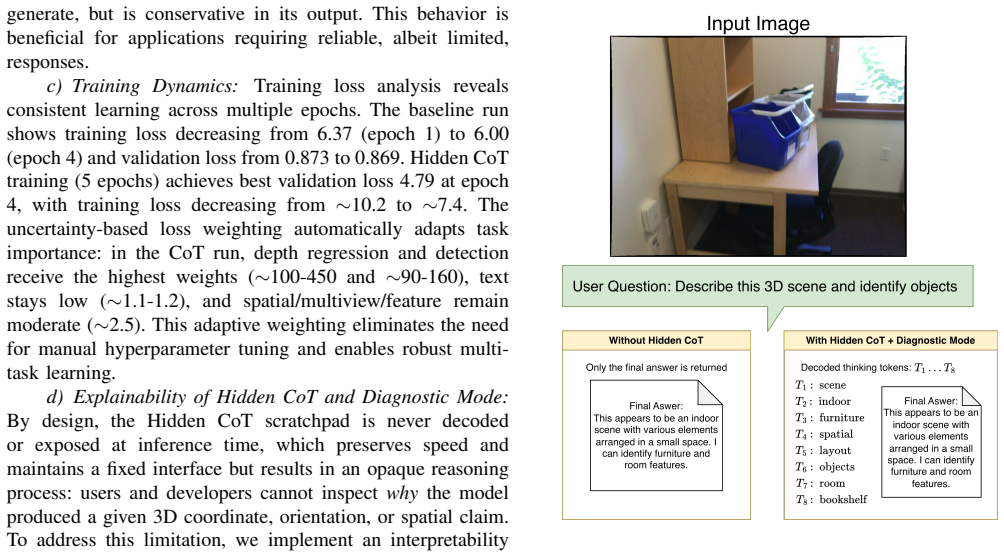
read the original abstract
Large-scale 3D vision-language models (VLMs) like LLaVA-3D offer strong spatial reasoning but are difficult to deploy due to high computational costs. We propose a knowledge distillation framework that transfers spatial reasoning from a 7B teacher to a 2.29B student model. Our approach achieves 8.7x lower inference latency and a 3x reduction in model size while retaining 54-72% of the teacher's performance. The framework utilizes VGGT as the vision encoder and a multi-task distillation pipeline with uncertainty-aware loss weighting. To improve reasoning without chain-of-thought (CoT) data, we introduce "Hidden CoT": learnable latent tokens that serve as an internal scratchpad before answer generation. This is the first use of latent scratchpad reasoning in distilled 3D VLMs. The student model jointly performs spatial description, depth estimation, and object detection. Experiments on ScanNet and 3D-FRONT show strong spatial understanding, reaching 68-72% accuracy on proximity and contact tasks. Our framework enables efficient 3D scene QA on resource-constrained platforms.
Editorial analysis
A structured set of objections, weighed in public.
Referee Report
Summary. The manuscript proposes a knowledge distillation framework to compress spatial reasoning from a 7B-parameter 3D VLM teacher (LLaVA-3D) into a 2.29B student model. It uses the VGGT vision encoder, a multi-task distillation pipeline with uncertainty-aware loss weighting across spatial description, depth estimation, and object detection, and introduces learnable 'Hidden CoT' latent tokens as an internal scratchpad to enable reasoning without explicit chain-of-thought data. On ScanNet and 3D-FRONT, the student is reported to achieve 8.7x lower inference latency, 3x model-size reduction, and 54-72% retention of teacher performance (68-72% accuracy on proximity and contact tasks).
Significance. If the retention figures are shown to stem from the Hidden CoT mechanism rather than the multi-task setup alone, the work would be significant for practical deployment of 3D spatial reasoning on resource-limited platforms. The efficiency gains and the first reported use of latent scratchpad tokens in distilled 3D VLMs would constitute a useful engineering contribution, provided the empirical isolation of components is supplied.
major comments (2)
- [Abstract] Abstract: The central claim that Hidden CoT latent tokens transfer spatial reasoning and account for the 54-72% performance retention is load-bearing, yet no ablation is reported that compares the full pipeline against an identical student trained without the latent tokens. The 68-72% accuracies on proximity/contact tasks could therefore be produced by the VGGT encoder and uncertainty-weighted multi-task losses alone; without this isolation the attribution to the proposed reasoning mechanism cannot be verified.
- [Abstract] Abstract: No training details, loss formulation for the latent tokens, hyper-parameters, or optimization schedule are supplied. This absence prevents assessment of whether the reported 8.7x latency and 3x size reductions are reproducible or whether the uncertainty-aware weighting is defined in a manner that could be fitted to the same benchmarks.
minor comments (2)
- [Abstract] Abstract: The exact baselines, number of evaluation samples, and any error bars or variance across runs for the 68-72% accuracy figures are not stated, making the retention percentages difficult to interpret in context.
- [Abstract] Abstract: The VGGT encoder is referenced without a citation or brief description of its architecture; adding this would improve accessibility for readers unfamiliar with the component.
Simulated Author's Rebuttal
We thank the referee for the constructive feedback on our manuscript. We address the major comments point by point below and will incorporate the suggested revisions to improve clarity and verifiability.
read point-by-point responses
-
Referee: [Abstract] Abstract: The central claim that Hidden CoT latent tokens transfer spatial reasoning and account for the 54-72% performance retention is load-bearing, yet no ablation is reported that compares the full pipeline against an identical student trained without the latent tokens. The 68-72% accuracies on proximity/contact tasks could therefore be produced by the VGGT encoder and uncertainty-weighted multi-task losses alone; without this isolation the attribution to the proposed reasoning mechanism cannot be verified.
Authors: We agree that an explicit ablation isolating the Hidden CoT latent tokens is necessary to substantiate the attribution of the reported performance retention. The current results reflect the complete framework (VGGT encoder + multi-task distillation + Hidden CoT), and we did not include a direct comparison against an otherwise identical student without the latent tokens. In the revised manuscript we will add this ablation: we will train and evaluate an ablated student that replaces the learnable Hidden CoT tokens with standard positional embeddings while retaining the VGGT encoder, uncertainty-weighted losses, and all other training settings. We will report the resulting accuracies on the proximity and contact tasks from ScanNet and 3D-FRONT so that readers can directly assess the incremental contribution of the latent scratchpad mechanism. revision: yes
-
Referee: [Abstract] Abstract: No training details, loss formulation for the latent tokens, hyper-parameters, or optimization schedule are supplied. This absence prevents assessment of whether the reported 8.7x latency and 3x size reductions are reproducible or whether the uncertainty-aware weighting is defined in a manner that could be fitted to the same benchmarks.
Authors: We acknowledge that the main text omitted the necessary implementation details. The loss formulation for the Hidden CoT tokens (treated as an auxiliary task within the uncertainty-weighted multi-task objective), the full set of hyperparameters, and the optimization schedule are documented in the supplementary material. In the revised version we will add a dedicated “Implementation Details” subsection to the main text that includes the loss equations, a hyperparameter table, the optimizer and learning-rate schedule, and the precise definition of the uncertainty-aware weighting (following the standard learnable-uncertainty formulation applied to the three tasks). This will make the 8.7x latency and performance numbers fully reproducible from the manuscript alone. revision: yes
Circularity Check
No circularity; claims rest on external benchmarks and architectural comparisons
full rationale
The paper describes a distillation pipeline transferring capabilities from a 7B teacher to a 2.29B student via VGGT encoder and multi-task losses, with performance measured on independent external datasets (ScanNet, 3D-FRONT). No equations, fitted parameters, or self-referential definitions appear that would make the reported 54-72% retention or latency reductions equivalent to quantities defined inside the same experiment. The Hidden CoT mechanism is introduced descriptively without a loss formulation or derivation that reduces to the input data by construction. All quantitative claims are therefore falsifiable against held-out benchmarks rather than tautological.
Axiom & Free-Parameter Ledger
free parameters (1)
- uncertainty-aware loss weights
axioms (1)
- domain assumption VGGT encoder provides suitable 3D visual features for the distillation target
invented entities (1)
-
Hidden CoT latent tokens
no independent evidence
Reference graph
Works this paper leans on
-
[1]
Learning transferable visual models from natural language supervision,
A. Radford, J. W. Kim, C. Hallacy, A. Ramesh, G. Goh, S. Agarwal, G. Sastry, A. Askell, P. Mishkin, J. Clark,et al., “Learning transferable visual models from natural language supervision,” inInternational conference on machine learning, pp. 8748–8763, PmLR, 2021
work page 2021
-
[2]
Flamingo: a visual language model for few-shot learning,
J.-B. Alayrac, J. Donahue, P. Luc, A. Miech, I. Barr, Y . Hasson, K. Lenc, A. Mensch, K. Millican, M. Reynolds,et al., “Flamingo: a visual language model for few-shot learning,”Advances in neural information processing systems, vol. 35, pp. 23716–23736, 2022
work page 2022
-
[3]
Superlora: Parameter-efficient unified adaptation for large vision models,
X. Chen, J. Liu, Y . Wang, P. Wang, M. Brand, G. Wang, and T. Koike- Akino, “Superlora: Parameter-efficient unified adaptation for large vision models,” inProceedings of the IEEE/CVF Conference on Computer Vision and Pattern Recognition, pp. 8050–8055, 2024
work page 2024
-
[4]
C. Zhu, T. Wang, W. Zhang, J. Pang, and X. Liu, “Llava-3d: A simple yet effective pathway to empowering lmms with 3d-awareness,”arXiv preprint arXiv:2409.18125, 2024
-
[5]
Palm-e: An embodied multimodal language model,
D. Driess, F. Xia, M. S. Sajjadi, C. Lynch, A. Chowdhery, A. Wahid, J. Tompson, Q. Vuong, T. Yu, W. Huang,et al., “Palm-e: An embodied multimodal language model,” 2023
work page 2023
-
[6]
RT-1: Robotics Transformer for Real-World Control at Scale
A. Brohan, N. Brown, J. Carbajal, Y . Chebotar, J. Dabis, C. Finn, K. Gopalakrishnan, K. Hausman, A. Herzog, J. Hsu,et al., “Rt-1: Robotics transformer for real-world control at scale,”arXiv preprint arXiv:2212.06817, 2022
work page internal anchor Pith review Pith/arXiv arXiv 2022
-
[7]
Energy and policy con- siderations for deep learning in nlp,
E. Strubell, A. Ganesh, and A. McCallum, “Energy and policy con- siderations for deep learning in nlp,” inProceedings of the 57th annual meeting of the association for computational linguistics, pp. 3645–3650, 2019
work page 2019
-
[8]
Mofa: A model simplification roadmap for image restoration on mobile devices,
X. Chen, R. Zhen, S. Li, X. Li, and G. Wang, “Mofa: A model simplification roadmap for image restoration on mobile devices,” in Proceedings of the IEEE/CVF International Conference on Computer Vision, pp. 1322–1332, 2023
work page 2023
-
[9]
Learning efficient vision transformers via fine-grained manifold distil- lation,
Z. Hao, J. Guo, D. Jia, K. Han, Y . Tang, C. Zhang, H. Hu, and Y . Wang, “Learning efficient vision transformers via fine-grained manifold distil- lation,”Advances in Neural Information Processing Systems, vol. 35, pp. 9164–9175, 2022
work page 2022
-
[10]
Flashattention: Fast and memory-efficient exact attention with io-awareness,
T. Dao, D. Fu, S. Ermon, A. Rudra, and C. R ´e, “Flashattention: Fast and memory-efficient exact attention with io-awareness,”Advances in neural information processing systems, vol. 35, pp. 16344–16359, 2022
work page 2022
-
[11]
Knowledge distillation in vision transformers: A critical review,
G. Habib, T. J. Saleem, and B. Lall, “Knowledge distillation in vision transformers: A critical review,”arXiv preprint arXiv:2302.02108, 2023
-
[12]
Distilling the Knowledge in a Neural Network
G. Hinton, O. Vinyals, and J. Dean, “Distilling the knowledge in a neural network,”arXiv preprint arXiv:1503.02531, 2015
work page internal anchor Pith review Pith/arXiv arXiv 2015
-
[13]
Knowledge distillation: A survey,
J. Gou, B. Yu, S. J. Maybank, and D. Tao, “Knowledge distillation: A survey,”International journal of computer vision, vol. 129, no. 6, pp. 1789–1819, 2021
work page 2021
-
[14]
Vggt: Visual geometry grounded transformer,
J. Wang, M. Chen, N. Karaev, A. Vedaldi, C. Rupprecht, and D. Novotny, “Vggt: Visual geometry grounded transformer,” inProceedings of the Computer Vision and Pattern Recognition Conference, pp. 5294–5306, 2025
work page 2025
-
[15]
Pf3det: A prompted foundation feature assisted visual lidar 3d detector,
K. Li, T. Zhang, K.-C. Peng, and G. Wang, “Pf3det: A prompted foundation feature assisted visual lidar 3d detector,” inProceedings of the Computer Vision and Pattern Recognition Conference, pp. 3778– 3787, 2025
work page 2025
-
[16]
H. Liu, C. Li, Q. Wu, and Y . J. Lee, “Visual instruction tuning,” Advances in neural information processing systems, vol. 36, pp. 34892– 34916, 2023
work page 2023
-
[17]
J. Li, D. Li, C. Xiong, and S. Hoi, “Blip: Bootstrapping language-image pre-training for unified vision-language understanding and generation,” inInternational conference on machine learning, pp. 12888–12900, PMLR, 2022
work page 2022
-
[18]
Vqa: Visual question answering,
S. Antol, A. Agrawal, J. Lu, M. Mitchell, D. Batra, C. L. Zitnick, and D. Parikh, “Vqa: Visual question answering,” inProceedings of the IEEE international conference on computer vision, pp. 2425–2433, 2015
work page 2015
-
[19]
Gqa: A new dataset for real-world visual reasoning and compositional question answering,
D. A. Hudson and C. D. Manning, “Gqa: A new dataset for real-world visual reasoning and compositional question answering,” inProceedings of the IEEE/CVF conference on computer vision and pattern recognition, pp. 6700–6709, 2019
work page 2019
-
[20]
3d-llm: Injecting the 3d world into large language models,
Y . Hong, H. Zhen, P. Chen, S. Zheng, Y . Du, Z. Chen, and C. Gan, “3d-llm: Injecting the 3d world into large language models,”Advances in Neural Information Processing Systems, vol. 36, pp. 20482–20494, 2023
work page 2023
-
[21]
Distilling vision-language models on millions of videos,
Y . Zhao, L. Zhao, X. Zhou, J. Wu, C.-T. Chu, H. Miao, F. Schroff, H. Adam, T. Liu, B. Gong,et al., “Distilling vision-language models on millions of videos,” inProceedings of the IEEE/CVF Conference on Computer Vision and Pattern Recognition, pp. 13106–13116, 2024
work page 2024
-
[22]
Chain-of-thought prompting elicits reasoning in large language models,
J. Wei, X. Wang, D. Schuurmans, M. Bosma, F. Xia, E. Chi, Q. V . Le, D. Zhou,et al., “Chain-of-thought prompting elicits reasoning in large language models,”Advances in neural information processing systems, vol. 35, pp. 24824–24837, 2022
work page 2022
-
[23]
Large lan- guage models are zero-shot reasoners,
T. Kojima, S. S. Gu, M. Reid, Y . Matsuo, and Y . Iwasawa, “Large lan- guage models are zero-shot reasoners,”Advances in neural information processing systems, vol. 35, pp. 22199–22213, 2022
work page 2022
-
[24]
Scanqa: 3d question answering for spatial scene understanding,
D. Azuma, T. Miyanishi, S. Kurita, and M. Kawanabe, “Scanqa: 3d question answering for spatial scene understanding,” inproceedings of the IEEE/CVF conference on computer vision and pattern recognition, pp. 19129–19139, 2022
work page 2022
-
[25]
3d-sps: Single-stage 3d visual grounding via referred point progressive selection,
J. Luo, J. Fu, X. Kong, C. Gao, H. Ren, H. Shen, H. Xia, and S. Liu, “3d-sps: Single-stage 3d visual grounding via referred point progressive selection,” inProceedings of the IEEE/CVF Conference on Computer Vision and Pattern Recognition, pp. 16454–16463, 2022
work page 2022
-
[26]
Embodiedscan: A holistic multi-modal 3d perception suite towards embodied ai,
T. Wang, X. Mao, C. Zhu, R. Xu, R. Lyu, P. Li, X. Chen, W. Zhang, K. Chen, T. Xue,et al., “Embodiedscan: A holistic multi-modal 3d perception suite towards embodied ai,” inProceedings of the IEEE/CVF Conference on Computer Vision and Pattern Recognition, pp. 19757– 19767, 2024
work page 2024
-
[27]
LLaMA: Open and Efficient Foundation Language Models
H. Touvron, T. Lavril, G. Izacard, X. Martinet, M.-A. Lachaux, T. Lacroix, B. Rozi `ere, N. Goyal, E. Hambro, F. Azhar,et al., “Llama: Open and efficient foundation language models,”arXiv preprint arXiv:2302.13971, 2023
work page internal anchor Pith review Pith/arXiv arXiv 2023
-
[28]
E. Zelikman, G. Harik, Y . Shao, V . Jayasiri, N. Haber, and N. D. Good- man, “Quiet-star: Language models can teach themselves to think before speaking, 2024,”URL https://arxiv. org/abs/2403.09629, vol. 2403
-
[29]
Multi-task learning using uncer- tainty to weigh losses for scene geometry and semantics,
A. Kendall, Y . Gal, and R. Cipolla, “Multi-task learning using uncer- tainty to weigh losses for scene geometry and semantics,” inProceedings of the IEEE conference on computer vision and pattern recognition, pp. 7482–7491, 2018
work page 2018
-
[30]
Scannet: Richly-annotated 3d reconstructions of indoor scenes,
A. Dai, A. X. Chang, M. Savva, M. Halber, T. Funkhouser, and M. Nießner, “Scannet: Richly-annotated 3d reconstructions of indoor scenes,” inProceedings of the IEEE conference on computer vision and pattern recognition, pp. 5828–5839, 2017
work page 2017
-
[31]
Midi: Multi-instance diffusion for single image to 3d scene generation,
Z. Huang, Y .-C. Guo, X. An, Y . Yang, Y . Li, Z.-X. Zou, D. Liang, X. Liu, Y .-P. Cao, and L. Sheng, “Midi: Multi-instance diffusion for single image to 3d scene generation,” inProceedings of the Computer Vision and Pattern Recognition Conference, pp. 23646–23657, 2025
work page 2025
-
[32]
SpatialBench: Benchmarking Multimodal Large Language Models for Spatial Cognition
P. Xu, S. Wang, Y . Zhu, J. Li, and Y . Zhang, “Spatialbench: Bench- marking multimodal large language models for spatial cognition,”arXiv preprint arXiv:2511.21471, 2025
work page internal anchor Pith review Pith/arXiv arXiv 2025
-
[33]
3dsrbench: A comprehensive 3d spatial reasoning bench- mark,
W. Ma, H. Chen, G. Zhang, Y .-C. Chou, J. Chen, C. de Melo, and A. Yuille, “3dsrbench: A comprehensive 3d spatial reasoning bench- mark,” inProceedings of the IEEE/CVF International Conference on Computer Vision, pp. 6924–6934, 2025
work page 2025
-
[34]
Mobilevlm : A fast, strong and open vision language assistant for mobile devices
X. Chu, L. Qiao, X. Lin, S. Xu, Y . Yang, Y . Hu, F. Wei, X. Zhang, B. Zhang, X. Wei,et al., “Mobilevlm: A fast, strong and open vision language assistant for mobile devices,”arXiv preprint arXiv:2312.16886, 2023
-
[35]
PaliGemma: A versatile 3B VLM for transfer
L. Beyer, A. Steiner, A. S. Pinto, A. Kolesnikov, X. Wang, D. Salz, M. Neumann, I. Alabdulmohsin, M. Tschannen, E. Bugliarello, et al., “Paligemma: A versatile 3b vlm for transfer,”arXiv preprint arXiv:2407.07726, 2024
work page internal anchor Pith review Pith/arXiv arXiv 2024
discussion (0)
Sign in with ORCID, Apple, or X to comment. Anyone can read and Pith papers without signing in.