Recognition: no theorem link
Small and Complex I: The Three Component Structure of z sim 0 Massive Compact Quiescent Galaxies
Pith reviewed 2026-05-12 03:32 UTC · model grok-4.3
The pith
Massive compact quiescent galaxies mostly require three structural components unlike typical ones.
A machine-rendered reading of the paper's core claim, the machinery that carries it, and where it could break.
Core claim
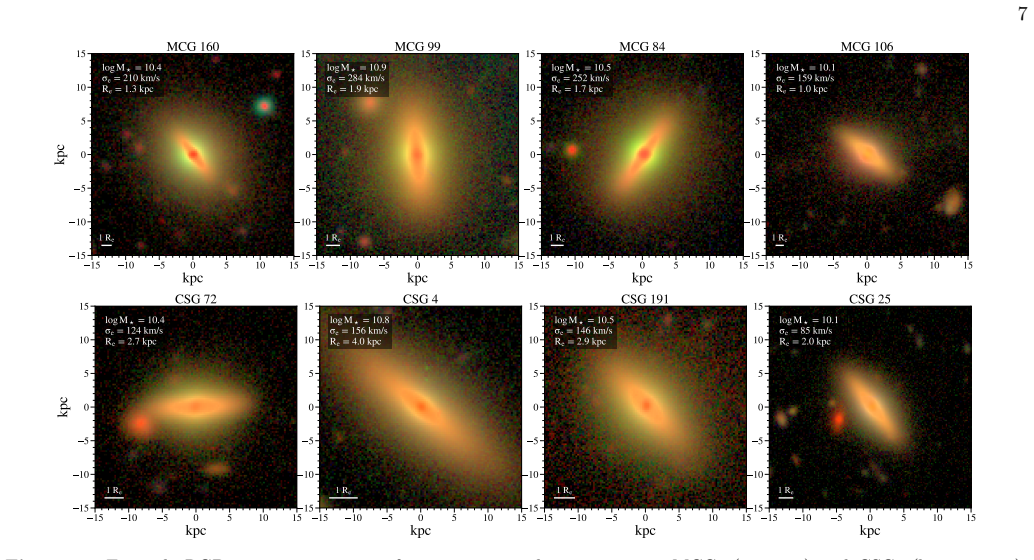
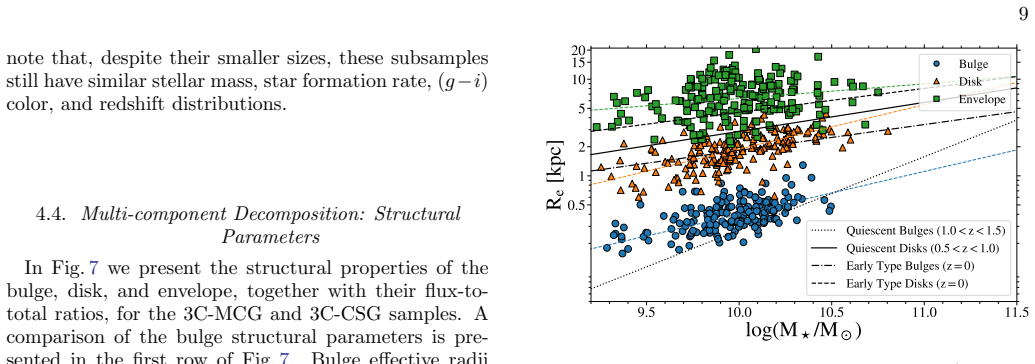
Multi-component decompositions of the g- and r-band images show that 75% of massive compact quiescent galaxies require a three-component model (bulge, disk, and envelope), while only 7% of control sample galaxies exhibit a comparable three-component structure. For three-component systems the bulge and envelope sizes are similar between samples, but the disks in compact galaxies are significantly more compact.
What carries the argument
Three-component Sersic decomposition separating a bulge, a disk, and an envelope in galaxy surface brightness profiles.
If this is right
- The prevalence of three components ties the overall compactness of these galaxies to the presence of both a compact disk and an extended outer part.
- Similar bulge and envelope sizes across samples but smaller disks in compact galaxies indicate that disk scale length is a primary driver of the observed compactness.
- The absence of bars in compact galaxies suggests dynamical differences from normal quiescent galaxies that may reflect distinct formation paths.
- The broad range of envelope ellipticities supports the interpretation that this component is either a stellar halo or a thick disk.
Where Pith is reading between the lines
- If the components prove physically real, these galaxies likely experienced an early dense core formation followed by later addition of disk and envelope material.
- Kinematic maps could test whether the envelope rotates independently of the inner disk, providing a direct check on its identity as a halo or thick disk.
- Repeating the same decompositions on higher-redshift compact quiescent galaxies would show whether the three-component structure is already in place at earlier epochs.
Load-bearing premise
The three fitted Sersic components represent physically distinct galactic structures rather than fitting artifacts or projection effects from inclination.
What would settle it
Integral-field spectroscopy that shows the envelope component has no distinct kinematics or stellar populations from the disk would indicate the three components are not separate structures.
Figures





read the original abstract
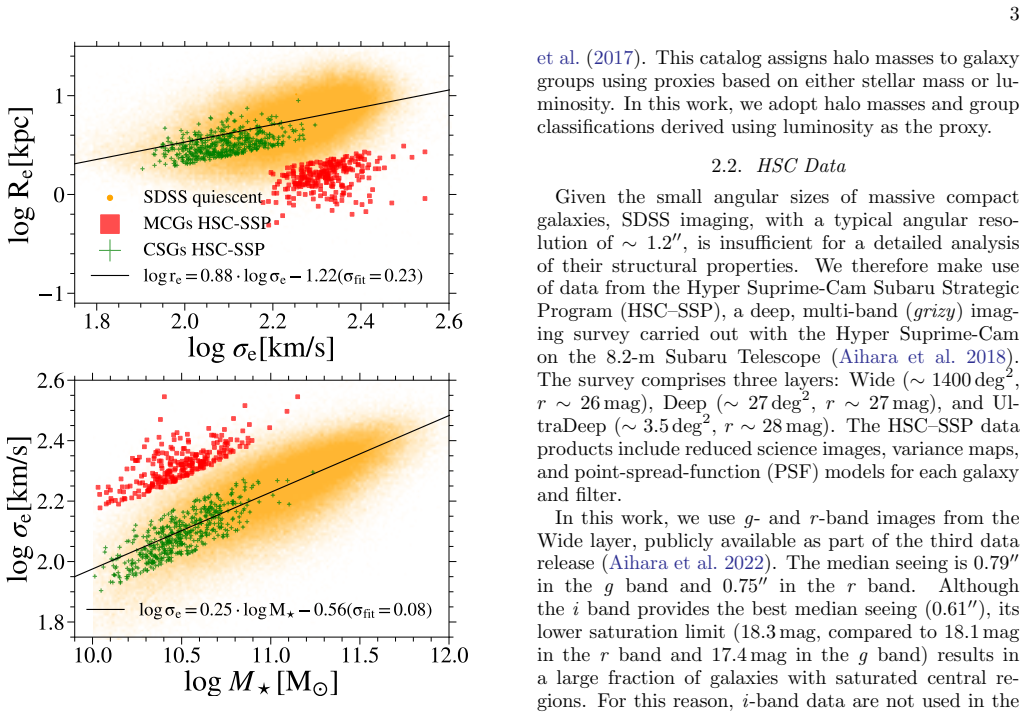
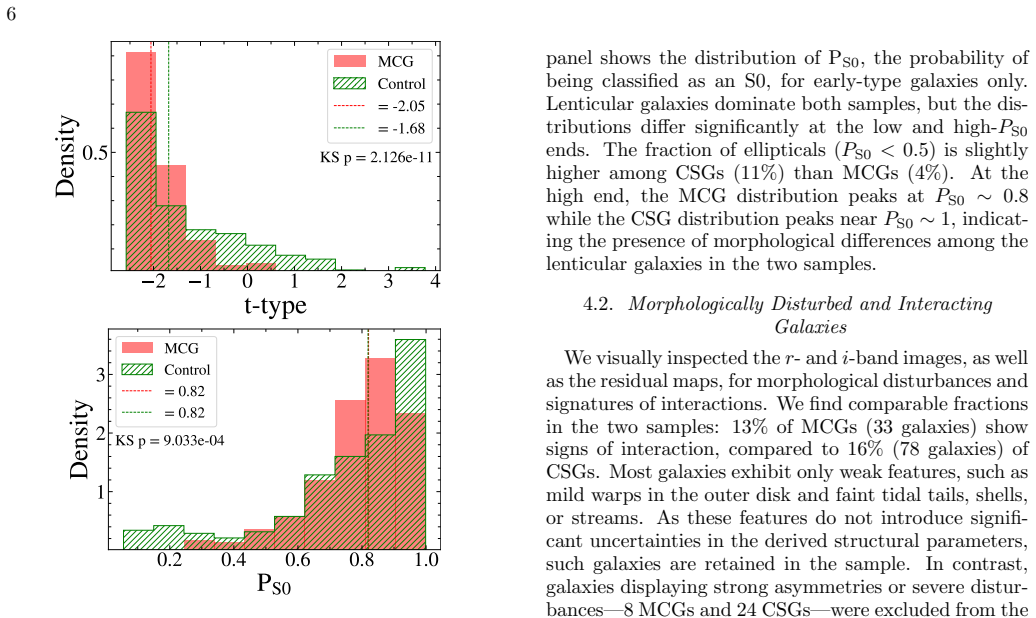
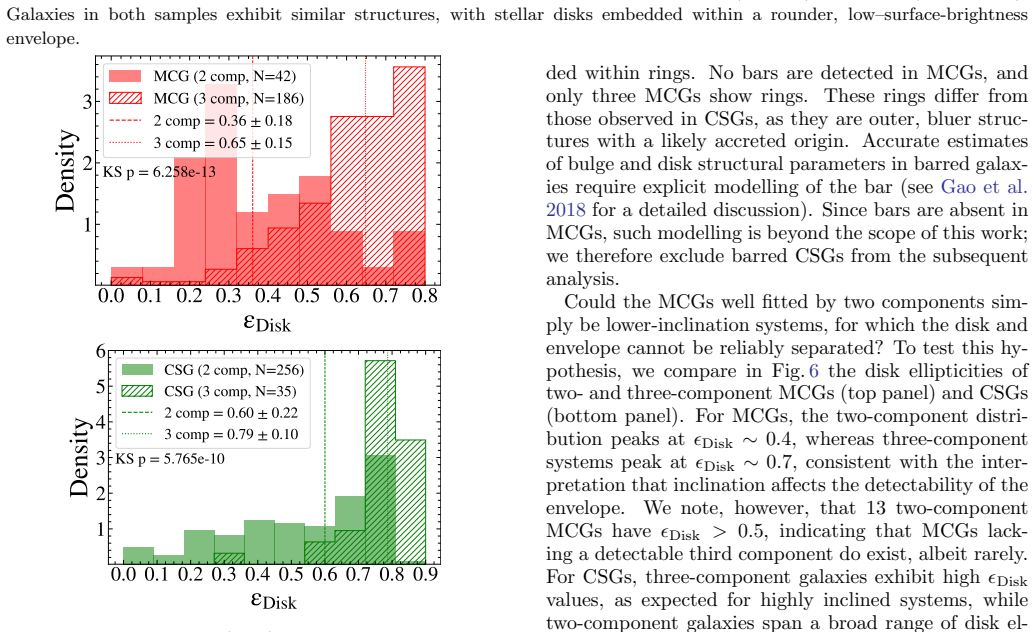
We investigate the morphology and structural properties of 246 massive compact quiescent galaxies (MCGs; $\log M_{\star} \sim 10$-$11$, $\sigma_{\mathrm{e}} \sim 150$-$350\,$km\,s$^{-1}$, $R_{\mathrm{e}} \sim 0.7$-$2.5\,$kpc) at $z \sim 0$, selected as outliers in the stellar mass-velocity dispersion and velocity dispersion-size relations, using $g$-, $r$-, and $i$-band Hyper Suprime-Cam images. We compare them to a control sample of average-sized quiescent galaxies (CSGs) matched in stellar mass, star formation rate, redshift, and $g-i$ color. Both samples are dominated by S0 galaxies, comprising $93\%$ of MCGs and $71\%$ of CSGs, while ellipticals account for $4\%$ and $11\%$, respectively. The fraction of interacting or morphologically disturbed systems is low in both samples ($13\%$ for MCGs and $16\%$ for CSGs). Multi-component decompositions of the $g$- and $r$-band images show that $75\%$ of MCGs require a three-component model (bulge, disk, and envelope), while $21\%$ are best fit by two components and $4\%$ by a single S\'ersic profile. Two-component MCGs are preferentially low-inclination systems, suggesting that the three-component fraction represents a lower limit. In contrast, only $7\%$ of CSGs exhibit a comparable three-component structure. Bars are present in $29\%$ of CSGs but are absent in MCGs. For three-component systems, MCGs and CSGs have similar bulge ($R_\mathrm{e}=0.39$ vs.\ $0.45$\,kpc) and envelope ($R_\mathrm{e}=6.4$ vs.\ $5.8$\,kpc) sizes, while MCG disks are significantly more compact ($R_\mathrm{e}=1.9$ vs.\ $3.3$\,kpc). The envelope component shows a broad ellipticity distribution ($\epsilon_\mathrm{Envelope} \sim 0.0$-$0.6$), which we interpret as corresponding to either a stellar halo or a thick disk.
Editorial analysis
A structured set of objections, weighed in public.
Referee Report
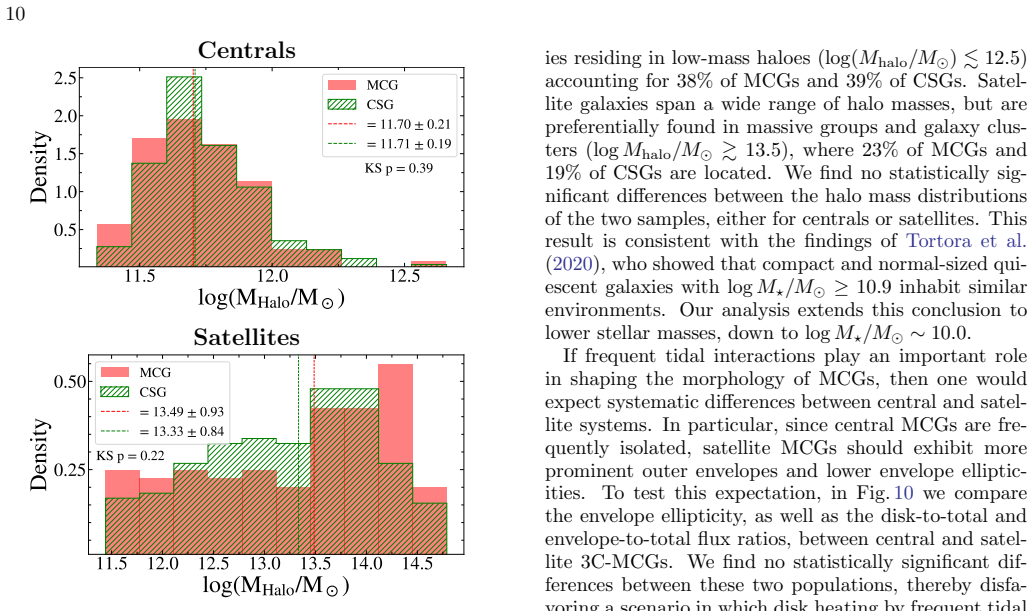
Summary. The manuscript analyzes the structural properties of 246 massive compact quiescent galaxies (MCGs) at z ≈ 0 using multi-component Sersic decompositions on Hyper Suprime-Cam g- and r-band images, comparing them to a control sample of average-sized quiescent galaxies (CSGs) matched in stellar mass, SFR, redshift, and g-i color. It reports that 75% of MCGs require a three-component model (bulge, disk, and envelope) while only 7% of CSGs do, with MCG disks significantly more compact (Re ≈ 1.9 kpc vs. 3.3 kpc for CSGs); both samples are dominated by S0 galaxies (93% and 71%), show low interaction rates, and the envelope component is interpreted as a stellar halo or thick disk based on its broad ellipticity distribution.
Significance. If the decompositions prove robust, the work demonstrates that MCGs possess a distinct three-component structure absent in typical quiescent galaxies of similar mass and color, with implications for formation scenarios involving early compaction and subsequent disk assembly. The matched control sample, large sample size, and absence of bars in MCGs are notable strengths that could constrain simulations of galaxy structural evolution. The finding that MCG disks are more compact than those in CSGs while bulges and envelopes have similar sizes provides a concrete observational benchmark.
major comments (3)
- [§3] §3 (image decomposition methods): The precise model-selection criterion for adopting a three-component fit (e.g., Δχ² threshold, BIC/AIC difference, F-test, or visual inspection) is not stated. Because Sersic profiles are flexible, an extra component will always improve the fit; without this statistic or recovery tests on mock images, the reported 75% vs. 7% difference cannot be confidently attributed to physical structure rather than fitting degrees of freedom.
- [§4] §4 (results on two-component systems): The statement that two-component MCGs are preferentially low-inclination (implying the three-component fraction is a lower limit) lacks a quantitative comparison, such as axis-ratio histograms or a Kolmogorov-Smirnov test, between the two-component MCG subsample and the full CSG sample to confirm that inclination distributions are comparable.
- [§3] §3 (robustness of fits): No details are provided on fitting convergence, parameter uncertainties, or tests against mock galaxies with known components and realistic PSF convolution. These checks are load-bearing for the central fractions, size comparisons (e.g., disk Re = 1.9 vs. 3.3 kpc), and the claim that three-component models are physically distinct.
minor comments (2)
- [Abstract] Abstract and §4: The abstract states decompositions were performed on g- and r-band images, but the full text should clarify whether i-band data were used for any component constraints or only for morphology classification.
- [§4] §4: The envelope ellipticity range (εEnvelope ∼ 0.0–0.6) is given without quoting the median or standard deviation; adding these statistics would aid comparison to literature halo or thick-disk samples.
Simulated Author's Rebuttal
We thank the referee for their constructive comments on our manuscript. We address each major point below and have revised the paper to incorporate additional methodological details and statistical tests as recommended.
read point-by-point responses
-
Referee: [§3] §3 (image decomposition methods): The precise model-selection criterion for adopting a three-component fit (e.g., Δχ² threshold, BIC/AIC difference, F-test, or visual inspection) is not stated. Because Sersic profiles are flexible, an extra component will always improve the fit; without this statistic or recovery tests on mock images, the reported 75% vs. 7% difference cannot be confidently attributed to physical structure rather than fitting degrees of freedom.
Authors: We agree that the precise model-selection criterion should be stated explicitly. In the revised manuscript, we will describe our use of a BIC improvement threshold (ΔBIC > 10) along with visual inspection of residuals to decide on the number of components. We will also add recovery tests on mock galaxies to show that the fitting procedure reliably identifies three-component structures when present and does not overfit two-component systems, thereby supporting the reported difference between MCGs and CSGs. revision: yes
-
Referee: [§4] §4 (results on two-component systems): The statement that two-component MCGs are preferentially low-inclination (implying the three-component fraction is a lower limit) lacks a quantitative comparison, such as axis-ratio histograms or a Kolmogorov-Smirnov test, between the two-component MCG subsample and the full CSG sample to confirm that inclination distributions are comparable.
Authors: We agree that a quantitative comparison is needed to support the claim. In the revised manuscript, we will include axis-ratio histograms comparing the two-component MCGs to the CSG sample and report the results of a Kolmogorov-Smirnov test on their distributions. This will provide the statistical evidence for the inclination bias and confirm that the three-component fraction is indeed a lower limit. revision: yes
-
Referee: [§3] §3 (robustness of fits): No details are provided on fitting convergence, parameter uncertainties, or tests against mock galaxies with known components and realistic PSF convolution. These checks are load-bearing for the central fractions, size comparisons (e.g., disk Re = 1.9 vs. 3.3 kpc), and the claim that three-component models are physically distinct.
Authors: We acknowledge the importance of these robustness checks. The revised manuscript will include details on the convergence criteria used during fitting, the uncertainties on the derived parameters (such as effective radii), and results from tests on mock galaxies with known components convolved with the appropriate PSF. These additions will strengthen the reliability of the reported fractions and size comparisons. revision: yes
Circularity Check
No circularity: purely empirical decomposition fractions from image fits
full rationale
The paper reports observed fractions (75% of MCGs vs 7% of CSGs requiring three-component Sersic models) obtained by fitting g- and r-band images of two matched samples. No equation, parameter fit, or self-citation reduces the reported three-component fraction to itself by construction; the result is a direct count of which models are selected by the fitting procedure on external photometric data. The analysis contains no derivation chain, uniqueness theorem, ansatz smuggled via prior work, or renaming of a known result. Minor self-citations (if present) are not load-bearing for the central empirical claim.
Axiom & Free-Parameter Ledger
free parameters (1)
- Sersic indices and effective radii per component
axioms (2)
- domain assumption Sersic profiles adequately describe the light distribution of bulge, disk, and envelope components
- domain assumption The control sample matching removes all relevant selection biases
Reference graph
Works this paper leans on
-
[1]
Antitruncation of Disks in Early-Type Barred Galaxies. , keywords =. doi:10.1086/431739 , archivePrefix =. astro-ph/0505216 , primaryClass =
-
[2]
The Fornax 3D project: Unveiling the thick disk origin in FCC 170; possible signs of accretion. , keywords =. doi:10.1051/0004-6361/201833193 , archivePrefix =. 1901.04310 , primaryClass =
-
[3]
The MASSIVE Survey. II. Stellar Population Trends Out to Large Radius in Massive Early-type Galaxies. , keywords =. doi:10.1088/0004-637X/807/1/11 , archivePrefix =. 1504.02483 , primaryClass =
-
[4]
The Catalog of Southern Ringed Galaxies. , keywords =. doi:10.1086/192113 , adsurl =
-
[5]
Massive Relic Galaxies Challenge the Co-evolution of Super-massive Black Holes and Their Host Galaxies. , keywords =. doi:10.1088/0004-637X/808/1/79 , archivePrefix =. 1506.02663 , primaryClass =
-
[6]
Third Reference Catalogue of Bright Galaxies
-
[7]
Handbuch der Physik , year = 1959, month = jan, volume =
Classification and Morphology of External Galaxies. Handbuch der Physik , year = 1959, month = jan, volume =. doi:10.1007/978-3-642-45932-0_7 , adsurl =
-
[8]
A monolithic collapse origin for the thin and thick disc structure of the S0 galaxy <ASTROBJ>ESO 243-49</ASTROBJ>. , keywords =. doi:10.1051/0004-6361/201629292 , archivePrefix =. 1608.04238 , primaryClass =
-
[9]
The Fornax 3D project: Thick disks in a cluster environment. , keywords =. doi:10.1051/0004-6361/201935154 , archivePrefix =. 1904.01260 , primaryClass =
-
[10]
SPIDER - VII. Revealing the stellar population content of massive early-type galaxies out to 8R _ e. , keywords =. doi:10.1111/j.1365-2966.2012.21848.x , archivePrefix =. 1208.0587 , primaryClass =
-
[11]
The frequency and stellar-mass dependence of boxy/peanut-shaped bulges in barred galaxies. , keywords =. doi:10.1093/mnras/stx620 , archivePrefix =. 1703.01602 , primaryClass =
-
[13]
The Evolution of Galaxy Structure Over Cosmic Time. , keywords =. doi:10.1146/annurev-astro-081913-040037 , archivePrefix =. 1403.2783 , primaryClass =
-
[14]
Galaxy groups in the low-redshift Universe. , keywords =. doi:10.1093/mnras/stx1462 , archivePrefix =. 1706.02307 , primaryClass =
-
[15]
Robust galaxy image decompositions with differential evolution optimization and the problem of classical bulges in and beyond the nearby Universe. , keywords =. doi:10.1093/mnras/staf2072 , archivePrefix =. 2511.13823 , primaryClass =
-
[16]
A Catalog of Detailed Visual Morphological Classifications for 14,034 Galaxies in the Sloan Digital Sky Survey. , keywords =. doi:10.1088/0067-0049/186/2/427 , archivePrefix =. 1001.2401 , primaryClass =
-
[17]
First data release of the Hyper Suprime-Cam Subaru Strategic Program. , keywords =. doi:10.1093/pasj/psx081 , archivePrefix =. 1702.08449 , primaryClass =
-
[18]
A Catalog of Bulge+disk Decompositions and Updated Photometry for 1.12 Million Galaxies in the Sloan Digital Sky Survey. , keywords =. doi:10.1088/0067-0049/196/1/11 , archivePrefix =. 1107.1518 , primaryClass =
-
[19]
The SAURON project - IV. The mass-to-light ratio, the virial mass estimator and the Fundamental Plane of elliptical and lenticular galaxies. , keywords =. doi:10.1111/j.1365-2966.2005.09981.x , archivePrefix =. astro-ph/0505042 , primaryClass =
-
[20]
Dust Attenuation Curves in the Local Universe: Demographics and New Laws for Star-forming Galaxies and High-redshift Analogs. , keywords =. doi:10.3847/1538-4357/aabf3c , archivePrefix =. 1804.05850 , primaryClass =
-
[21]
Nature versus nurture: relic nature and environment of the most massive passive galaxies at z < 0.5. , keywords =. doi:10.1051/0004-6361/202038373 , archivePrefix =. 2006.13235 , primaryClass =
-
[22]
Studying late-type spiral galaxies using SDSS
The structure of galactic disks. Studying late-type spiral galaxies using SDSS. , keywords =. doi:10.1051/0004-6361:20064883 , archivePrefix =. astro-ph/0603682 , primaryClass =
-
[23]
A cosmological context for compact massive galaxies. , keywords =. doi:10.1093/mnras/stv455 , archivePrefix =. 1503.03078 , primaryClass =
-
[24]
Superdense Massive Galaxies in Wings Local Clusters. , keywords =. doi:10.1088/0004-637X/712/1/226 , archivePrefix =. 0907.2392 , primaryClass =
-
[25]
The Environment of Massive Quiescent Compact Galaxies at 0.1 < z < 0.4 in the COSMOS Field. , keywords =. doi:10.1088/0004-637X/815/2/104 , archivePrefix =. 1508.03346 , primaryClass =
-
[26]
Massive relic galaxies prefer dense environments. , keywords =. doi:10.1093/mnras/stw1240 , archivePrefix =. 1605.06503 , primaryClass =
-
[27]
2004, MNRAS, 351, 1379, doi: 10.1111/j.1365-2966.2004.07876.x
The environmental dependence of the relations between stellar mass, structure, star formation and nuclear activity in galaxies. , keywords =. doi:10.1111/j.1365-2966.2004.08117.x , archivePrefix =. astro-ph/0402030 , primaryClass =
-
[28]
Galaxy morphology in rich clusters: implications for the formation and evolution of galaxies. , keywords =. doi:10.1086/157753 , adsurl =
-
[29]
Relationship between Environment and the Broadband Optical Properties of Galaxies in the Sloan Digital Sky Survey. , keywords =. doi:10.1086/422897 , archivePrefix =. astro-ph/0310453 , primaryClass =
-
[30]
An Optimal Strategy for Accurate Bulge-to-disk Decomposition of Disk Galaxies. , keywords =. doi:10.3847/1538-4357/aa7da4 , archivePrefix =. 1709.00746 , primaryClass =
-
[31]
Bars, Ovals, and Lenses in Early-Type Disk Galaxies: Probes of Galaxy Evolution. , keywords =. doi:10.1088/0004-637X/692/1/L34 , archivePrefix =. 0901.0641 , primaryClass =
-
[32]
Improving galaxy morphologies for SDSS with Deep Learning. , keywords =. doi:10.1093/mnras/sty338 , archivePrefix =. 1711.05744 , primaryClass =
-
[33]
, archivePrefix = "arXiv", eprint =
Near-infrared atlas of S0-Sa galaxies (NIRS0S). , keywords =. doi:10.1111/j.1365-2966.2011.19283.x , archivePrefix =. 1110.1996 , primaryClass =
-
[34]
The K-Band Luminosities of Galaxies: Do S0s Come from Spiral Galaxies?. , keywords =. doi:10.1086/427408 , adsurl =
-
[35]
The Carnegie-Irvine Galaxy Survey. VII. Constraints on the Origin of S0 Galaxies from Their Photometric Structure. , keywords =. doi:10.3847/1538-4357/aacdac , archivePrefix =. 1806.06350 , primaryClass =
-
[36]
Fossil Evidence for the Two-phase Formation of Elliptical Galaxies. , keywords =. doi:10.1088/2041-8205/768/2/L28 , archivePrefix =. 1304.2299 , primaryClass =
-
[37]
A new classification system for galaxies. , keywords =. doi:10.1086/154452 , adsurl =
-
[38]
Mass assembly and morphological transformations since z 3 from CANDELS. , keywords =. doi:10.1093/mnras/stw1866 , archivePrefix =. 1606.04952 , primaryClass =
-
[39]
Detection of Prominent Stellar Disks in the Progenitors of Present-day Massive Elliptical Galaxies. , keywords =. doi:10.3847/1538-4357/836/1/75 , archivePrefix =. 1606.07571 , primaryClass =
-
[40]
INSPIRE: INvestigating Stellar Population In RElics. I. Survey presentation and pilot study. , keywords =. doi:10.1051/0004-6361/202038936 , archivePrefix =. 2011.05347 , primaryClass =
-
[41]
2014, ApJL, 780, L20, doi: 10.1088/2041-8205/780/2/L20
NGC 1277: A Massive Compact Relic Galaxy in the Nearby Universe. , keywords =. doi:10.1088/2041-8205/780/2/L20 , archivePrefix =. 1310.6367 , primaryClass =
-
[42]
Young ages and other intriguing properties of massive compact galaxies in the local Universe. , keywords =. doi:10.1111/j.1365-2966.2012.20897.x , archivePrefix =. 1203.2623 , primaryClass =
-
[43]
Panic! at the Disks: First Rest-frame Optical Observations of Galaxy Structure at z > 3 with JWST in the SMACS 0723 Field. , keywords =. doi:10.3847/2041-8213/ac947c , archivePrefix =. 2207.09428 , primaryClass =
-
[44]
Morphology of Galaxies in JWST Fields: Initial Distribution and Evolution of Galaxy Morphology. , keywords =. doi:10.3847/1538-4357/ad3448 , archivePrefix =. 2312.04899 , primaryClass =
-
[45]
Galaxy morphology from z 6 through the lens of JWST. , keywords =. doi:10.1051/0004-6361/202346800 , archivePrefix =. 2305.02478 , primaryClass =
-
[46]
P., 1926, @doi [ ] 10.1086/143018 , https://ui.adsabs.harvard.edu/abs/1926ApJ....64..321H 64, 321
Extragalactic nebulae. , year = 1926, month = dec, volume =. doi:10.1086/143018 , adsurl =
-
[47]
Resolving Quiescent Galaxies at z 2. II. Direct Measures of Rotational Support. , keywords =. doi:10.3847/1538-4357/aacd4f , archivePrefix =. 1806.06815 , primaryClass =
-
[48]
Fast rotators at cosmic noon: Stellar kinematics for 15 quiescent galaxies from JWST-SUSPENSE. , keywords =. doi:10.1051/0004-6361/202555812 , archivePrefix =. 2506.04310 , primaryClass =
-
[49]
The structural and dynamical properties of compact elliptical galaxies. , keywords =. doi:10.1093/mnras/stx732 , archivePrefix =. 1701.05898 , primaryClass =
-
[50]
Compact, bulge-dominated structures of spectroscopically confirmed quiescent galaxies at z 3. , keywords =. doi:10.1093/mnras/staa3766 , archivePrefix =. 2012.02766 , primaryClass =
-
[51]
The Majority of Compact Massive Galaxies at z -0.5ex 2 are Disk Dominated. , keywords =. doi:10.1088/0004-637X/730/1/38 , archivePrefix =. 1101.2423 , primaryClass =
-
[52]
The Outer Disks of Early-type Galaxies. II. Surface-brightness Profiles of Unbarred Galaxies and Trends with Hubble Type. , keywords =. doi:10.1088/0004-6256/142/5/145 , archivePrefix =. 1108.3662 , primaryClass =
-
[53]
The environmental dependence of the structure of galactic discs in STAGES S0 galaxies: implications for S0 formation. , keywords =. doi:10.1093/mnras/stu2536 , archivePrefix =. 1412.3167 , primaryClass =
-
[54]
Varied origins of up-bending breaks in galaxy disks. , keywords =. doi:10.1051/0004-6361/201935130 , archivePrefix =. 1903.09384 , primaryClass =
-
[55]
A Revised Parallel-sequence Morphological Classification of Galaxies: Structure and Formation of S0 and Spheroidal Galaxies. , keywords =. doi:10.1088/0067-0049/198/1/2 , archivePrefix =. 1110.4384 , primaryClass =
-
[56]
The Optical and Near-Infrared Properties of Galaxies. I. Luminosity and Stellar Mass Functions. , keywords =. doi:10.1086/378847 , archivePrefix =. astro-ph/0302543 , primaryClass =
-
[57]
Structural and stellar-population properties versus bulge types in Sloan Digital Sky Survey central galaxies. , keywords =. doi:10.1093/mnras/staa328 , archivePrefix =. 1908.08055 , primaryClass =
-
[58]
A catalog of polychromatic bulge-disc decompositions of 17.600 galaxies in CANDELS. , keywords =. doi:10.1093/mnras/sty1379 , archivePrefix =. 1803.10234 , primaryClass =
-
[59]
_ SFR -M _ * Diagram: A Valuable Galaxy Evolution Diagnostic to Complement (s)SFR-M _ * Diagrams. , keywords =. doi:10.3847/1538-4357/ad04db , archivePrefix =. 2310.11493 , primaryClass =
-
[60]
The structural properties of classical bulges and discs from z 2. , keywords =. doi:10.1093/mnras/stz2421 , archivePrefix =. 1902.04089 , primaryClass =
-
[61]
The morphologies of massive galaxies at 1 < z < 3 in the CANDELS-UDS field: compact bulges, and the rise and fall of massive discs. , keywords =. doi:10.1111/j.1365-2966.2012.22087.x , archivePrefix =. 1206.4322 , primaryClass =
-
[62]
The SAURON project - IX. A kinematic classification for early-type galaxies. , keywords =. doi:10.1111/j.1365-2966.2007.11752.x , archivePrefix =. astro-ph/0703531 , primaryClass =
-
[63]
, archivePrefix = "arXiv", eprint =
The ATLAS ^ 3D project - VII. A new look at the morphology of nearby galaxies: the kinematic morphology-density relation. , keywords =. doi:10.1111/j.1365-2966.2011.18600.x , archivePrefix =. 1104.3545 , primaryClass =
-
[64]
The stellar mass distribution in early-type disc galaxies: surface photometry and bulge-disc decompositions. , keywords =. doi:10.1111/j.1365-2966.2007.11532.x , archivePrefix =. astro-ph/0701730 , primaryClass =
-
[65]
Structural properties of pseudo-bulges, classical bulges and elliptical galaxies: a Sloan Digital Sky Survey perspective. , keywords =. doi:10.1111/j.1365-2966.2008.14257.x , archivePrefix =. 0810.1953 , primaryClass =
-
[66]
Bulge Growth and Quenching since z = 2.5 in CANDELS/3D-HST. , keywords =. doi:10.1088/0004-637X/788/1/11 , archivePrefix =. 1402.0866 , primaryClass =
-
[67]
The decomposed bulge and disc size-mass relations of massive galaxies at 1 < z < 3 in CANDELS. , keywords =. doi:10.1093/mnras/stu1537 , archivePrefix =. 1405.5221 , primaryClass =
-
[68]
Galaxy And Mass Assembly (GAMA): M\_star - R\_e relations of z = 0 bulges, discs and spheroids. , keywords =. doi:10.1093/mnras/stw1495 , archivePrefix =. 1607.01096 , primaryClass =
-
[69]
Galaxy And Mass Assembly (GAMA): bulge-disc decomposition of KiDS data in the nearby Universe. , keywords =. doi:10.1093/mnras/stac2267 , archivePrefix =. 2208.07608 , primaryClass =
-
[70]
Bulge-disc decomposition of the Hydra cluster galaxies in 12 bands. , keywords =. doi:10.1093/mnras/stad3571 , archivePrefix =. 2311.09313 , primaryClass =
-
[71]
Bulge+disc decomposition of HFF and CANDELS galaxies: UVJ diagrams and stellar mass-size relations of galaxy components at 0.2 z 1.5. , keywords =. doi:10.1093/mnras/stae1702 , archivePrefix =. 2406.14613 , primaryClass =
-
[72]
Massive compact quiescent galaxies in the M _ versus _ e plane: insights from stellar population properties. , keywords =. doi:10.1093/mnras/stae1213 , archivePrefix =. 2405.02348 , primaryClass =
-
[73]
SExtractor: Software for source extraction. , keywords =. doi:10.1051/aas:1996164 , adsurl =
-
[74]
IMFIT: A Fast, Flexible New Program for Astronomical Image Fitting. , keywords =. doi:10.1088/0004-637X/799/2/226 , archivePrefix =. 1408.1097 , primaryClass =
-
[75]
The Carnegie-Irvine Galaxy Survey. III. The Three-component Structure of Nearby Elliptical Galaxies. , keywords =. doi:10.1088/0004-637X/766/1/47 , archivePrefix =. 1212.2639 , primaryClass =
-
[76]
Ho and Kosuke Imai and Gary King and Elizabeth A
Daniel E. Ho and Kosuke Imai and Gary King and Elizabeth A. Stuart , journal =. 2011 , volume =
work page 2011
-
[77]
P. R. Rosenbaum and D. B. Rubin. The Central Role of the Propensity Score in Observational Studies for Causal Effects. Biometrika. doi:10.1093/biomet/70.1.41
-
[78]
Is the cluster environment quenching the Seyfert activity in elliptical and spiral galaxies?. , keywords =. doi:10.1093/mnras/stw1459 , archivePrefix =. 1603.06256 , primaryClass =
-
[79]
Testing the Presence of Multiple Photometric Components in Nearby Early-type Galaxies using SDSS. , keywords =. doi:10.3847/1538-4357/836/1/115 , archivePrefix =. 1612.06495 , primaryClass =
-
[80]
Parametrizing the stellar haloes of galaxies. , keywords =. doi:10.1093/mnras/stu1194 , archivePrefix =. 1404.2123 , primaryClass =
-
[81]
Surprises in image decomposition of edge-on galaxies: does Sombrero have a (classical) bulge?. , keywords =. doi:10.1111/j.1365-2966.2012.20925.x , archivePrefix =. 1101.2900 , primaryClass =
discussion (0)
Sign in with ORCID, Apple, or X to comment. Anyone can read and Pith papers without signing in.