Recognition: 2 theorem links
· Lean TheoremSymmetry-Empowered Through-Barrier Sensing in Complex Media
Pith reviewed 2026-05-12 02:46 UTC · model grok-4.3
The pith
Tuning programmable scatterers to maximize broadband transmission recovers unknown scatterer characteristics across a barrier in symmetric chaotic cavities.
A machine-rendered reading of the paper's core claim, the machinery that carries it, and where it could break.
Core claim
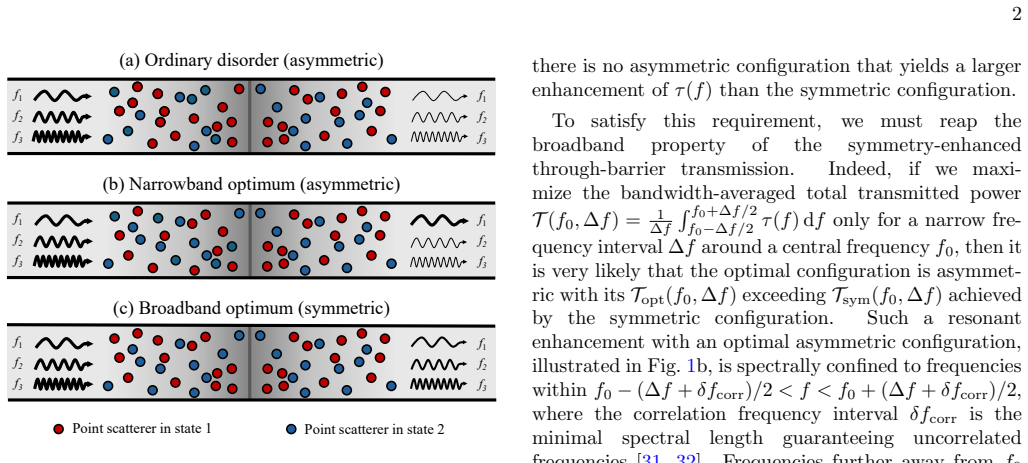
In two mirror-symmetric chaotic cavities coupled through a narrow slit and containing point scatterers at mirror-symmetric positions, tuning the programmable scatterers to maximize broadband total transmission recovers the unknown scatterers' characteristics across the barrier.
What carries the argument
Symmetry-induced through-barrier transmission enhancement: the mechanism in which mirror symmetry between scatterer configurations boosts total transmission across the coupling slit, so that optimization of the programmable side reveals the unknown configuration.
If this is right
- Quantitative sensing of unknown scatterers becomes possible without direct access to the far side.
- A minimum bandwidth threshold exists below which narrowband asymmetric resonances can dominate and prevent reliable recovery.
- Higher absorption or greater barrier opacity increases the bandwidth needed for the symmetry effect to prevail.
- The same principle offers a route to through-wall imaging in complex, scattering environments.
Where Pith is reading between the lines
- The approach could extend to acoustic or quantum wave systems if mirror symmetry can be engineered.
- Continuous scatterer distributions might work if overall mirror symmetry is maintained.
- Adaptive real-time tuning of the programmable side could enable ongoing monitoring in changing chaotic environments.
Load-bearing premise
The cavities must stay chaotic and perfectly mirror-symmetric with scatterers at exact mirror-symmetric positions, and the operating bandwidth must be wide enough that symmetry-induced enhancement dominates any narrowband asymmetric resonance.
What would settle it
An experiment or simulation in which the scatterer positions are made asymmetric or the bandwidth is narrowed, after which optimizing the programmable scatterers no longer accurately recovers the unknown parameters, would falsify the claim.
Figures

read the original abstract
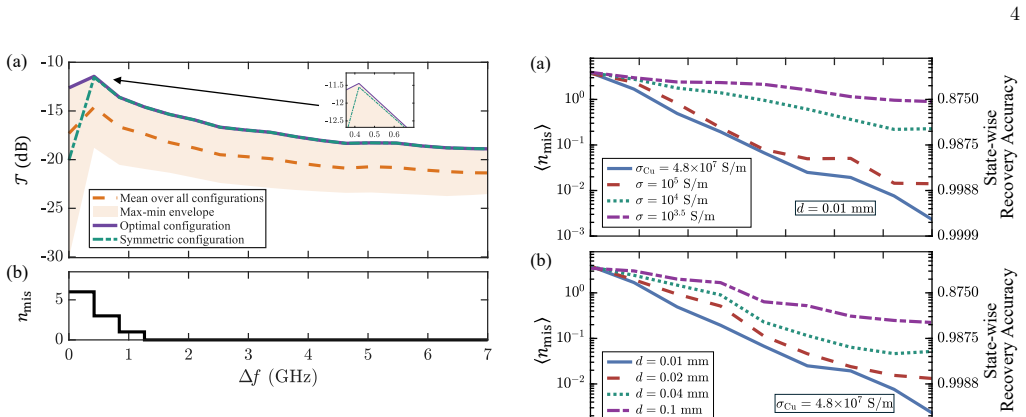
Symmetry strongly impacts wave transport in complex media. In this Letter, we demonstrate that the phenomenon of symmetry-induced through-barrier transmission enhancement enables quantitative sensing across barriers in complex media. We consider two mirror-symmetric chaotic cavities coupled through a narrow slit and containing point scatterers at mirror-symmetric positions. The characteristics of the scatterers in one cavity are unknown, whereas those of the scatterers in the other cavity are programmable. By tuning the programmable scatterers to maximize broadband total transmission, we recover the unknown scatterers' characteristics across the barrier. We show that reliable sensing requires a sufficiently large bandwidth, because otherwise a narrowband asymmetric resonant enhancement can dominate over the desired symmetry-induced enhancement. We further examine how absorption and barrier opacity influence the minimum required bandwidth. Our results establish a symmetry-empowered principle for through-barrier sensing in complex media, suggesting a route toward through-wall imaging in complex environments.
Editorial analysis
A structured set of objections, weighed in public.
Referee Report
Summary. The paper claims that symmetry-induced through-barrier transmission enhancement enables quantitative sensing in complex media. It models two mirror-symmetric chaotic cavities coupled by a narrow slit with point scatterers at mirror-symmetric positions. The scatterers in one cavity are unknown while those in the other are programmable; tuning the programmable scatterers to maximize broadband total transmission recovers the unknown scatterers' characteristics. The approach requires a sufficiently large bandwidth so that symmetry-induced enhancement dominates narrowband asymmetric resonances, and it examines how absorption and barrier opacity affect the minimum required bandwidth.
Significance. If the central recovery principle holds under the stated conditions, the work introduces a symmetry-based route to through-barrier sensing without direct access to the target region, with potential relevance to through-wall imaging in complex environments. The explicit conditioning on bandwidth and analysis of absorption/opacity effects are positive features that strengthen the conceptual framework. The model is internally consistent within its assumptions of chaotic cavities and point scatterers, but the absence of detailed methods, quantitative data, error analysis, or verification in accessible sections limits assessment of practical robustness and reproducibility.
minor comments (3)
- Abstract: the phrasing 'we demonstrate' and 'we recover' suggests a concrete result, yet the accessible text provides only a conceptual outline without explicit equations, simulation parameters, or recovery-error metrics; adding a brief quantitative example would clarify the strength of the claim.
- Setup description: the requirement for 'sufficiently large bandwidth' is stated but not accompanied by a specific threshold, scaling relation, or example calculation showing when asymmetric resonances begin to dominate; a short derivation or plot reference would make the condition operational.
- The manuscript should include a concise statement of the scattering model (e.g., how point-scatterer positions and strengths enter the transmission calculation) to allow readers to reproduce the symmetry argument.
Simulated Author's Rebuttal
We thank the referee for their positive assessment of our work and for recommending minor revision. We appreciate the constructive feedback on the conceptual framework and the explicit conditioning on bandwidth, absorption, and opacity. No specific major comments were enumerated in the report, so we interpret the noted limitations on methods, quantitative data, error analysis, and verification as guidance for improvement. We will revise the manuscript accordingly to enhance reproducibility while preserving the core symmetry-based principle.
Circularity Check
No significant circularity
full rationale
The paper derives its through-barrier sensing principle from the established physics of symmetry-induced transmission enhancement in mirror-symmetric chaotic cavities, where tuning programmable scatterers maximizes broadband total transmission to recover unknown scatterer characteristics. This chain relies on wave-transport symmetry arguments and explicit bandwidth conditions to suppress asymmetric resonances, without reducing to any fitted parameter renamed as a prediction, self-definitional loop, or load-bearing self-citation. The abstract and setup present the recovery as a direct consequence of the symmetry principle under stated assumptions (point scatterers, chaotic cavities), making the argument self-contained against external physical benchmarks rather than internally forced by construction.
Axiom & Free-Parameter Ledger
free parameters (1)
- minimum required bandwidth
axioms (1)
- domain assumption Mirror symmetry between cavities and scatterer positions leads to enhanced total transmission when characteristics match
Lean theorems connected to this paper
-
IndisputableMonolith/Foundation/AlexanderDuality.leanalexander_duality_circle_linking echoestwo mirror-symmetric chaotic cavities coupled through a narrow slit and containing point scatterers at mirror-symmetric positions... maximize broadband total transmission
Reference graph
Works this paper leans on
-
[1]
S. Yves, M. Fruchart, R. Fleury, G. Shmuel, V. Vitelli, M. R. Haberman, and A. Al` u, Symmetry-driven artificial phononic media, Nat. Rev. Mater. , 1 (2025)
work page 2025
-
[2]
S. Rotter and S. Gigan, Light fields in complex media: Mesoscopic scattering meets wave control, Rev. Mod. Phys.89, 015005 (2017)
work page 2017
-
[3]
H. Cao, A. P. Mosk, and S. Rotter, Shaping the prop- agation of light in complex media, Nat. Phys.18, 994 (2022)
work page 2022
-
[4]
H. U. Baranger and P. A. Mello, Reflection symmetric ballistic microstructures: Quantum transport properties, Phys. Rev. B54, R14297 (1996)
work page 1996
-
[5]
R. S. Whitney, H. Schomerus, and M. Kopp, Semiclassi- cal transport in nearly symmetric quantum dots. I. Sym- metry breaking in the dot, Phys. Rev. E80, 056209 (2009)
work page 2009
-
[6]
R. S. Whitney, H. Schomerus, and M. Kopp, Semiclassi- cal transport in nearly symmetric quantum dots. II. Sym- metry breaking due to asymmetric leads, Phys. Rev. E 80, 056210 (2009)
work page 2009
-
[7]
V. A. Gopar, S. Rotter, and H. Schomerus, Transport in chaotic quantum dots: Effects of spatial symmetries which interchange the leads, Phys. Rev. B73, 165308 (2006)
work page 2006
-
[8]
M. Kopp, H. Schomerus, and S. Rotter, Staggered re- pulsion of transmission eigenvalues in symmetric open mesoscopic systems, Phys. Rev. B78, 075312 (2008)
work page 2008
-
[9]
C. Birchall and H. Schomerus, Random-matrix theory of amplifying and absorbing resonators with PT or PTT’ symmetry, J. Phys. A Math. Theor.45, 444006 (2012)
work page 2012
-
[10]
A. A. Gorbatsevich and N. M. Shubin, PT-symmetry breaking in resonant tunneling heterostructures, JETP Lett.103, 769 (2016)
work page 2016
-
[11]
A. Gorbatsevich and N. Shubin, Coalescence of reso- nances in dissipationless resonant tunneling structures and PT-symmetry breaking, Ann. Phys.376, 353 (2017)
work page 2017
-
[12]
A. Gorbatsevich and N. Shubin, Unified theory of reso- nances and bound states in the continuum in Hermitian tight-binding models, Phys. Rev. B96, 205441 (2017)
work page 2017
-
[13]
A.-S. B.-B. Dhia, L. Chesnel, and V. Pagneux, Trapped modes and reflectionless modes as eigenfunctions of the same spectral problem, Proc. R. Soc. A Math. Phys. Eng. Sci.474(2018)
work page 2018
-
[14]
W. R. Sweeney, C. W. Hsu, and A. D. Stone, Theory of reflectionless scattering modes, Phys. Rev. A102, 063511 (2020)
work page 2020
-
[15]
A. D. Stone, W. R. Sweeney, C. W. Hsu, K. Wisal, and Z. Wang, Reflectionless excitation of arbitrary pho- tonic structures: a general theory, Nanophotonics10, 343 (2020)
work page 2020
- [16]
-
[17]
S. K. Saini, E. Marakis, K. Start, G. Osnabrugge, I. M. Vellekoop, and P. W. Pinkse, Mirror symmetry in three- dimensional multiple-scattering media, Phys. Rev. Lett. 133, 223802 (2024)
work page 2024
- [18]
-
[19]
Z. Zhumabay, C. Ferise, V. Pagneux, S. Rotter, and M. Davy, Inverse design of mirror-symmetric disordered systems for broadband perfect transmission, Laser Pho- tonics Rev. , e01055 (2026)
work page 2026
-
[20]
M. Macucci and P. Marconcini, Tunneling enhancement through a barrier surrounded by a mesoscopic cavity, J. Computat. Electron.6, 203 (2007)
work page 2007
-
[21]
R. S. Whitney, P. Marconcini, and M. Macucci, Huge conductance peak caused by symmetry in double quan- tum dots, Phys. Rev. Lett.102, 186802 (2009). 6
work page 2009
- [22]
-
[23]
M. Macucci, P. Marconcini, and S. Roche, Optimization of the sensitivity of a double-dot magnetic detector, Elec- tronics9, 1134 (2020)
work page 2020
-
[24]
P. Marconcini and M. Macucci, Symmetry-dependent transport behavior of graphene double dots, J. Appl. Phys.114(2013)
work page 2013
-
[25]
´E. Ch´ eron, S. F´ elix, and V. Pagneux, Broadband- enhanced transmission through symmetric diffusive slabs, Phys. Rev. Lett.122, 125501 (2019)
work page 2019
-
[26]
´E. Ch´ eron, S. F´ elix, and V. Pagneux, Broadband sub- wavelength sensitivity to symmetry defects of disordered slabs, Phys. Rev. B102, 134201 (2020)
work page 2020
-
[27]
´E. Ch´ eron, S. F´ elix, and V. Pagneux, Sensitivity to losses and defects of the symmetry-induced transmission en- hancement through diffusive slabs, Sci. Rep.10, 16635 (2020)
work page 2020
-
[28]
M. Davy, C. Ferise, ´E. Ch´ eron, S. F´ elix, and V. Pagneux, Experimental evidence of enhanced broadband transmis- sion in disordered systems with mirror symmetry, Appl. Phys. Lett.119(2021)
work page 2021
-
[29]
L. Borcea and J. Garnier, Enhanced wave transmission in random media with mirror symmetry, Proc. R. Soc. A Math. Phys. Eng. Sci.480(2024)
work page 2024
-
[30]
A. Flegontov and D. Rogozkin, Symmetry-induced en- hancement of transmission through a disordered system, Phys. Rev. B111, 174205 (2025)
work page 2025
- [31]
- [32]
- [33]
-
[34]
C. Draeger and M. Fink, One-channel time reversal of elastic waves in a chaotic 2D-silicon cavity, Phys. Rev. Lett.79, 407 (1997)
work page 1997
- [35]
-
[36]
V. Doya, O. Legrand, and F. Mortessagne, Optimized absorption in a chaotic double-clad fiber amplifier, Opt. Lett.26, 872 (2001)
work page 2001
-
[37]
B. Redding, A. Cerjan, X. Huang, M. L. Lee, A. D. Stone, M. A. Choma, and H. Cao, Low spatial coherence elec- trically pumped semiconductor laser for speckle-free full- field imaging, Proc. Natl. Acad. Sci. U.S.A.112, 1304 (2015)
work page 2015
-
[38]
F. T. Faul, L. Cronier, A. Alhulaymi, A. D. Stone, and P. del Hougne, Agile free-form signal filtering and rout- ing with a chaotic-cavity-backed non-local programmable metasurface, Adv. Sci.12, 2500796 (2025)
work page 2025
-
[39]
P. del Hougne, Experimental multiport-network parame- ter estimation and optimization for multi-bit RIS, IEEE Wirel. Commun. Lett.15, 790 (2025)
work page 2025
-
[40]
J. Sol, H. Prod’homme, L. Le Magoarou, and P. del Hougne, Experimentally realized physical-model-based frugal wave control in metasurface-programmable com- plex media, Nat. Commun.15, 2841 (2024)
work page 2024
-
[41]
P. del Hougne, Ambiguity-aware segmented estimation of mutual coupling in large RIS: Algorithm and experimen- tal validation, IEEE Trans. Commun.74, 4615 (2026)
work page 2026
-
[42]
P. del Hougne, Reduced-rank mutual coupling represen- tation and experimental estimation for large RIS, IEEE Wirel. Commun. Lett.15, 1836 (2026)
work page 2026
-
[43]
J. Tapie and P. del Hougne, Experimental multiport- network parameter estimation for a dynamic metasurface antenna, IEEE Trans. Antennas Propag. (2026)
work page 2026
-
[44]
J. Tapie, B. Sokal, A. L. F. de Almeida, and P. del Hougne, Channel estimation via tensor decomposition for dynamic metasurface antennas with known mutual coupling: Algorithms and experiments, arXiv:2603.19155 (2026)
-
[45]
P. del Hougne, Electromagnetic bounds on realizing tar- geted MIMO transfer functions in real-world systems with wave-domain programmability, arXiv:2602.14152 (2026)
-
[46]
P. del Hougne, A physics-compliant diagonal represen- tation for wireless channels parametrized by beyond- diagonal reconfigurable intelligent surfaces, IEEE Trans. Wirel. Commun.24, 5871 (2025). END MA TTER We summarize here how we predictT(f) for any de- sired configuration based on a single full-wave simula- tion. As mentioned in the main text, our poi...
work page 2025
discussion (0)
Sign in with ORCID, Apple, or X to comment. Anyone can read and Pith papers without signing in.