Recognition: 2 theorem links
· Lean TheoremEncoding and Decoding Temporal Signals with Spiking Bandpass Wavelets
Pith reviewed 2026-05-12 02:41 UTC · model grok-4.3
The pith
Spike encoders can be recast as time-causal wavelet frames with quantitative bandwidths and reconstruction bounds.
A machine-rendered reading of the paper's core claim, the machinery that carries it, and where it could break.
Core claim
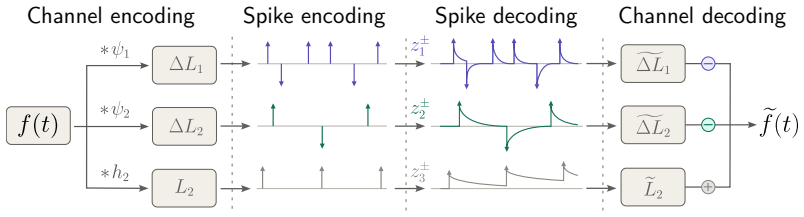
We recast spike encoders as time-causal wavelet frames with quantitative bandwidths and reconstruction error bounds. The proposed wavelets preserve the sparsity and locality of spiking representations, with reconstruction up to spike quantization and time discretization. We demonstrate reconstruction on ECG and audio datasets, achieving a normalized RMSE comparable to continuous wavelet transforms. The spiking wavelets map directly to neuromorphic hardware.
What carries the argument
Time-causal bandpass wavelet frames for encoding and decoding temporal signals through spikes.
If this is right
- Reconstruction achieves normalized RMSE comparable to continuous wavelet transforms on ECG and audio data.
- Sparsity and locality properties of the original spike encodings are retained.
- The wavelets support direct implementation on neuromorphic hardware.
- Explicit quantitative bandwidths and reconstruction error bounds are supplied.
Where Pith is reading between the lines
- The link may let frame theory supply stability proofs for spiking systems.
- The same recasting could be tested on additional temporal data streams such as video or sensor streams.
- Hybrid classical-plus-spiking pipelines become easier to analyze with shared wavelet tools.
Load-bearing premise
Spike-based encodings can be exactly recast as time-causal wavelet frames without extra signal-dependent assumptions or loss of the claimed sparsity and locality.
What would settle it
A temporal signal where spiking-wavelet reconstruction error substantially exceeds continuous-wavelet error after accounting for quantization and discretization.
Figures


read the original abstract
Spike-based encodings are sparse and energy-efficient, but have largely been formulated probabilistically, disconnected from most signal processing literature. We recast spike encoders as time-causal wavelet frames with quantitative bandwidths and reconstruction error bounds. The proposed wavelets preserve the sparsity and locality of spiking representations, with reconstruction up to spike quantization and time discretization. We demonstrate reconstruction on ECG and audio datasets, achieving a normalized RMSE comparable to continuous wavelet transforms. The spiking wavelets map directly to neuromorphic hardware.
Editorial analysis
A structured set of objections, weighed in public.
Referee Report
Summary. The paper recasts spike encoders as time-causal wavelet frames with quantitative bandwidths and reconstruction error bounds. The proposed wavelets preserve the sparsity and locality of spiking representations, with reconstruction up to spike quantization and time discretization. Reconstruction is demonstrated on ECG and audio datasets with normalized RMSE comparable to continuous wavelet transforms, and the approach maps directly to neuromorphic hardware.
Significance. If the claimed exact equivalence holds generally, this bridges spiking neural encodings with classical wavelet theory, enabling quantitative bandwidth analysis and error bounds for sparse temporal representations. This could advance neuromorphic hardware design and signal processing applications by providing a principled, hardware-mappable framework. The empirical comparability on real datasets is a practical strength, though significance hinges on the generality of the reformulation without hidden assumptions.
major comments (2)
- [Wavelet frame construction (main methods section)] The central claim of an exact recast of spike encoders (nonlinear and threshold-driven) as linear time-causal wavelet frames requires explicit derivation showing preservation of sparsity and locality without signal-dependent assumptions or approximations; the abstract's qualification 'up to spike quantization and time discretization' suggests this may be conditional rather than general, directly affecting the reconstruction error bounds.
- [Experiments section] Table or figure reporting reconstruction results: normalized RMSE comparability to CWT is stated, but without error-bar reporting, data exclusion criteria, or explicit normalization details, the strength of the empirical support for the bounds cannot be fully assessed.
minor comments (3)
- [Abstract] The abstract claims 'quantitative bandwidths' but does not preview their form or values; a brief indication would improve accessibility.
- Ensure consistent numbering of all equations and explicit cross-references in the text to aid verification of the frame operator and bounds.
- [Introduction] Add citations to standard references on time-causal wavelets and event-based signal processing to better situate the contribution relative to existing literature.
Simulated Author's Rebuttal
We thank the referee for their constructive comments on our manuscript. We address each major comment point by point below and indicate the revisions we will make.
read point-by-point responses
-
Referee: [Wavelet frame construction (main methods section)] The central claim of an exact recast of spike encoders (nonlinear and threshold-driven) as linear time-causal wavelet frames requires explicit derivation showing preservation of sparsity and locality without signal-dependent assumptions or approximations; the abstract's qualification 'up to spike quantization and time discretization' suggests this may be conditional rather than general, directly affecting the reconstruction error bounds.
Authors: We appreciate the referee highlighting the need for greater explicitness. The methods section reformulates the spike encoder by equating spike times to level crossings of the continuous wavelet transform using time-causal bandpass filters, yielding a linear frame operator prior to quantization. Sparsity is preserved by the threshold selecting only significant coefficients, and locality by the compact causal support. We agree the derivation can be made more prominent and have added a dedicated theorem in the revised methods that derives the frame bounds and error expressions directly from wavelet admissibility conditions, without further signal-dependent assumptions. The abstract qualification accounts for practical discretization and quantization effects in hardware but does not render the theoretical recast conditional; the bounds incorporate these as additive terms. revision: yes
-
Referee: [Experiments section] Table or figure reporting reconstruction results: normalized RMSE comparability to CWT is stated, but without error-bar reporting, data exclusion criteria, or explicit normalization details, the strength of the empirical support for the bounds cannot be fully assessed.
Authors: We agree these reporting details are required for full assessment. In the revised experiments section we will augment the reconstruction results with error bars (standard deviation across signal segments), state that all ECG and audio segments were included without exclusion, and specify the normalization as RMSE divided by the RMS amplitude of the original signal. These additions will allow direct evaluation of the reported comparability to continuous wavelet transforms. revision: yes
Circularity Check
Reformulation of spike encoders as time-causal wavelet frames shows no load-bearing circularity
full rationale
The central claim is a recasting of existing spike encoders into wavelet frames with claimed preservation of sparsity and locality. No equations or steps in the abstract reduce by construction to fitted inputs, self-citations, or renamed known results. The equivalence is presented as a theoretical mapping grounded in standard wavelet and spiking concepts rather than a self-referential definition. This is consistent with a minor self-citation score at most, with the derivation remaining externally grounded.
Axiom & Free-Parameter Ledger
axioms (1)
- domain assumption Spike encoders admit an exact representation as time-causal bandpass wavelet frames that preserve sparsity and locality
Lean theorems connected to this paper
-
IndisputableMonolith/CostJcost uniqueness (washburn_uniqueness_aczel) unclear?
unclearRelation between the paper passage and the cited Recognition theorem.
We recast spike encoders as time-causal wavelet frames... DoE (19) and DoT (18)... frame bounds (22) and closed-form reconstruction error bound (32)
-
IndisputableMonolith/Foundation/ArithmeticFromLogicLogicNat recovery unclear?
unclearRelation between the paper passage and the cited Recognition theorem.
time-causal scale spaces... truncated exponential kernel (7)... LIF (11)
What do these tags mean?
- matches
- The paper's claim is directly supported by a theorem in the formal canon.
- supports
- The theorem supports part of the paper's argument, but the paper may add assumptions or extra steps.
- extends
- The paper goes beyond the formal theorem; the theorem is a base layer rather than the whole result.
- uses
- The paper appears to rely on the theorem as machinery.
- contradicts
- The paper's claim conflicts with a theorem or certificate in the canon.
- unclear
- Pith found a possible connection, but the passage is too broad, indirect, or ambiguous to say the theorem truly supports the claim.
Reference graph
Works this paper leans on
-
[1]
Scale-covariant spiking wavelets , author=. IEEE Int. Conf. Acoust., Speech, Signal Process. (ICASSP 2026) , pages = "20347--20351", year=
work page 2026
-
[2]
IEEE Transactions on Signal Processing , volume=
Sampling and reconstruction of bandlimited signals with multi-channel time encoding , author=. IEEE Transactions on Signal Processing , volume=. 2020 , publisher=
work page 2020
-
[3]
IEEE Transactions on Circuits and Systems , volume=
Perfect recovery and sensitivity analysis of time encoded bandlimited signals , author=. IEEE Transactions on Circuits and Systems , volume=. 2004 , publisher=
work page 2004
- [4]
-
[5]
IEEE Transactions on Communications
Burt, P. J. and Adelson, E. H. , Journal = "IEEE Transactions on Communications", Pages =. The
-
[6]
Candes, E.J. and Romberg, J. and Tao, T. , year = 2006, month = feb, journal =. Robust Uncertainty Principles: Exact Signal Reconstruction from Highly Incomplete Frequency Information , shorttitle =. doi:10.1109/TIT.2005.862083 , urldate =
-
[7]
IEEE Transactions on Information Theory , volume =
Decoding by Linear Programming , author =. IEEE Transactions on Information Theory , volume =. doi:10.1109/TIT.2005.858979 , urldate =
-
[8]
Model agnostic signal encoding by leaky integrate-and-fire, performance and uncertainty , volume =
Carbajal, Diana and Romero, José Luis , year =. Model agnostic signal encoding by leaky integrate-and-fire, performance and uncertainty , volume =. doi:10.1016/j.acha.2026.101856 , journal =
-
[9]
International Conference on Machine Learning , pages =
Group equivariant convolutional networks , author =. International Conference on Machine Learning , pages =. 2016 , organization =
work page 2016
-
[10]
Frontiers in neuroscience , volume =
Spiking autoencoders with temporal coding , author =. Frontiers in neuroscience , volume =. 2021 , publisher =
work page 2021
- [11]
-
[12]
Communications on Pure and Applied Mathematics , author =
An optimal family of exponentially accurate one-bit Sigma-Delta quantization schemes , volume =. Communications on Pure and Applied Mathematics , author =. 2011 , pages =. doi:10.1002/cpa.20367 , number =
-
[13]
IEEE Transactions on Information Theory , volume =
Compressed Sensing , author =. IEEE Transactions on Information Theory , volume =
-
[14]
Neuronal Dynamics: From Single Neurons to Networks and Models of Cognition , author =. 2014 , publisher =
work page 2014
-
[15]
Goh, Say Song and Goodman, Tim N. T. and Lee, S. L. , year =. Singular integrals, scale-space and wavelet transforms , volume =. doi:10.1016/j.jat.2013.09.007 , journal =
-
[16]
Applied and Computational Harmonic Analysis , volume =
Sampling based on timing: Time encoding machines on shift-invariant subspaces , author =. Applied and Computational Harmonic Analysis , volume =. 2014 , publisher =
work page 2014
-
[17]
Applied and Computational Harmonic Analysis , author =
Quantized Frame Expansions with Erasures , volume =. Applied and Computational Harmonic Analysis , author =. 2001 , month = may, pages =. doi:10.1006/acha.2000.0340 , number =
-
[18]
URLhttps://doi.org/10.1007/BF01456326
Zur. Mathematische Annalen , author =. 1910 , month =. doi:10.1007/BF01456326 , number =
-
[19]
Computational Brain & Behavior , author =
Learning Temporal Relationships Between Symbols with. Computational Brain & Behavior , author =. 2025 , month =. doi:10.1007/s42113-024-00230-8 , number =
-
[20]
James Bradbury and Roy Frostig and Peter Hawkins and Matthew James Johnson and Yash Katariya and Chris Leary and Dougal Maclaurin and George Necula and Adam Paszke and Jake Vander
-
[21]
Proceedings of the AAAI Conference on Artificial Intelligence , author =
Fully Spiking Variational Autoencoder , volume =. Proceedings of the AAAI Conference on Artificial Intelligence , author =. 2022 , month =. doi:10.1609/aaai.v36i6.20665 , number =
-
[22]
Biological Cybernetics , volume =
The structure of images , author =. Biological Cybernetics , volume =. 1984 , publisher =
work page 1984
-
[23]
Biological Cybernetics , author =
Scale-time , volume =. Biological Cybernetics , author =. 1988 , month = feb, pages =. doi:10.1007/BF00364135 , number =
-
[24]
Lee, Gregory R. and Gommers, Ralf and Waselewski, Filip and Wohlfahrt, Kai and O'Leary, Aaron , year = 2019, month = apr, journal =
work page 2019
-
[25]
Lindeberg, Tony , year = 1994, volume =. Scale-. doi:10.1007/978-1-4757-6465-9 , urldate =
-
[26]
Journal of Mathematical Imaging and Vision , volume =
Image matching using generalized scale-space interest points , author =. Journal of Mathematical Imaging and Vision , volume =. doi:10.1007/s10851-014-0541-0 , urldate =
-
[27]
Journal of Mathematical Imaging and Vision , volume =
Time-causal and time-recursive spatio-temporal receptive fields , author =. Journal of Mathematical Imaging and Vision , volume =
-
[28]
Biological Cybernetics , volume =
A time-causal and time-recursive scale-covariant scale-space representation of temporal signals and past time , author =. Biological Cybernetics , volume =. 2023 , publisher =
work page 2023
-
[29]
Time-causal and time-recursive wavelets
Time-causal and time-recursive wavelets , author =. ar X iv:2510.05834
work page internal anchor Pith review Pith/arXiv arXiv
-
[30]
Distinctive image features from scale-invariant keypoints , author =. International Journal of Computer Vision , volume =. doi:10.1023/B:VISI.0000029664.99615.94 , urldate =
-
[31]
, year = 1989, month = jul, journal =
Mallat, S.G. , year = 1989, month = jul, journal =. A Theory for Multiresolution Signal Decomposition: The Wavelet Representation , shorttitle =. doi:10.1109/34.192463 , urldate =
-
[32]
Proceedings of the Royal Society of London
Theory of Edge Detection , author =. Proceedings of the Royal Society of London. B. Biological Sciences , volume =. doi:10.1098/rspb.1980.0020 , urldate =
-
[33]
and Werzi, Anna and Lunglmayr, Michael , year =
Moser, Bernhard A. and Werzi, Anna and Lunglmayr, Michael , year =. Integrate-and-Fire from a Mathematical and Signal Processing Perspective , rights =. doi:10.1109/IEEECONF60004.2024.10942672 , journal =
-
[34]
Audlet Filter Banks: A Versatile Analysis/Synthesis Framework Using Auditory Frequency Scales , volume =. Applied Sciences , author =. 2018 , month = jan, pages =. doi:10.3390/app8010096 , number =
-
[35]
Panayotov, Vassil and Chen, Guoguo and Povey, Daniel and Khudanpur, Sanjeev , booktitle =. Librispeech:. 2015 , organization =
work page 2015
-
[36]
Nature Communications , volume =
Neuromorphic intermediate representation: A unified instruction set for interoperable brain-inspired computing , author =. Nature Communications , volume =. 2024 , publisher =
work page 2024
-
[37]
Nature Communications , volume =
Covariant spatio-temporal receptive fields for spiking neural networks , author =. Nature Communications , volume =. 2025 , publisher =
work page 2025
-
[38]
Proceedings of the National Academy of Sciences of the United States of America , volume =
On variation-diminishing integral operators of the convolution type , author =. Proceedings of the National Academy of Sciences of the United States of America , volume =
-
[39]
Moody, G.B. and Mark, R.G. , year =. The Impact of the. IEEE Engineering in Medicine and Biology Magazine , volume =. doi:10.1109/51.932724 , urldate =
-
[40]
Warland, David and Rieke, Fred and van Steveninck, Rob de Ruyter and Bialek, William , year = 1996, month = dec, series =. Spikes:
work page 1996
-
[41]
Song, Yang and. Score-. doi:10.48550/arXiv.2011.13456 , urldate =. arXiv , keywords =:2011.13456 , primaryclass =
work page internal anchor Pith review Pith/arXiv arXiv doi:10.48550/arxiv.2011.13456 2011
-
[42]
IEEE Transactions on Information Theory , volume =
De-Noising by Soft-Thresholding , author =. IEEE Transactions on Information Theory , volume =. doi:10.1109/18.382009 , urldate =
-
[43]
IEEE Transactions on Circuits and Systems , volume =
Generalized Sampling Expansion , author =. IEEE Transactions on Circuits and Systems , volume =. doi:10.1109/TCS.1977.1084284 , urldate =
-
[44]
Szu, Harold H. and Telfer, Brian A. and Lohmann, Adolf W. , year =. Causal analytical wavelet transform , volume =. Optical Engineering , publisher =. doi:10.1117/12.59911 , number =
-
[45]
IEEE Transactions on Neural Networks and Learning Systems , author =
LIF and Simplified SRM Neurons Encode Signals Into Spikes via a Form of Asynchronous Pulse Sigma-Delta Modulation. IEEE Transactions on Neural Networks and Learning Systems , author =. 2017 , month = may, pages =. doi:10.1109/TNNLS.2016.2526029 , number =
-
[46]
An Autoencoder-based Spiking Representation for Images , rights =
Zhan, Qiugang and Tao, Ran and Wei, Ru and Jiang, Anning , year =. An Autoencoder-based Spiking Representation for Images , rights =. doi:10.1109/ICICML60161.2023.10424792 , publisher =
discussion (0)
Sign in with ORCID, Apple, or X to comment. Anyone can read and Pith papers without signing in.