Recognition: no theorem link
A computational model of spatial politics: Hotelling-Downs model as statistical physics
Pith reviewed 2026-05-12 03:24 UTC · model grok-4.3
The pith
Two-party systems reduce polarization even with bimodal voter distributions, while multiparty systems increase it.
A machine-rendered reading of the paper's core claim, the machinery that carries it, and where it could break.
Core claim
Simulations of parties iteratively repositioning to maximize their share of voters in a two-dimensional policy space show that two-party systems converge on moderate platforms closer to the overall electorate median than to their own supporters, even under bimodal voter distributions, whereas multiparty systems produce greater party spread and less representative winning coalitions or governments, with turnout and activist effects amplifying polarization in both settings.
What carries the argument
The extended two-dimensional Hotelling-Downs model in which parties adjust positions to maximize the count of voters for whom they are the closest option under fixed voter distributions.
If this is right
- Two-party competition yields winning platforms more moderate than core supporters but more representative of the full population.
- Multiparty systems improve individual voter-party matches but produce governments less aligned with the population as a whole.
- Abstention by moderates or activist influence increases polarization even when only two parties compete.
- Observed party polarization need not require polarized voters if turnout or intra-party dynamics favor the extremes.
Where Pith is reading between the lines
- Electoral rules that limit effective party numbers could lower polarization levels but would leave extreme voter groups without close representation.
- Monitoring shifts in turnout by ideological position could provide early indicators of changes in party platform locations.
- Adding media amplification or donor effects to the model would test whether those factors override the basic vote-maximization logic.
Load-bearing premise
Parties adjust policy positions only to increase their vote share from a fixed map of voter preferences in two dimensions, with no other constraints or influences present.
What would settle it
Longitudinal data from a two-party democracy showing sustained extreme party positions despite a stable bimodal voter distribution and no major changes in turnout or activism would contradict the predicted convergence.
Figures



read the original abstract
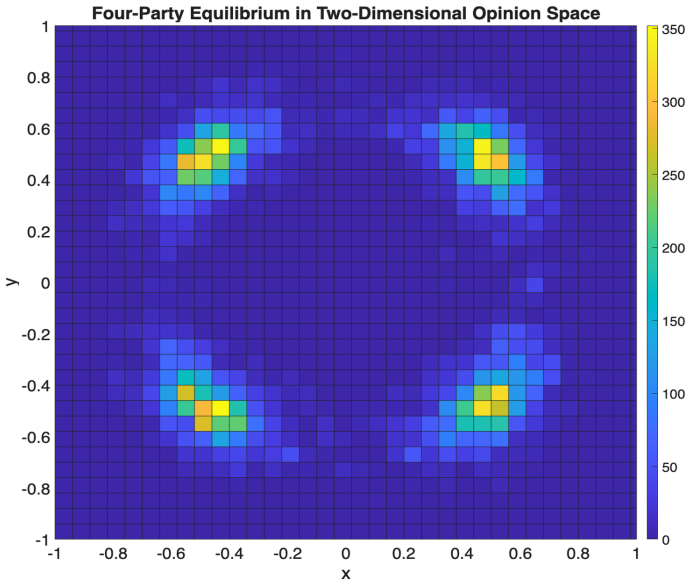
The Hotelling-Downs model considers parties changing policy to maximise their vote-share. Where policy position lies on a left-right axis, it describes a tendency for political parties to move towards centrist platforms. This is in contrast with widely observed political polarisation. We extend the model to two dimensions, with many parties and with single and multiple-peaked voter distribution. We find that a two party system reduces polarisation, even if voters are polarised with a bimodal distribution. By contrast, multiparty systems induce polarisation, even when most voters favour moderate position. We model the effect of turnout and activists as influences on the parties, showing that this results in more polarisation, even in a two-party system. This suggests that polarisation of parties can be driven by abstention, intra-party politics and turnout on the extremes. In the two-party case, the winning party's positions are more moderate than the views of their supporters but better representative of the electorate as a whole. With polarisation, individual voters are better able to find a party which represents their views, but the government (winning part or coalition) is less representative of the population, even when the population has a clear consensus on all issues.
Editorial analysis
A structured set of objections, weighed in public.
Referee Report
Summary. The paper extends the classic one-dimensional Hotelling-Downs spatial voting model to two policy dimensions, multiple parties, and both unimodal and bimodal voter distributions. Using forward simulations, it reports that two-party competition drives party platforms toward the center (reducing polarization) even when the voter distribution is bimodal, while multiparty competition produces more polarized platforms even when most voters are moderate. Additional simulations incorporate turnout and activist effects, which are shown to increase polarization in both two- and multi-party settings. The work also compares voter-party congruence and government representativeness under polarized versus centrist outcomes.
Significance. If the computational results are robust, the manuscript supplies a clean, falsifiable mechanism linking the number of parties and turnout/activist parameters to equilibrium polarization levels, offering a statistical-physics-style account of why multiparty systems can sustain divergence despite moderate electorates. The two-dimensional formulation and explicit treatment of abstention are genuine extensions beyond the standard Hotelling-Downs literature.
major comments (3)
- [§3] §3 (Model and simulation procedure): The iterative rule by which parties adjust positions to maximize vote share is described only at a high level. Because the multiparty Hotelling-Downs game generically lacks pure-strategy Nash equilibria, the headline finding that multiparty systems 'induce polarisation' is load-bearing on the precise dynamics (simultaneous gradient steps, best-response, stochastic search, convergence tolerance, etc.). Without the exact algorithm, step size, and stopping criterion, it is impossible to determine whether the reported spread is a stable attractor or an artifact of persistent cycling or slow drift.
- [§4] §4 (Results): No parameter values, number of Monte Carlo runs, statistical tests for convergence, or robustness checks against alternative update rules or initial conditions are reported. The abstract and results sections therefore provide no quantitative basis for assessing whether the contrast between two-party convergence and multiparty polarization survives changes in these implementation details.
- [§5] §5 (Turnout and activist extensions): The claim that turnout and activists increase polarization even in the two-party case rests on the same unspecified dynamics. If the update rule already produces cycling in the multiparty case, the additional polarization attributed to activists may be confounded with the choice of dynamics rather than a genuine effect of the new parameters.
minor comments (2)
- [§2] Notation for the two-dimensional policy space and voter density functions is introduced without an explicit equation reference; a single displayed equation defining the utility or vote-share function would improve clarity.
- [Figures 2-4] Figure captions do not state the number of simulation runs or the convergence criterion used to generate the plotted party positions.
Simulated Author's Rebuttal
We thank the referee for their careful reading and constructive comments, which identify key areas where the simulation methodology requires greater specificity. We will revise the manuscript accordingly to provide the requested details on the update algorithm, parameter reporting, and robustness analyses.
read point-by-point responses
-
Referee: [§3] §3 (Model and simulation procedure): The iterative rule by which parties adjust positions to maximize vote share is described only at a high level. Because the multiparty Hotelling-Downs game generically lacks pure-strategy Nash equilibria, the headline finding that multiparty systems 'induce polarisation' is load-bearing on the precise dynamics (simultaneous gradient steps, best-response, stochastic search, convergence tolerance, etc.). Without the exact algorithm, step size, and stopping criterion, it is impossible to determine whether the reported spread is a stable attractor or an artifact of persistent cycling or slow drift.
Authors: We agree that the description of the iterative adjustment procedure in §3 is high-level and insufficient given the known absence of pure-strategy Nash equilibria in multiparty Hotelling-Downs games. In the revised manuscript we will specify the exact algorithm: simultaneous position updates via gradient ascent on each party's vote-share function, with a fixed step size of 0.01, a convergence tolerance of 10^{-4} on the maximum position change, and a maximum of 500 iterations or until all parties' vote shares stabilize within 0.5%. We will also report diagnostics confirming that the observed multiparty polarization is a stable attractor rather than cycling or unbounded drift. revision: yes
-
Referee: [§4] §4 (Results): No parameter values, number of Monte Carlo runs, statistical tests for convergence, or robustness checks against alternative update rules or initial conditions are reported. The abstract and results sections therefore provide no quantitative basis for assessing whether the contrast between two-party convergence and multiparty polarization survives changes in these implementation details.
Authors: We accept that §4 lacks the quantitative implementation details needed for reproducibility and robustness assessment. The revised version will include a new subsection (or appendix) listing all parameter values (voter distribution means/variances, number of parties, turnout thresholds, activist weights), the number of Monte Carlo replications (200 per condition), Kolmogorov-Smirnov tests for convergence of platform positions, and results from robustness checks using asynchronous updates, different initial conditions, and alternative step sizes. These additions will demonstrate that the two-party convergence versus multiparty polarization contrast is robust. revision: yes
-
Referee: [§5] §5 (Turnout and activist extensions): The claim that turnout and activists increase polarization even in the two-party case rests on the same unspecified dynamics. If the update rule already produces cycling in the multiparty case, the additional polarization attributed to activists may be confounded with the choice of dynamics rather than a genuine effect of the new parameters.
Authors: We acknowledge that the turnout and activist results in §5 inherit the same update-rule ambiguity identified in §3. With the detailed algorithm now specified, the revision will add targeted sensitivity analyses that vary turnout and activist parameters while holding the core dynamics fixed. These will show that the polarization increase occurs in both two- and multiparty settings even under the clarified update rule, and we will include direct comparisons of polarization metrics with and without the new parameters to isolate their contribution. revision: yes
Circularity Check
No significant circularity; results from direct forward simulation of extended spatial model
full rationale
The paper defines an agent-based computational extension of the classic Hotelling-Downs spatial voting model in two policy dimensions. Party positions are updated iteratively to maximize vote share against fixed voter distributions (unimodal or bimodal). The reported contrasts between two-party moderation and multiparty polarization emerge directly from running these dynamics; no equations reduce to fitted parameters renamed as predictions, no self-definitional loops, and no load-bearing self-citations. The model assumptions and update rules are stated independently of the target outcomes, making the derivation self-contained against external benchmarks.
Axiom & Free-Parameter Ledger
free parameters (3)
- voter distribution parameters
- number of parties
- turnout and activist parameters
axioms (2)
- domain assumption Parties adjust policy positions solely to maximize their vote share.
- domain assumption Voter preferences are static and distributed in a two-dimensional policy space.
Reference graph
Works this paper leans on
-
[1]
Hotelling H. Stability in Competition. The Economic Journal. 1929;39(153):41–57
work page 1929
-
[2]
An Economic Theory of Political Action in a Democracy
Downs A. An Economic Theory of Political Action in a Democracy. Journal of Political Economy. 1957;65(2):135–150. doi:10.1086/257897
-
[3]
Robustness of the Multidimensional Voting Model: Candidate Motivations, Uncertainty, and Convergence
Calvert RL. Robustness of the Multidimensional Voting Model: Candidate Motivations, Uncertainty, and Convergence. American Journal of Political Science. 1985;29(1):69. doi:10.2307/2111212
-
[4]
Party Polarization in American Politics: Characteristics, Causes, and Consequences
Layman GC, Carsey TM, Horowitz JM. Party Polarization in American Politics: Characteristics, Causes, and Consequences. Annual Review of Political Science. 2006;9(1):83–110. doi:10.1146/annurev.polisci.9.070204.105138
-
[5]
Boxell L, Gentzkow M, Shapiro JM. Cross-Country Trends in Affective Polarization. The Review of Economics and Statistics. 2024;106(2):557–565. doi:10.1162/rest a 01160
-
[6]
Young DJ, Ackland JA, Kapounek A, Madsen JK, Greening LJ, de-Wit L A new measure of issue polarization using k-means clustering: US trends 1988–2024 and predictors of polarization across the world, Royal Society Open Science. 2026;13(2):251428. doi:10.1098/rsos.251428,
-
[7]
Whatever Happened to the Median Voter? In: MIT Conference on Parties and Congress, Cambridge, MA
Fiorina MP. Whatever Happened to the Median Voter? In: MIT Conference on Parties and Congress, Cambridge, MA. vol. 2. Citeseer; 1999. p. 1999
work page 1999
-
[8]
The Polarization of American Politics
Poole KT, Rosenthal H. The Polarization of American Politics. The Journal of Politics. 1984;46(4):1061–1079. doi:10.2307/2131242
-
[9]
Party Polarization and ‘Conflict Extension’ in the American Electorate
Layman GC, Carsey TM. Party Polarization and ‘Conflict Extension’ in the American Electorate. American Journal of Political Science. 2002;46(4):786. doi:10.2307/3088434. May 12, 2026 16/18
-
[10]
Political Polarization in the American Public
Fiorina MP, Abrams SJ. Political Polarization in the American Public. Annual Review of Political Science. 2008;11:563–588. doi:https://doi.org/10.1146/annurev.polisci.11.053106.153836
-
[11]
Turnout, Polarization, and Duverger’s Law
Callander S, Wilson CH. Turnout, Polarization, and Duverger’s Law. The Journal of Politics. 2007;69(4):1047–1056. doi:10.1111/j.1468-2508.2007.00606.x
-
[12]
An Economic Model of Representative Democracy
Besley T, Coate S. An Economic Model of Representative Democracy. The Quarterly Journal of Economics. 1997;112(1):85–114. doi:10.1162/003355397555136
-
[13]
A Model of Political Competition with Citizen-Candidates
Osborne MJ, Slivinski A. A Model of Political Competition with Citizen-Candidates. The Quarterly Journal of Economics. 1996;111(1):65–96. doi:10.2307/2946658
-
[14]
Candidate Motivation: A Synthesis of Alternative Theories
Wittman D. Candidate Motivation: A Synthesis of Alternative Theories. American Political Science Review. 1983;77(1):142–157. doi:10.2307/1956016
-
[15]
Spatial Equilibrium with Entry
Palfrey TR. Spatial Equilibrium with Entry. The Review of Economic Studies. 1984;51(1):139. doi:10.2307/2297710
-
[16]
Spatial Models of Party Competition
Stokes DE. Spatial Models of Party Competition. The American Political Science Review. 1963;57(2):368–377
work page 1963
-
[17]
Downs and Two-Party Convergence
Grofman B. Downs and Two-Party Convergence. Annual Review of Political Science. 2004;7(Volume 7, 2004):25–46. doi:https://doi.org/10.1146/annurev.polisci.7.012003.104711
-
[18]
A Theory of the Calculus of Voting
Riker WH, Ordeshook PC. A Theory of the Calculus of Voting. The American Political Science Review. 1968;62(1):25–42
work page 1968
-
[19]
A Hotelling-Downs Framework for Party Nominees
Harrenstein P, Lisowski G, Sridharan R, Turrini P. A Hotelling-Downs Framework for Party Nominees. In: 20th International Conference on Autonomous Agents and Multiagent Systems (AAMAS 20201). Association for Computing Machinery; 2021. p. 593–601
work page 2021
-
[20]
Party Competition: An Agent-Based Model
Laver M, Sergenti E. Party Competition: An Agent-Based Model. Princeton University Press; 2012
work page 2012
-
[21]
Statistical Physics of Social Dynamics
Castellano C, Fortunato S, Loreto V. Statistical Physics of Social Dynamics. Rev Mod Phys. 2009;81:591–646. doi:10.1103/RevModPhys.81.591
-
[22]
Application of statistical physics to politics
Galam S. Application of statistical physics to politics. Physica A: Statistical Mechanics and its Applications. 1999;274(1-2):132–139. doi:10.1016/S0378-4371(99)00320-9
-
[23]
Preventing Extreme Polarization of Political Attitudes
Axelrod R, Daymude JJ, Forrest S. Preventing Extreme Polarization of Political Attitudes. Proceedings of the National Academy of Sciences. 2021;118(50):e2102139118. doi:10.1073/pnas.2102139118
-
[24]
Party Strategies: Valence versus Position
Magyar A, Wagner S, Zur R. Party Strategies: Valence versus Position. In: Carter N, Keith D, Sindre GM, Vasilopoulou S, editors. The Routledge Handbook of Political Parties. Routledge; 2023. p. 199–210
work page 2023
-
[25]
Voter Turnout and Candidate Strategies in American Elections
Adams J, Merrill S. Voter Turnout and Candidate Strategies in American Elections. The Journal of Politics. 2003;65(1):161–189. doi:10.1111/1468-2508.t01-1-00008. May 12, 2026 17/18
-
[26]
The Journal of Chemical Physics21(6), 1087–1092 (1953) https://doi.org/10.1063/1.1699114
Metropolis N, Rosenbluth A W, Rosenbluth MN, Teller AH, Teller E. Equation of State Calculations by Fast Computing Machines. The Journal of Chemical Physics. 1953;21(6):1087–1092. doi:10.1063/1.1699114
-
[27]
Does voter polarisation induce party extremism? The moderating role of abstention
Dreyer P, Bauer J. Does voter polarisation induce party extremism? The moderating role of abstention. West European Politics. 2019;42(4):824–847. doi:10.1080/01402382.2019.1566852
-
[28]
Primary Election Systems and Candidate Deviation
Westley C, Calcagno PT, Ault R. Primary Election Systems and Candidate Deviation. Eastern Economic Journal. 2004;30(3):365–376
work page 2004
-
[29]
Political Polarisation Compared: Creating the Comparative Political Polarisation Index
van der Veen O. Political Polarisation Compared: Creating the Comparative Political Polarisation Index. European Political Science. 2023;22(2):260–280
work page 2023
-
[30]
Global Dataset on Turnout (GD-Turnout); 2023
Martinez i Coma F, Leiva Van De Maele D. Global Dataset on Turnout (GD-Turnout); 2023
work page 2023
-
[31]
Electoral Choice, Ideological Conflict, and Political Participation
Rogowski JC. Electoral Choice, Ideological Conflict, and Political Participation. American Journal of Political Science. 2014;58(2):479–494. doi:https://doi.org/10.1111/ajps.12059
-
[32]
Voter Turnout and Electoral Polarisation: Evidence from the Dutch General Elections; 2024
Yussef AA, Heyndels B. Voter Turnout and Electoral Polarisation: Evidence from the Dutch General Elections; 2024
work page 2024
-
[33]
The Mobilising Effect of Political Choice
Hobolt SB, Hoerner JM. The Mobilising Effect of Political Choice. European Journal of Political Research. 2020;59(2):229–247. doi:https://doi.org/10.1111/1475-6765.12353
-
[34]
The Impact of Party Polarization and Postmaterialism on Voter Turnout
Crepaz MML. The Impact of Party Polarization and Postmaterialism on Voter Turnout. European Journal of Political Research. 1990;18(2):183–205. doi:https://doi.org/10.1111/j.1475-6765.1990.tb00228.x
-
[35]
Polarization, Number of Parties, and Voter Turnout: Explaining Turnout in 26 OECD Countries
Wilford AM. Polarization, Number of Parties, and Voter Turnout: Explaining Turnout in 26 OECD Countries. Social Science Quarterly. 2017;98(5):1391–1405. doi:https://doi.org/10.1111/ssqu.12366
-
[36]
Does Affective Polarisation Increase Turnout? Evidence from Germany, The Netherlands and Spain
Harteveld E, Wagner M. Does Affective Polarisation Increase Turnout? Evidence from Germany, The Netherlands and Spain. West European Politics. 2023;46(4):732–759. doi:10.1080/01402382.2022.2087395
-
[37]
Is Polarization a Myth? The Journal of Politics
Abramowitz AI, Saunders KL. Is Polarization a Myth? The Journal of Politics. 2008;70(2):542–555. doi:10.1017/S0022381608080493
-
[38]
A Downsian Spatial Model with Party Activism
Aldrich JH. A Downsian Spatial Model with Party Activism. The American Political Science Review. 1983;77(4):974–990
work page 1983
-
[39]
Morris Fiorina’s Foundational Contributions to the Study of Partisanship and Mass Polarization
Levendusky M. Morris Fiorina’s Foundational Contributions to the Study of Partisanship and Mass Polarization. The Forum. 2017;15(1):189–201. doi:doi:10.1515/for-2017-0011
-
[40]
Can a Science-Humanities Collaboration Be Successful? Adaptive Behavior
Blythe R, Croft W. Can a Science-Humanities Collaboration Be Successful? Adaptive Behavior. 2010;18(1):12–20. doi:10.1177/1059712309350969
-
[41]
The populist radical-right turn of the mainstream right in France
Ivaldi, G. The populist radical-right turn of the mainstream right in France. FEPS. 2024; 80–93 doi:sciencespo.hal.science/hal-04567687. May 12, 2026 18/18
work page 2024
discussion (0)
Sign in with ORCID, Apple, or X to comment. Anyone can read and Pith papers without signing in.