Recognition: 2 theorem links
· Lean TheoremFrom Discrete to Continuous Highest-earning Imitation Dynamics
Pith reviewed 2026-05-12 04:28 UTC · model grok-4.3
The pith
Fluctuations from imitating highest earners vanish almost surely as population size grows to infinity.
A machine-rendered reading of the paper's core claim, the machinery that carries it, and where it could break.
Core claim
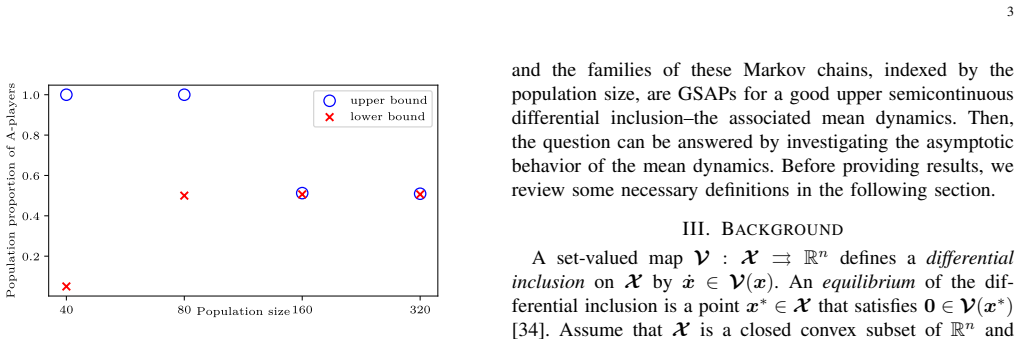
The family of Markov chains describing the discrete population dynamics forms a generalized stochastic approximation process for a good upper semicontinuous differential inclusion—the mean dynamics. The mean dynamics always equilibrate. By stochastic approximation theory, the amplitudes of fluctuations in the population proportions of the two strategies diminish to zero with probability one as the population size approaches infinity.
What carries the argument
Generalized stochastic approximation process linking the discrete Markov chain to an upper semicontinuous differential inclusion that governs the mean-field limit of highest-earner imitation.
If this is right
- The continuous mean dynamics reach equilibrium from any initial state.
- Random fluctuations in strategy proportions are suppressed with probability one in the infinite-population limit.
- Highest-earner imitation does not sustain large-scale perpetual cycling in well-mixed large groups.
- The result holds when players have heterogeneous payoff perceptions but follow identical imitation.
Where Pith is reading between the lines
- Observed fluctuations in small laboratory groups may disappear in real-world populations of hundreds or thousands.
- The same stochastic-approximation route could be used to test stability under other imitation or learning rules.
- Network structure or non-well-mixed mixing could prevent the fluctuation decay that occurs under the paper's assumptions.
Load-bearing premise
The discrete dynamics are accurately captured by the mean differential inclusion, which requires a well-mixed heterogeneous population using the same imitation rule.
What would settle it
A simulation or experiment in which the amplitude of proportion fluctuations stays bounded away from zero with positive probability as population size is increased without bound would refute the convergence claim.
Figures

read the original abstract
Decision-making by imitating the highest earners has been observed in experimental studies. In two-strategy decision-making problems, this behavior may result in perpetual fluctuations in the population proportions of the two strategies. How these fluctuations evolve for large population sizes remains unclear. This paper addresses this question for a heterogeneous population of players imitating the highest earners. We show that the family of Markov chains describing the discrete population dynamics forms a generalized stochastic approximation process for a good upper semicontinuous differential inclusion--the mean dynamics. Furthermore, we prove that the mean dynamics always equilibrate. Then, by using results from stochastic approximation theory, we show that the amplitudes of fluctuations in the population proportions of the two strategies diminish to zero with probability one, as the population size approaches infinity. Our results suggest that in a well-mixed, large population, imitating the highest earners is unlikely to generate large-scale, perpetual fluctuations.
Editorial analysis
A structured set of objections, weighed in public.
Referee Report
Summary. The paper claims that for a heterogeneous population of players in a two-strategy game who imitate the highest earners, the discrete-time Markov chain on population proportions forms a generalized stochastic approximation process for an upper semicontinuous differential inclusion (the mean dynamics). It proves that all solutions of this differential inclusion equilibrate and invokes stochastic approximation theory to conclude that the amplitudes of fluctuations in the strategy proportions converge to zero almost surely as the population size N tends to infinity.
Significance. If the result holds, the work is significant for evolutionary game theory and the study of imitation dynamics, as it provides a rigorous large-population limit result showing that perpetual large-scale fluctuations are precluded in well-mixed heterogeneous populations. Strengths include the explicit construction of the set-valued drift map from the imitation rule, verification of upper semicontinuity and growth conditions, and the direct one-dimensional analysis proving equilibration of the differential inclusion; these steps allow clean application of existing stochastic approximation theorems without ad-hoc assumptions.
minor comments (3)
- The statement of the main theorem (likely in the section following the differential inclusion construction) would benefit from an explicit listing of the precise conditions of the invoked stochastic approximation result that are being verified, to make the application fully self-contained.
- Notation for the set-valued map F (the drift of the differential inclusion) is introduced without a dedicated display equation summarizing its definition from the highest-earner imitation rule; adding this would improve readability for readers unfamiliar with differential inclusions.
- The abstract mentions 'heterogeneous population' but does not clarify whether heterogeneity is in payoffs, imitation thresholds, or both; a single sentence in the introduction or model section would resolve this.
Simulated Author's Rebuttal
We thank the referee for the careful reading of our manuscript and for the positive summary and significance assessment. We appreciate the recommendation of minor revision.
Circularity Check
No significant circularity
full rationale
The derivation proceeds by constructing the set-valued drift map directly from the imitation rule on the two-strategy simplex, verifying upper semicontinuity and linear growth, proving that all solutions of the resulting differential inclusion equilibrate by direct one-dimensional analysis, and then invoking an external stochastic approximation theorem to conclude almost-sure convergence of the discrete chain to the equilibria as population size tends to infinity. None of these steps reduces to a self-definition, a fitted parameter renamed as a prediction, or a load-bearing self-citation; the stochastic approximation results are standard external theorems whose hypotheses are checked rather than assumed.
Axiom & Free-Parameter Ledger
axioms (2)
- domain assumption The family of Markov chains describing the discrete population dynamics forms a generalized stochastic approximation process for a good upper semicontinuous differential inclusion.
- domain assumption The mean dynamics always equilibrate.
Lean theorems connected to this paper
-
IndisputableMonolith/Cost/FunctionalEquation.leanwashburn_uniqueness_aczel unclear?
unclearRelation between the paper passage and the cited Recognition theorem.
the family of Markov chains ... forms a generalized stochastic approximation process for a good upper semicontinuous differential inclusion—the mean dynamics ... V(x) = {ρ−x} ... Conv(ρ−x,−x) ...
-
IndisputableMonolith/Foundation/RealityFromDistinction.leanreality_from_one_distinction unclear?
unclearRelation between the paper passage and the cited Recognition theorem.
the Birkhoff center of the dynamical system induced by ... is ⋃_{k} {q_k ρ}
What do these tags mean?
- matches
- The paper's claim is directly supported by a theorem in the formal canon.
- supports
- The theorem supports part of the paper's argument, but the paper may add assumptions or extra steps.
- extends
- The paper goes beyond the formal theorem; the theorem is a base layer rather than the whole result.
- uses
- The paper appears to rely on the theorem as machinery.
- contradicts
- The paper's claim conflicts with a theorem or certificate in the canon.
- unclear
- Pith found a possible connection, but the passage is too broad, indirect, or ambiguous to say the theorem truly supports the claim.
Reference graph
Works this paper leans on
-
[1]
From discrete to continuous imitation dynamics,
A. Aghaeeyan and P. Ramazi, “From discrete to continuous imitation dynamics,” in2024 IEEE 63rd Conference on Decision and Control (CDC). IEEE, 2024, pp. 966–971
work page 2024
-
[2]
Innovators and imitators in innovation diffusion modelling,
S. M. Tanny and N. A. Derzko, “Innovators and imitators in innovation diffusion modelling,”Journal of Forecasting, vol. 7, no. 4, pp. 225–234, 1988
work page 1988
-
[3]
New product diffusion with influentials and imitators,
C. Van den Bulte and Y . V . Joshi, “New product diffusion with influentials and imitators,”Marketing science, vol. 26, no. 3, pp. 400– 421, 2007
work page 2007
-
[4]
Imitation dynamics predict vaccinating behaviour,
C. T. Bauch, “Imitation dynamics predict vaccinating behaviour,”Pro- ceedings of the Royal Society B: Biological Sciences, vol. 272, no. 1573, pp. 1669–1675, 2005
work page 2005
-
[5]
Evolutionary game theory and social learning can determine how vaccine scares unfold,
C. T. Bauch and S. Bhattacharyya, “Evolutionary game theory and social learning can determine how vaccine scares unfold,”PLoS computational biology, vol. 8, no. 4, p. e1002452, 2012
work page 2012
-
[6]
Robust coordination of linear threshold dynamics on directed weighted networks,
L. Arditti, G. Como, F. Fagnani, and M. Vanelli, “Robust coordination of linear threshold dynamics on directed weighted networks,”IEEE Transactions on Automatic Control, vol. 69, no. 10, pp. 6515–6529, 2024
work page 2024
-
[7]
G. Chen and Y . Yu, “Convergence analysis and strategy control of evo- lutionary games with imitation rule on toroidal grid,”IEEE Transactions on Automatic Control, vol. 68, no. 12, pp. 8185–8192, 2023
work page 2023
-
[8]
Convergence of linear threshold decision- making dynamics in finite heterogeneous populations,
P. Ramazi and M. Cao, “Convergence of linear threshold decision- making dynamics in finite heterogeneous populations,”Automatica, vol. 119, p. 109063, 2020
work page 2020
-
[9]
——, “Asynchronous decision-making dynamics under best-response update rule in finite heterogeneous populations,”IEEE Transactions on Automatic Control, vol. 63, no. 3, pp. 742–751, 2017
work page 2017
-
[10]
Anti-conformism in the threshold model of collective behavior,
M. Grabisch and F. Li, “Anti-conformism in the threshold model of collective behavior,”Dynamic Games and Applications, vol. 10, no. 2, pp. 444–477, 2020
work page 2020
-
[11]
Characterizing oscillations in heteroge- neous populations of coordinators and anticoordinators,
P. Ramazi and M. H. Roohi, “Characterizing oscillations in heteroge- neous populations of coordinators and anticoordinators,”Automatica, vol. 154, p. 111068, 2023
work page 2023
-
[12]
Evolutionary matrix-game dynamics under imi- tation in heterogeneous populations,
Y . Fu and P. Ramazi, “Evolutionary matrix-game dynamics under imi- tation in heterogeneous populations,”Automatica, vol. 159, p. 111354, 2024
work page 2024
-
[13]
W. H. Sandholm,Population games and evolutionary dynamics. MIT press, 2010
work page 2010
-
[14]
Stability for the best response dynamics,
J. Hofbauer, “Stability for the best response dynamics,”Technical Report, 1995, university of Vienna
work page 1995
-
[15]
Basins of attraction and equilibrium selec- tion under different learning rules,
R. Golman and S. E. Page, “Basins of attraction and equilibrium selec- tion under different learning rules,”Journal of evolutionary economics, vol. 20, no. 1, pp. 49–72, 2010
work page 2010
-
[16]
On best-response dynamics in potential games,
B. Swenson, R. Murray, and S. Kar, “On best-response dynamics in potential games,”SIAM Journal on Control and Optimization, vol. 56, no. 4, pp. 2734–2767, 2018
work page 2018
-
[17]
Two more classes of games with the continuous-time fictitious play property,
U. Berger, “Two more classes of games with the continuous-time fictitious play property,”Games and Economic Behavior, vol. 60, no. 2, pp. 247–261, 2007
work page 2007
-
[18]
Selfish response to epidemic propagation,
G. Theodorakopoulos, J.-Y . Le Boudec, and J. S. Baras, “Selfish response to epidemic propagation,”IEEE Transactions on Automatic Control, vol. 58, no. 2, pp. 363–376, 2012
work page 2012
-
[19]
Imitation dynamics in population games on community networks,
G. Como, F. Fagnani, and L. Zino, “Imitation dynamics in population games on community networks,”IEEE Transactions on Control of Network Systems, vol. 8, no. 1, pp. 65–76, 2021
work page 2021
-
[20]
Game interactions and dynamics on net- worked populations,
D. Madeo and C. Mocenni, “Game interactions and dynamics on net- worked populations,”IEEE Transactions on Automatic Control, vol. 60, no. 7, pp. 1801–1810, 2015
work page 2015
-
[21]
Passivity analysis of replicator dynamics and its variations,
M. A. Mabrok, “Passivity analysis of replicator dynamics and its variations,”IEEE Transactions on Automatic Control, vol. 66, no. 8, pp. 3879–3884, 2021
work page 2021
-
[22]
Replicator based on imitation for finite and arbitrary networked communities,
J. M. S. Nogales and S. Zazo, “Replicator based on imitation for finite and arbitrary networked communities,”Applied Mathematics and Computation, vol. 378, p. 125166, 2020
work page 2020
-
[23]
Optimally combined incentive for cooperation among interacting agents in population games,
S. Wang, M. Cao, and X. Chen, “Optimally combined incentive for cooperation among interacting agents in population games,”IEEE Trans- actions on Automatic Control, vol. 70, no. 7, pp. 4562–4577, 2025
work page 2025
-
[24]
Stochastic approximations and differential inclusions,
M. Bena ¨ım, J. Hofbauer, and S. Sorin, “Stochastic approximations and differential inclusions,”SIAM Journal on Control and Optimization, vol. 44, no. 1, pp. 328–348, 2005
work page 2005
-
[25]
Recursive algorithms, urn processes and chaining number of chain recurrent sets,
M. Bena ¨ım, “Recursive algorithms, urn processes and chaining number of chain recurrent sets,”Ergodic Theory and Dynamical Systems, vol. 18, no. 1, pp. 53–87, 1998
work page 1998
-
[26]
Deterministic approximation of stochas- tic evolution in games,
M. Bena ¨ım and J. W. Weibull, “Deterministic approximation of stochas- tic evolution in games,”Econometrica, vol. 71, no. 3, pp. 873–903, 2003
work page 2003
-
[27]
Mean-field approximation of stochastic population processes in games,
M. Bena ¨ım and J. Weibull, “Mean-field approximation of stochastic population processes in games,”hal-00435515, 2009
work page 2009
-
[28]
Stochastic approximations with constant step size and differential inclusions,
G. Roth and W. H. Sandholm, “Stochastic approximations with constant step size and differential inclusions,”SIAM Journal on Control and Optimization, vol. 51, no. 1, pp. 525–555, 2013
work page 2013
-
[29]
A. Aghaeeyan and P. Ramazi, “From discrete to continuous best- response dynamics: Discrete fluctuations do not scale with population size,” in2024 American Control Conference (ACC). IEEE, 2024, pp. 851–856
work page 2024
-
[30]
——, “From discrete to continuous binary best-response dynamics: Discrete fluctuations almost surely vanish with population size,”arXiv preprint arXiv:2311.01995v2, 2024
-
[31]
Evolutionary games and spatial chaos,
M. A. Nowak and R. M. May, “Evolutionary games and spatial chaos,” Nature, vol. 359, no. 6398, pp. 826–829, 1992
work page 1992
-
[32]
J. Henrich and F. J. Gil-White, “The evolution of prestige: Freely conferred deference as a mechanism for enhancing the benefits of cultural transmission,”Evolution and human behavior, vol. 22, no. 3, pp. 165–196, 2001
work page 2001
-
[33]
B. J. Barrett, R. L. McElreath, and S. E. Perry, “Pay-off-biased social learning underlies the diffusion of novel extractive foraging traditions in a wild primate,”Proceedings of the Royal Society B: Biological Sciences, vol. 284, no. 1856, p. 20170358, 2017
work page 2017
-
[34]
Discontinuous dynamical systems,
J. Cortes, “Discontinuous dynamical systems,”IEEE Control systems magazine, vol. 28, no. 3, pp. 36–73, 2008
work page 2008
-
[35]
On the topological structure of attraction basins for differential inclusions,
C. G. Mayhew and A. R. Teel, “On the topological structure of attraction basins for differential inclusions,”Systems & Control Letters, vol. 60, no. 12, pp. 1045–1050, 2011
work page 2011
-
[36]
Filippov,Differential Equations with Discontinuous Righthand Sides
A. Filippov,Differential Equations with Discontinuous Righthand Sides. Kluwer Academic Publishers, 1988
work page 1988
-
[37]
Sliding motion in filippov differential systems: theoretical results and a computational approach,
L. Dieci and L. Lopez, “Sliding motion in filippov differential systems: theoretical results and a computational approach,”SIAM Journal on Numerical Analysis, vol. 47, no. 3, pp. 2023–2051, 2009
work page 2023
-
[38]
——, “Sliding motion on discontinuity surfaces of high co-dimension. a construction for selecting a filippov vector field,”Numerische Mathe- matik, vol. 117, pp. 779–811, 2011. APPENDIX Lemma A1:The continuous-time population dynamics (11) are good upper semicontinuous. Proof:For eachx∈X s,V(x)is nonempty and bounded. As for convexity ofV(x), ifV(x)is a si...
work page 2011
discussion (0)
Sign in with ORCID, Apple, or X to comment. Anyone can read and Pith papers without signing in.