Recognition: 2 theorem links
· Lean TheoremGeometry-induced pulse dynamics in a bulk-surface reaction-diffusion system for cell polarization
Pith reviewed 2026-05-12 03:08 UTC · model grok-4.3
The pith
Cell shape controls where polarization pulses settle by driving their slow motion along a potential defined by the Neumann Green's function.
A machine-rendered reading of the paper's core claim, the machinery that carries it, and where it could break.
Core claim
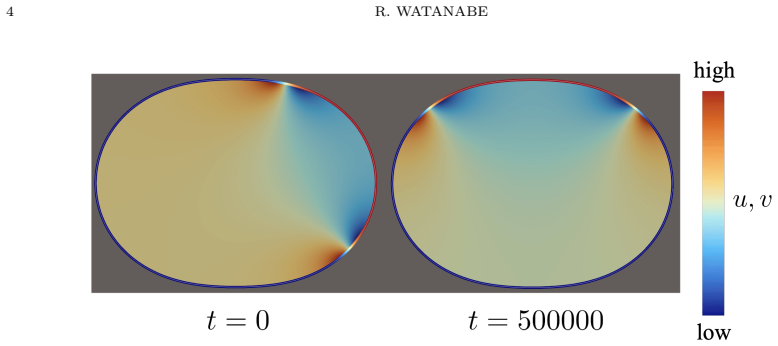
Using singular perturbation methods, the authors formally derive reduced ordinary differential equations describing the wave-pinning dynamics on a fast time scale and the subsequent slow drift of pulse solutions induced by domain geometry. The resulting slow dynamics is a gradient flow of a potential function whose geometry-dependent part is expressed in terms of the Neumann Green's function. Analysis of dumbbell-shaped domains and perforated disks, with the Green's function evaluated via conformal mapping, characterizes stationary pulse positions, their stability, and the bifurcation structures that arise when geometric parameters change.
What carries the argument
The reduced slow dynamics as a gradient flow of a potential that includes the Neumann Green's function of the domain.
If this is right
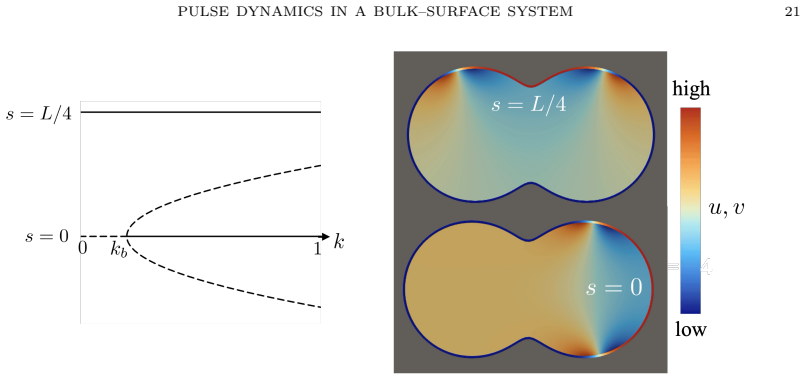
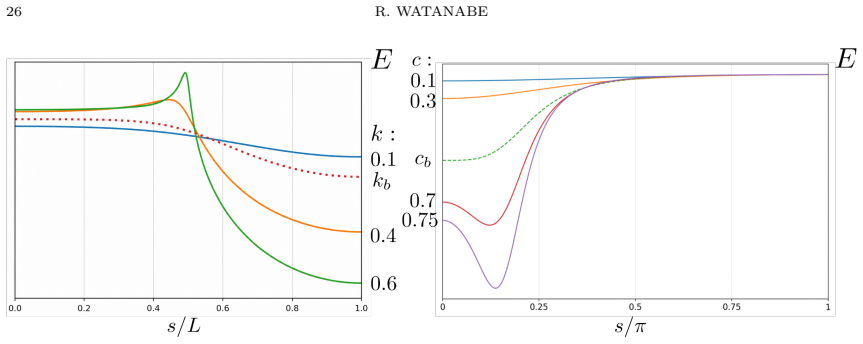
- In dumbbell domains, pulse equilibria occur at locations determined by critical points of the geometry-dependent potential, with stability set by the second derivative of that potential.
- As the width or length parameters of a dumbbell vary, pitchfork bifurcations change the number and stability of stationary pulse positions.
- In perforated disks, holes shift the stable pulse locations away from the geometric center through the same Green's function term.
- The fast-time wave-pinning stage produces a localized pulse whose subsequent slow evolution is fully determined by the reduced gradient flow.
Where Pith is reading between the lines
- The same reduction technique could be tested on three-dimensional domains to see whether surface curvature adds new drift terms beyond the planar Green's function.
- If the predicted bifurcations are observed experimentally by stretching cells into dumbbell shapes, it would link cell geometry directly to polarization site selection.
- The Neumann Green's function term might be approximated for irregular cell outlines by boundary integral methods, allowing predictions without full conformal mapping.
Load-bearing premise
The formal reduction requires a clear separation of timescales between fast wave-pinning and slow geometric drift together with the continued existence of a localized pulse.
What would settle it
Numerical integration of the full bulk-surface system in a dumbbell domain that shows pulse trajectories or final positions differing from those predicted by the gradient flow on the Neumann Green's function potential.
Figures


read the original abstract
This paper studies a bulk-surface reaction-diffusion system for cell polarization in two-dimensional domains. The model describes the formation of localized patterns through the wave-pinning mechanism, while explicitly incorporating the effect of cell shape. Using singular perturbation methods, we formally derive reduced ordinary differential equations describing the wave-pinning dynamics on a fast time scale and the subsequent slow drift of pulse solutions induced by domain geometry. The resulting slow dynamics is a gradient flow of a potential function whose geometry-dependent part is expressed in terms of the Neumann Green's function. We then analyze the reduced dynamics in several concrete geometries, including dumbbell-shaped domains and perforated disks. In these examples, we characterize stationary pulse positions, their stability, and the bifurcation structures arising from changes in geometric parameters. To evaluate the geometric terms appearing in the reduced dynamics, we use a conformal mapping method to compute the Neumann Green's function for these domains. Our analysis reveals geometry-induced phenomena such as nontrivial stationary pulse locations and both supercritical and subcritical pitchfork bifurcations. Finally, we perform numerical simulations to support the theoretical predictions.
Editorial analysis
A structured set of objections, weighed in public.
Referee Report
Summary. The manuscript studies a bulk-surface reaction-diffusion system for cell polarization in two-dimensional domains. It employs singular perturbation methods to formally derive reduced ordinary differential equations that capture the fast wave-pinning dynamics and the subsequent slow drift of pulse solutions due to domain geometry. The slow dynamics is shown to be a gradient flow of a potential whose geometry-dependent component is given by the Neumann Green's function. The reduced model is then analyzed in dumbbell-shaped domains and perforated disks, where stationary pulse positions, their stability, and bifurcation structures are characterized. The Neumann Green's function is computed using conformal mapping techniques, and numerical simulations are performed to support the theoretical findings.
Significance. If the formal reduction holds under the stated assumptions, this provides a useful reduced description for geometry-induced effects on pulse dynamics in cell polarization models. The explicit geometry term via the Neumann Green's function, combined with exact conformal-mapping computations in 2D and the identification of supercritical and subcritical pitchfork bifurcations, are clear strengths. Numerical simulations add supporting evidence for the reduced ODE predictions in the chosen domains.
major comments (2)
- [Derivation of reduced dynamics] The formal singular perturbation reduction (derivation of the reduced ODEs for fast pinning and slow drift): the leading-order balance assumes persistence of a localized pulse structure and clear timescale separation in the reaction kinetics, but no explicit parameter regime or error estimate is supplied to guarantee this holds in dumbbell or perforated domains where curvature variations or necks could induce deformation or radiation.
- [Analysis in concrete geometries] Analysis of stationary positions and bifurcations in dumbbell-shaped domains and perforated disks: these conclusions rest on the accuracy of the gradient-flow reduction; without verification that the pulse remains localized and the adiabatic approximation remains valid when geometric parameters vary (e.g., neck width or hole radius), the reported pitchfork structures may not correspond to the full PDE dynamics.
minor comments (2)
- [Abstract and § on Green's function computation] The abstract states that conformal mapping is used to evaluate the geometric terms, but the main text should include a brief statement of the mapping functions employed for the dumbbell and perforated-disk cases to aid reproducibility.
- [Throughout] Notation for the Neumann Green's function and the potential function should be introduced once and used consistently; occasional redefinition across sections can confuse readers.
Simulated Author's Rebuttal
We thank the referee for the careful reading, the positive overall assessment, and the constructive identification of points where the formal nature of the reduction and its range of validity could be clarified. We address each major comment below and outline the revisions we will make.
read point-by-point responses
-
Referee: [Derivation of reduced dynamics] The formal singular perturbation reduction (derivation of the reduced ODEs for fast pinning and slow drift): the leading-order balance assumes persistence of a localized pulse structure and clear timescale separation in the reaction kinetics, but no explicit parameter regime or error estimate is supplied to guarantee this holds in dumbbell or perforated domains where curvature variations or necks could induce deformation or radiation.
Authors: We agree that the derivation is formal and that the manuscript would benefit from an explicit statement of the working assumptions. In the revised version we will insert a new subsection (immediately following the derivation of the reduced ODEs) that (i) recalls the small parameters implicit in the reaction kinetics (separation between the two stable states and the interface width), (ii) states the geometric scale-separation hypotheses under which the pulse is expected to remain localized (neck width and curvature radii large compared with the interface width), and (iii) notes that a rigorous error analysis lies outside the scope of the present work. We will also add a short remark that the subsequent numerical comparisons serve as practical validation of these assumptions within the regimes explored. revision: partial
-
Referee: [Analysis in concrete geometries] Analysis of stationary positions and bifurcations in dumbbell-shaped domains and perforated disks: these conclusions rest on the accuracy of the gradient-flow reduction; without verification that the pulse remains localized and the adiabatic approximation remains valid when geometric parameters vary (e.g., neck width or hole radius), the reported pitchfork structures may not correspond to the full PDE dynamics.
Authors: The stationary-position and bifurcation analysis is performed on the reduced gradient-flow ODE, whose validity we already support by direct numerical simulations of the full bulk-surface PDE in the same geometries. In the revision we will strengthen this evidence by (i) adding a quantitative comparison table or plot that reports the discrepancy between the reduced ODE equilibria and the long-time pulse locations obtained from the PDE for a sequence of neck widths (dumbbell) and hole radii (perforated disk), and (ii) including a brief discussion of the parameter values at which visible deformation or radiation begins to appear. These additions will make the range of applicability of the pitchfork predictions more transparent. revision: yes
Circularity Check
No circularity: formal singular perturbation reduction derives reduced ODEs independently from the PDE system
full rationale
The derivation proceeds by applying singular perturbation methods to the bulk-surface reaction-diffusion PDE system to obtain reduced ODEs for fast wave-pinning and slow geometric drift of pulses. The geometry-dependent term in the potential is the Neumann Green's function, evaluated independently via conformal mapping on concrete domains rather than fitted or defined in terms of the target dynamics. No steps reduce by construction to self-definition, renamed empirical patterns, or self-citation load-bearing arguments; the reduced system remains an asymptotic consequence of the original equations under stated timescale separation assumptions.
Axiom & Free-Parameter Ledger
axioms (2)
- standard math Existence and regularity of the Neumann Green's function for the considered 2D domains
- domain assumption Sufficient timescale separation between fast wave-pinning and slow geometric drift
Lean theorems connected to this paper
-
IndisputableMonolith/Foundation/RealityFromDistinction.leanreality_from_one_distinction unclearUsing singular perturbation methods, we formally derive reduced ordinary differential equations describing the wave-pinning dynamics
Reference graph
Works this paper leans on
-
[1]
Matthieu Alfaro, Danielle Hilhorst, and Hiroshi Matano,The singular limit of the Allen–Cahn equation and the FitzHugh–Nagumo system, Journal of Differential Equations245(2008), no. 2, 505–565
work page 2008
-
[2]
Johannes Borgqvist, Adam Malik, Carl Lundholm, Anders Logg, Philip Gerlee, and Marija Cvijovic,Cell polarisation in a bulk-surface model can be driven by both classic and non-classic Turing instability, npj Systems Biology and Applications7(2021), no. 1, 13
work page 2021
-
[3]
Diogo Caetano, Charles M. Elliott, and Bao Quoc Tang,Bulk-surface systems on evolving domains, Journal of Evolution Equations25(2025), no. 4, 103
work page 2025
-
[4]
W. Chen and M. J. Ward,The Stability and Dynamics of Localized Spot Patterns in the Two-Dimensional Gray–Scott Model, SIAM Journal on Applied Dynamical Systems10(2011), no. 2, 582–666
work page 2011
-
[5]
Xinfu Chen,Generation and propagation of interfaces for reaction-diffusion equations, Journal of Differential Equations96(1992), no. 1, 116–141
work page 1992
-
[6]
D. Cusseddu, L. Edelstein-Keshet, J.A. Mackenzie, S. Portet, and A. Madzvamuse,A coupled bulk-surface model for cell polarisation, Journal of Theoretical Biology481(2019), 119–135
work page 2019
-
[7]
Davide Cusseddu and Anotida Madzvamuse,Numerical investigations of the bulk-surface wave pinning model, Mathematical Biosciences354(2022), 108925
work page 2022
-
[8]
Antoine Diez, Andrew L. Krause, Philip K. Maini, Eamonn A. Gaffney, and Sungrim Seirin-Lee,Turing Pattern Formation in Reaction-Cross-Diffusion Systems with a Bilayer Geometry, Bulletin of Mathematical Biology86 (2024), no. 2, 13
work page 2024
-
[9]
Fernando P. Duda, Francisco S. Forte Neto, and Eliot Fried,Modelling of surface reactions and diffusion mediated by bulk diffusion, Philosophical Transactions of the Royal Society A: Mathematical, Physical and Engineering Sciences381(2023), no. 2263, 20220367
work page 2023
- [10]
-
[11]
Goehring, Philipp Khuc Trong, Justin S
Nathan W. Goehring, Philipp Khuc Trong, Justin S. Bois, Debanjan Chowdhury, Ernesto M. Nicola, Anthony A. Hyman, and Stephan W. Grill,Polarization of PAR Proteins by Advective Triggering of a Pattern-Forming System, Science334(2011), no. 6059, 1137–1141
work page 2011
-
[12]
Gis` ele Ruiz Goldstein, Alain Miranville, and Giulio Schimperna,A Cahn–Hilliard model in a domain with non-permeable walls, Physica D: Nonlinear Phenomena240(2011), no. 8, 754–766
work page 2011
-
[13]
Daniel Gomez, King-Yeung Lam, and Yoichiro Mori,Front propagation in the shadow wave-pinning model, Journal of Mathematical Biology86(2023), no. 5, 72
work page 2023
-
[14]
Jack K. Hale and Kunimochi Sakamoto,A Lyapunov-Schmidt method for transition layers in reaction-diffusion systems, Hiroshima Mathematical Journal35(2005), no. 2, 205–249
work page 2005
-
[15]
Lawley,Revising Berg-Purcell for finite receptor kinetics, Biophysical Journal120 (2021), no
Gregory Handy and Sean D. Lawley,Revising Berg-Purcell for finite receptor kinetics, Biophysical Journal120 (2021), no. 11, 2237–2248
work page 2021
-
[16]
Stephan Hausberg and Matthias R¨ oger,Well-posedness and fast-diffusion limit for a bulk–surface reaction– diffusion system, Nonlinear Differential Equations and Applications NoDEA25(2018), no. 3, 17
work page 2018
- [17]
-
[18]
Hideo Ikeda and Masataka Kuwamura,Stability of single transition layer in mass-conserving reaction-diffusion systems with bistable nonlinearity, Journal of Differential Equations440(2025), 113430
work page 2025
-
[19]
PULSE DYNAMICS IN A BULK–SURFACE SYSTEM 29
Hiroshi Ishii and Riku Watanabe,Spot solutions to a neural field equation on oblate spheroids, Communications in Nonlinear Science and Numerical Simulation152(2026), 109172. PULSE DYNAMICS IN A BULK–SURFACE SYSTEM 29
work page 2026
- [20]
- [21]
-
[22]
Masataka Kuwamura, Takashi Teramoto, and Hideo Ikeda,Single transition layer in mass-conserving reaction- diffusion systems with bistable nonlinearity, Nonlinearity37(2024), no. 11, 115013
work page 2024
-
[23]
G. MacDonald, J.A. Mackenzie, M. Nolan, and R.H. Insall,A computational method for the coupled solution of reaction–diffusion equations on evolving domains and manifolds: Application to a model of cell migration and chemotaxis, Journal of Computational Physics309(2016), 207–226
work page 2016
-
[24]
Anotida Madzvamuse and Andy H.W. Chung,The bulk-surface finite element method for reaction–diffusion systems on stationary volumes, Finite Elements in Analysis and Design108(2016), 9–21
work page 2016
-
[25]
Matthieu Mangeat and Heiko Rieger,The narrow escape problem in a circular domain with radial piecewise constant diffusivity, Journal of Physics A: Mathematical and Theoretical52(2019), no. 42, 424002
work page 2019
-
[26]
Miller, Daniel Fortunato, Matteo Novaga, Stanislav Y
Pearson W. Miller, Daniel Fortunato, Matteo Novaga, Stanislav Y. Shvartsman, and Cyrill B. Muratov,Gen- eration and Motion of Interfaces in a Mass-Conserving Reaction-Diffusion System, SIAM Journal on Applied Dynamical Systems22(2023), no. 3, 2408–2431
work page 2023
-
[27]
Tatsuki Mori, Tohru Tsujikawa, and Shoji Yotsutani,Representation formulas for stationary solutions of a cell polarization model, Japan Journal of Industrial and Applied Mathematics39(2022), no. 3, 1025–1053
work page 2022
-
[28]
Yoichiro Mori, Alexandra Jilkine, and Leah Edelstein-Keshet,Wave-Pinning and Cell Polarity from a Bistable Reaction-Diffusion System, Biophysical Journal94(2008), no. 9, 3684–3697
work page 2008
-
[29]
,Asymptotic and Bifurcation Analysis of Wave-Pinning in a Reaction-Diffusion Model for Cell Polar- ization, SIAM Journal on Applied Mathematics71(2011), no. 4, 1401–1427
work page 2011
-
[30]
Yoshihisa Morita and Kunimochi Sakamoto,Turing type instability in a diffusion model with mass transport on the boundary, Discrete and Continuous Dynamical Systems40(2020), no. 6, 3813–3836
work page 2020
-
[31]
Yoshihisa Morita and Sungrim Seirin-Lee,Long time behavior and stable patterns in high-dimensional polarity models of asymmetric cell division, Journal of Mathematical Biology82(2021), no. 7, 66
work page 2021
-
[32]
Wei-Ming Ni and Izumi Takagi,Locating the peaks of least-energy solutions to a semilinear Neumann problem, Duke Mathematical Journal70(1993), no. 2, 247–281
work page 1993
-
[33]
Mikiya Otsuji, Shuji Ishihara, Carl Co, Kozo Kaibuchi, Atsushi Mochizuki, and Shinya Kuroda,A Mass Con- served Reaction–Diffusion System Captures Properties of Cell Polarity, PLOS Computational Biology3(2007), no. 6, e108
work page 2007
-
[34]
Ramirez, Sridhar Raghavachari, and Daniel J
Samuel A. Ramirez, Sridhar Raghavachari, and Daniel J. Lew,Dendritic spine geometry can localize GTPase signaling in neurons, Molecular Biology of the Cell26(2015), no. 22, 4171–4181
work page 2015
-
[35]
Andreas R¨ atz and Matthias R¨ oger,Symmetry breaking in a bulk–surface reaction–diffusion model for signalling networks, Nonlinearity27(2014), no. 8, 1805–1827
work page 2014
-
[36]
Takashi Sakajo and Penghao Wang,Spot Dynamics of a Reaction-Diffusion System on the Surface of a Torus, SIAM Journal on Applied Dynamical Systems20(2021), no. 2, 1053–1089
work page 2021
-
[37]
Arnd Scheel, Angela Stevens, and Christoph Tenbrock,Signaling gradients in surface dynamics as basis for planarian regeneration, Journal of Mathematical Biology83(2021), no. 1, 6
work page 2021
-
[38]
Tony Wong and Michael J. Ward,Spot patterns in the 2-D Schnakenberg model with localized heterogeneities, Studies in Applied Mathematics146(2021), no. 4, 779–833
work page 2021
-
[39]
Shoji Yotsutani, Tohru Tsujikawa, Masaharu Nagayama, Kousuke Kuto, and Tatsuki Mori,Global bifurcation sheet and diagrams of wave-pinning in a reaction-diffusion model for cell polarization, Dynamical Systems and Differential Equations, AIMS Proceedings 2015 (2015), 861–877. Department of Mathematics, F aculty of Science, Hokkaido University, Hokkaido, 06...
work page 2015
discussion (0)
Sign in with ORCID, Apple, or X to comment. Anyone can read and Pith papers without signing in.