Recognition: 2 theorem links
· Lean TheoremMedical Incident Causal Factors and Preventive Measures Generation Using Tag-based Example Selection in Few-shot Learning
Pith reviewed 2026-05-12 02:43 UTC · model grok-4.3
The pith
Tag-based few-shot selection leads LLMs to generate more precise causal factors and preventive measures from medical incident reports.
A machine-rendered reading of the paper's core claim, the machinery that carries it, and where it could break.
Core claim
The tag-based approach achieves the highest precision and most stable generation behavior for producing background/causal factors and preventive measures from medical incident details, while similarity-based selection often leads to unintended outputs and safety filter activation.
What carries the argument
Tag-based few-shot example selection, which matches prompting examples to the target incident using shared human-assigned tags from the dataset.
If this is right
- LLMs produce more precise clinical insights from incident reports.
- Generation becomes more stable with fewer unintended or blocked outputs.
- Human-interpretable tags outperform vector similarity for safe selection in high-stakes domains.
- Clinical applications of LLMs gain reliability without additional model training.
Where Pith is reading between the lines
- Similar tag-driven selection could help in other fields like legal case analysis or engineering failure reports where datasets carry categorical labels.
- Vector embeddings may overlook practical relevance that tags encode directly, suggesting a need to combine both approaches in future prompts.
- Testing the method on incidents where tags are added automatically rather than by humans would show if the benefit holds without expert annotation.
Load-bearing premise
The pre-existing tags accurately and comprehensively represent the key aspects of each medical incident so that matching on tags selects truly relevant examples.
What would settle it
Human experts rating the accuracy and completeness of the generated causal factors and preventive measures across the three selection methods on a held-out set of incidents.
Figures
read the original abstract
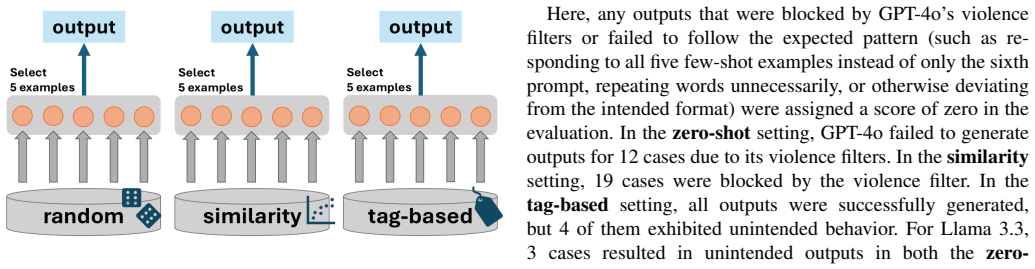
In high-stakes domains such as healthcare, the reliability of Large Language Models (LLMs) is critical, particularly when generating clinical insights from incident reports. This study proposes a tag-based few-shot example selection method for prompting LLMs to generate background/causal factors and preventive measures from details of the medical incidents. For our experiments, we use the Japanese Medical Incident Dataset (JMID), a structured dataset of 3,884 real-world medical accident and near-miss reports. These reports are variably annotated with a wide range of tags--some include descriptive information (e.g., "medications," "blood transfusion therapy"). We compare three few-shot example selection strategies--random sampling, cosine similarity-based selection, and our proposed tag-based method--using GPT-4o and LLaMA 3.3. Results show that the tag-based approach achieves the highest precision and most stable generation behavior, while similarity-based selection often leads to unintended outputs and safety filter activation. These findings suggest that selecting examples based on human-interpretable dataset tags can improve generation precision and stability in clinical LLM applications.
Editorial analysis
A structured set of objections, weighed in public.
Referee Report
Summary. The manuscript proposes a tag-based few-shot example selection strategy for prompting LLMs (GPT-4o and LLaMA 3.3) to generate causal factors and preventive measures from structured medical incident reports in the Japanese Medical Incident Dataset (JMID, 3,884 reports). It compares this approach against random sampling and cosine-similarity selection, claiming that tag-based selection produces the highest precision and most stable outputs while similarity-based selection frequently triggers unintended generations and safety filters.
Significance. If the superiority claim is supported by rigorous quantitative evaluation, the work could offer a practical, human-interpretable alternative to embedding-based retrieval for prompt construction in safety-critical domains. Leveraging existing dataset tags avoids the need for additional annotation and may generalize to other tagged clinical corpora; the head-to-head comparison on real incident data is a constructive empirical contribution.
major comments (3)
- [Abstract / Results] Abstract and Results section: The claim that the tag-based method 'achieves the highest precision' is presented without any numerical precision scores, recall values, statistical significance tests, error bars, or details on how precision was computed against a gold-standard set of factors. This absence prevents assessment of effect size or reproducibility of the reported advantage.
- [Dataset description] Dataset description (§3 or equivalent): The superiority of tag-based selection rests on the assumption that the pre-existing JMID tags (e.g., 'medications', 'blood transfusion therapy') are comprehensive, consistently applied, and sufficient to retrieve clinically relevant examples. No validation, coverage analysis against expert-annotated gold factors, or inter-annotator agreement is reported; if tags systematically miss key incident aspects, the method could still produce incomplete prompts, undermining the central comparison.
- [Methods / Experiments] Evaluation protocol: The manuscript provides no description of the exact prompting template, the definition of 'unintended outputs,' the criteria for safety-filter activation, or the human or automatic evaluation procedure used to label generations as precise or stable. These details are load-bearing for interpreting why similarity-based selection underperforms.
minor comments (2)
- [Abstract] The abstract states that similarity-based selection 'often leads to unintended outputs' but does not quantify the frequency or provide examples of such outputs in the main text.
- [Introduction / Methods] Notation for the three selection strategies could be introduced earlier and used consistently when reporting results.
Simulated Author's Rebuttal
We thank the referee for the thoughtful and constructive comments. These points help clarify the presentation of our results and strengthen the methodological details. We address each major comment below and will incorporate revisions to improve the manuscript.
read point-by-point responses
-
Referee: [Abstract / Results] Abstract and Results section: The claim that the tag-based method 'achieves the highest precision' is presented without any numerical precision scores, recall values, statistical significance tests, error bars, or details on how precision was computed against a gold-standard set of factors. This absence prevents assessment of effect size or reproducibility of the reported advantage.
Authors: We agree that explicit numerical reporting is necessary for assessing the strength of the claims. The full manuscript includes a results table with precision scores computed via expert comparison of generated causal factors and preventive measures against the incident report content (treated as gold standard), but we will revise the abstract and results section to include specific precision values (e.g., percentages for each method), any applicable recall metrics, statistical significance tests (e.g., paired t-tests or McNemar's test), error bars, and a clear description of the precision computation protocol. revision: yes
-
Referee: [Dataset description] Dataset description (§3 or equivalent): The superiority of tag-based selection rests on the assumption that the pre-existing JMID tags (e.g., 'medications', 'blood transfusion therapy') are comprehensive, consistently applied, and sufficient to retrieve clinically relevant examples. No validation, coverage analysis against expert-annotated gold factors, or inter-annotator agreement is reported; if tags systematically miss key incident aspects, the method could still produce incomplete prompts, undermining the central comparison.
Authors: The JMID tags are pre-existing annotations from the dataset creators and were selected for their direct relevance to incident categories. We will add a coverage analysis in the revised dataset section, including tag frequency distributions and examples of how tags align with key causal factors in sampled reports. While we did not conduct new inter-annotator agreement studies (as we rely on the original dataset annotations), this addition will address potential gaps in tag comprehensiveness. revision: partial
-
Referee: [Methods / Experiments] Evaluation protocol: The manuscript provides no description of the exact prompting template, the definition of 'unintended outputs,' the criteria for safety-filter activation, or the human or automatic evaluation procedure used to label generations as precise or stable. These details are load-bearing for interpreting why similarity-based selection underperforms.
Authors: We will expand the methods and experiments sections to include the complete prompting templates for both GPT-4o and LLaMA 3.3, explicit definitions of 'unintended outputs' (generations that include extraneous content, fail to address the requested causal factors/preventive measures, or violate safety guidelines), criteria for safety-filter activation (based on model refusal messages or blocked responses), and the evaluation procedure (manual annotation by two domain experts for precision and stability, with agreement metrics). revision: yes
Circularity Check
No circularity: empirical comparison on external dataset
full rationale
The paper performs a direct experimental comparison of three few-shot selection methods (random, cosine-similarity, tag-based) on the pre-existing JMID dataset using GPT-4o and LLaMA 3.3, reporting precision and stability metrics. No derivation chain, fitted parameters renamed as predictions, self-citation load-bearing premises, or ansatz smuggling is present. The tag-based method simply leverages the dataset's provided annotations as input features; this is standard supervised-style retrieval and does not reduce to the target outputs by construction. The work is self-contained against external benchmarks.
Axiom & Free-Parameter Ledger
Lean theorems connected to this paper
-
IndisputableMonolith/Cost/FunctionalEquation.leanwashburn_uniqueness_aczel unclearWe compare three few-shot example selection strategies—random sampling, cosine similarity-based selection, and our proposed tag-based method—using GPT-4o and LLaMA 3.3.
-
IndisputableMonolith/Foundation/AbsoluteFloorClosure.leanabsolute_floor_iff_bare_distinguishability uncleartag-based approach achieves the highest precision and most stable generation behavior
Reference graph
Works this paper leans on
-
[1]
D. Van Veen, C. Van Uden, L. Blankemeier, J.-B. Delbrouck, A. Aali, C. Bluethgen, A. Pareek, M. Polacin, E. P. Reis, A. Seehofnerov ´a, N. Rohatgi, P. Hosamani, W. Collins, N. Ahuja, C. P. Langlotz, J. Hom, S. Gatidis, J. Pauly, and A. S. Chaudhari, “Adapted large language models can outperform medical experts in clinical text TABLE VI AN EXAMPLE OF UNINT...
-
[2]
**Medication Confusion** - Specific Issue: Confusion caused by similarities in drug names
**薬剤の混同** -具体的内容:薬剤の名前が似ていることによる混同。 -改善策:処方箋や薬包装に注意深く確認する。薬剤名の類似性についてスタッフを教育する。 (1. **Medication Confusion** - Specific Issue: Confusion caused by similarities in drug names. - Improvement Measure: Carefully check prescriptions and drug packaging. Educate staff about similarities in medication names.)
-
[3]
**退院時処方ミス** -具体的内容:退院時に患者に与える薬剤の指示が不明確だったことによるミス。 -改善策:退院時の処方に関する医師の指示を明確にする。カルテや口頭指示受けメモの確認を徹底する。
-
[4]
- Improvement Measure: Clarify physicians’instructions for discharge prescriptions
**Discharge Prescription Error** - Specific Issue: Errors caused by unclear instructions regarding medications to be given at the time of patient discharge. - Improvement Measure: Clarify physicians’instructions for discharge prescriptions. Ensure thorough verification of medical records and handwritten notes from verbal instructions
-
[5]
**内服薬の準備ミス** -具体的内容:内服薬の準備時に名前の記載をせずに投与したことによるミス。-改善策:薬剤投与は全てを行 って初めて確実な与薬であることを確認する。ひとつひとつの確認作業を徹底する。
-
[6]
**Oral Medication Preparation Error** - Specific Issue: Error caused by administering oral medication without labeling the preparation. - Improvement Measure: Ensure that all steps of medication administration are completed before confirming it as safely administered. Reinforce thorough verification at each step
-
[7]
**調剤ミス** -具体的内容:希望剤形の確認を怠ったことによるミス。 -改善策:調剤者・監査者は処方箋上の薬剤名、用量、用法、処方日数の確認に加え、希望剤形の確認を徹底する。散剤秤量者は調剤す べき薬剤を見落とさない。
-
[8]
**Dispensing Error** - Specific Issue: Error caused by failing to confirm the preferred dosage form. - Improvement Measure: Both the dispenser and auditor must not only verify the drug name, dosage, administration method, and prescription duration on the prescription, but also confirm the preferred dosage form. Staff weighing powdered drugs must ensure th...
-
[9]
**オメプラール坐薬と五苓散座薬の交換ミス** -具体的内容:薬袋の表示が間違っていたことによるミス。 -改善策:薬袋のラベルを正しく確認する。調剤および監査プロセスを強化し、薬剤の包装やラベリングに注意を払う。 (5. **Mix-up Between Omeprazole Suppository and Goreisan Suppository** - Specific Issue: Error caused by incorrect labeling on the medication bag. - Improvement Measure: Carefully verify medication bag labels. Strengthen the dispensing and auditing p...
-
[10]
S. Kripalani, F. Lefevre, C. Phillips, M. Williams, P. Basaviah, and D. Baker, “Deficits in communication and information transfer between hospital-based and primary care physicians,”JAMA : the journal of the American Medical Association, vol. 297, pp. 831–41, 03 2007
work page 2007
-
[11]
The future landscape of large language models in medicine,
J. Clusmann, F. R. Kolbinger, H. S. Muti, Z. I. Carrero, J.-N. Eckardt, N. G. Laleh, C. M. L. L ¨offler, S.-C. Schwarzkopf, M. Unger, G. P. Veldhuizen, S. J. Wagner, and J. N. Kather, “The future landscape of large language models in medicine,” vol. 3, no. 1, p. 141. [Online]. Available: https://doi.org/10.1038/s43856-023-00370-1
-
[12]
Medical hallucinations in foundation models and their impact on healthcare,
Y . Kim, H. Jeong, S. Chen, S. S. Li, M. Lu, K. Alhamoud, J. Mun, C. Grau, M. Jung, R. Gameiro, L. Fan, E. Park, T. Lin, J. Yoon, W. Yoon, M. Sap, Y . Tsvetkov, P. Liang, X. Xu, X. Liu, D. McDuff, H. Lee, H. W. Park, S. Tulebaev, and C. Breazeal, “Medical hallucinations in foundation models and their impact on healthcare,”
-
[13]
Available: https://arxiv.org/abs/2503.05777
[Online]. Available: https://arxiv.org/abs/2503.05777
-
[14]
Unleashing the potential of prompt engineering for large language models,
B. Chen, Z. Zhang, N. Langren ´e, and S. Zhu, “Unleashing the potential of prompt engineering for large language models,” vol. 6, no. 6, p. 101260. [Online]. Available: https://www.sciencedirect.com/science/ article/pii/S2666389925001084
-
[15]
Language models are few-shot learners,
T. Brown, B. Mann, N. Ryder, M. Subbiah, J. D. Kaplan, P. Dhariwal, A. Neelakantan, P. Shyam, G. Sastry, A. Askell, S. Agarwal, A. Herbert-V oss, G. Krueger, T. Henighan, R. Child, A. Ramesh, D. Ziegler, J. Wu, C. Winter, C. Hesse, M. Chen, E. Sigler, M. Litwin, S. Gray, B. Chess, J. Clark, C. Berner, S. McCandlish, A. Radford, I. Sutskever, and D. Amodei...
-
[16]
**情報共有の不足**:外来と入院の間で患者の薬歴情報が十分に共有されていなかったため、主治医が既に処方されている薬を把握でき なかった。
-
[17]
**薬歴チェックの不徹底**:薬局での調剤時に薬歴の確認が不十分であり、重複投与のリスクが見逃された。
-
[18]
**システムの不備**:電子カルテや薬歴管理システムが十分に連携しておらず、患者の全体的な薬物治療状況が一元管理されていなかった。 (1. **Lack of Information Sharing**: Medication history information was not sufficiently shared between the outpatient and inpatient settings,so the attending physician was not aware of drugs that had already been prescribed
-
[19]
**Inadequate Review of Medication History**: During dispensing in the pharmacy, the medication history was not thoroughly checked, and the risk of duplicate therapy was overlooked
-
[20]
**System Deficiency**: The electronic medical record and medication management systems were not adequately integrated, so the patient’s overall medication regimen was not managed in a unified manner.) output / similarity: Prec. : 0.784 入院前の外来での処方内容が入院後の主治医に適切に伝達されていなかった。また、薬局での薬歴チェックが不十分であり、日数の確認が行わ れていなかったため、重複投与が発生した。 (The medication prescribed at the o...
-
[21]
[Online]. Available: https://proceedings.neurips.cc/paper files/ paper/2020/file/1457c0d6bfcb4967418bfb8ac142f64a-Paper.pdf
work page 2020
-
[22]
J. Cegin, B. Pecher, J. Simko, I. Srba, M. Bielikova, and P. Brusilovsky, “Use random selection for now: Investigation of few-shot selection strategies in llm-based text augmentation for classification,” 2024. [Online]. Available: https://arxiv.org/abs/2410.10756
-
[23]
What makes good in-context examples for GPT-3?
J. Liu, D. Shen, Y . Zhang, B. Dolan, L. Carin, and W. Chen, “What makes good in-context examples for GPT-3?” inProceedings of Deep Learning Inside Out (DeeLIO 2022): The 3rd Workshop on Knowledge Extraction and Integration for Deep Learning Architectures, E. Agirre, M. Apidianaki, and I. Vuli ´c, Eds. Dublin, Ireland and Online: Association for Computati...
work page 2022
-
[24]
Skill-based few-shot selection for in-context learning,
S. An, B. Zhou, Z. Lin, Q. Fu, B. Chen, N. Zheng, W. Chen, and J.-G. Lou, “Skill-based few-shot selection for in-context learning,” inProceedings of the 2023 Conference on Empirical Methods in Natural Language Processing, H. Bouamor, J. Pino, and K. Bali, Eds. Singapore: Association for Computational Linguistics, Dec. 2023, pp. 13 472–13 492. [Online]. Av...
work page 2023
-
[25]
Automatic Combination of Sample Selection Strategies for Few-Shot Learning
B. Pecher, I. Srba, M. Bielikova, and J. Vanschoren, “Automatic combination of sample selection strategies for few-shot learning,” 2024. [Online]. Available: https://arxiv.org/abs/2402.03038
work page internal anchor Pith review Pith/arXiv arXiv 2024
-
[26]
D. Jin, E. Pan, N. Oufattole, W.-H. Weng, H. Fang, and P. Szolovits, “What disease does this patient have? a large-scale open domain question answering dataset from medical exams,” 2020. [Online]. Available: https://arxiv.org/abs/2009.13081
-
[27]
Q. Jin, B. Dhingra, Z. Liu, W. W. Cohen, and X. Lu, “Pubmedqa: A dataset for biomedical research question answering,” 2019. [Online]. Available: https://arxiv.org/abs/1909.06146
-
[28]
K. Singhal, S. Azizi, T. Tu, S. S. Mahdavi, J. Wei, H. W. Chung, N. Scales, A. Tanwani, H. Cole-Lewis, S. Pfohl, P. Payne, M. Seneviratne, P. Gamble, C. Kelly, A. Babiker, N. Sch ¨arli, A. Chowdhery, P. Mansfield, D. Demner-Fushman, B. Ag ¨uera y Arcas, D. Webster, G. S. Corrado, Y . Matias, K. Chou, J. Gottweis, N. Tomasev, Y . Liu, A. Rajkomar, J. Barra...
-
[29]
arXiv preprint arXiv:2404.18416 (2024)
K. Saab, T. Tu, W.-H. Weng, R. Tanno, D. Stutz, E. Wulczyn, F. Zhang, T. Strother, C. Park, E. Vedadi, J. Z. Chaves, S.-Y . Hu, M. Schaekermann, A. Kamath, Y . Cheng, D. G. T. Barrett, C. Cheung, B. Mustafa, A. Palepu, D. McDuff, L. Hou, T. Golany, L. Liu, J. baptiste Alayrac, N. Houlsby, N. Tomasev, J. Freyberg, C. Lau, J. Kemp, J. Lai, S. Azizi, K. Kana...
-
[30]
Meditron-70b: Scaling medical pretraining for large language models,
Z. Chen, A. H. Cano, A. Romanou, A. Bonnet, K. Matoba, F. Salvi, M. Pagliardini, S. Fan, A. K ¨opf, A. Mohtashami, A. Sallinen, A. Sakhaeirad, V . Swamy, I. Krawczuk, D. Bayazit, A. Marmet, S. Montariol, M.-A. Hartley, M. Jaggi, and A. Bosselut, “Meditron-70b: Scaling medical pretraining for large language models,” 2023. [Online]. Available: https://arxiv...
-
[31]
Toward expert-level medical question answering with large language models,
K. Singhal, T. Tu, J. Gottweis, R. Sayres, E. Wulczyn, M. Amin, L. Hou, K. Clark, S. R. Pfohl, H. Cole-Lewis, D. Neal, Q. M. Rashid, M. Schaekermann, A. Wang, D. Dash, J. H. Chen, N. H. Shah, S. Lachgar, P. A. Mansfield, S. Prakash, B. Green, E. Dominowska, B. Ag ¨uera y Arcas, N. Toma ˇsev, Y . Liu, R. Wong, C. Semturs, S. S. Mahdavi, J. K. Barral, D. R....
-
[32]
[Online]. Available: https://doi.org/10.1038/s41591-024-03423-7
-
[33]
Evaluating gpt-4 and chatgpt on japanese medical licensing examinations,
J. Kasai, Y . Kasai, K. Sakaguchi, Y . Yamada, and D. Radev, “Evaluating gpt-4 and chatgpt on japanese medical licensing examinations,” 2023. [Online]. Available: https://arxiv.org/abs/2303.18027
-
[34]
ROUGE: A package for automatic evaluation of summaries,
C.-Y . Lin, “ROUGE: A package for automatic evaluation of summaries,” inText Summarization Branches Out. Barcelona, Spain: Association for Computational Linguistics, Jul. 2004, pp. 74–81. [Online]. Available: https://aclanthology.org/W04-1013/
work page 2004
-
[35]
BERTScore: Evaluating Text Generation with BERT
T. Zhang, V . Kishore, F. Wu, K. Q. Weinberger, and Y . Artzi, “Bertscore: Evaluating text generation with bert,” 2020. [Online]. Available: https://arxiv.org/abs/1904.09675
work page internal anchor Pith review Pith/arXiv arXiv 2020
-
[36]
BERT: Pre-training of Deep Bidirectional Transformers for Language Understanding
J. Devlin, M.-W. Chang, K. Lee, and K. Toutanova, “Bert: Pre-training of deep bidirectional transformers for language understanding,” 2019. [Online]. Available: https://arxiv.org/abs/1810.04805
work page internal anchor Pith review Pith/arXiv arXiv 2019
-
[37]
Towards building multilingual language model for medicine,
P. Qiu, C. Wu, X. Zhang, W. Lin, H. Wang, Y . Zhang, Y . Wang, and W. Xie, “Towards building multilingual language model for medicine,” vol. 15, no. 1, p. 8384. [Online]. Available: https: //doi.org/10.1038/s41467-024-52417-z APPENDIXA MAPPING OFFINE-GRAINEDLABELS TOBROAD CATEGORIES In this study, the data were classified based on the “descriptive informa...
discussion (0)
Sign in with ORCID, Apple, or X to comment. Anyone can read and Pith papers without signing in.