Recognition: no theorem link
Bridging the Cognitive Gap: A Unified Memory Paradigm for 6G Agentic AI-RAN
Pith reviewed 2026-05-12 02:40 UTC · model grok-4.3
The pith
Mapping biological memory hierarchies onto 6G computing fabrics dissolves the boundaries between sensing and reasoning in agentic AI.
A machine-rendered reading of the paper's core claim, the machinery that carries it, and where it could break.
Core claim
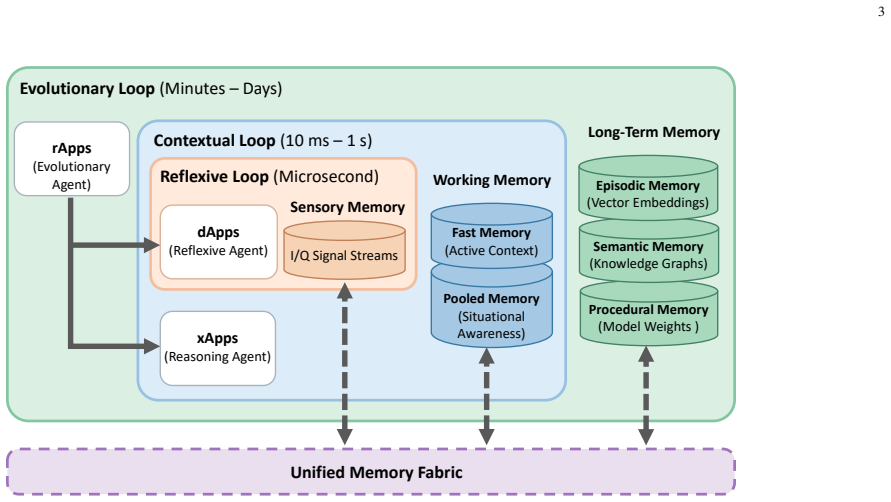
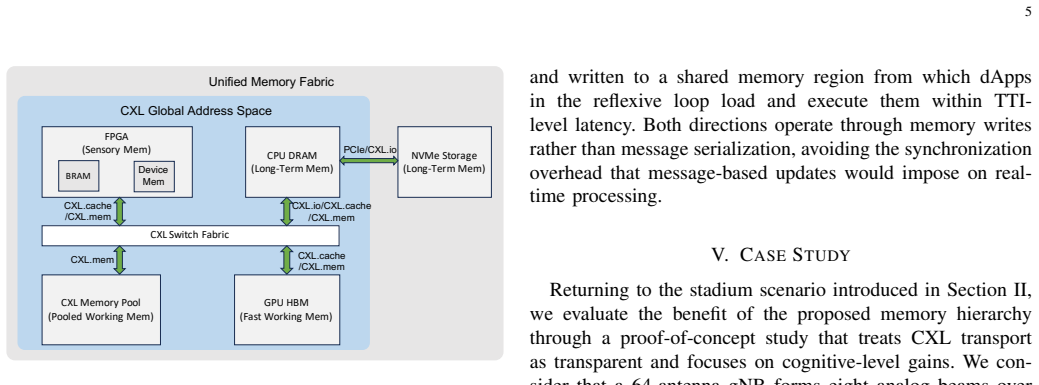
The paper claims that a unified memory paradigm dissolves the boundaries between sensing and reasoning by mapping biological memory hierarchies onto heterogeneous computing fabrics. Enabled by emerging coherent interconnects, this produces a cognitive continuum in which microsecond-level reflexes, millisecond-level reasoning, and long-term evolution share state across time scales. Replacing message passing with zero-copy observability empowers AI agents to close the gap between real-time responsiveness and long-horizon context, supporting truly autonomous 6G networks.
What carries the argument
The unified memory paradigm, which maps biological memory hierarchies onto heterogeneous computing fabrics to enable zero-copy observability and shared state across time scales.
If this is right
- AI agents obtain direct access to high-dimensional physical-layer states rather than compressed metrics.
- Multi-time-scale cognition operates through shared memory instead of message-passing interfaces.
- Networks support continuous evolution and adaptation without semantic information loss.
- Heterogeneous fabrics in base stations and edge nodes enable agentic behavior across reflexes to long-term planning.
Where Pith is reading between the lines
- Similar memory-mapping ideas could transfer to other real-time autonomous systems that must integrate fast perception with slower planning.
- Direct state sharing might lower data-movement energy costs in dense deployments.
- Specific biological structures such as short-term versus long-term memory could be tested separately for hardware fit.
Load-bearing premise
That emerging coherent interconnects will deliver practical zero-copy observability and that biological memory hierarchies can be directly and usefully mapped onto the heterogeneous computing fabrics of 6G base stations and edge nodes.
What would settle it
A hardware test showing that coherent interconnects in realistic 6G base-station settings fail to deliver low-latency zero-copy access at scale, or that applying the biological memory mapping produces no measurable improvement in agent performance over conventional interfaces.
Figures

read the original abstract
As 6G evolves, the radio access network must transcend traditional automation to embrace agentic AI capable of perception, reasoning, and evolution. A fundamental cognitive gap persists in current disaggregated architectures, where interfaces force the physical layer to compress high-dimensional states into low-dimensional metrics, trapping reasoning agents behind a semantic bottleneck. This article envisions a shift from interface-bound to memory-centric architectures. We propose a unified memory paradigm that dissolves the boundaries between sensing and reasoning by mapping biological memory hierarchies onto heterogeneous computing fabrics. Enabled by emerging coherent interconnects, this approach creates a cognitive continuum where microsecond-level reflexes, millisecond-level reasoning, and long-term evolution share state across time scales. By replacing message passing with zero-copy observability, we empower AI agents to bridge the gap between real-time responsiveness and long-horizon context for truly autonomous 6G networks.
Editorial analysis
A structured set of objections, weighed in public.
Referee Report
Summary. The manuscript is a vision paper proposing a shift from interface-bound to memory-centric architectures in 6G AI-RAN. It claims that a unified memory paradigm, achieved by mapping biological memory hierarchies (microsecond reflexes, millisecond reasoning, long-term evolution) onto heterogeneous computing fabrics via coherent interconnects, dissolves the semantic bottleneck between physical-layer sensing and agentic reasoning, enabling a cognitive continuum with zero-copy observability.
Significance. If the proposed mapping can be implemented without loss of low-latency properties or introduction of new bottlenecks, the work could influence future 6G standards by providing a conceptual framework for cross-timescale AI autonomy. The paper correctly identifies the compression of high-dimensional PHY states as a real limitation in current disaggregated RANs and highlights the potential of emerging interconnect technologies.
major comments (2)
- [Abstract and Unified Memory Paradigm section] Abstract and the section describing the unified memory paradigm: the central claim that biological memory hierarchies can be directly and usefully mapped onto 6G base-station fabrics to preserve low-latency access and hierarchical abstraction is asserted without any mechanism, latency model, or preservation argument. This is load-bearing because the entire proposal of a 'cognitive continuum' rests on the unexamined transfer of biological properties to heterogeneous fabrics.
- [Coherent Interconnects and Cognitive Continuum discussion] The discussion of coherent interconnects and zero-copy observability: no analysis quantifies observability overhead, shows how microsecond PHY state remains accessible to millisecond agents without violating real-time constraints, or demonstrates absence of new bottlenecks. This directly undermines the feasibility of replacing message passing with shared state across time scales.
minor comments (2)
- [Abstract and Introduction] Several terms (e.g., 'cognitive continuum', 'agentic AI-RAN') are introduced in the abstract without explicit definition or reference to prior literature in the opening sections.
- [Throughout] The manuscript would benefit from a dedicated section contrasting the proposed paradigm with existing disaggregated RAN interfaces (e.g., O-RAN) using concrete examples of current semantic bottlenecks.
Simulated Author's Rebuttal
We thank the referee for their insightful and constructive comments on our vision paper. We address each major comment below, clarifying the conceptual scope of the work while committing to targeted revisions that strengthen the presentation without expanding beyond a high-level framework.
read point-by-point responses
-
Referee: [Abstract and Unified Memory Paradigm section] Abstract and the section describing the unified memory paradigm: the central claim that biological memory hierarchies can be directly and usefully mapped onto 6G base-station fabrics to preserve low-latency access and hierarchical abstraction is asserted without any mechanism, latency model, or preservation argument. This is load-bearing because the entire proposal of a 'cognitive continuum' rests on the unexamined transfer of biological properties to heterogeneous fabrics.
Authors: We acknowledge that the mapping is presented conceptually without detailed mechanisms or quantitative latency models. As a vision paper, the objective is to articulate a paradigm shift and its potential implications rather than to deliver an engineering blueprint. We will revise the Unified Memory Paradigm section to include a short discussion of the key assumptions (e.g., hardware support for coherence) and a high-level argument for latency preservation based on properties of emerging interconnects, supported by references to related computing literature. This addresses the load-bearing nature of the claim while preserving the paper's visionary character. revision: partial
-
Referee: [Coherent Interconnects and Cognitive Continuum discussion] The discussion of coherent interconnects and zero-copy observability: no analysis quantifies observability overhead, shows how microsecond PHY state remains accessible to millisecond agents without violating real-time constraints, or demonstrates absence of new bottlenecks. This directly undermines the feasibility of replacing message passing with shared state across time scales.
Authors: We agree that no quantitative analysis of overhead or real-time constraint preservation is provided. The manuscript emphasizes the architectural opportunity enabled by coherent interconnects rather than performance evaluation. We will expand the Cognitive Continuum discussion with a qualitative outline of potential overhead sources and mitigation strategies (e.g., hardware-level coherence protocols), along with a note that microsecond-scale access would rely on direct memory mapping. Detailed quantification and constraint verification lie outside the scope of this vision paper and would require dedicated simulation work. revision: partial
- Provision of concrete latency models, quantitative observability overhead measurements, or full mechanisms for the biological-to-fabric mapping, as these require implementation-level analysis and simulations that exceed the intended scope of a vision paper.
Circularity Check
No circularity: purely conceptual vision without derivations or self-referential reductions
full rationale
The paper advances a high-level architectural vision for mapping biological memory hierarchies onto 6G heterogeneous fabrics via coherent interconnects and zero-copy observability. No equations, fitted parameters, uniqueness theorems, or derivation chains appear in the provided text or abstract. The central claim is an asserted analogy and future-enabled paradigm shift, not a computed result that reduces to its own inputs. The reader's assessment of score 1.0 aligns with the absence of any load-bearing steps that could be circular by the enumerated patterns. Self-citations are not invoked as justification for the mapping, and the proposal remains self-contained as a conceptual framework rather than a closed mathematical or empirical derivation.
Axiom & Free-Parameter Ledger
axioms (2)
- domain assumption Biological memory hierarchies can be mapped onto heterogeneous computing fabrics in a way that preserves functional benefits
- domain assumption Coherent interconnects will enable practical zero-copy observability across time scales
invented entities (2)
-
unified memory paradigm
no independent evidence
-
cognitive continuum
no independent evidence
Reference graph
Works this paper leans on
-
[1]
Study on artificial intelligence (AI)/machine learning (ML) for NR air interface,
3GPP, “Study on artificial intelligence (AI)/machine learning (ML) for NR air interface,” 3GPP TR 38.843, Release 18, 2024
work page 2024
-
[2]
Agen- tic ai empowered intent-based networking for 6g.arXiv preprint arXiv:2601.06640, 2026
G. Jiang, K. Wang, X. Chen, and Y . Huang, “Agentic AI empowered intent-based networking for 6G,”arXiv preprint arXiv:2601.06640, 2026
-
[3]
Agentic AI for 6G: A New Paradigm for Autonomous RAN Security Compliance
S. Chatzimiltis, M. B. Mashhadi, M. Shojafar, M. Debbah, and R. Tafazolli, “Agentic AI for 6G: A new paradigm for autonomous RAN security compliance,”arXiv preprint arXiv:2512.12400, 2025
work page internal anchor Pith review Pith/arXiv arXiv 2025
-
[4]
Toward 6G native-AI network: Foundation model- based cloud-edge-end collaboration framework,
X. Chen, Z. Guo, X. Wang, C. Feng, H. H. Yang, S. Han, X. Wang, and T. Q. S. Quek, “Toward 6G native-AI network: Foundation model- based cloud-edge-end collaboration framework,”IEEE Commun. Mag., vol. 63, no. 8, pp. 23–30, 2025
work page 2025
-
[5]
O-RAN architecture description,
O-RAN Alliance, “O-RAN architecture description,” O-RAN.WG1, v11.00, 2024
work page 2024
-
[6]
K. Alam, M. A. Habibi, M. Tammen, D. Krummacker, W. Saad, M. Di Renzo, T. Melodia, X. Costa-Pérez, M. Debbah, A. Dutta, and H. D. Schotten, “A comprehensive tutorial and survey of O-RAN: Exploring slicing-aware architecture, deployment options, use cases, and challenges,”IEEE Commun. Surv. Tutor., vol. 28, pp. 1637–1678, 2026
work page 2026
-
[7]
G. M. Almeida, G. Z. Bruno, A. Huff, M. Hiltunen, E. P. Duarte, C. B. Both, and K. V . Cardoso, “RIC-O: Efficient placement of a disaggregated and distributed RAN intelligent controller with dynamic clustering of radio nodes,”IEEE J. Sel. Areas Commun., vol. 42, no. 2, pp. 446–459, Feb. 2024
work page 2024
-
[8]
Aerial RAN CoLab Over-the-Air product brief,
NVIDIA, “Aerial RAN CoLab Over-the-Air product brief,” 2024. [Online]. Available: https://docs.nvidia.com/aerial/aerial-ran-colab-ota/ current/text/product_brief/index.html
work page 2024
-
[9]
Intel FlexRAN Reference Architecture for Wireless Access,
Intel, “Intel FlexRAN Reference Architecture for Wireless Access,” [On- line]. Available: https://www.intel.com/content/www/us/en/developer/ topic-technology/edge-5g/tools/flexran.html
-
[10]
Cloud architecture and deployment scenarios for O- RAN virtualized RAN,
O-RAN Alliance, “Cloud architecture and deployment scenarios for O- RAN virtualized RAN,” O-RAN.WG6, v08.01, 2025
work page 2025
-
[11]
Compute Express Link Specification Revision 3.1,
Compute Express Link Consortium, “Compute Express Link Specification Revision 3.1,” Nov. 2023. [Online]. Available: https://computeexpresslink.org/wp-content/uploads/2024/02/CXL-3. 1-Specification.pdf
work page 2023
-
[12]
Next-gen computing systems with compute express link: a comprehensive survey,
C. Chen, X. Zhao, G. Cheng, Y . Xu, S. Deng, and J. Yin, “Next-gen computing systems with compute express link: a comprehensive survey,” arXiv preprint arXiv:2412.20249, 2024
-
[13]
D. Kim, M. Lee, J. Kim, H. Kwon, H. Jeong, S. Park, M. Yoon, S. Roh, Y . Kwon, J. So, and J. Choi, “Scalable processing-near-memory for 1M-token LLM inference: CXL-enabled KV-cache management beyond GPU limits,” inProc. Int. Conf. Parallel Architectures and Compilation Techniques (PACT), pp. 1–13, 2025
work page 2025
-
[14]
RAN Cortex: Memory-augmented intelligence for context- aware decision-making in AI-native networks,
S. Barros, “RAN Cortex: Memory-augmented intelligence for context- aware decision-making in AI-native networks,”arXiv preprint arXiv:2505.07842, 2025. Xijun Wang(wangxijun@mail.sysu.edu.cn) received the B.S. degree from Xidian University, China, in 2005, and the Ph.D. degree from Tsinghua University, China, in 2012. Currently, he is an Associate Professor...
discussion (0)
Sign in with ORCID, Apple, or X to comment. Anyone can read and Pith papers without signing in.