Recognition: no theorem link
GenioSim: A Novel Simulation Platform for Edge Computing over Optical Networks
Pith reviewed 2026-05-12 02:09 UTC · model grok-4.3
The pith
GenioSim simulates PON-enabled edge infrastructures with realistic optical behavior and hybrid virtualization to evaluate resource policies.
A machine-rendered reading of the paper's core claim, the machinery that carries it, and where it could break.
Core claim
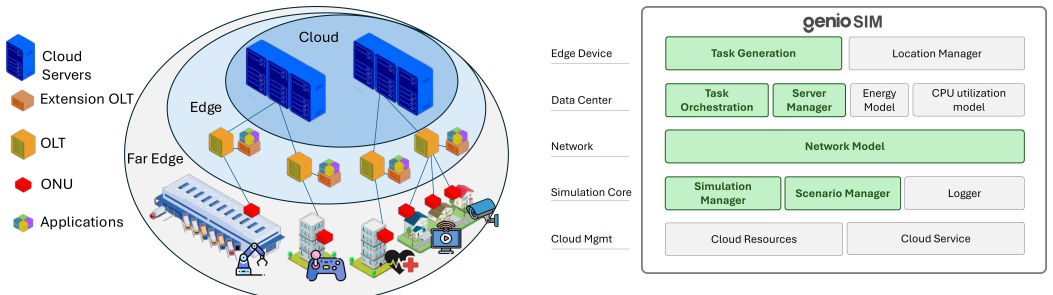
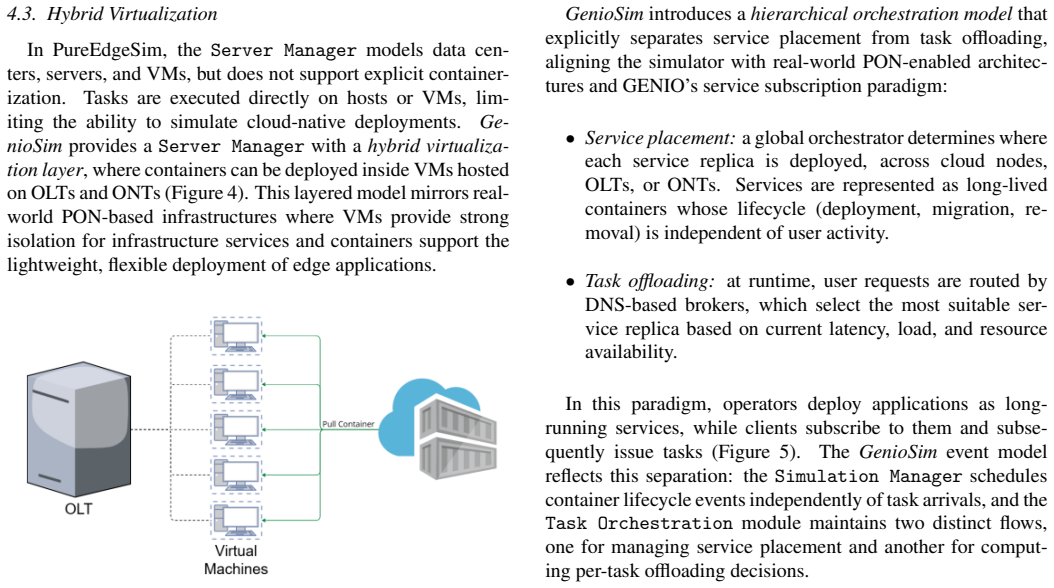
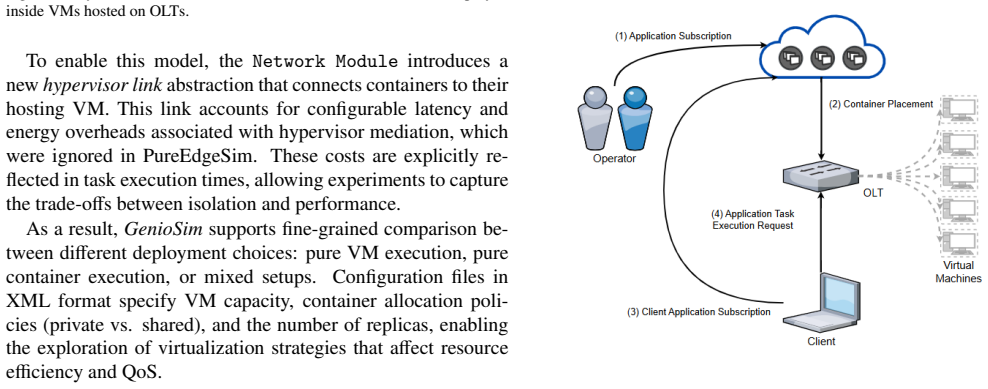
GenioSim is a simulation platform for hierarchical PON-enabled edge infrastructures. It models OLTs and ONTs with realistic PON behavior, supports hybrid container- and VM-based virtualization, and provides multiple service and execution models. These capabilities enable the evaluation of resource management policies under complex, heterogeneous conditions.
What carries the argument
GenioSim simulation platform that combines realistic Passive Optical Network element models with hybrid container-VM virtualization and multiple execution models for testing edge policies.
If this is right
- Capacity planning for PON edge setups can be performed before hardware is available.
- Different policies for container placement and task offloading can be compared under controlled yet realistic conditions.
- Industrial use cases can be studied to obtain concrete guidance on resource management.
- Hybrid virtualization allows mixed container and VM workloads to be tested within the same optical edge model.
Where Pith is reading between the lines
- Validation against physical hardware measurements would strengthen in the simulation outputs for policy decisions.
- The same modeling approach could later incorporate energy consumption or dynamic topology changes not detailed in the initial experiments.
- Insights from GenioSim runs could inform the design of management interfaces that later run on actual OLT and ONT hardware.
Load-bearing premise
Existing simulation tools cannot accurately represent the combination of PON behavior, hierarchical edge nodes, and hybrid virtualization needed to study these systems.
What would settle it
Run the same container placement policy and workload in GenioSim and on a physical PON testbed, then check whether the simulated latency, throughput, and resource usage match the measured values within acceptable error.
Figures



read the original abstract
The convergence of Passive Optical Networks (PONs) and edge computing creates new opportunities: Optical Line Terminals (OLTs) and Optical Network Terminals (ONTs) can be repurposed as low-latency edge compute nodes for offloading workloads. However, exploring such design options early in the development cycle is costly and time-consuming, as prototyping requires specialized hardware and realistic traffic conditions. Simulation becomes essential, yet current tools are unable to accurately model this emerging class of systems. To address these gaps, we introduce GenioSim, a simulation platform for hierarchical PON-enabled edge infrastructures. It models OLTs and ONTs with realistic PON behavior, supports hybrid container- and VM-based virtualization, and provides multiple service and execution models. These capabilities enable the evaluation of resource management policies under complex, heterogeneous conditions. We present experiments in the context of use cases of industrial relevance, to show GenioSim can provide insights for capacity planning and for the choice of policies for container placement and task offloading in PON-enabled edge infrastructures.
Editorial analysis
A structured set of objections, weighed in public.
Referee Report
Summary. The manuscript introduces GenioSim, a simulation platform for hierarchical PON-enabled edge infrastructures. It models OLTs and ONTs with realistic PON behavior, supports hybrid container- and VM-based virtualization, and provides multiple service and execution models. These features are claimed to enable evaluation of resource management policies under complex heterogeneous conditions, with experiments presented for industrial use cases including capacity planning and choices of container placement and task offloading policies.
Significance. If the platform is implemented with the claimed fidelity, validated against hardware, and made available, it could address a gap in tools for simulating the convergence of passive optical networks and edge computing. This would allow early-stage exploration of design options and policy evaluation without requiring specialized hardware, offering value to researchers in optical networking and edge systems.
major comments (2)
- [Abstract] Abstract: The statement that 'current tools are unable to accurately model this emerging class of systems' is asserted without any references, comparisons, or analysis of existing simulators (such as ns-3 with optical extensions or dedicated PON tools). This assumption is load-bearing for the motivation to introduce a new platform.
- [Abstract] Abstract: The manuscript states that 'we present experiments in the context of use cases of industrial relevance, to show GenioSim can provide insights' for capacity planning and policy choices, yet supplies no experimental setup, results, validation data, error metrics, figures, or comparisons to real hardware or other simulators. This prevents assessment of the central claims regarding realism and usefulness.
minor comments (1)
- [Abstract] The abstract would benefit from a brief enumeration of the specific service and execution models supported, as well as the virtualization mechanisms, to clarify the platform's scope without requiring the reader to infer details.
Simulated Author's Rebuttal
We thank the referee for the constructive comments on the abstract. We address each point below and will revise the manuscript to strengthen the motivation and clarify the experimental contributions.
read point-by-point responses
-
Referee: [Abstract] Abstract: The statement that 'current tools are unable to accurately model this emerging class of systems' is asserted without any references, comparisons, or analysis of existing simulators (such as ns-3 with optical extensions or dedicated PON tools). This assumption is load-bearing for the motivation to introduce a new platform.
Authors: We agree that the abstract would benefit from explicit support for this claim. In the revised version, we will add references to existing simulators such as ns-3 with optical extensions and dedicated PON tools, along with a brief note on their limitations regarding hybrid container-VM virtualization and realistic PON behavior in edge computing scenarios. This will be incorporated without expanding the abstract beyond typical length constraints. revision: yes
-
Referee: [Abstract] Abstract: The manuscript states that 'we present experiments in the context of use cases of industrial relevance, to show GenioSim can provide insights' for capacity planning and policy choices, yet supplies no experimental setup, results, validation data, error metrics, figures, or comparisons to real hardware or other simulators. This prevents assessment of the central claims regarding realism and usefulness.
Authors: The abstract is a high-level summary and does not contain detailed experimental data, which appears in the main body of the manuscript in sections describing the setups, results, figures, and analysis for the industrial use cases. To address the concern, we will revise the abstract to include a concise summary of key findings and the validation approach. We will also ensure the main text provides clearer metrics, error analysis, and any available hardware comparisons. revision: partial
Circularity Check
No significant circularity
full rationale
The paper is a tool-description paper whose central claim is the introduction of GenioSim, a simulation platform with stated modeling capabilities for hierarchical PON edge systems. The abstract provides only capability assertions and a motivation that existing simulators are insufficient; it contains no equations, derivations, fitted parameters, self-citations, or load-bearing uniqueness theorems. Consequently no derivation chain exists that could reduce a claimed result to its own inputs by construction, and the work is self-contained as a platform presentation.
Axiom & Free-Parameter Ledger
axioms (1)
- domain assumption Current simulation tools are unable to accurately model PON-enabled edge infrastructures
invented entities (1)
-
GenioSim
no independent evidence
Reference graph
Works this paper leans on
-
[1]
Fiber and Copper Access Equip- ment Forecast: 2021-27,
OMIDIA, “Fiber and Copper Access Equip- ment Forecast: 2021-27,” 2022. [Online]. Available: https://omdia.tech.informa.com/om022089/ fiber-and-copper-access-equipment-forecast-202127
work page 2021
-
[2]
A survey on network functions virtualization for telecom paradigm,
P. v. Anvith, N. Gunavathi, B. Malarkodi, and B. Rebekka, “A survey on network functions virtualization for telecom paradigm,” in2019 TEQIP III Sponsored International Conference on Microwave Integrated Circuits, Photonics and Wireless Networks (IMICPW), 2019, pp. 302–306
work page 2019
-
[3]
W. Z. Khan, E. Ahmed, S. Hakak, I. Yaqoob, and A. Ahmed, “Edge computing: A survey,”Future Generation Computer Systems, vol. 97, pp. 219–235,
-
[4]
Available: https://www.sciencedirect
[Online]. Available: https://www.sciencedirect. com/science/article/pii/S0167739X18319903
-
[5]
Telefónica Open Access and Edge Comput- ing,
Telefonica, “Telefónica Open Access and Edge Comput- ing,” 2019, accessed on 05.02.2024. [Online]. Available: https://www.telefonica.com/es/wp-content/uploads/sites/ 4/2021/02/whitepaper-telefonica-opa-mec-feb-2019.pdf
work page 2019
-
[6]
TIM, “Edge Cloud Computing,” 2022, ac- cessed on 05.02.2024. [Online]. Available: https: //www.gruppotim.it/it/newsroom/notiziario-tecnico-tim/ 2022/n1-2022/cap03-edge-cloud-computing.html
work page 2022
-
[7]
Genio: Synergizing edge computing with optical network infrastructures,
C. Cesarano, A. Foggia, G. Roscigno, L. Andreani, and R. Natella, “Genio: Synergizing edge computing with optical network infrastructures,”IEEE Communications Magazine, 2025
work page 2025
-
[8]
Simulating fog and edge computing scenarios: An overview and research challenges,
S. Svorobej, P. Takako Endo, M. Bendechache, C. Filelis- Papadopoulos, K. M. Giannoutakis, G. A. Gravvanis, D. Tzovaras, J. Byrne, and T. Lynn, “Simulating fog and edge computing scenarios: An overview and research challenges,”Future Internet, vol. 11, no. 3, 2019. [Online]. Available: https://www.mdpi.com/1999-5903/ 11/3/55 15
work page 2019
-
[9]
Edgecloudsim: An environment for performance evaluation of edge com- puting systems,
C. Sonmez, A. Ozgovde, and C. Ersoy, “Edgecloudsim: An environment for performance evaluation of edge com- puting systems,”Transactions on Emerging Telecommu- nications Technologies, vol. 29, no. 11, p. e3493, 2018
work page 2018
-
[10]
C. Mechalikh, H. Taktak, and F. Moussa, “Pureedgesim: A simulation toolkit for performance evaluation of cloud, fog, and pure edge computing environments,” in2019 in- ternational conference on high performance computing& simulation (HPCS). IEEE, 2019, pp. 700–707
work page 2019
-
[11]
Edgesimpy: Python-based modeling and simulation of edge computing resource management policies,
P. S. Souza, T. Ferreto, and R. N. Calheiros, “Edgesimpy: Python-based modeling and simulation of edge computing resource management policies,”Future Generation Com- puter Systems, vol. 148, pp. 446–459, 2023
work page 2023
-
[12]
I. Dias, L. Ruan, C. Ranaweera, and E. Wong, “From 5g to beyond: Passive optical network and multi-access edge computing integration for latency-sensitive applications,” Optical Fiber Technology, vol. 75, p. 103191, 2023. [On- line]. Available: https://www.sciencedirect.com/science/ article/pii/S1068520022003753
work page 2023
-
[13]
Consolidate iot edge computing with lightweight virtualization,
R. Morabito, V . Cozzolino, A. Y . Ding, N. Beijar, and J. Ott, “Consolidate iot edge computing with lightweight virtualization,”IEEE Network, vol. 32, no. 1, pp. 102– 111, 2018
work page 2018
-
[14]
Privacy-aware service placement for mobile edge computing via federated learning,
Y . Qian, L. Hu, J. Chen, X. Guan, M. M. Hassan, and A. Alelaiwi, “Privacy-aware service placement for mobile edge computing via federated learning,”Information Sci- ences, vol. 505, pp. 562–570, 2019
work page 2019
-
[15]
T. He, H. Khamfroush, S. Wang, T. La Porta, and S. Stein, “It’s hard to share: Joint service placement and request scheduling in edge clouds with sharable and non-sharable resources,” in2018 IEEE 38th International Conference on Distributed Computing Systems (ICDCS). IEEE, 2018, pp. 365–375
work page 2018
-
[16]
Y . Guo, Y . Zhang, L. Wu, M. Li, X. Cai, and J. Chen, “Edge computing service deployment and task offloading based on multi-task high-dimensional multi-objective op- timization,”arXiv preprint arXiv:2312.04101, 2023
-
[17]
T. Chen, F. Tan, J. Ai, X. Xiong, C. Wu, and X. Ren, “Joint Optimization of Task Offloading and Service Placement for Digital Twin empowered Mobile Edge Computing,” in Proceedings of the 2024 3rd International Conference on Networks, Communications and Information Technology, 2024, pp. 132–137
work page 2024
-
[18]
R. N. Calheiros, R. Ranjan, C. A. F. D. Rose, and R. Buyya, “Cloudsim: A novel framework for modeling and simulation of cloud computing infrastructures and services,” 2009. [Online]. Available: https://arxiv.org/abs/ 0903.2525
-
[19]
H. Gupta, A. Vahid Dastjerdi, S. K. Ghosh, and R. Buyya, “ifogsim: A toolkit for modeling and simulation of re- source management techniques in the internet of things, edge and fog computing environments,”Software: Prac- tice and Experience, vol. 47, no. 9, pp. 1275–1296, 2017
work page 2017
-
[20]
R. Mahmud, S. Pallewatta, M. Goudarzi, and R. Buyya, “Ifogsim2: An extended ifogsim simulator for mobility, clustering, and microservice management in edge and fog computing environments,”Journal of Systems and Soft- ware, vol. 190, p. 111351, 2022
work page 2022
-
[21]
Fognetsim++: A toolkit for modeling and simulation of distributed fog environment,
T. Qayyum, A. W. Malik, M. A. K. Khattak, O. Khalid, and S. U. Khan, “Fognetsim++: A toolkit for modeling and simulation of distributed fog environment,”IEEE Ac- cess, vol. 6, pp. 63 570–63 583, 2018
work page 2018
-
[22]
Yafs: A simulator for iot scenarios in fog computing,
I. Lera, C. Guerrero, and C. Juiz, “Yafs: A simulator for iot scenarios in fog computing,”IEEE Access, vol. 7, pp. 91 745–91 758, 2019
work page 2019
-
[23]
Leaf: Simulating large energy-aware fog computing environments,
P. Wiesner and L. Thamsen, “Leaf: Simulating large energy-aware fog computing environments,” in2021 IEEE 5th International Conference on Fog and Edge Computing (ICFEC). IEEE, 2021, pp. 29–36
work page 2021
-
[24]
A scalable simulator for cloud, fog and edge computing platforms with mobility sup- port,
E. Del-Pozo-Puñal, F. García-Carballeira, and D. Camarmas-Alonso, “A scalable simulator for cloud, fog and edge computing platforms with mobility sup- port,”Future Generation Computer Systems, vol. 144, pp. 117–130, 2023
work page 2023
-
[25]
Myifogsim: A simulator for virtual machine migration in fog computing,
M. M. Lopes, W. A. Higashino, M. A. Capretz, and L. F. Bittencourt, “Myifogsim: A simulator for virtual machine migration in fog computing,” inCompanion proceedings of the10th international conference on utility and cloud computing, 2017, pp. 47–52
work page 2017
-
[26]
Modeling and simulation tools for fog computing—a comprehensive survey from a cost perspective,
S. V . Margariti, V . V . Dimakopoulos, and G. Tsouma- nis, “Modeling and simulation tools for fog computing—a comprehensive survey from a cost perspective,”Future In- ternet, vol. 12, no. 5, p. 89, 2020
work page 2020
-
[27]
Measurement-driven design and runtime optimization in edge computing: Methodology and tools,
C. Caiazza, C. Cicconetti, V . Luconi, and A. Vecchio, “Measurement-driven design and runtime optimization in edge computing: Methodology and tools,”Computer Net- works, vol. 194, p. 108140, 2021
work page 2021
-
[28]
Energy-focused simulation of edge computing architec- tures in 5g networks,
B. Gómez, E. Coronado, J. Villalón, and A. Garrido, “Energy-focused simulation of edge computing architec- tures in 5g networks,”The Journal of Supercomputing, vol. 80, no. 9, pp. 12 564–12 584, 2024
work page 2024
-
[29]
N. Kaftantzis, D. G. Kogias, and C. Z. Patrikakis, “Explor- ing the impact of resource management strategies on sim- ulated edge cloud performance: An experimental study,” Network, vol. 4, no. 4, pp. 498–522, 2024
work page 2024
-
[30]
Navigating the edge-cloud continuum: A state-of- practice survey,
L. Belcastro, F. Marozzo, A. Orsino, D. Talia, and P. Trun- fio, “Navigating the edge-cloud continuum: A state-of- practice survey,”arXiv preprint arXiv:2506.02003, 2025. 16
-
[31]
Dynamic virtual network slic- ing and orchestration for selective mec services over wide- area sdn,
D. Kim and Y .-H. Kim, “Dynamic virtual network slic- ing and orchestration for selective mec services over wide- area sdn,”Algorithms, vol. 13, no. 10, p. 245, 2020
work page 2020
-
[32]
M. Gharbaoui, B. Martini, G. Cecchetti, and P. Cas- toldi, “Resource orchestration strategies with retrials for latency-sensitive network slicing over distributed telco clouds,”Ieee Access, vol. 9, pp. 132 801–132 817, 2021
work page 2021
-
[33]
Emulating software- defined disaggregated optical networks in a containerized framework,
F.-J. Moreno-Muro, M. Garrich, I. Iglesias-Castreño, S. Zahir, and P. Pavón-Mariño, “Emulating software- defined disaggregated optical networks in a containerized framework,”Applied Sciences, vol. 11, no. 5, p. 2081, 2021
work page 2081
-
[34]
Cloud-edge orchestration for smart cities: A review of kubernetes-based orchestration architectures,
S. Böhm and G. Wirtz, “Cloud-edge orchestration for smart cities: A review of kubernetes-based orchestration architectures,”EAI Endorsed Trans. Smart Cities, vol. 6, no. 18, p. e2, 2022
work page 2022
-
[35]
Towards latency-aware vnf placement on heterogeneous hosts at the network edge,
H. U. Adoga and D. P. Pezaros, “Towards latency-aware vnf placement on heterogeneous hosts at the network edge,” inGLOBECOM 2023-2023 IEEE Global Commu- nications Conference. IEEE, 2023, pp. 6383–6388
work page 2023
-
[36]
Vnf placement optimization at the edge and cloud,
A. Leivadeas, G. Kesidis, M. Ibnkahla, and I. Lambadaris, “Vnf placement optimization at the edge and cloud,”Fu- ture Internet, vol. 11, no. 3, p. 69, 2019
work page 2019
-
[37]
faas- sim: A trace-driven simulation framework for serverless edge computing platforms,
P. Raith, T. Rausch, A. Furutanpey, and S. Dustdar, “faas- sim: A trace-driven simulation framework for serverless edge computing platforms,”Software: Practice and Ex- perience, vol. 53, no. 12, pp. 2327–2361, 2023
work page 2023
-
[38]
Ai-assisted network-slicing based next- generation wireless networks,
X. Shen, J. Gao, W. Wu, K. Lyu, M. Li, W. Zhuang, X. Li, and J. Rao, “Ai-assisted network-slicing based next- generation wireless networks,”IEEE Open Journal of Ve- hicular Technology, vol. 1, pp. 45–66, 2020
work page 2020
-
[39]
C.-H. Hsiao, Y .-F. Wen, F. Y .-S. Lin, Y .-F. Chen, Y . Huang, Y .-C. Su, and Y .-S. Wu, “An optimization- based orchestrator for resource access and operation man- agement in sliced 5g core networks,”Sensors, vol. 22, no. 1, p. 100, 2021
work page 2021
-
[40]
Oakestra white paper: An orchestrator for edge computing,
G. Bartolomeo, M. Yosofie, S. Bäurle, O. Haluszczyn- ski, N. Mohan, and J. Ott, “Oakestra white paper: An orchestrator for edge computing,”arXiv preprint arXiv:2207.01577, 2022
-
[41]
A. S. Tanenbaum and H. Bos,Modern Operating Systems, 4th ed. USA: Prentice Hall Press, 2014
work page 2014
-
[42]
Enhancing AI-Generated Content Efficiency Through Adaptive Multi-Edge Collaboration,
C. Xu, J. Guo, J. Zeng, S. Meng, X. Chu, J. Cao, and T. Wang, “Enhancing AI-Generated Content Efficiency Through Adaptive Multi-Edge Collaboration,” in2024 IEEE 44th International Conference on Distributed Com- puting Systems (ICDCS), 2024, pp. 960–970
work page 2024
-
[43]
W. Fan, L. Zhao, X. Liu, Y . Su, S. Li, F. Wu, and Y . Liu, “Collaborative Service Placement, Task Schedul- ing, and Resource Allocation for Task Offloading With Edge-Cloud Cooperation,”IEEE Transactions on Mobile Computing, vol. 23, no. 1, pp. 238–256, 2024
work page 2024
-
[44]
DigitalPlatforms, Selta enters the fiber market with V olt,
Selta, “DigitalPlatforms, Selta enters the fiber market with V olt,” 2024, accessed on 25.06.2024. [Online]. Available: https://selta.com/en/news/corporate-news/ digitalplatforms-selta-volt/
work page 2024
-
[45]
SiSoftware, “Sandra Lite,” 2020, accessed on 10.06.2024. [Online]. Available: https://sisoftware-sandra-download. com/ 17
work page 2020
discussion (0)
Sign in with ORCID, Apple, or X to comment. Anyone can read and Pith papers without signing in.