Recognition: 3 theorem links
· Lean TheoremFractal phenomenon in c- and g-vectors of the Markov quiver
Pith reviewed 2026-05-12 04:19 UTC · model grok-4.3
The pith
Modified c- and g-vectors of the Markov quiver form fractal patterns through linear isomorphisms of subpatterns.
A machine-rendered reading of the paper's core claim, the machinery that carries it, and where it could break.
Core claim
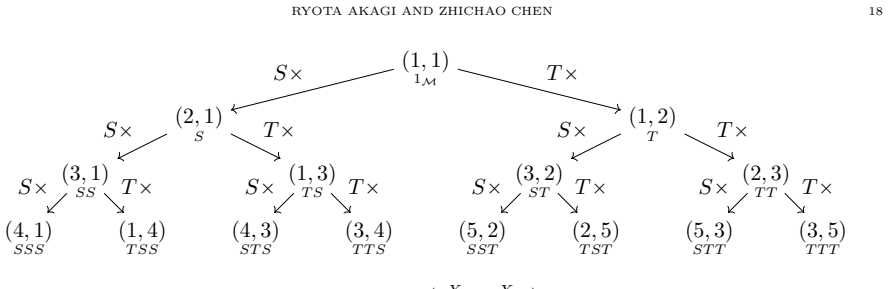
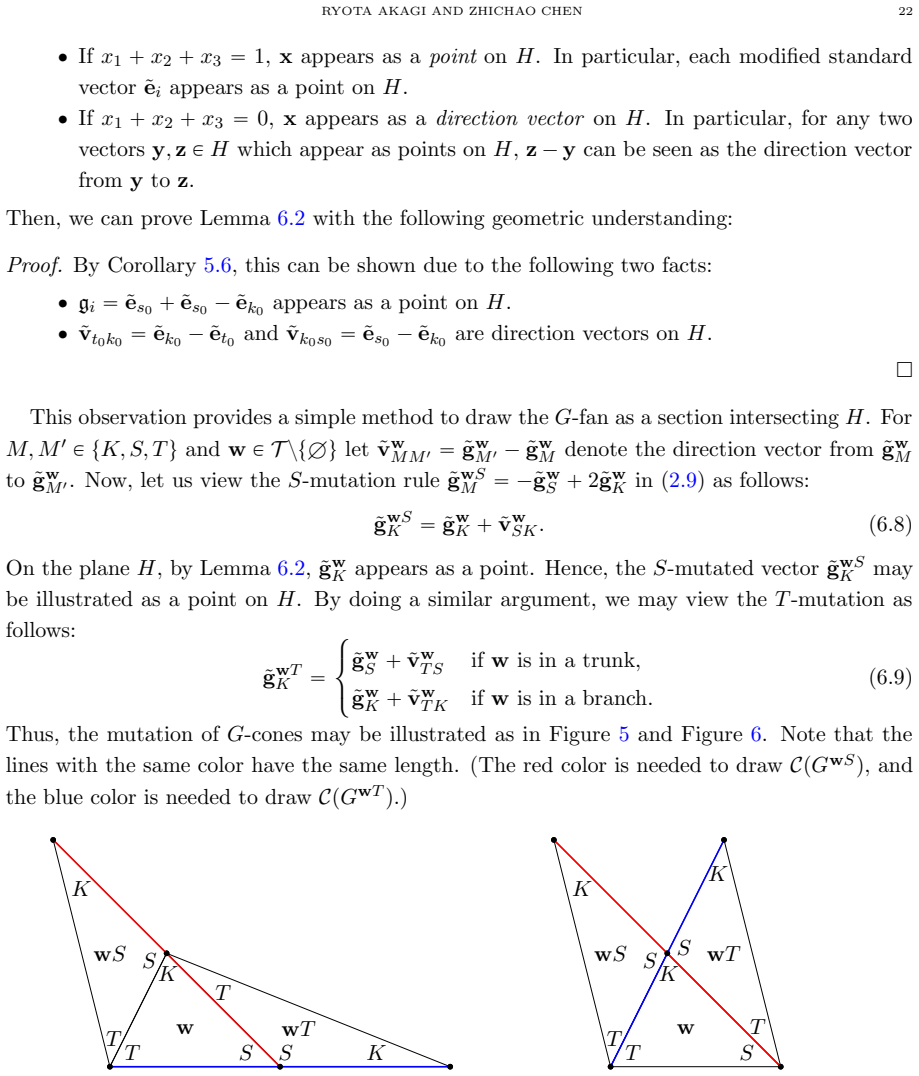
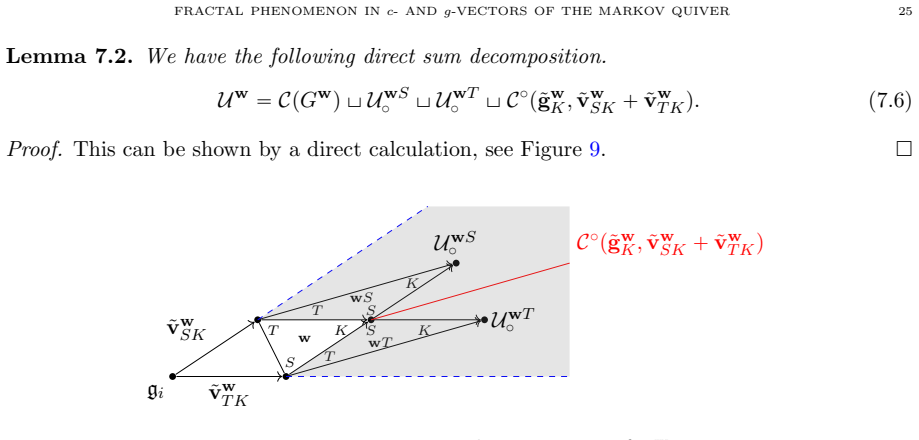
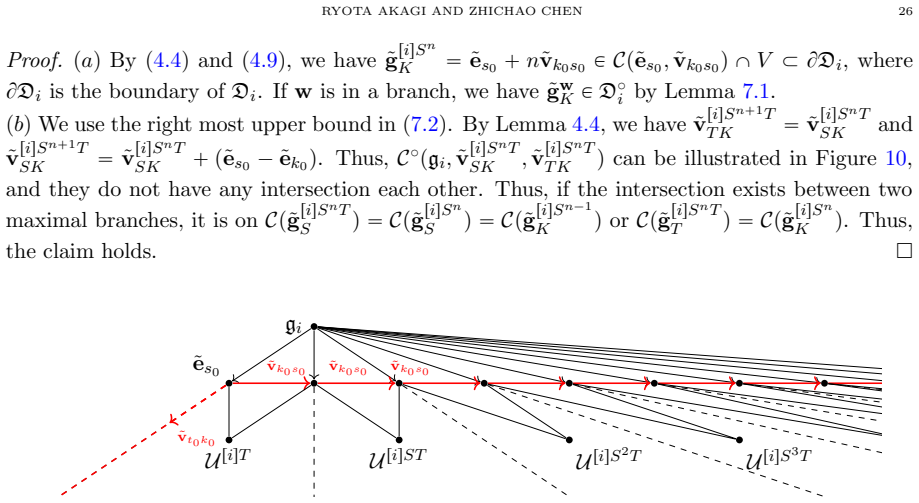
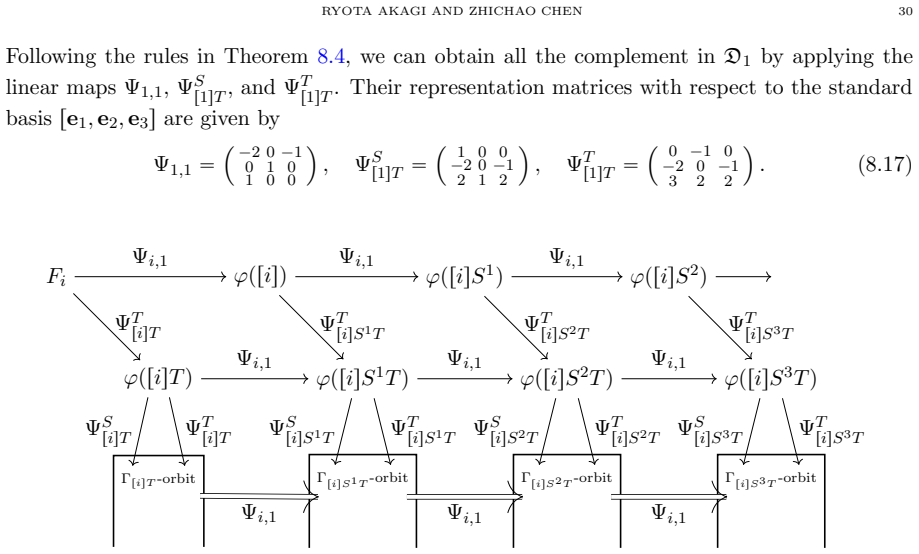
We prove that large classes of subpatterns of modified c- and g-vectors are linearly isomorphic, yielding a fractal structure of the corresponding G-fan. We further derive explicit recursive formulas for all modified c- and g-vectors in terms of integer pairs satisfying a recursion analogous to the Calkin-Wilf tree, which leads to a parameterization by coprime integers. As an application, we describe all connected components of the complement of the support of the G-fan, and show that they are generated recursively by three kinds of linear maps.
What carries the argument
Linear isomorphisms between subpatterns of modified c- and g-vectors, which induce the fractal structure, together with the recursive formulas that parametrize the vectors by coprime integer pairs via a Calkin-Wilf-like tree recursion.
If this is right
- The G-fan displays self-similar fractal structure across its subpatterns.
- Every modified c-vector and g-vector admits a unique parameterization by a pair of coprime integers.
- The complement of the G-fan support decomposes into connected components that are recursively generated by exactly three linear maps.
- The same linear-isomorphism and recursive phenomena hold for all rank-3 skew-symmetrizable matrices of B-invariant type.
Where Pith is reading between the lines
- The coprime-integer parameterization may connect to number-theoretic objects such as the Farey diagram or Stern-Brocot tree.
- Analogous fractal patterns could be sought in cluster structures of higher rank or different mutation classes.
- The linear maps generating the complement components might preserve additional invariants such as sign patterns or denominator vectors.
Load-bearing premise
The mutations for Markov-type cluster algebras are self-contained and simple, which permits the identification of specific subpatterns that admit linear isomorphisms.
What would settle it
Direct computation of a modified c-vector or g-vector for a specific seed in the Markov quiver that fails to satisfy the claimed linear isomorphism with its subpattern or deviates from the recursive formula generated by its corresponding coprime integer pair.
Figures





read the original abstract
We study the $C$- and $G$-patterns associated with rank $3$ skew-symmetrizable matrices of $B$-invariant type, including the Markov quiver. Motivated by the self-contained simple mutations in Markov-type cluster algebras, we prove that large classes of subpatterns of modified $c$- and $g$-vectors are linearly isomorphic, yielding a fractal structure of the corresponding $G$-fan. We further derive explicit recursive formulas for all modified $c$- and $g$-vectors in terms of integer pairs satisfying a recursion analogous to the Calkin-Wilf tree, which leads to a parameterization by coprime integers. As an application, we describe all connected components of the complement of the support of the $G$-fan, and show that they are generated recursively by three kinds of linear maps.
Editorial analysis
A structured set of objections, weighed in public.
Referee Report
Summary. The manuscript studies the C- and G-patterns associated to rank-3 skew-symmetrizable matrices of B-invariant type, with emphasis on the Markov quiver. Motivated by the self-contained nature of mutations in Markov-type cluster algebras, it proves that large classes of subpatterns of modified c- and g-vectors are linearly isomorphic, thereby establishing a fractal structure on the corresponding G-fan. Explicit recursive formulas are derived for all modified c- and g-vectors in terms of integer pairs obeying a Calkin-Wilf-type recursion; this yields a parameterization by coprime integers. As an application, the connected components of the complement of the support of the G-fan are classified and shown to be generated recursively by three families of linear maps.
Significance. If the derivations hold, the paper supplies an explicit, recursive combinatorial description of c- and g-vectors for an important infinite-mutation class, together with a fractal decomposition of the G-fan and a complete classification of its complement components. The coprime-integer parameterization and the three linear maps furnish concrete, computable tools that could be used to test further conjectures in cluster algebra theory. The explicit link between mutation self-containment and linear isomorphisms is a methodological strength that may generalize beyond rank 3.
minor comments (3)
- The precise definition of 'modified' c- and g-vectors (as opposed to the standard ones) should be stated at the first occurrence, together with a short explanation of why the modification is required for the linear-isomorphism statements to hold.
- In the application section describing the connected components, an explicit low-dimensional example (e.g., the first few iterates of the three linear maps) would help the reader verify that the recursion indeed exhausts all components.
- Figure captions should indicate which linear map or recursion step is illustrated in each panel so that the fractal self-similarity is immediately visible.
Simulated Author's Rebuttal
We thank the referee for the positive assessment of our work on the fractal structure of modified c- and g-vectors for the Markov quiver and related B-invariant matrices. The recommendation for minor revision is noted; we will prepare a revised version incorporating any editorial improvements.
Circularity Check
No significant circularity; derivation self-contained from mutation structure
full rationale
The paper's central claims rest on proving linear isomorphisms among subpatterns of modified c- and g-vectors, motivated explicitly by the self-contained simple mutations of Markov-type cluster algebras, followed by derivation of recursive formulas analogous to the Calkin-Wilf tree that parameterize the vectors by coprime integer pairs. These recursions are then applied independently to classify connected components of the G-fan complement via three families of linear maps. No load-bearing step reduces by construction to a fitted input, self-citation, or ansatz smuggled from prior work; the abstract and high-level argument present the recursions as derived outputs rather than inputs, with no equations or citations in the provided text that collapse the target results to the assumptions. The derivation chain is therefore independent of the patterns it describes.
Axiom & Free-Parameter Ledger
axioms (1)
- domain assumption Mutations in Markov-type cluster algebras are self-contained and simple
Lean theorems connected to this paper
-
IndisputableMonolith/Foundation/ArithmeticFromLogic.leanLogicNat ≃ Nat, embed_injective echoesTheorem 5.1 and recursion (1.11): coefficients (a_X, b_X) obey (a_{M'X}, b_{M'X}) = (a_X + b_X, b_X) for M'=S and (b_X, a_X + b_X) for M'=T, generating all coprime pairs exactly once (Lemma 5.3).
Reference graph
Works this paper leans on
- [1]
-
[2]
arXiv preprint arXiv:2509.07454 , year=
Sign-coherence and tropical sign pattern for rank 3 real cluster-cyclic exchange matrices , author=. arXiv preprint arXiv:2509.07454 , year=
- [3]
-
[4]
Fock, V. V. and Goncharov, A. B. , TITLE =. Selecta Math. (N.S.) , FJOURNAL =. 2016 , NUMBER =. doi:10.1007/s00029-016-0282-6 , URL =
-
[5]
Fomin, S. and Shapiro, M. and Thurston, D. , TITLE =. Acta Math. , FJOURNAL =. 2008 , NUMBER =. doi:10.1007/s11511-008-0030-7 , URL =
-
[6]
On the c-vectors and g-vectors of the
Ch. On the c-vectors and g-vectors of the. S\'em. Lothar. Combin. , FJOURNAL =. 2012 , PAGES =. doi:10.1029/jz069i001p00001 , URL =
-
[7]
Chen, Z. and Li, Z. , TITLE =. J. Pure Appl. Algebra , FJOURNAL =. 2025 , NUMBER =. doi:10.1016/j.jpaa.2025.108058 , URL =
-
[8]
Calkin, N. and Wilf, H. S. , TITLE =. Amer. Math. Monthly , FJOURNAL =. 2000 , NUMBER =. doi:10.2307/2589182 , URL =
-
[9]
arXiv preprint arXiv:2411.07083 , year=
Cluster-cyclic condition of skew-symmetrizable matrices of rank 3 via the Markov constant , author=. arXiv preprint arXiv:2411.07083 , year=
- [10]
-
[11]
Ricke, C. , TITLE =. J. Pure Appl. Algebra , FJOURNAL =. 2015 , NUMBER =. doi:10.1016/j.jpaa.2015.03.015 , URL =
-
[12]
Fomin, S. and Zelevinsky, A. , TITLE =. J. Amer. Math. Soc. , FJOURNAL =. 2002 , NUMBER =. doi:10.1090/S0894-0347-01-00385-X , URL =
-
[13]
Fomin, S. and Zelevinsky, A. , TITLE =. Compos. Math. , FJOURNAL =. 2007 , NUMBER =. doi:10.1112/S0010437X06002521 , URL =
-
[14]
Nakanishi, T. , TITLE =. 2023 , PAGES =. doi:10.1142/e073 , URL =
-
[15]
Derksen, H. and Weyman, J. and Zelevinsky, A. , TITLE =. Selecta Math. (N.S.) , FJOURNAL =. 2008 , NUMBER =. doi:10.1007/s00029-008-0057-9 , URL =
- [16]
-
[17]
arXiv preprint arXiv:2507.06900 , year=
Cluster algebraic interpretation of generalized Markov numbers and their matrixizations , author=. arXiv preprint arXiv:2507.06900 , year=
-
[18]
Gross, M. and Hacking, P. and Keel, S. and Kontsevich, M. , TITLE =. J. Amer. Math. Soc. , FJOURNAL =. 2018 , NUMBER =. doi:10.1090/jams/890 , URL =
-
[19]
Reading, N. , TITLE =. Math. Z. , FJOURNAL =. 2014 , NUMBER =. doi:10.1007/s00209-013-1264-4 , URL =
- [20]
-
[21]
Reading, N. and Speyer, D. E. , TITLE =. Int. Math. Res. Not. IMRN , FJOURNAL =. 2016 , NUMBER =. doi:10.1093/imrn/rnv101 , URL =
-
[22]
Reading, N. and Speyer, D. E. , TITLE =. Trans. Amer. Math. Soc. , FJOURNAL =. 2018 , NUMBER =. doi:10.1090/tran/7193 , URL =
discussion (0)
Sign in with ORCID, Apple, or X to comment. Anyone can read and Pith papers without signing in.