Recognition: unknown
Arcane: An Assertion Reduction Framework through Semantic Clustering and MCTS-Guided Rule Exploring
Pith reviewed 2026-05-12 03:47 UTC · model grok-4.3
The pith
Arcane cuts redundant hardware assertions by up to 76.2 percent using semantic clustering and MCTS while preserving full formal coverage and mutation detection.
A machine-rendered reading of the paper's core claim, the machinery that carries it, and where it could break.
Core claim
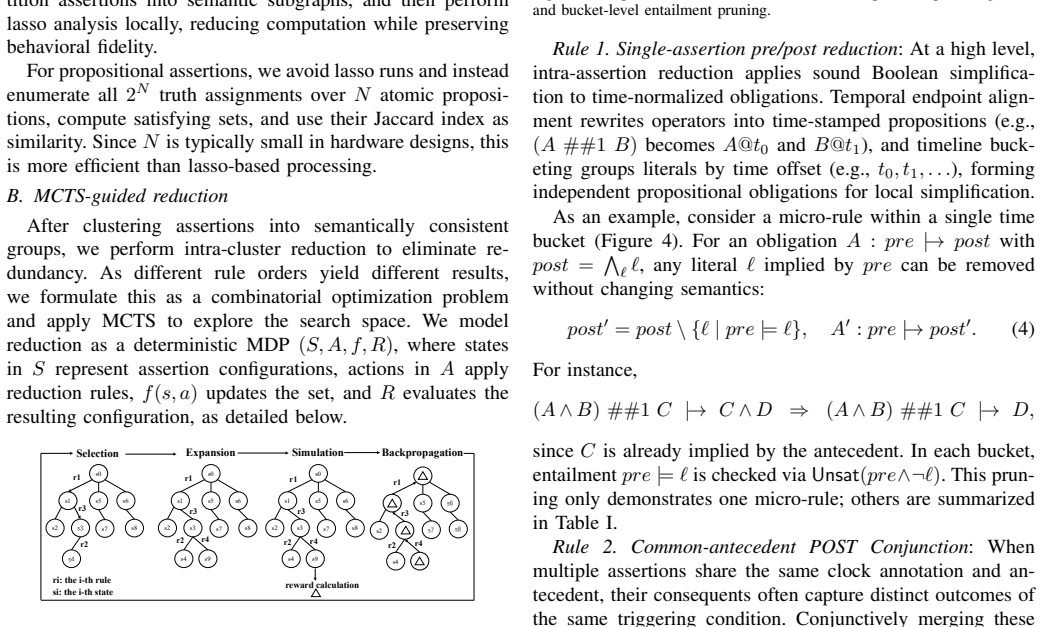
Arcane integrates a two-tier assertion clustering approach for accurate semantic classification of large assertion sets and employs Monte Carlo Tree Search to explore optimal rule-application sequences, achieving up to 76.2% reduction in assertion count on Assertionbench while fully preserving formal coverage and mutation-detection ability, with simulation speedups of 2.6x to 6.1x.
What carries the argument
Two-tier semantic clustering of assertions combined with MCTS to search for shortest valid reduction-rule sequences.
If this is right
- Reduced assertion sets maintain identical formal coverage and mutation-detection scores as the original sets.
- Simulation runtime for verification drops by a factor of 2.6x to 6.1x.
- The approach works on assertion sets produced by current automated generators such as LLM-based frameworks.
- MCTS finds near-optimal reduction sequences even when the initial assertion count is large.
Where Pith is reading between the lines
- The same clustering-plus-search pattern could be tried on other verification artifacts such as test vectors or temporal properties.
- Embedding Arcane inside commercial EDA verification suites would let engineers apply it routinely without changing their flow.
- Experiments on industrial-scale designs larger than Assertionbench would reveal whether the reported speedups hold at full chip level.
Load-bearing premise
The two-tier semantic clustering must correctly group redundant assertions without removing any that are essential for coverage or mutation detection.
What would settle it
Apply the reduced assertion set to a design that contains a known injected fault; if the reduced set fails to detect that fault while the original set succeeds, the claim is falsified.
Figures



read the original abstract
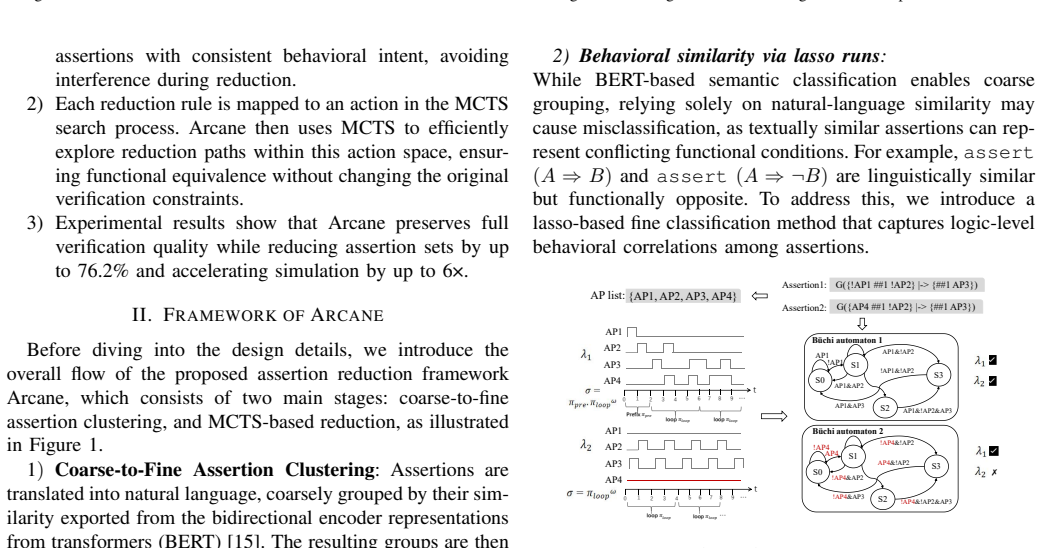
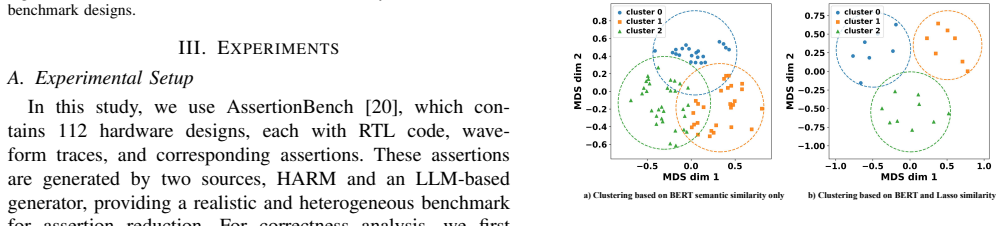
Assertion-based Verification (ABV) is essential for ensuring that hardware designs conform to their intended specifications. However, existing automated assertion-generation approaches, such as LLM-based frameworks, often generate large numbers of redundant assertions, which significantly degrade simulation efficiency. To mitigate the simulation overhead caused by redundant assertions, this paper proposes Arcane, an efficient assertion reduction framework. It integrates a two-tier assertion clustering approach for accurate semantic classification of large assertion sets, and employs Monte Carlo Tree Search (MCTS) to explore optimal rule-application sequences for efficient assertion reduction. The experimental results on Assertionbench [20] show that Arcane achieves a reduction of up to 76.2% in the assertion count while fully preserving formal coverage and mutation-detection ability. Further simulation studies demonstrate a speedup of 2.6x to 6.1x speedup in simulation time. The proposed framework is released at https://anonymous.4open.science/r/Arcane1-0A6F/.
Editorial analysis
A structured set of objections, weighed in public.
Referee Report
Summary. The paper proposes Arcane, a framework for reducing redundant assertions generated by automated methods in assertion-based verification (ABV). It combines a two-tier semantic clustering approach for classifying large assertion sets with Monte Carlo Tree Search (MCTS) to identify optimal sequences of reduction rules. Experiments on Assertionbench report up to 76.2% reduction in assertion count while preserving formal coverage and mutation-detection ability, along with simulation speedups of 2.6x to 6.1x. The framework code is released via an anonymous repository.
Significance. If the central claims hold, Arcane could meaningfully improve simulation efficiency in hardware verification by addressing redundancy in LLM-generated assertions without sacrificing verification quality. The open release of the implementation is a strength that supports reproducibility and community validation.
major comments (2)
- [§4 (Experimental Results)] §4 (Experimental Results): The claim of up to 76.2% reduction while 'fully preserving formal coverage and mutation-detection ability' is load-bearing but unsupported by details on the embedding model, semantic similarity threshold, clustering features, or intra-cluster validation. Without these, it is impossible to confirm that the two-tier clustering avoids grouping non-equivalent assertions that differ in corner cases or signal dependencies.
- [§3 (Framework Description)] §3 (Framework Description): The MCTS-guided rule exploration inherits any mis-groupings from the clustering stage. The paper provides no ablation on MCTS hyperparameters (exploration budget, reward weights) or statistical significance tests across data splits, leaving the 2.6x–6.1x speedup claim difficult to generalize beyond the specific Assertionbench runs.
minor comments (2)
- [Abstract] Abstract: The phrase 'a speedup of 2.6x to 6.1x speedup in simulation time' contains a duplicated word.
- [§4] The manuscript would benefit from an explicit table listing all free parameters (similarity threshold, MCTS budget, reward weights) and their chosen values for the reported experiments.
Simulated Author's Rebuttal
We thank the referee for their insightful comments on our manuscript. We address each of the major concerns below and outline the revisions we plan to make to improve the clarity and completeness of the paper.
read point-by-point responses
-
Referee: The claim of up to 76.2% reduction while 'fully preserving formal coverage and mutation-detection ability' is load-bearing but unsupported by details on the embedding model, semantic similarity threshold, clustering features, or intra-cluster validation. Without these, it is impossible to confirm that the two-tier clustering avoids grouping non-equivalent assertions that differ in corner cases or signal dependencies.
Authors: We agree that additional details on the two-tier semantic clustering are necessary to fully support our claims. In the revised manuscript, we will expand §4 to include the specific embedding model employed, the semantic similarity threshold used for clustering, the features considered (such as assertion text embeddings and signal dependencies), and the intra-cluster validation procedures (including sampling and equivalence checks). These additions will allow readers to verify that non-equivalent assertions are not incorrectly grouped. We have prepared these details based on our implementation and will incorporate them directly. revision: yes
-
Referee: The MCTS-guided rule exploration inherits any mis-groupings from the clustering stage. The paper provides no ablation on MCTS hyperparameters (exploration budget, reward weights) or statistical significance tests across data splits, leaving the 2.6x–6.1x speedup claim difficult to generalize beyond the specific Assertionbench runs.
Authors: We acknowledge the dependency between clustering and MCTS, as well as the need for more rigorous evaluation of the MCTS component. In the revised version, we will add ablation experiments on key MCTS hyperparameters, including the exploration budget and the weights in the reward function. Furthermore, we will conduct and report statistical significance tests across multiple random data splits of the Assertionbench dataset to demonstrate the robustness and generalizability of the observed speedups. These results will be presented in an updated §3 and §4. revision: yes
Circularity Check
No circularity: empirical results on external benchmark with no definitional or fitted reductions
full rationale
The paper describes an empirical assertion-reduction pipeline (two-tier semantic clustering plus MCTS rule exploration) whose central claims are measured outcomes on the external Assertionbench benchmark [20]. No equations, parameters fitted to the target metric, or self-definitional steps appear in the abstract or described method. Reduction percentages and speedups are reported as experimental results rather than predictions derived by construction from the inputs. No load-bearing self-citations or uniqueness theorems are invoked; the framework is released for external reproduction. This is the normal non-circular case for an applied engineering paper whose validity rests on benchmark measurements rather than algebraic equivalence.
Axiom & Free-Parameter Ledger
free parameters (2)
- semantic similarity threshold
- MCTS exploration budget and reward weights
axioms (1)
- domain assumption Assertions that are semantically similar are redundant for coverage and mutation detection purposes.
Reference graph
Works this paper leans on
-
[1]
Focs–automatic genera- tion of simulation checkers from formal specifications,
Y . Abarbanel, I. Beer, L. Gluhovsky, et al., “Focs–automatic genera- tion of simulation checkers from formal specifications,”International Conference on Computer Aided Verification, pp.538-542, 2000
work page 2000
-
[2]
A survey on assertion-based hardware verification,
H. Witharana, Y . Lyu, S. Charles, et al., “A survey on assertion-based hardware verification,”ACM Computing Surveys. (CSUR), vol. 54, no. 11, pp. 1-33, 2022
work page 2022
-
[3]
Block-based shema-driven assertion gen- eration for functional verification,
A. Hekmatpour, A. Salehi, “Block-based shema-driven assertion gen- eration for functional verification,”IEEE 14th Asian Test Symposium. (ATS), pp. 34-39, 2005
work page 2005
-
[4]
Germiniani, Samuele, and Graziano Pravadelli. ”Harm: a hint-based assertion miner.” IEEE Transactions on Computer-Aided Design of Integrated Circuits and Systems 41.11, pp. 4277-4288, 2022
work page 2022
-
[5]
Vasudevan, Shobha, et al. ”Goldmine: Automatic assertion generation using data mining and static analysis.” 2010 Design, Automation & Test in Europe Conference & Exhibition (DATE), 2010
work page 2010
-
[6]
SpecToSV A: Circuit specification document to systemverilog assertion translation,
G. Parthasarathy, S. Nanda, P. Choudhary, et al., “SpecToSV A: Circuit specification document to systemverilog assertion translation,”Second Document Intelligence Workshop at KDD, 2021
work page 2021
-
[7]
(Security) assertions by large language models,
R. Kande, H. Pearce, B. Tan, et al., “(Security) assertions by large language models,”IEEE Trans. on Information Forensics and Security, vol. 19, pp. 4374-4389, 2024
work page 2024
-
[8]
Are LLMs Ready for Practical Adoption for Assertion Generation?,
V . Pulavarthi, D. Nandal, S. Dan, et al., “Are LLMs Ready for Practical Adoption for Assertion Generation?,”IEEE Design, Automation & Test in Europe Conference. (DATE), pp. 1-7, 2025
work page 2025
-
[9]
F. Aditi, M. S. Hsiao, “Hybrid rule-based and machine learning system for assertion generation from natural language specifications,”IEEE 31st Asian Test Symposium. (ATS), pp. 126-131, 2022
work page 2022
-
[10]
F. Wu, E. Pan, R. Kande, et al., “Spec2Assertion: Automatic pre- RTL assertion generation using large language models with progressive regularization,”arXiv preprint arXiv:2505.07995, 2025
-
[11]
ARTmine: Automatic as- sociation rule mining with temporal behavior for hardware verification,
M. R. H. Iman, G. Jervan, T. Ghasempouri, “ARTmine: Automatic as- sociation rule mining with temporal behavior for hardware verification,” IEEE Design, Automation & Test in Europe Conference & Exhibition. (DATE), pp. 1-6, 2024
work page 2024
-
[12]
Stulova, Nataliia, Jos ´e F. Morales, and Manuel V . Hermenegildo. ”Re- ducing the overhead of assertion run-time checks via static analysis.” Proceedings of the 18th International Symposium on Principles and Practice of Declarative Programming., 2016
work page 2016
-
[13]
Sanjaya, Sahan, Hasini Witharana, and Prabhat Mishra. ”Assertion- Based Validation using Clustering and Dynamic Refinement of Hard- ware Checkers.”ACM Transactions on Design Automation of Electronic Systems 29.6, pp. 1-22, 2024
work page 2024
-
[14]
´Swiechowski, Maciej, et al. ”Monte Carlo tree search: A review of recent modifications and applications.” Artificial Intelligence Review 56.3, pp. 2497-2562, 2023
work page 2023
-
[15]
Lee, J. D. M. C. K., and K. Toutanova. ”Pre-training of deep bidirectional transformers for language understanding.” arXiv preprint arXiv:1810.04805 3.8, pp. 4171-4186, 2018
work page internal anchor Pith review Pith/arXiv arXiv 2018
-
[16]
Schewe, Sven. ”Tighter bounds for the determinisation of B ¨uchi au- tomata.” International Conference on Foundations of Software Science and Computational Structures. Berlin, Heidelberg: Springer Berlin Hei- delberg, 2009
work page 2009
-
[17]
Niwattanakul, Suphakit, et al. ”Using of Jaccard coefficient for keywords similarity.” Proceedings of the international multiconference of engineers and computer scientists. V ol. 1. No. 6. 2013
work page 2013
-
[18]
Deng, Dingsheng. ”DBSCAN clustering algorithm based on density.” 2020 7th international forum on electrical engineering and automation (IFEEA), 2020
work page 2020
-
[19]
”Spot: a platform for LTL and omega- automata manipulation.”Online: https://spot
Duret-Lutz, Alexandre, et al. ”Spot: a platform for LTL and omega- automata manipulation.”Online: https://spot. lre. epita. fr, 2023
work page 2023
-
[20]
Pulavarthi, Vaishnavi, et al. ”Assertionbench: A benchmark to evaluate large-language models for assertion generation.” Findings of the Asso- ciation for Computational Linguistics: NAACL, 2025
work page 2025
-
[21]
Armoni, Roy, Dana Fisman, and Naiyong Jin. ”SV A and PSL local variables-a practical approach.” International Conference on Computer Aided Verification. Berlin, Heidelberg: Springer Berlin Heidelberg, 2013
work page 2013
-
[22]
Davies Bouldin Index based hierarchical initialization K-means
Xiao, J., Lu, J., & Li, X. . Davies Bouldin Index based hierarchical initialization K-means. Intelligent Data Analysis, 21(6), pp. 1327-1338, 2017
work page 2017
discussion (0)
Sign in with ORCID, Apple, or X to comment. Anyone can read and Pith papers without signing in.