Recognition: 2 theorem links
· Lean TheoremComputing eigenpairs of quantum many-body systems with Polfed.jl
Pith reviewed 2026-05-14 21:51 UTC · model grok-4.3
The pith
Polfed.jl computes mid-spectrum eigenpairs of quantum many-body Hamiltonians by applying polynomial spectral transformations on the fly inside Lanczos iterations.
A machine-rendered reading of the paper's core claim, the machinery that carries it, and where it could break.
Core claim
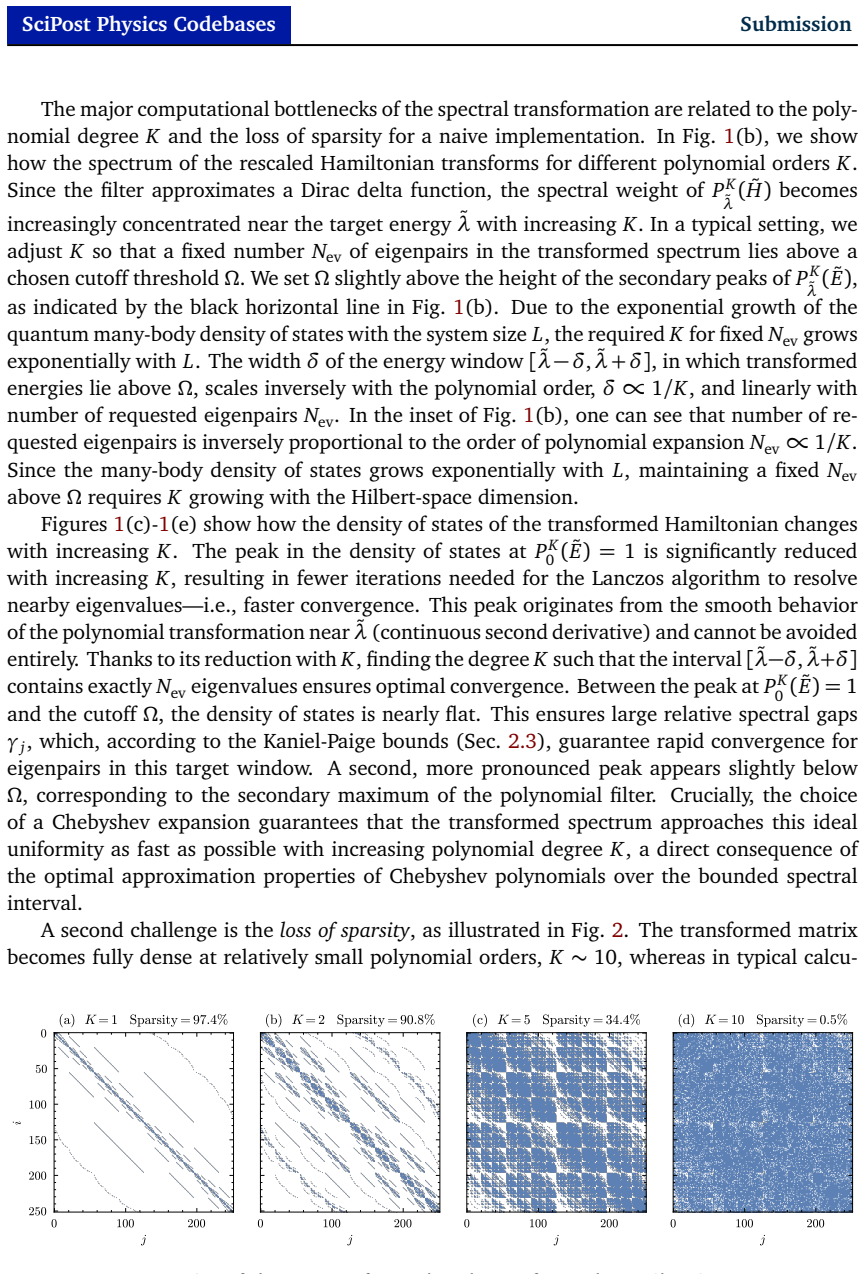
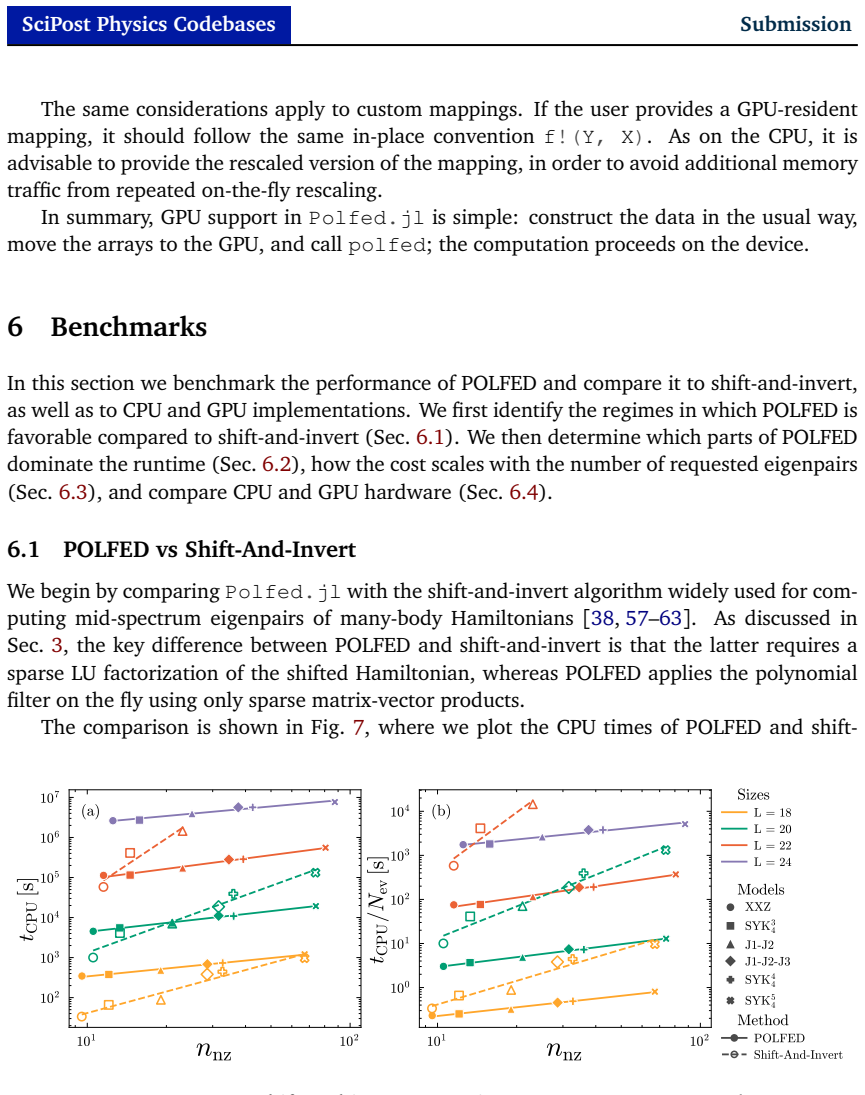
POLFED performs a polynomial spectral transformation evaluated on the fly within a Lanczos iteration to compute mid-spectrum eigenpairs while preserving the sparsity of the Hamiltonian and reducing memory costs compared to other diagonalization methods.
What carries the argument
The polynomial spectral transformation evaluated on the fly within a Lanczos iteration, which maps the target energy window so that sparse matrix-vector multiplications dominate the cost.
If this is right
- Mid-spectrum eigenpairs become reachable for larger disordered spin-chain and fermionic systems than with conventional diagonalization.
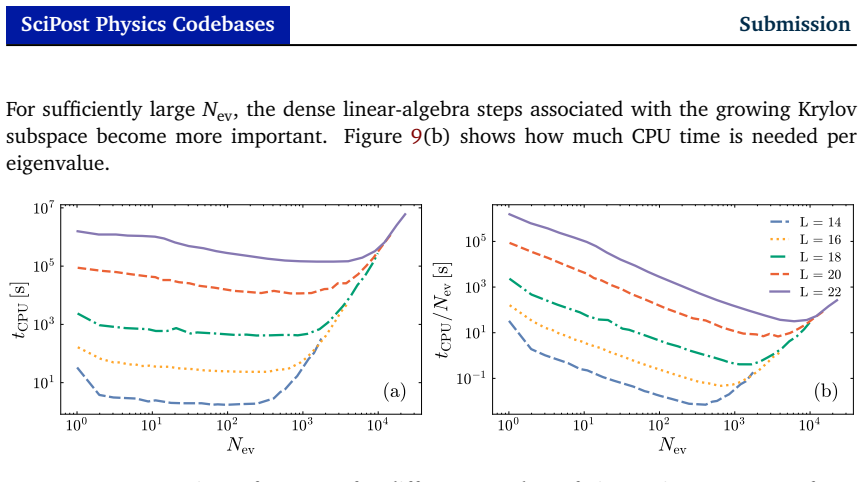
- GPU acceleration yields substantial speedups because the dominant operations remain sparse matrix-vector multiplications.
- Flexible energy targeting and automatic spectral mapping optimization are available for structured Hamiltonians.
- The quantum sun model Hamiltonian can be constructed directly to study many-body ergodicity-breaking transitions.
Where Pith is reading between the lines
- The same on-the-fly filtering approach could be applied to any large sparse matrix problem outside quantum many-body physics.
- Users could combine POLFED output with time-evolution routines to study dynamics around targeted energies.
- The method's scaling on GPU hardware suggests it may push accessible system sizes in studies of many-body localization or ergodicity breaking.
Load-bearing premise
The polynomial spectral transformation evaluated on the fly inside Lanczos maintains numerical stability and sufficient accuracy for mid-spectrum states without prohibitive overhead or convergence failures on the targeted sparse Hamiltonians.
What would settle it
Run POLFED on a Hamiltonian small enough for full exact diagonalization and check whether the returned mid-spectrum eigenpairs agree with the exact results to within machine precision.
Figures






read the original abstract
We present Polfed$.$jl, an open-source Julia package implementing the Polynomially Filtered Exact Diagonalization (POLFED) algorithm for computing mid-spectrum eigenvalues and eigenvectors (shortly, eigenpairs) of quantum many-body Hamiltonians. Access to such eigenpairs is essential for studying non-equilibrium many-body physics, but is hindered by the exponential growth of Hilbert-space dimension. POLFED addresses this challenge through a polynomial spectral transformation evaluated on the fly within a Lanczos iteration, preserving Hamiltonian sparsity and substantially reducing memory costs compared to other diagonalization methods. The package supports flexible energy targeting, automatic optimization of the spectral mapping for structured Hamiltonians, and GPU acceleration, which is particularly effective since the dominant computational cost reduces to repeated sparse matrix-vector multiplications. Benchmarks on disordered spin-chain and fermionic models demonstrate access to larger system sizes than alternative approaches, and CPU--GPU comparisons confirm significant speedups. In particular, we also provide code for constructing the quantum sun model Hamiltonian, a toy model of a many-body ergodicity-breaking transition. While our focus is on many-body Hamiltonians, Polfed$.$jl may be applied to any large sparse matrix.
Editorial analysis
A structured set of objections, weighed in public.
Referee Report
Summary. The paper introduces Polfed.jl, an open-source Julia package implementing the Polynomially Filtered Exact Diagonalization (POLFED) algorithm. It computes mid-spectrum eigenpairs of large sparse quantum many-body Hamiltonians by applying a polynomial spectral transformation on the fly inside a Lanczos iteration. This preserves Hamiltonian sparsity, reduces memory footprint relative to full diagonalization or shift-invert methods, supports flexible energy targeting and automatic spectral mapping optimization, and includes GPU acceleration. Benchmarks on disordered spin chains and fermionic models claim access to larger Hilbert-space dimensions than alternative approaches, and the package ships code for the quantum sun model Hamiltonian.
Significance. If the numerical stability and accuracy claims hold, the work supplies a practical, memory-efficient tool for accessing mid-spectrum states in many-body systems that are otherwise inaccessible, directly supporting studies of non-equilibrium dynamics and ergodicity breaking. The open-source implementation, GPU support (reducing cost to repeated sparse matvecs), and provision of the quantum sun model code are concrete strengths that enhance reproducibility and usability.
major comments (2)
- [Benchmarks] Benchmarks section: the reported access to larger system sizes for disordered spin-chain and fermionic models is presented without quantitative controls on eigenvector accuracy, residual norms, or convergence behavior of the Lanczos iteration when the polynomial filter degree is increased. This is load-bearing because the central claim of reliable mid-spectrum eigenpairs rests on the on-the-fly polynomial transformation not amplifying round-off errors in dense spectra.
- [Method] Method description: the automatic optimization of the spectral mapping for structured Hamiltonians is described at a high level but lacks explicit pseudocode or parameter choices showing that the procedure remains free of ad-hoc fitting parameters that could affect the claimed parameter-free character of the filtered Lanczos step.
minor comments (2)
- [Abstract] Abstract: the notation 'Polfed$.$jl' appears to be a LaTeX artifact and should be rendered consistently as Polfed.jl throughout.
- [Benchmarks] The manuscript would benefit from a short table comparing memory scaling and wall-time per eigenpair against standard sparse eigensolvers (e.g., ARPACK, FEAST) for the same models.
Simulated Author's Rebuttal
We thank the referee for their careful reading of the manuscript and for the constructive comments. We address each major point below and have revised the manuscript to incorporate additional details and controls as requested.
read point-by-point responses
-
Referee: [Benchmarks] Benchmarks section: the reported access to larger system sizes for disordered spin-chain and fermionic models is presented without quantitative controls on eigenvector accuracy, residual norms, or convergence behavior of the Lanczos iteration when the polynomial filter degree is increased. This is load-bearing because the central claim of reliable mid-spectrum eigenpairs rests on the on-the-fly polynomial transformation not amplifying round-off errors in dense spectra.
Authors: We agree that quantitative controls on accuracy and convergence are essential to support the reliability claims. In the revised manuscript we have added residual norm tables for representative eigenvectors across the benchmarked system sizes, plots of Lanczos residual convergence versus iteration count for increasing polynomial degrees, and direct comparisons of eigenvector accuracy (via overlap with reference shift-invert results where feasible). These additions demonstrate that round-off amplification remains controlled for the filter degrees used, consistent with the on-the-fly evaluation preserving sparsity and numerical stability. revision: yes
-
Referee: [Method] Method description: the automatic optimization of the spectral mapping for structured Hamiltonians is described at a high level but lacks explicit pseudocode or parameter choices showing that the procedure remains free of ad-hoc fitting parameters that could affect the claimed parameter-free character of the filtered Lanczos step.
Authors: We thank the referee for highlighting this point. The revised Methods section now includes explicit pseudocode for the automatic spectral mapping optimization. The procedure relies solely on the analytically known spectral bounds of the Hamiltonian (e.g., from the Pauli-string structure) together with a fixed, small number of Chebyshev iterations for the mapping; no user-tuned or fitting parameters are introduced. This preserves the parameter-free nature of the subsequent filtered Lanczos iteration. revision: yes
Circularity Check
No circularity in POLFED derivation or implementation
full rationale
The paper presents POLFED.jl as a direct implementation of polynomial spectral transformation evaluated on-the-fly inside a Lanczos iteration for sparse many-body Hamiltonians. No equations, fitted parameters, or central claims reduce by construction to the paper's own inputs. The method is described as preserving sparsity via repeated sparse matvecs with no self-definitional loops, no load-bearing self-citations, and no imported uniqueness theorems. Benchmarks are presented as empirical validation rather than predictions forced by the algorithm definition itself. This is a standard algorithmic description with independent content.
Axiom & Free-Parameter Ledger
Lean theorems connected to this paper
-
IndisputableMonolith/Cost/FunctionalEquation.leanwashburn_uniqueness_aczel unclear?
unclearRelation between the paper passage and the cited Recognition theorem.
POLFED addresses this challenge through a polynomial spectral transformation evaluated on the fly within a Lanczos iteration, preserving Hamiltonian sparsity... Chebyshev expansion of the spectral filter PK_λ̃( H̃ ) = 1/χ ∑ c_λ̃_n Tn(H̃)
-
IndisputableMonolith/Foundation/AlexanderDualityProof.leancircle_nontrivial_in_degree_one unclear?
unclearRelation between the paper passage and the cited Recognition theorem.
The Chebyshev polynomials of the first kind are defined by the recurrence relation T0=1, T1=H̃, Tn+1=2H̃Tn−Tn−1
What do these tags mean?
- matches
- The paper's claim is directly supported by a theorem in the formal canon.
- supports
- The theorem supports part of the paper's argument, but the paper may add assumptions or extra steps.
- extends
- The paper goes beyond the formal theorem; the theorem is a base layer rather than the whole result.
- uses
- The paper appears to rely on the theorem as machinery.
- contradicts
- The paper's claim conflicts with a theorem or certificate in the canon.
- unclear
- Pith found a possible connection, but the passage is too broad, indirect, or ambiguous to say the theorem truly supports the claim.
Reference graph
Works this paper leans on
-
[1]
H. Q. Lin, Exact diagonalization of quantum-spin models, Phys. Rev. B 42, 6561 (1990), doi:10.1103/PhysRevB.42.6561
-
[2]
Simulations of pure and doped low-dimensional spin-1/2 gapped systems
N. Laflorencie and D. Poilblanc, Simulations of pure and doped low-dimensional spin-1/2 gapped systems, In U. Schollw \"o ck, J. Richter, D. J. J. Farnell and R. F. Bishop, eds., Quantum Magnetism, vol. 645 of Lecture Notes in Physics, pp. 227--252. Springer, Berlin, Heidelberg, doi:10.1007/BFb0119595 (2004), cond-mat/0408363
work page internal anchor Pith review Pith/arXiv arXiv doi:10.1007/bfb0119595 2004
-
[3]
A. W. Sandvik, Computational studies of quantum spin systems, AIP Conf. Proc. 1297, 135 (2010), doi:10.1063/1.3518900, 1101.3281
work page internal anchor Pith review Pith/arXiv arXiv doi:10.1063/1.3518900 2010
-
[4]
P. Weinberg and M. Bukov, QuSpin : a Python package for dynamics and exact diagonalisation of quantum many body systems. Part I : spin chains , SciPost Phys. 2, 003 (2017), doi:10.21468/SciPostPhys.2.1.003, 1610.03042
work page internal anchor Pith review Pith/arXiv arXiv doi:10.21468/scipostphys.2.1.003 2017
- [5]
-
[6]
XDiag: Exact Diagonalization for Quantum Many-Body Systems
A. Wietek, L. Staszewski, M. Ulaga, P. L. Ebert, H. Karlsson, S. Sarkar, L. Shackleton, A. Sinha and R. D. Soares, XDiag : Exact diagonalization for quantum many-body systems (2026), 2505.02901
work page internal anchor Pith review Pith/arXiv arXiv 2026
-
[7]
Bethe, Zur theorie der metalle, Zeitschrift f \"u r Physik 71(3), 205 (1931), doi:10.1007/BF01341708
H. Bethe, Zur theorie der metalle, Zeitschrift f \"u r Physik 71(3), 205 (1931), doi:10.1007/BF01341708
-
[8]
E. H. Lieb and W. Liniger, Exact analysis of an interacting bose gas. i. the general solution and the ground state, Phys. Rev. 130, 1605 (1963), doi:10.1103/PhysRev.130.1605
-
[9]
E. H. Lieb, Exact analysis of an interacting bose gas. ii. the excitation spectrum, Phys. Rev. 130, 1616 (1963), doi:10.1103/PhysRev.130.1616
-
[10]
C. N. Yang and C. P. Yang, One-dimensional chain of anisotropic spin-spin interactions. i. proof of bethe's hypothesis for ground state in a finite system, Phys. Rev. 150, 321 (1966), doi:10.1103/PhysRev.150.321
-
[11]
C. N. Yang and C. P. Yang, One-dimensional chain of anisotropic spin-spin interactions. ii. properties of the ground-state energy per lattice site for an infinite system, Phys. Rev. 150, 327 (1966), doi:10.1103/PhysRev.150.327
-
[12]
E. H. Lieb and F. Y. Wu, Absence of mott transition in an exact solution of the short-range, one-band model in one dimension, Phys. Rev. Lett. 20, 1445 (1968), doi:10.1103/PhysRevLett.20.1445
-
[13]
Gaudin, The Bethe Wavefunction, Cambridge University Press, doi:10.1017/CBO9781107053885 (2014)
M. Gaudin, The Bethe Wavefunction, Cambridge University Press, doi:10.1017/CBO9781107053885 (2014)
-
[14]
E. Anderson, Z. Bai, C. Bischof, S. Blackford, J. Demmel, J. Dongarra, J. Du Croz, A. Greenbaum, S. Hammarling, A. McKenney and D. Sorensen, LAPACK Users' Guide , Society for Industrial and Applied Mathematics, Philadelphia, PA, third edn., doi:10.1137/1.9780898719604 (1999)
-
[15]
C. Lanczos, An iteration method for the solution of the eigenvalue problem of linear differential and integral operators , J. Res. Natl. Bur. Stand. B 45, 255 (1950), doi:10.6028/jres.045.026
-
[16]
P. Lambin and J. P. Gaspard, Continued-fraction technique for tight-binding systems. a generalized-moments method, Phys. Rev. B 26, 4356 (1982), doi:10.1103/PhysRevB.26.4356
-
[17]
C. Benoit, G. Poussigue and A. Assaf, Dynamic and scattering properties of the sierpinski gasket, Journal of Physics: Condensed Matter 4(12), 3153 (1992), doi:10.1088/0953-8984/4/12/011
-
[18]
R. Haydock, V. Heine and M. J. Kelly, Electronic structure based on the local atomic environment for tight-binding bands, Journal of Physics C: Solid State Physics 5(20), 2845 (1972), doi:10.1088/0022-3719/5/20/004
-
[19]
M. Aichhorn, M. Daghofer, H. G. Evertz and W. von der Linden, Low-temperature lanczos method for strongly correlated systems, Phys. Rev. B 67, 161103 (2003), doi:10.1103/PhysRevB.67.161103
-
[20]
J. Jakli c c and P. Prelov s s ek, Lanczos method for the calculation of finite-temperature quantities in correlated systems, Phys. Rev. B 49, 5065 (1994), doi:10.1103/PhysRevB.49.5065
-
[21]
J. M. Soler, E. Artacho, J. D. Gale, A. García, J. Junquera, P. Ordejón and D. Sánchez-Portal, The siesta method for ab initio order-n materials simulation, Journal of Physics: Condensed Matter 14(11), 2745 (2002), doi:10.1088/0953-8984/14/11/302
-
[22]
S. T. Pantelides, The electronic structure of impurities and other point defects in semiconductors, Rev. Mod. Phys. 50, 797 (1978), doi:10.1103/RevModPhys.50.797
-
[23]
J. Jakli c and P. Prelov s ek, Finite-temperature properties of doped antiferromagnets, Advances in Physics 49(1), 1 (2000), doi:10.1080/000187300243381, https://doi.org/10.1080/000187300243381
-
[24]
Dagotto, Correlated electrons in high-temperature superconductors, Rev
E. Dagotto, Correlated electrons in high-temperature superconductors, Rev. Mod. Phys. 66, 763 (1994), doi:10.1103/RevModPhys.66.763
-
[25]
A. Weiße, G. Wellein, A. Alvermann and H. Fehske, The kernel polynomial method, Reviews of Modern Physics 78(1), 275–306 (2006), doi:10.1103/revmodphys.78.275
-
[26]
J. M. Deutsch, Quantum statistical mechanics in a closed system, Phys. Rev. A 43, 2046 (1991), doi:10.1103/PhysRevA.43.2046
-
[27]
Srednicki,Chaos and quantum thermalization, Phys
M. Srednicki, Chaos and quantum thermalization, Phys. Rev. E 50, 888 (1994), doi:10.1103/PhysRevE.50.888
-
[28]
A. Polkovnikov, K. Sengupta, A. Silva and M. Vengalattore, Colloquium: Nonequilibrium dynamics of closed interacting quantum systems , Rev. Mod. Phys. 83, 863 (2011), doi:10.1103/RevModPhys.83.863
-
[29]
L. D'Alessio, Y. Kafri, A. Polkovnikov and M. Rigol, From quantum chaos and eigenstate thermalization to statistical mechanics and thermodynamics, Adv. Phys. 65, 239 (2016), doi:10.1080/00018732.2016.1198134
-
[30]
R. Nandkishore and D. A. Huse, Many-body localization and thermalization in quantum statistical mechanics, Annu. Rev. Condens. Matter Phys. 6, 15 (2015), doi:10.1146/annurev-conmatphys-031214-014726
-
[31]
D. A. Abanin, E. Altman, I. Bloch and M. Serbyn, Colloquium: Many-body localization, thermalization, and entanglement , Rev. Mod. Phys. 91, 021001 (2019), doi:10.1103/RevModPhys.91.021001
-
[32]
Laflorencie, Quantum entanglement in condensed matter systems, Phys
N. Laflorencie, Quantum entanglement in condensed matter systems, Phys. Rep. 646, 1 (2016), doi:10.1016/j.physrep.2016.06.008
-
[33]
F. Alet and N. Laflorencie, Many-body localization: An introduction and selected topics , Comptes Rendus Physique 19(6), 498 (2018), doi:10.1016/j.crhy.2018.03.003
-
[34]
P. Sierant, M. Lewenstein, A. Scardicchio, L. Vidmar and J. Zakrzewski, Many-body localization in the age of classical computing, Rep. Prog. Phys. 88, 026502 (2025), doi:10.1088/1361-6633/ad9756
-
[35]
M. Serbyn, D. A. Abanin and Z. Papi\' c , Quantum many-body scars and weak breaking of ergodicity, Nat. Phys. 17, 675 (2021), doi:10.1038/s41567-021-01230-2
-
[36]
A. Chandran, T. Iadecola, V. Khemani and R. Moessner, Quantum many-body scars: A quasiparticle perspective, Annu. Rev. Condens. Matter Phys. 14, 443 (2023), doi:10.1146/annurev-conmatphys-031620-101617
-
[37]
S. Moudgalya, B. A. Bernevig and N. Regnault, Quantum many-body scars and Hilbert space fragmentation: a review of exact results , Rep. Prog. Phys. 85, 086501 (2022), doi:10.1088/1361-6633/ac73a0
-
[38]
F. Pietracaprina, N. Macé, D. J. Luitz and F. Alet, Shift-invert diagonalization of large many-body localizing spin chains, SciPost Physics 5(5) (2018), doi:10.21468/scipostphys.5.5.045
-
[39]
P. Sierant, M. Lewenstein and J. Zakrzewski, Polynomially filtered exact diagonalization approach to many-body localization, Phys. Rev. Lett. 125, 156601 (2020), doi:10.1103/PhysRevLett.125.156601
-
[40]
Y. Saad, Numerical Methods for Large Eigenvalue Problems, SIAM, Philadelphia, revised edn., doi:10.1137/1.9781611970739 (2011)
-
[41]
H.-r. Fang and Y. Saad, A filtered Lanczos procedure for extreme and interior eigenvalue problems , SIAM J. Sci. Comput. 34(4), A2220 (2012), doi:10.1137/110836535
-
[42]
A. Pieper, M. Kreutzer, M. Galgon, A. Alvermann, H. Fehske, G. Hager, G. Wellein and B. Lang, High-performance implementation of Chebyshev filter diagonalization for interior eigenvalue computations , J. Comput. Phys. 325, 226 (2016), doi:10.1016/j.jcp.2016.08.027
-
[43]
G. H. Golub and C. F. Van Loan, Matrix Computations, Johns Hopkins University Press, Baltimore, fourth edn., ISBN 9781421407944 (2013)
work page 2013
-
[44]
F. M. A. Avella, ed., Strongly Correlated Systems: Numerical Methods, Springer Berlin Heidelberg, ISBN 9783642351068, doi:10.1007/978-3-642-35106-8 (2013)
-
[45]
D. C. Sorensen, Implicit application of polynomial filters in a k -step Arnoldi method , SIAM J. Matrix Anal. Appl. 13(1), 357 (1992), doi:10.1137/0613025
-
[46]
R. B. Lehoucq, D. C. Sorensen and C. Yang, ARPACK Users' Guide: Solution of Large-Scale Eigenvalue Problems with Implicitly Restarted Arnoldi Methods , SIAM, Philadelphia, doi:10.1137/1.9780898719628 (1998)
-
[47]
G. H. Golub and R. Underwood, The block Lanczos method for computing eigenvalues , In J. R. Rice, ed., Mathematical Software III , pp. 361--377. Academic Press, New York, doi:10.1016/B978-0-12-587260-7.50018-2 (1977)
-
[48]
B. N. Parlett, The symmetric eigenvalue problem, SIAM (1998)
work page 1998
-
[49]
B. N. Parlett and D. S. Scott, The Lanczos algorithm with selective orthogonalization , Math. Comp. 33(145), 217 (1979), doi:10.1090/S0025-5718-1979-0514820-3
-
[50]
H. D. Simon, Analysis of the symmetric Lanczos algorithm with reorthogonalization methods , Linear Algebra Appl. 61, 101 (1984), doi:10.1016/0024-3795(84)90025-9
-
[51]
Y. Saad, On the rates of convergence of the lanczos and the block-lanczos methods, SIAM Journal on Numerical Analysis 17(5), 687 (1980)
work page 1980
-
[52]
R. R. Underwood, An iterative block lanczos method for the solution of large sparse symmetric eigenproblems, Tech. Rep. STAN-CS-75-496, Stanford University, Department of Computer Science (1975)
work page 1975
-
[53]
T. Ericsson and A. Ruhe, The spectral transformation Lanczos method for the numerical solution of large sparse generalized symmetric eigenvalue problems , Math. Comp. 35(152), 1251 (1980), doi:10.1090/S0025-5718-1980-0583502-2
-
[54]
M. W. Long, P. Prelov s s ek, S. El Shawish, J. Karadamoglou and X. Zotos, Finite-temperature dynamical correlations using the microcanonical ensemble and the lanczos algorithm, Phys. Rev. B 68, 235106 (2003), doi:10.1103/PhysRevB.68.235106
-
[55]
T. Ericsson and A. Ruhe, The spectral transformation lanczos method for the numerical solution of large sparse generalized symmetric eigenvalue problems, Mathematics of Computation 35(152), 1251 (1980)
work page 1980
-
[56]
W. E. Arnoldi, The principle of minimized iterations in the solution of the matrix eigenvalue problem, Quart. Appl. Math. 9(1), 17 (1951), doi:10.1090/qam/42792
-
[57]
D. J. Luitz, N. Laflorencie and F. Alet, Many-body localization edge in the random-field heisenberg chain, Phys. Rev. B 91, 081103 (2015), doi:10.1103/PhysRevB.91.081103
-
[58]
M. Serbyn, Z. Papi c \' c and D. A. Abanin, Thouless energy and multifractality across the many-body localization transition, Phys. Rev. B 96, 104201 (2017), doi:10.1103/PhysRevB.96.104201
-
[59]
N. Mac\'e, F. Alet and N. Laflorencie, Multifractal scalings across the many-body localization transition, Phys. Rev. Lett. 123, 180601 (2019), doi:10.1103/PhysRevLett.123.180601
-
[60]
J. S untajs, J. Bon c a, T. Prosen and L. Vidmar, Ergodicity breaking transition in finite disordered spin chains, Phys. Rev. B 102, 064207 (2020), doi:10.1103/PhysRevB.102.064207
-
[61]
J. Colbois and N. Laflorencie, Breaking the chains: Extreme value statistics and localization in random spin chains, Phys. Rev. B 108, 144206 (2023), doi:10.1103/PhysRevB.108.144206
-
[62]
J. Colbois, F. Alet and N. Laflorencie, Interaction-driven instabilities in the random-field xxz chain, Phys. Rev. Lett. 133, 116502 (2024), doi:10.1103/PhysRevLett.133.116502
-
[63]
N. Laflorencie, J. Colbois and F. Alet, Cat states carrying long-range correlations in the many-body localized phase, Phys. Rev. B 112, 224207 (2025), doi:10.1103/gtfr-nblw
-
[64]
P. R. Amestoy, I. S. Duff, J.-Y. L'Excellent and J. Koster, A fully asynchronous multifrontal solver using distributed dynamic scheduling, SIAM J. Matrix Anal. Appl. 23(1), 15 (2001), doi:10.1137/S0895479899358194
-
[65]
M. Bollh\" o fer and Y. Notay, JADAMILU : a software code for computing selected eigenvalues of large sparse symmetric matrices , Comput. Phys. Commun. 177(12), 951 (2007), doi:10.1016/j.cpc.2007.08.013
-
[66]
A. Rodriguez, L. J. Vasquez, K. Slevin and R. A. R\" o mer, Critical parameters from a generalized multifractal analysis at the Anderson transition , Phys. Rev. Lett. 105, 046403 (2010), doi:10.1103/PhysRevLett.105.046403
-
[67]
A. Rodriguez, L. J. Vasquez, K. Slevin and R. A. R\" o mer, Multifractal finite-size scaling and universality at the Anderson transition , Phys. Rev. B 84, 134209 (2011), doi:10.1103/PhysRevB.84.134209
-
[68]
R. SILVER and H. R\" O DER, Densities of states of mega-dimensional hamiltonian matrices, International Journal of Modern Physics C 05(04), 735 (1994), doi:10.1142/S0129183194000842, https://doi.org/10.1142/S0129183194000842
-
[69]
R. Silver, H. Roeder, A. Voter and J. Kress, Kernel polynomial approximations for densities of states and spectral functions, J. Comput. Phys. 124(1), 115–130 (1996), doi:10.1006/jcph.1996.0048
-
[70]
C. W. Clenshaw, A note on the summation of Chebyshev series , Math. Comp. 9(51), 118 (1955), doi:10.1090/S0025-5718-1955-0071856-0
-
[71]
B. N. Parlett, The Symmetric Eigenvalue Problem, Society for Industrial and Applied Mathematics, Philadelphia, PA, doi:10.1137/1.9781611971163 (1998)
-
[72]
I. S. Dhillon and B. N. Parlett, Multiple representations to compute orthogonal eigenvectors of symmetric tridiagonal matrices, Linear Algebra and its Applications 387, 1 (2004), doi:10.1016/j.laa.2003.12.025
-
[73]
J. W. Demmel, O. A. Marques, B. N. Parlett and C. V \"o mel, Performance and accuracy of LAPACK 's symmetric tridiagonal eigensolvers , SIAM Journal on Scientific Computing 30(3), 1508 (2008), doi:10.1137/070688778
-
[74]
A. Sai Aramthottil, A. Emami Kopaei, P. Sierant, L. Vidmar and J. Zakrzewski, False signatures of non-ergodic behavior in disordered quantum many-body systems, New Journal of Physics 27(12), 125001 (2025), doi:10.1088/1367-2630/ae20b3
-
[75]
P. R. N. Falcão, J. Zakrzewski and P. Sierant, Fermionic magic resources in disordered quantum spin chains, doi:10.48550/arXiv.2602.00245 (2026), 2602.00245
-
[76]
A. S. Aramthottil, T. Chanda, P. Sierant and J. Zakrzewski, Finite-size scaling analysis of the many-body localization transition in quasiperiodic spin chains, Phys. Rev. B 104, 214201 (2021), doi:10.1103/PhysRevB.104.214201
-
[77]
P. R. N. Falc\ ao, A. S. Aramthottil, P. Sierant and J. Zakrzewski, Many-body localization crossover is sharper in a quasiperiodic potential, Phys. Rev. B 110, 184209 (2024), doi:10.1103/PhysRevB.110.184209
-
[78]
A. S. Aramthottil, P. Sierant, M. Lewenstein and J. Zakrzewski, Phenomenology of many-body localization in bond-disordered spin chains, Phys. Rev. Lett. 133, 196302 (2024), doi:10.1103/PhysRevLett.133.196302
-
[79]
M. Prodius, A. S. Aramthottil and J. Zakrzewski, Interplay of localization and topology in disordered dimerized arrays of rydberg atoms, Phys. Rev. B 113, 064205 (2026), doi:10.1103/lx2h-w9fl
-
[80]
X. Turkeshi, A. Dymarsky and P. Sierant, Pauli spectrum and nonstabilizerness of typical quantum many-body states, Phys. Rev. B 111, 054301 (2025), doi:10.1103/PhysRevB.111.054301
discussion (0)
Sign in with ORCID, Apple, or X to comment. Anyone can read and Pith papers without signing in.