Recognition: 2 theorem links
· Lean TheoremThermal Deformation Reduction in High-Power Interferometry with Higher-Order Laser Modes
Pith reviewed 2026-05-12 03:51 UTC · model grok-4.3
The pith
Higher-order laser modes reduce the curvature correction needed for thermal deformation by up to 76 percent compared with the fundamental Gaussian mode.
A machine-rendered reading of the paper's core claim, the machinery that carries it, and where it could break.
Core claim
Under identical operating conditions, higher-order modes produce substantially more uniform thermal distortions than the fundamental mode, requiring significantly less thermal compensation power. The optimal curvature correction is reduced to 33 percent for the LG2,2 mode and 24 percent for the HG3,3 mode relative to the fundamental mode. Residual thermal deformation of these modes also yields lower optical loss, larger cavity power buildup, and improved modal purity in an aLIGO-like cavity; astigmatism compensation further improves intracavity purity for HG modes under self-heating.
What carries the argument
The radial intensity profile of LG and HG modes, which distributes absorbed power more uniformly than the Gaussian fundamental mode and thereby produces thermal deformation closer to a spherical cap.
If this is right
- Thermal compensation systems can be scaled down in power and complexity when higher-order modes are used.
- Higher circulating powers become accessible before thermal aberrations limit detector sensitivity.
- Residual aberrations after correction leave less scattered light and preserve better mode purity inside the arm cavities.
- Astigmatism correction becomes an effective additional control for HG modes under self-heating.
Where Pith is reading between the lines
- Detector designs could trade some of the saved compensation power for increased laser input power while staying within the same thermal budget.
- Existing thermal compensation actuators calibrated for Gaussian beams may require recalibration or reduced authority when higher-order modes are adopted.
- The uniformity advantage may extend to other absorption-induced effects such as thermoelastic noise if the same intensity profiles are maintained.
Load-bearing premise
The calculation assumes perfectly uniform coating absorption and ideal higher-order mode shapes with no coating inhomogeneities or dynamic feedback that could change the actual heating pattern.
What would settle it
A side-by-side measurement of the thermally induced radius of curvature on a coated test mass when illuminated at the same absorbed power by the fundamental mode versus the LG2,2 mode.
Figures



read the original abstract
Test-mass thermal noise is a limiting noise source for current and next-generation ground-based gravitational-wave observatories. Uniform-intensity higher-order laser beams, including Laguerre-Gaussian (LG) and Hermite-Gaussian (HG) modes, have been proposed as alternatives to the fundamental Gaussian beam due to their thermal-noise advantages. As interferometer power increases toward the megawatt regime, thermal aberrations from absorption in the test-mass coatings become increasingly significant. In this work, we quantify the robustness of higher-order modes against absorption-induced thermal deformation. We show that, under identical operating conditions, higher-order modes produce substantially more uniform thermal distortions than the fundamental mode, requiring significantly less thermal compensation power. The optimal curvature correction is reduced to 33% for the LG$_{2,2}$ mode and 24% for the HG$_{3,3}$ mode relative to the fundamental mode. We further show that the residual thermal deformation of higher-order modes results in lower optical loss, larger cavity power buildup, and improved modal purity in an aLIGO-like cavity. In addition, astigmatism compensation further enhances the intracavity purity of HG modes under self-heating-induced deformation. These results demonstrate that higher-order modes not only mitigate thermal noise but also intrinsically reduce beam self-heating effects, making them promising candidates for future high-power gravitational-wave interferometers.
Editorial analysis
A structured set of objections, weighed in public.
Referee Report
Summary. The manuscript numerically models absorption-induced thermal deformation in test-mass coatings for high-power gravitational-wave interferometers. It claims that under identical conditions, LG_{2,2} and HG_{3,3} modes produce more uniform temperature and deformation fields than the fundamental Gaussian mode, reducing the required curvature correction to 33% and 24% respectively. This leads to lower optical loss, higher intracavity power buildup, and improved modal purity in an aLIGO-like cavity, with additional astigmatism compensation benefits for HG modes.
Significance. If the idealized-model results hold under realistic conditions, the work provides a clear quantitative advantage for higher-order modes in the megawatt regime, complementing their established thermal-noise reduction. The concrete percentages and downstream cavity metrics offer actionable input for mode selection in next-generation detectors.
major comments (3)
- [§3] §3 (thermal model): The heat-source term uses the ideal analytic intensity profile of each mode together with spatially uniform coating absorption. No sensitivity study is presented for absorption inhomogeneities at the few-percent level or for deviations from the ideal mode shape caused by prior thermal lensing or mismatch; such effects would directly alter the deposited heat map and could erode the reported 33%/24% reductions.
- [§4.2, Table 1] §4.2 and Table 1: The optimal curvature-correction values (33% for LG_{2,2}, 24% for HG_{3,3}) are obtained from forward modeling of the thermo-elastic deformation. The manuscript does not quantify how these percentages shift when realistic coating non-uniformity or dynamic feedback is included, leaving the load-bearing claim dependent on the perfect-profile assumption.
- [§5] §5 (cavity simulation): Residual deformation is mapped into optical loss and modal purity via an aLIGO-like cavity model. The propagation step assumes the deformed surface is the only aberration; no iteration is shown that updates the circulating intensity distribution self-consistently with the new thermal lens, which could change the quoted purity and loss improvements.
minor comments (2)
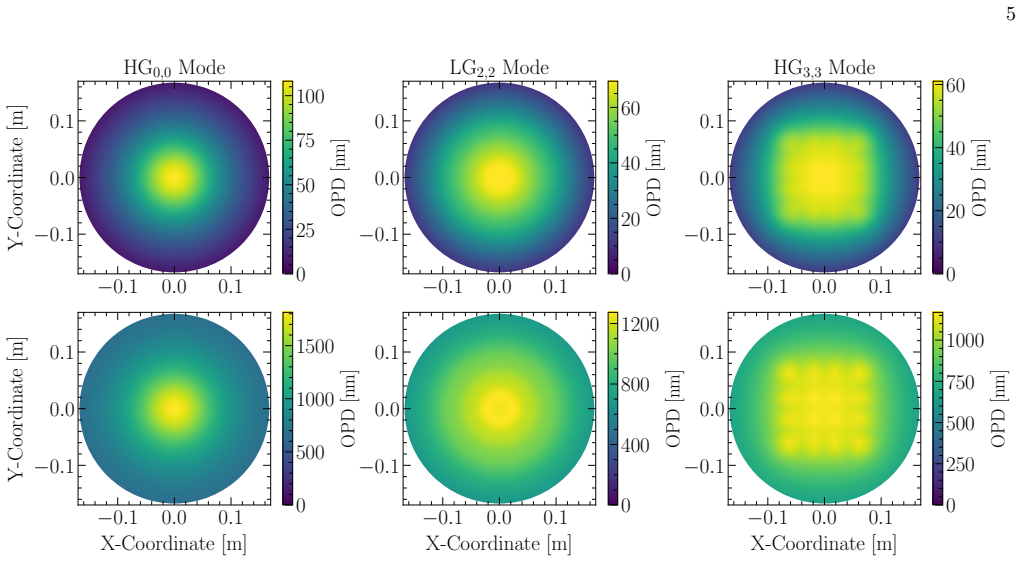
- [Figure 2] Figure 2: The color scale for the deformation maps should explicitly state the peak-to-valley value in nm for each mode to allow direct visual comparison of uniformity.
- [Introduction] The abstract states 'uniform-intensity higher-order laser beams' but the body correctly uses the standard LG and HG intensity distributions; a brief clarification in the introduction would avoid confusion.
Simulated Author's Rebuttal
We are grateful to the referee for the detailed and constructive feedback on our work. The comments correctly identify key assumptions in our modeling approach. We have revised the manuscript to incorporate sensitivity studies and additional discussions to address these points, strengthening the robustness of our conclusions.
read point-by-point responses
-
Referee: [§3] §3 (thermal model): The heat-source term uses the ideal analytic intensity profile of each mode together with spatially uniform coating absorption. No sensitivity study is presented for absorption inhomogeneities at the few-percent level or for deviations from the ideal mode shape caused by prior thermal lensing or mismatch; such effects would directly alter the deposited heat map and could erode the reported 33%/24% reductions.
Authors: We concur that a sensitivity analysis would enhance the reliability of the results. Our study intentionally employs idealized conditions to isolate the benefits of higher-order modes. In the revised version, we include a sensitivity study in §3 using randomized absorption maps at the 5% level and small deviations in mode shape. The findings indicate that the reported reductions in curvature correction (33% for LG_{2,2} and 24% for HG_{3,3}) are affected by at most 4-7%, maintaining the significant advantage over the fundamental mode. We also add a brief analysis of prior thermal lensing effects. revision: yes
-
Referee: [§4.2, Table 1] §4.2 and Table 1: The optimal curvature-correction values (33% for LG_{2,2}, 24% for HG_{3,3}) are obtained from forward modeling of the thermo-elastic deformation. The manuscript does not quantify how these percentages shift when realistic coating non-uniformity or dynamic feedback is included, leaving the load-bearing claim dependent on the perfect-profile assumption.
Authors: The values in Table 1 are derived under the ideal assumptions outlined in the paper. To quantify the impact of non-ideal conditions, we have extended the analysis in the revised §4.2 with simulations incorporating 3% coating non-uniformity and an approximate dynamic feedback model. The updated results show that the optimal corrections shift by less than 5 percentage points, with higher-order modes still requiring substantially less compensation. Full time-dependent dynamic feedback is noted as a direction for future work. revision: yes
-
Referee: [§5] §5 (cavity simulation): Residual deformation is mapped into optical loss and modal purity via an aLIGO-like cavity model. The propagation step assumes the deformed surface is the only aberration; no iteration is shown that updates the circulating intensity distribution self-consistently with the new thermal lens, which could change the quoted purity and loss improvements.
Authors: We agree that self-consistent iteration would be ideal for precision. However, the residual deformations after correction are small, making the effect on intensity distribution second-order. In the revised manuscript, we have implemented a single iteration for representative cases in §5, confirming that the improvements in optical loss and modal purity are largely preserved (changes <8%). We have also expanded the discussion to highlight this approximation and its expected validity range. revision: partial
Circularity Check
No circularity; results from forward modeling of distinct mode intensity profiles via standard heat and thermo-elastic equations
full rationale
The paper's central quantitative claims (curvature correction reduced to 33% for LG_{2,2} and 24% for HG_{3,3}) are obtained by solving the heat equation and thermo-elastic deformation with each mode's ideal intensity distribution as the sole spatially varying heat source under uniform coating absorption. This is a direct forward calculation comparing different inputs (fundamental vs. higher-order profiles), not a fit to data followed by a renamed prediction of the same quantity, nor any self-definitional loop, self-citation load-bearing step, or imported uniqueness theorem. No load-bearing self-citations appear in the abstract or described derivation; the model is self-contained against external physical equations and produces outputs that are not equivalent to the inputs by construction.
Axiom & Free-Parameter Ledger
axioms (2)
- domain assumption Linear thermoelastic response of the test-mass substrate and coating to absorbed laser power
- standard math Paraxial approximation for higher-order Laguerre-Gaussian and Hermite-Gaussian mode propagation
Lean theorems connected to this paper
-
IndisputableMonolith/Cost/FunctionalEquation.leanwashburn_uniqueness_aczel unclearWe adopt a numerical finite element analysis (FEA) approach to solve this problem... using FEniCSx... test-mass-thermal-state
-
IndisputableMonolith/Foundation/AlexanderDuality.leanalexander_duality_circle_linking unclearhigher-order modes produce substantially more uniform thermal distortions... optimal curvature correction reduced to 33% for LG2,2 and 24% for HG3,3
Reference graph
Works this paper leans on
-
[1]
Calculate and rescale the thermal distortion mirror maps for the surface and substrate fromFEniCSx according to the absorbed power at the specified circulating power
-
[2]
Apply the mirror maps to both IM and EM in 0 2 4 6 8 10 12 Curvature Actuation [ µD] 10−1 100 101 Single Bounce Scattering Loss [%] HG0,0 LG2,2 HG3,3 FIG. 7: Single-bounce scattering loss induced by the thermally-induced mirror surface distortion map as the applied curvature actuation is increased, shown for the HG0,0, LG2,2, and HG 3,3 modes. Finesseand ...
-
[3]
Determine the required input power to achieve the target arm power based on the optical gain
-
[4]
Compute the corresponding modal impurity us- ing theamplitude detectorA n,m and thepower detectorP arm inFinesse. B. Single-bounce scattering loss To quantify the mode scattering effect of the ther- mally induced mirror distortion maps on the incident beam, we first compute the single-bounce power loss. The deformed mirror modifies the wavefront of the in...
-
[5]
E. Capote, W. Jia, N. Aritomi, M. Nakano, V. Xu, R. Abbott, I. Abouelfettouh, R. Adhikari, A. Ananyeva, S. Appert, S. Apple, K. Arai, S. Aston, M. Ball, S. Ballmer, D. Barker, L. Barsotti, B. Berger, J. Bet- zwieser, D. Bhattacharjee, G. Billingsley, S. Biscans, C. Blair, N. Bode, E. Bonilla, V. Bossilkov, A. Branch, A. Brooks, D. Brown, J. Bryant, C. Cah...
-
[6]
F. Acernese, M. Agathos, K. Agatsuma, D. Aisa, N. Alle- mandou, A. Allocca, J. Amarni, P. Astone, G. Balestri, G. Ballardin, F. Barone, J.-P. Baronick, M. Barsug- lia, A. Basti, F. Basti, T. S. Bauer, V. Bavigadda, M. Bejger, M. G. Beker, C. Belczynski, D. Bersanetti, A. Bertolini, M. Bitossi, M. A. Bizouard, S. Bloemen, M. Blom, M. Boer, G. Bogaert, D. B...
work page 2014
-
[7]
Code issue time: 13:22, 19 February 2024
ET Steering Committee,ET Design Report Update 2020, Official document ET-0007C-20 (Einstein Tele- scope, 2024) latest release. Code issue time: 13:22, 19 February 2024. Series: Projects ILIAS and Design Study Project, WP5 – Management. Previous releases: ET- 0007A-20, ET-0007B-20
work page 2020
-
[8]
A Horizon Study for Cosmic Explorer: Science, Observatories, and Community
M. Evans, R. X. Adhikari, C. Afle, S. W. Ballmer, S. Bis- coveanu, S. Borhanian, D. A. Brown, Y. Chen, R. Eisen- stein, A. Gruson, A. Gupta, E. D. Hall, R. Huxford, B. Kamai, R. Kashyap, J. S. Kissel, K. Kuns, P. Landry, A. Lenon, G. Lovelace, L. McCuller, K. Ng, A. H. Nitz, J. Read, B. S. Sathyaprakash, D. H. Shoemaker, B. Slag- molen, J. R. Smith, V. Sr...
work page internal anchor Pith review arXiv 2021
- [9]
-
[10]
E. Oelkeret al., Demonstration of 4.8×10⁻¹⁷ stability at 1 s for two independent optical clocks, Nature Photon. 13, 714 (2019), arXiv:1902.02741 [physics.atom-ph]
-
[11]
M. Dovale Alvarez,Optical Cavities for Optical Atomic Clocks, Atom Interferometry and Gravitational-Wave Detection, Springer Theses (Springer, 2019)
work page 2019
-
[12]
E. Savalle, A. Hees, F. Frank, E. Cantin, P.-E. Pottie, B. M. Roberts, L. Cros, B. T. McAllister, and P. Wolf, Searching for dark matter with an optical cavity and an unequal-delay interferometer, Physical Review Letters 126, 10.1103/physrevlett.126.051301 (2021)
-
[13]
G. Vajente, L. Yang, A. Davenport, M. Fazio, A. Ananyeva, L. Zhang, G. Billingsley, K. Prasai, A. Markosyan, R. Bassiri, M. M. Fejer, M. Chicoine, F. m. c. Schiettekatte, and C. S. Menoni, Low mechani- cal loss tio 2 : geo2 coatings for reduced thermal noise in gravitational wave interferometers, Phys. Rev. Lett.127, 071101 (2021)
work page 2021
-
[14]
R. X. Adhikari, K. Arai, A. F. Brooks, C. Wipf, O. Aguiar, P. Altin, B. Barr, L. Barsotti, R. Bassiri, A. Bell, G. Billingsley, R. Birney, D. Blair, E. Bonilla, J. Briggs, D. D. Brown, R. Byer, H. Cao, M. Con- stancio, S. Cooper, T. Corbitt, D. Coyne, A. Cum- ming, E. Daw, R. deRosa, G. Eddolls, J. Eichholz, M. Evans, M. Fejer, E. C. Ferreira, A. Freise, ...
work page 2020
- [15]
-
[16]
J.-Y. Vinet, Thermal noise in advanced gravitational wave interferometric antennas: A comparison between arbitrary order hermite and laguerre gaussian modes, Phys. Rev. D82, 042003 (2010)
work page 2010
- [17]
-
[18]
C. Bond, P. Fulda, L. Carbone, K. Kokeyama, and A. Freise, Higher order laguerre-gauss mode degeneracy in realistic, high finesse cavities, Phys. Rev. D84, 102002 (2011)
work page 2011
-
[19]
B. Sorazu, P. J. Fulda, B. W. Barr, A. S. Bell, C. Bond, L. Carbone, A. Freise, S. Hild, S. H. Huttner, J. Macarthur, and K. A. Strain, Experimental test of higher-order laguerre–gauss modes in the 10 m glasgow prototype interferometer, Classical and Quantum Grav- ity30, 035004 (2013)
work page 2013
-
[20]
M. Granata, C. Buy, R. Ward, and M. Barsuglia, Higher- order laguerre-gauss mode generation and interferometry for gravitational wave detectors, Phys. Rev. Lett.105, 231102 (2010)
work page 2010
- [21]
-
[22]
A. Allocca, A. Gatto, M. Tacca, R. A. Day, M. Bar- suglia, G. Pillant, C. Buy, and G. Vajente, Higher-order laguerre-gauss interferometry for gravitational-wave de- tectors with in situ mirror defects compensation, Phys. Rev. D92, 102002 (2015)
work page 2015
-
[23]
L. Tao, A. Green, and P. Fulda, Higher-order hermite- gauss modes as a robust flat beam in interferometric gravitational wave detectors, Phys. Rev. D102, 122002 (2020)
work page 2020
-
[24]
S. Ast, S. Di Pace, J. Millo, M. Pichot, M. Turconi, N. Christensen, and W. Chaibi, Higher-order hermite- gauss modes for gravitational waves detection, Phys. Rev. D103, 042008 (2021)
work page 2021
- [25]
-
[26]
B. v. Behren, J. Heinze, N. Bode, and B. Willke, High-power laser beam in higher-order hermite–gaussian modes, Applied Physics Letters122, 191105 (2023)
work page 2023
- [27]
- [28]
-
[29]
K. Zou, K. Pang, H. Song, J. Fan, Z. Zhao, H. Song, R. Zhang, H. Zhou, A. Minoofar, C. Liu, X. Su, N. Hu, A. McClung, M. Torfeh, A. Arbabi, M. Tur, and A. E. Willner, High-capacity free-space optical communica- tions using wavelength- and mode-division-multiplexing in the mid-infrared region, Nature Communications13, 7662 (2022)
work page 2022
-
[30]
J. Lee, S. Alexander, S. Kevan, S. Roy, and B. McMor- ran, Laguerre–gauss and hermite–gauss soft x-ray states generated using diffractive optics, Nature Photonics13 (2019)
work page 2019
-
[31]
N. Uribe-Patarroyo, A. Fraine, D. S. Simon, O. Minaeva, and A. V. Sergienko, Object identification using corre- lated orbital angular momentum states, Phys. Rev. Lett. 110, 043601 (2013)
work page 2013
-
[32]
H. Sun, K. Liu, Z. Liu, P. Guo, J. Zhang, and J. Gao, Small-displacement measurements using high- order hermite-gauss modes, Applied Physics Letters104, 121908 (2014)
work page 2014
- [33]
- [34]
-
[35]
P. Fritschel, K. Kuns, J. Driggers, A. Effler, B. Lantz, D. Ottaway, S. Ballmer, K. Dooley, R. X. Adhikari, M. Evans, B. Farr, G. Gonzalez, P. Schmidt, and S. Raja, Report of the LSC Post-O5 Study Group, LIGO Techni- cal Report LIGO-T2200287 (2022)
work page 2022
-
[36]
LIGO Scientific Collaboration,The LSC Instrument Sci- ence White Paper (2025 edition), LIGO Technical Report LIGO-T2400407 (2024)
work page 2025
-
[37]
H. Wang, C. Blair, M. Dovale ´Alvarez, A. Brooks, M. F. Kasprzack, J. Ramette, P. M. Meyers, S. Kaufer, B. O’Reilly, C. M. Mow-Lowry, and A. Freise, Thermal modelling of advanced ligo test masses, Classical and Quantum Gravity34, 115001 (2017)
work page 2017
-
[38]
A. F. Brooks, B. Abbott, M. A. Arain, G. Ciani, A. Cole, G. Grabeel, E. Gustafson, C. Guido, M. Heintze, A. Hep- tonstall, M. Jacobson, W. Kim, E. King, A. Lynch, S. O’Connor, D. Ottaway, K. Mailand, G. Mueller, J. Munch, V. Sannibale, Z. Shao, M. Smith, P. Veitch, T. Vo, C. Vorvick, and P. Willems, Overview of advanced ligo adaptive optics, Applied Optic...
work page 2016
-
[39]
T. Rosauer, H. T. Cao, M. Bhattacharya, P. Carney, L. Johnson, S. Levin, C. Liang, X. Ma, L. M. Gutier- rez, M. Padilla, L. Tao, A. Wilkin, A. Brooks, and J. W. Richardson, Demonstration of a next-generation wave- front actuator for gravitational-wave detection, Optica 12, 1569 (2025)
work page 2025
-
[40]
J.-Y. Vinet, Reducing thermal effects in mirrors of advanced gravitational wave interferometric detectors, Classical and Quantum Gravity24, 3897 (2007)
work page 2007
-
[41]
J.-Y. Vinet, On special optical modes and thermal issues in advanced gravitational wave interferometric detectors, Living Rev. Rel.12, 5 (2009)
work page 2009
- [42]
-
[43]
I. A. Baratta, J. P. Dean, J. S. Dokken, M. Habera, J. S. Hale, C. N. Richardson, M. E. Rognes, M. W. Scroggs, N. Sime, and G. N. Wells, DOLFINx: the next generation FEniCS problem solving environment, preprint (2023)
work page 2023
-
[44]
H. T. Cao, D. Brown, R. Smith, and A. Brooks, Thermal state modelling of optical elements,https: //gitlab.com/ifosim/test-mass-thermal-state, gPL v3 licensed software. Accessed: 26 January 2026
work page 2026
-
[45]
A. F. Brooks, G. Vajente, H. Yamamoto, R. Abbott, C. Adams, R. X. Adhikari, A. Ananyeva, S. Appert, K. Arai, J. S. Areeda, Y. Asali, S. M. Aston, C. Austin, A. M. Baer, M. Ball, S. W. Ballmer, S. Banagiri, D. Barker, L. Barsotti, J. Bartlett, B. K. Berger, J. Bet- zwieser, D. Bhattacharjee, G. Billingsley, S. Biscans, C. D. Blair, R. M. Blair, N. Bode, P....
work page 2021
-
[46]
D. D. Brown, A. Freise, H. T. Cao, A. Ciobanu, J. Gobeil, A. Green, P. Hapke, P. Jones, M. van der Kolk, K. Kuns, S. Leavey, J. W. Perry, S. Rowlinson, and M. Sall´ e, Fi- nesse (2025)
work page 2025
-
[47]
C. Bond, P. Fulda, L. Carbone, K. Kokeyama, and A. Freise, Higher order laguerre-gauss mode degeneracy in realistic, high finesse cavities, Physical Review D84, 10.1103/physrevd.84.102002 (2011)
-
[48]
L. McCuller, S. E. Dwyer, A. C. Green, H. Yu, K. Kuns, L. Barsotti, C. D. Blair, D. D. Brown, A. Effler, M. Evans, A. Fernandez-Galiana, P. Fritschel, V. V. Frolov, N. Kijbunchoo, G. L. Mansell, F. Matichard, N. Mavalvala, D. E. McClelland, T. McRae, A. Mullavey, D. Sigg, B. J. J. Slagmolen, M. Tse, T. Vo, R. L. Ward, C. Whittle, R. Abbott, C. Adams, R. X...
work page 2021
-
[49]
L. Taoet al., Improving beam quality in gravitational- wave interferometers illuminated by higher-order laguerre-gaussian modes (2026), under preparation
work page 2026
discussion (0)
Sign in with ORCID, Apple, or X to comment. Anyone can read and Pith papers without signing in.