Recognition: no theorem link
Asymptotic Analysis of discrete nonlinear localised modes in a Kagome lattice
Pith reviewed 2026-05-12 05:13 UTC · model grok-4.3
The pith
A nonlinear Kagome lattice reduces small-amplitude waves near a flat band to a novel coupled system of nonlinear Schrödinger equations.
A machine-rendered reading of the paper's core claim, the machinery that carries it, and where it could break.
Core claim
By performing an asymptotic expansion for small-amplitude weakly nonlinear waves on the Kagome lattice at the degeneracy point where the flat band meets the upper surface of the dispersion relation, the authors obtain a novel system of coupled nonlinear Schrödinger equations in two spatial dimensions. Lie symmetry analysis of this system yields further reductions and solitary-wave solutions whose profiles are confirmed by numerical integration of the original lattice equations.
What carries the argument
The novel system of coupled nonlinear Schrödinger equations obtained from the multiple-scale expansion at the flat-band degeneracy point, which carries the leading-order balance for the localized modes.
If this is right
- The coupled system admits further reductions via Lie symmetries that produce solitary-wave solutions of increased complexity.
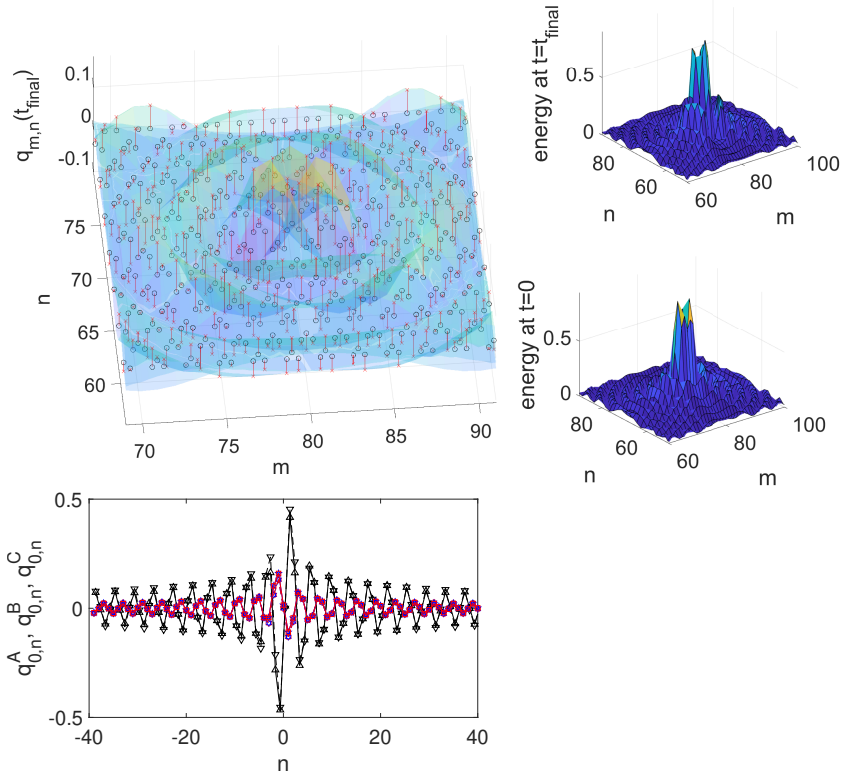
- Numerical simulations of the original lattice confirm the existence and approximate shape of the predicted localized modes.
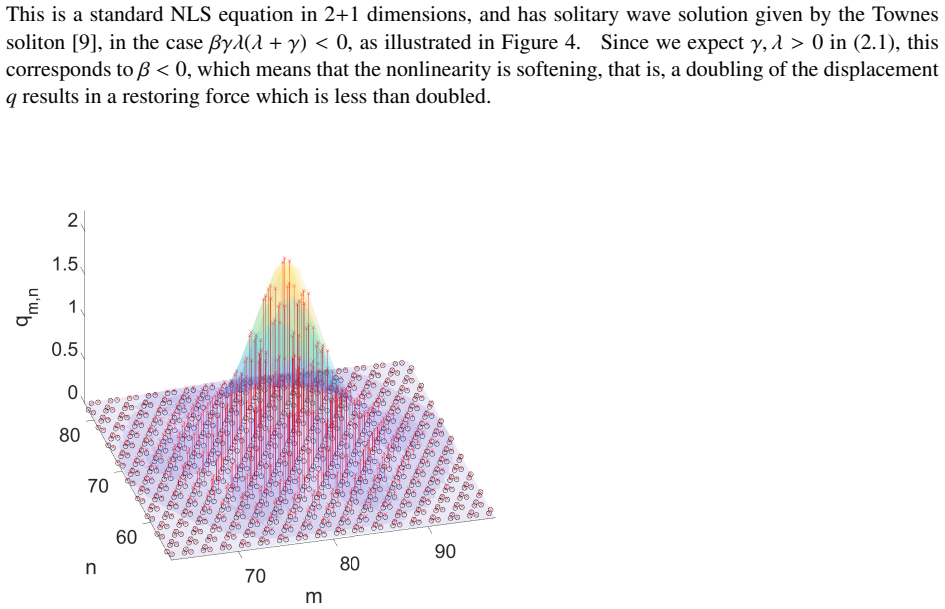
- Other points in the dispersion relation reduce to standard NLS equations whose solutions include Townes solitons.
- The same asymptotic procedure can be repeated at Dirac points or in band gaps to obtain different effective models.
Where Pith is reading between the lines
- The same lattice geometry appears in photonic and acoustic metamaterials, so the derived profiles could be tested in those experimental platforms.
- Stability and interaction properties of the solitary waves are not addressed here but would follow naturally from the coupled system.
- The method may extend to other flat-band lattices once the dispersion touching condition is identified.
Load-bearing premise
The multiple-scale asymptotic expansion remains valid when the flat band touches the upper dispersive surface, with the chosen scaling of amplitude and slow variables correctly capturing the leading-order balance.
What would settle it
Numerical integration of the original discrete lattice equations that produces no localized modes whose amplitude and propagation speed match the predictions of the coupled NLS system would falsify the reduction.
Figures




read the original abstract
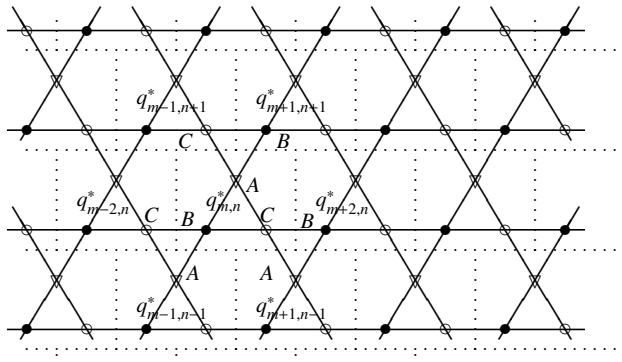
We describe a nonlinear kagome lattice with nonlinear dynamics described by Klein-Gordon interactions with a scalar unknown at each node, such as might occur in a nonlinear electrical lattice. We show that the dispersion relation has three bands - a flat band and two other surfaces which may meet in Dirac points or be separated by a gap. By using multiple scales asymptotic methods, we find a variety of reductions to nonlinear Schrodinger (NLS) systems, some of which are similar to those obtained previously, and have the Townes soliton as a solution. We find a novel system of coupled NLS equations, by forming an asymptotic expansion for small amplitude weakly nonlinear waves around the point where the flat band meets the upper surface of the dispersion relation. We analyse this 2+1 dimensional system using Lie symmetries, and find further reductions to more complicated solitary wave solutions. Numerical simulations of the wave are also presented.
Editorial analysis
A structured set of objections, weighed in public.
Referee Report
Summary. The manuscript analyzes small-amplitude nonlinear waves in a discrete Kagome lattice governed by Klein-Gordon interactions. The linear dispersion relation consists of three bands: a flat band and two dispersive surfaces that may touch at Dirac points or be separated by a gap. Multiple-scale asymptotic expansions are used to derive reductions to nonlinear Schrödinger (NLS) systems, including some that admit the Townes soliton. A novel coupled 2+1 dimensional NLS system is obtained at the degeneracy where the flat band touches the upper dispersive surface; this system is analyzed via Lie symmetries to obtain further reductions to solitary-wave solutions, with supporting numerical simulations of the waves.
Significance. If the central reduction is valid, the work supplies a new coupled NLS model for localized modes in lattices featuring flat-band degeneracies with dispersive surfaces, extending earlier single-band or gapped reductions. The explicit use of Lie symmetries to generate additional solitary-wave reductions and the inclusion of numerical checks are strengths. The result would be of interest for modeling nonlinear electrical or optical lattices, but its significance is limited by the absence of detailed error estimates or explicit checks on the expansion at the touching point.
major comments (1)
- [asymptotic expansion around the flat-band degeneracy] The derivation of the novel coupled NLS system (described in the abstract and the section on asymptotic expansions around the flat-band degeneracy): the chosen amplitude and slow-variable scalings must be shown to produce a closed system at leading order. The zero group velocity on the flat band together with the curvature of the upper surface can generate additional O(ε) or O(ε²) interactions from the Klein-Gordon nonlinearity that are not automatically removed by solvability conditions. The manuscript does not supply the explicit solvability conditions, the form of the higher-order terms, or error estimates confirming that secular terms and missed resonances are absent; without these the reduction to the claimed coupled NLS system is not fully verified.
minor comments (2)
- The abstract states that 'numerical simulations of the wave are also presented' but does not identify which solution (e.g., the Townes soliton or a reduction of the coupled system) is being simulated or quantify the agreement with the asymptotic predictions.
- Notation for the three dispersion bands and the degeneracy point should be introduced with an explicit equation for the lattice dispersion relation before the asymptotic analysis begins, to improve readability for readers unfamiliar with Kagome lattices.
Simulated Author's Rebuttal
We thank the referee for their thorough review of our manuscript. We address the major comment on the asymptotic expansion around the flat-band degeneracy below.
read point-by-point responses
-
Referee: The derivation of the novel coupled NLS system (described in the abstract and the section on asymptotic expansions around the flat-band degeneracy): the chosen amplitude and slow-variable scalings must be shown to produce a closed system at leading order. The zero group velocity on the flat band together with the curvature of the upper surface can generate additional O(ε) or O(ε²) interactions from the Klein-Gordon nonlinearity that are not automatically removed by solvability conditions. The manuscript does not supply the explicit solvability conditions, the form of the higher-order terms, or error estimates confirming that secular terms and missed resonances are absent; without these the reduction to the claimed coupled NLS system is not fully verified.
Authors: We agree that greater explicitness in the derivation would strengthen the presentation. In the revised manuscript, we will include the explicit solvability conditions from the multiple-scale analysis at the degeneracy point. These conditions ensure the system closes at leading order by removing secular terms, accounting for the zero group velocity on the flat band and the curvature of the upper dispersive surface. The additional interactions from the nonlinearity are shown to appear only at higher order (O(ε³)) and do not affect the leading coupled NLS equations. We acknowledge that a full rigorous error estimate is not provided, as it lies outside the scope of this asymptotic analysis paper; however, we have added a note on the scaling of the approximation error and rely on the numerical simulations to support the reduction's validity. revision: partial
Circularity Check
No circularity: direct asymptotic reduction from lattice equations
full rationale
The paper computes the dispersion relation directly from the linearised Klein-Gordon lattice and obtains the novel coupled NLS system via an explicit multiple-scale expansion at the flat-band touching point. Solvability conditions at successive orders close the system without fitted parameters, self-referential definitions, or load-bearing self-citations. The Lie-symmetry reductions and numerical simulations are performed on the derived equations rather than presupposing them. The procedure is self-contained against the original discrete model.
Axiom & Free-Parameter Ledger
Reference graph
Works this paper leans on
-
[1]
M.J. Ablowitz, N. Antar, I. Bakurtas, B. Ilan, V ortex and dipole solitons in complex two-dimensional lattices. Phys Rev A, 86, 033804, (2012)
work page 2012
-
[2]
Int J Solids & Structures, 318, 113387, (2025)
R Augello, E Carrera, WQ Chen, B Wu, YZ Wang, Nonlinear static analysis of metamaterial structures based on the Kagome lattice using beam finite elements and component-wise approach. Int J Solids & Structures, 318, 113387, (2025)
work page 2025
-
[3]
R.I. Babicheva, A.S. Semenov, E.G. Soboleva, A.A. Kudreyko, K. Zhou, S.V . Dmitriev. Discrete breathers in a triangular β-Fermi-Pasta-Ulam-Tsingou lattice. Phys Rev E, 103, 052202, (2021)
work page 2021
-
[4]
O. Bahat-Treidel, O. Peleg, M. Segev, H. Buljan, Breakdown of Dirac dynamics in honeycomb lattices due to nonlinear interactions, Phys Rev A, 82, 013830, (2010)
work page 2010
- [5]
- [6]
-
[7]
I.A. Butt, J.A.D. Wattis, Discrete breathers in a two-dimensional hexagonal Fermi-Pasta Ulam lattice. J Phys A, Math & Theor, 40, 1239–1264, (2007)
work page 2007
-
[8]
G-W. Chern, C-C. Chien, M. Di V entra, Dynamically generated flat-band phases in optical kagome lattices. Phys Rev A , 90, 013609, (2014)
work page 2014
- [9]
-
[10]
T.A. Davydova, A.I. Y akimenko, Y u.A. Zaliznyak, Two-dimensional solitons and vortices in normal and anomalous disper- sive media, Phys Rev E, 67, 026402, (2003)
work page 2003
-
[11]
D. Di Sante, T. Neupert, G. Sangiovanni, R. Thomale, R. Comin, J.G. Checkelsky, I. Zeljkovic, S.D. Wilson, Kagome metals, Rev Mod Phys, 98, 015002, (2026)
work page 2026
-
[12]
F. Ferrari, F. Becca, R. V alenti, Charge density waves in kagome-lattice extended Hubbard model at the van Hove filling. Phys Rev B, 106, L081107, (2022)
work page 2022
-
[13]
S. Flach, A.V . Gorbach, Discrete breathers-advances in theory and applications, Phys. Rep. 467, 1–116, (2008)
work page 2008
-
[14]
R. Fu, J. Zhan, M. Durnagel, H. Hohmann, R. Thomale, J. Hu, Z. Wang, S. Zhou, X. Wu. Exotic charge-density waves and superconductivity on the kagome lattice. National Science Review, 12, nwaf414, (2025)
work page 2025
- [15]
- [16]
-
[17]
A. Hofstrand, H. Li, M.I. Weinstein, Discrete breathers of nonlinear dimer lattices: bridging the anti-continuous and contin- uous limits, Journal of Nonlinear Science 33, (2023)
work page 2023
-
[18]
J-H. Im, C-J. Kang, Electronic structure and physical properties of the monolayer kagome lattice system A V3Sb5 (A = K, Rb, Cs). Curr Appl Phys 54, 26–30, (2023)
work page 2023
-
[19]
J.L. Jacobsen, C.R. Scullard, Critical manifold of the Kagome-lattice Potts model. J. Phys. A: Math. Theor . , 45, 494003 (2012)
work page 2012
-
[20]
V .I. Karpman. Stabilization of soliton instabilities by higher-order dispersion: fourth-order nonlinear Schrödinger-type equa- tions. Phys Rev E, 53, R1336, (1996)
work page 1996
-
[21]
Y .V . Kartashov, B.A. Malomed, V .A. Vysloukh, L. Turner. Two-dimensional solitons in nonlinear lattices.Optics Letters, 34, 770–772, (2009). 21
work page 2009
- [22]
- [23]
- [24]
-
[25]
K.J.H. Law, A. Saxena, P .G. Kevrekidis, A.R. Bishop. Localized structures in kagome lattices. Phys Rev A , 79, 053818, (2009)
work page 2009
-
[26]
Lee, Dirac Cones for Point Scatterers on a Honeycomb Lattice, SIAM J Math Anal , 48, (2016)
M. Lee, Dirac Cones for Point Scatterers on a Honeycomb Lattice, SIAM J Math Anal , 48, (2016)
work page 2016
-
[27]
F.W.S. Lima, N. Crokidakis. Nonequilibrium opinion dynamics on triangular, honeycomb, and Kagome lattices. Int J Mod Phys C, 28, 1750123, (2017)
work page 2017
-
[28]
X. Liu, J. Lai, J.Z. Zhan, T. Y u, P . Liu, S. Y unoki, X-Q. Chen, Nonlinear optical response in kagome lattice with inversion symmetry breaking. ACS Nano 19, 19018–19026, (2025)
work page 2025
- [29]
-
[30]
Maple, a division of Waterloo Maple Inc, Waterloo, Ontario, (2020)
work page 2020
-
[31]
J.L. Marin, F.M. Russell, and J.C. Eilbeck. Breathers in cuprate-like lattices, Phys. Lett. A 281, 21 (2001)
work page 2001
-
[32]
J.L. Marín, J.C. Eilbeck, and F.M. Russell. Localized moving breathers in a 2D hexagonal lattice, Phys. Lett. A , 248, 225, (1998)
work page 1998
-
[33]
Olver, Applications of Lie Groups to Differential Equations, 2nd edn., Springer, New Y ork, (1993)
P .J. Olver, Applications of Lie Groups to Differential Equations, 2nd edn., Springer, New Y ork, (1993)
work page 1993
-
[34]
F.W.J. Olver, D.W. Lozier, R.F. Boisvert, C.W. Clark, Handbook of Mathematical Functions, NIST, CUP , Cambridge, (2010), dlmf.nist.gov [§16.17]
work page 2010
-
[35]
K. Prabith, G. Theocharis, R. Chaunsali. Nonlinearity-induced corner states in a kagome lattice. New Journal of Physics, 27, 083501, (2025)
work page 2025
- [36]
-
[37]
S. Singh, A.C. Garcia-Castro. Kagome KMn 3Sb5 metal: magnetism, lattice dynamics, and anomalous Hall conductivity. Phys Rev B, 108, 245143, (2023)
work page 2023
-
[38]
Stephani, Differential Equations, Their Solution Using Symmetries, CUP , Cambridge, (1989)
H. Stephani, Differential Equations, Their Solution Using Symmetries, CUP , Cambridge, (1989)
work page 1989
- [39]
-
[40]
N.G. V akhitov, A.A. Kolokolov. Stationary solutions of the wave equation in a medium with nonlinearity saturation. Radio- physics and Quantum Electronics , 16, 783–789, (1973)
work page 1973
-
[41]
R.A. Vicencio, M. Johansson, Discrete flat-band solitons in the Kagome lattice, Phys Rev A, 87, 061803, (2013)
work page 2013
-
[42]
J.A.D. Wattis, A.S.M. Alzaidi. Asymptotic analysis of breather modes in a two-dimensional mechanical lattice, Physica D, 401, 132207, (2020)
work page 2020
-
[43]
J.A.D. Wattis. Asymptotic approximation of discrete breather modes in two-dimensional lattices. in Ed J.F.R. Archilla, et al (eds), Quodons in Mica, Springer series in materials Science, vol 221, Springer, Cham. (2015)
work page 2015
-
[44]
J.A.D. Wattis, L.M. James. Discrete Breathers in honeycomb Fermi-Pasta-Ulam lattices. J Phys A, Math Theor , 47, 345101, (23pp), (2014)
work page 2014
-
[45]
Whitham, Linear and Nonlinear Waves, Wiley, New Y ork, (1974), [Section 15.6]
G.B. Whitham, Linear and Nonlinear Waves, Wiley, New Y ork, (1974), [Section 15.6]
work page 1974
-
[46]
Proc Roy Soc Lond A, 479, 20220713, (2023)
Z-J Y ang, Y -Z Wang, Non-Abelian mechanics of elastic waves in kagome metamaterials with internal structures. Proc Roy Soc Lond A, 479, 20220713, (2023). 22 -40 -20 0 20 40 n -0.5 0 0.5 qA 0,n, qB 0,n, qC 0,n Figure 7: Results of numerical simulations of breather mode with initial conditions given by (3.33), (3.21), (2.40), (2.11)–(2.12), then numericall...
work page 2023
discussion (0)
Sign in with ORCID, Apple, or X to comment. Anyone can read and Pith papers without signing in.