Recognition: no theorem link
MARGIN: Margin-Aware Regularized Geometry for Imbalanced Vulnerability Detection
Pith reviewed 2026-05-12 05:22 UTC · model grok-4.3
The pith
MARGIN corrects geometric distortions in hyperspherical embeddings to improve vulnerability detection on imbalanced datasets.
A machine-rendered reading of the paper's core claim, the machinery that carries it, and where it could break.
Core claim
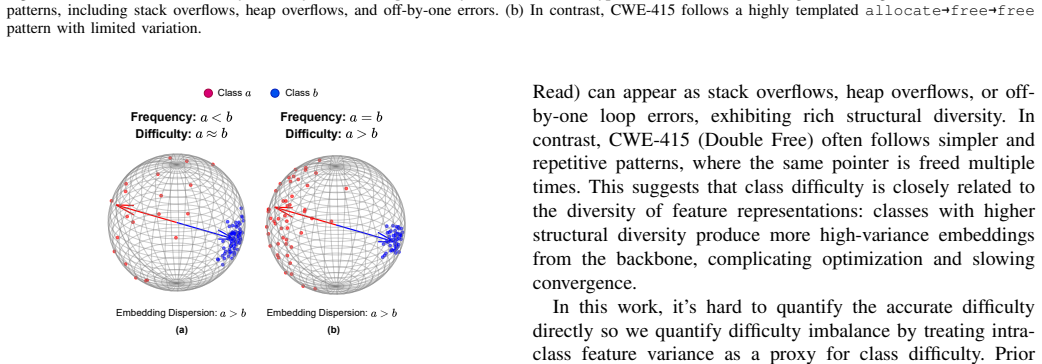
By dynamically adjusting geometric regularization according to the distribution structure estimated by the von Mises-Fisher concentration, MARGIN aligns the probability mass of embedding distributions with their corresponding Voronoi cells in hyperspherical space, thereby reducing geometric distortion induced by frequency and difficulty imbalances and yielding more stable decision boundaries for vulnerability classification and detection.
What carries the argument
The MARGIN framework performs adaptive margin metric learning and hyperspherical prototype modeling, using von Mises-Fisher concentration to align embedding probability mass with Voronoi cells and reduce hyperspherical distortion.
If this is right
- Consistent outperformance of strong baselines in classification accuracy and detection tasks on imbalanced vulnerability datasets
- More structured embedding geometries that enhance robustness, interpretability, and generalization
- Reduced geometric distortion leading to more stable decision boundaries for downstream vulnerability models
- Improved performance specifically on challenging subsets where frequency or difficulty imbalance is pronounced
Where Pith is reading between the lines
- The geometric regularization could transfer to other security classification tasks such as malware or intrusion detection where class imbalance distorts embeddings
- Integrating MARGIN with graph neural networks for vulnerability analysis might further stabilize representations on code graphs
- The approach implies that many deep learning failures on imbalanced security data originate from unregularized hyperspherical geometry rather than model capacity alone
- Testing the method on real-world streaming vulnerability reports could reveal whether the Voronoi alignment remains effective under distribution shift
Load-bearing premise
Frequency and difficulty imbalances manifest primarily as geometric distortions in hyperspherical representation space that aligning with Voronoi cells via von Mises-Fisher concentration will reliably improve detection without introducing new failure modes.
What would settle it
An experiment on the same public vulnerability datasets in which MARGIN produces no measurable reduction in embedding distortion (as quantified by distance to Voronoi cell boundaries) yet still fails to improve detection metrics over baselines.
Figures



read the original abstract
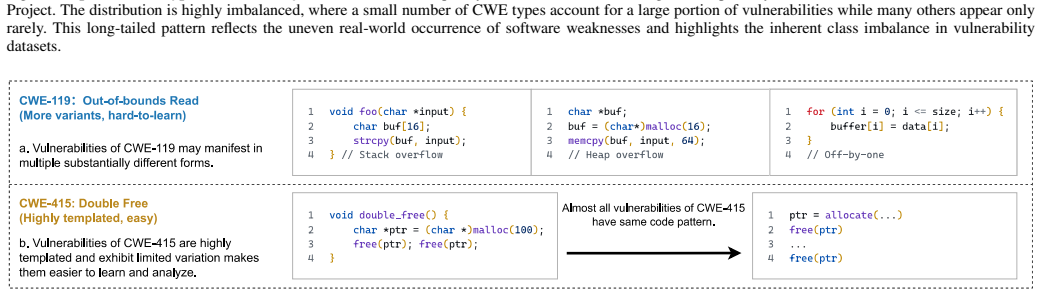
Software vulnerability detection is critical for ensuring software security and reliability. Despite recent advances in deep learning, real-world vulnerability datasets suffer from two severe challenges: frequency imbalance and difficulty imbalance. We reinterpret these challenges from an embedding geometry perspective, observing that such imbalances induce geometric distortions in hyperspherical representation space. To address this issue, we propose MARGIN, a metric-based framework that learns discriminative vulnerability representations through adaptive margin metric learning and hyperspherical prototype modeling. MARGIN dynamically adjusts geometric regularization according to the distribution structure estimated by the von Mises-Fisher concentration, aligning the probability mass of embedding distributions with their corresponding Voronoi cells, thereby reducing geometric distortion and yielding more stable decision boundaries. Extensive experiments on public vulnerability datasets show that MARGIN consistently outperforms strong baselines, achieving notable improvements in classification and detection, especially on challenging, imbalanced datasets. Further analysis demonstrates that MARGIN produces more structured embedding geometries, improving robustness, interpretability, and generalization.
Editorial analysis
A structured set of objections, weighed in public.
Referee Report
Summary. The manuscript proposes MARGIN, a metric-based framework for software vulnerability detection that reinterprets frequency and difficulty imbalances as geometric distortions in hyperspherical embedding space. It introduces adaptive margin metric learning combined with hyperspherical prototype modeling, where von Mises-Fisher concentration parameters are used to dynamically adjust margins and align embedding distributions with Voronoi cells, thereby reducing distortions and producing more stable decision boundaries. Experiments on public vulnerability datasets demonstrate that MARGIN outperforms strong baselines in classification and detection tasks, particularly on imbalanced data, with additional analysis showing improved embedding structure, robustness, and generalization.
Significance. If the geometric alignment mechanism holds under validation, the work would offer a principled, geometry-aware regularization strategy for handling imbalances in security-critical ML tasks. The hyperspherical prototype approach and explicit analysis of embedding geometries represent a strength, as does the use of public datasets that supports potential reproducibility. This could contribute to more interpretable and robust vulnerability detectors beyond standard class-reweighting techniques.
major comments (2)
- [Abstract] Abstract: the central claim that vMF concentration estimation produces reliable Voronoi alignment (and thereby stable boundaries) without new failure modes is load-bearing but unsupported by any derivation, ablation, or statistical test in the provided description; the skeptic concern on sensitivity to small samples and label noise in vulnerability data therefore remains unaddressed.
- [Abstract] The experimental outcomes asserting 'notable improvements' and 'more structured embedding geometries' rest entirely on unverified results; no equations, tables, or ablation studies are referenced to confirm that the observed gains arise from the claimed geometric correction rather than other factors.
minor comments (1)
- Clarify the exact procedure for estimating the von Mises-Fisher concentration parameter κ from finite, noisy samples and how it is used to set per-class margins.
Simulated Author's Rebuttal
We thank the referee for the thoughtful and detailed comments. We agree that the abstract would benefit from clearer references to the supporting derivations, ablations, and analyses in the full manuscript. We address each major comment below and will revise the abstract accordingly.
read point-by-point responses
-
Referee: [Abstract] Abstract: the central claim that vMF concentration estimation produces reliable Voronoi alignment (and thereby stable boundaries) without new failure modes is load-bearing but unsupported by any derivation, ablation, or statistical test in the provided description; the skeptic concern on sensitivity to small samples and label noise in vulnerability data therefore remains unaddressed.
Authors: The abstract is necessarily concise and does not contain the full technical details. The manuscript derives the vMF-based adaptive margin in Section 3, shows how concentration parameters align embedding distributions with Voronoi cells, and includes ablations plus boundary-stability metrics in Section 4. We will revise the abstract to explicitly reference these sections. On sensitivity, the paper reports experiments with reduced sample sizes and synthetic label noise; the adaptive regularization does not introduce new instabilities relative to baselines. If the referee finds the current robustness analysis insufficient, we can expand it in a revision. revision: partial
-
Referee: [Abstract] The experimental outcomes asserting 'notable improvements' and 'more structured embedding geometries' rest entirely on unverified results; no equations, tables, or ablation studies are referenced to confirm that the observed gains arise from the claimed geometric correction rather than other factors.
Authors: We accept that the abstract should make the source of the reported gains verifiable. The full manuscript contains the relevant performance tables, embedding-geometry visualizations with quantitative metrics, and ablation studies that isolate the contribution of the geometric regularization. We will update the abstract to cite these specific results and sections so that the claims are directly traceable. revision: yes
Circularity Check
No circularity in MARGIN derivation chain
full rationale
The paper proposes MARGIN as a new metric-based framework that reinterprets frequency and difficulty imbalances as hyperspherical geometric distortions, then applies adaptive margin learning and vMF-based concentration to align embeddings with Voronoi cells. No equations, steps, or claims reduce the outputs to inputs by construction, fitted parameters renamed as predictions, or load-bearing self-citations. The method is presented as an independent contribution with external experimental validation on public datasets, so the derivation remains self-contained against benchmarks.
Axiom & Free-Parameter Ledger
Reference graph
Works this paper leans on
-
[1]
A comprehensive survey of loss functions and metrics in deep learning,
J. Terven, D.-M. Cordova-Esparza, J.-A. Romero-Gonz ´alez, A. Ram´ırez- Pedraza, and E. Ch ´avez Urbiola, “A comprehensive survey of loss functions and metrics in deep learning,”Artificial Intelligence Review, vol. 58, 04 2025
work page 2025
-
[2]
An empirical study of the im- balance issue in software vulnerability detection,
Y . Guo, Q. Hu, Q. Tang, and Y . L. Traon, “An empirical study of the im- balance issue in software vulnerability detection,” inComputer Security – ESORICS 2023, G. Tsudik, M. Conti, K. Liang, and G. Smaragdakis, Eds. Cham: Springer Nature Switzerland, 2024, pp. 371–390
work page 2023
-
[3]
Neural collapse to multiple centers for imbalanced data,
F. Li, J. Luo, F. Peng, Y . Qian, H. Yan, and Z. Zhu, “Neural collapse to multiple centers for imbalanced data,” inAdvances in Neural Information Processing Systems 37, ser. NeurIPS 2024. Neural Information Processing Systems Foundation, Inc. (NeurIPS), 2024, p. 65583–65617. [Online]. Available: https://dx.doi.org/10.52202/ 079017-2095
work page 2024
-
[4]
Class- balanced loss based on effective number of samples,
Y . Cui, M. Jia, T.-Y . Lin, Y . Song, and S. Belongie, “Class- balanced loss based on effective number of samples,” in2019 IEEE/CVF Conference on Computer Vision and Pattern Recognition (CVPR). IEEE, Jun. 2019, p. 9260–9269. [Online]. Available: https://dx.doi.org/10.1109/cvpr.2019.00949
-
[5]
An investigation of quality issues in vulnerability detection datasets,
Y . Guo and S. Bettaieb, “An investigation of quality issues in vulnerability detection datasets,” in2023 IEEE European Symposium on Security and Privacy Workshops (EuroS&;PW). IEEE, Jul. 2023, p. 29–33. [Online]. Available: https://dx.doi.org/10.1109/eurospw59978. 2023.00008
-
[6]
Code2vec: Learning distributed representations of code,
U. Alon, M. Zilberstein, O. Levy, and E. Yahav, “Code2vec: Learning distributed representations of code,”Proc. ACM Program. Lang., vol. 3, no. POPL, pp. 40:1–40:29, Jan. 2019. [Online]. Available: https://doi.acm.org/10.1145/3290353
-
[7]
Neural networks and the bias/variance dilemma,
S. Geman, E. Bienenstock, and R. Doursat, “Neural networks and the bias/variance dilemma,”Neural Computation, vol. 4, no. 1, p. 1–58, Jan
-
[8]
Available: https://dx.doi.org/10.1162/neco.1992.4.1.1
[Online]. Available: https://dx.doi.org/10.1162/neco.1992.4.1.1
-
[9]
Hyperspherical prototype networks,
P. Mettes, E. van der Pol, and C. G. M. Snoek, “Hyperspherical prototype networks,” inAdvances in Neural Information Processing Systems, 2019
work page 2019
-
[10]
L2-constrained softmax loss for discriminative face verification,
R. Ranjan, C. D. Castillo, and R. Chellappa, “L2-constrained softmax loss for discriminative face verification,”ArXiv, vol. abs/1703.09507,
-
[11]
L2-constrained softmax loss for discriminative face verification,
[Online]. Available: https://doi.org/10.48550/arXiv.1703.09507
-
[12]
Guiding neural collapse: Optimising towards the nearest simplex equiangular tight frame,
E. Markou, T. Ajanthan, and S. Gould, “Guiding neural collapse: Optimising towards the nearest simplex equiangular tight frame,” in NeurIPS, 2024
work page 2024
-
[13]
Clustering on the unit hypersphere using von mises–fisher distributions,
A. Banerjee, I. S. Dhillon, J. Ghosh, and S. Sra, “Clustering on the unit hypersphere using von mises–fisher distributions,” inJournal of Machine Learning Research, vol. 6, 2005, pp. 1345–1382
work page 2005
-
[14]
Deep neural collapse is provably optimal for the deep unconstrained features model,
C. Lampert, M. Mondelli, and P. S ´uken´ık, “Deep neural collapse is provably optimal for the deep unconstrained features model,” inAdvances in Neural Information Processing Systems 36, ser. NeurIPS 2023. Neural Information Processing Systems Foundation, Inc. (NeurIPS), 2023, p. 52991–53024. [Online]. Available: https: //dx.doi.org/10.52202/075280-2306
-
[15]
V on mises-fisher clustering models,
S. Gopal and Y . Yang, “V on mises-fisher clustering models,” inProceedings of the 31st International Conference on Machine Learning, ser. Proceedings of Machine Learning Research, E. P. Xing and T. Jebara, Eds., vol. 32, no. 1. Bejing, China: PMLR, 22–24 Jun 2014, pp. 154–162. [Online]. Available: https: //proceedings.mlr.press/v32/gopal14.html
work page 2014
-
[16]
A c/c++ code vulnerability dataset with code changes and cve summaries,
J. Fan, Y . Li, S. Wang, and T. N. Nguyen, “A c/c++ code vulnerability dataset with code changes and cve summaries,” in2020 IEEE/ACM 17th International Conference on Mining Software Repositories (MSR), 2020, pp. 508–512
work page 2020
-
[17]
Megavul: A c/c++ vulnerability dataset with comprehensive code representations,
C. Ni, L. Shen, X. Yang, Y . Zhu, and S. Wang, “Megavul: A c/c++ vulnerability dataset with comprehensive code representations,” in Proceedings of the 21st International Conference on Mining Software Repositories, ser. MSR ’24. New York, NY , USA: Association for Computing Machinery, 2024, p. 738–742. [Online]. Available: https://doi.org/10.1145/3643991.3644886
-
[18]
Reposvul: A repository-level high-quality vulnerability dataset,
X. Wang, R. Hu, C. Gao, X.-C. Wen, Y . Chen, and Q. Liao, “Reposvul: A repository-level high-quality vulnerability dataset,” inProceedings of the 2024 IEEE/ACM 46th International Conference on Software Engineering: Companion Proceedings, ser. ICSE-Companion ’24. New York, NY , USA: Association for Computing Machinery, 2024, p. 472–483. [Online]. Available...
-
[19]
Deep learning based vulnerability detection: Are we there yet?
S. Chakraborty, R. Krishna, Y . Ding, and B. Ray, “Deep learning based vulnerability detection: Are we there yet?”IEEE Transactions on Software Engineering, vol. 48, no. 9, p. 3280–3296, Sep. 2022. [Online]. Available: https://dx.doi.org/10.1109/tse.2021.3087402
-
[20]
Livable: Exploring long-tailed classification of software vulnerability types,
X.-C. Wen, C. Gao, F. Luo, H. Wang, G. Li, and Q. Liao, “Livable: Exploring long-tailed classification of software vulnerability types,” IEEE Transactions on Software Engineering, vol. 50, no. 6, p. 1325–1339, Jun. 2024. [Online]. Available: https://dx.doi.org/10.1109/ tse.2024.3382361
-
[21]
µvuldeepecker: A deep learning-based system for multiclass vulnerability detection,
D. Zou, S. Wang, S. Xu, Z. Li, and H. Jin, “µvuldeepecker: A deep learning-based system for multiclass vulnerability detection,”IEEE Transactions on Dependable and Secure Computing, vol. 18, no. 5, pp. 2224–2236, 2021
work page 2021
-
[22]
Sysevr: A framework for using deep learning to detect software vulnerabilities,
Z. Li, D. Zou, S. Xu, H. Jin, Y . Zhu, and Z. Chen, “Sysevr: A framework for using deep learning to detect software vulnerabilities,” IEEE Transactions on Dependable and Secure Computing, vol. 19, no. 4, p. 2244–2258, Jul. 2022. [Online]. Available: https://dx.doi.org/ 10.1109/tdsc.2021.3051525
-
[23]
Applying contrastive learning to code vulnerability type classification,
C. Ji, S. Yang, H. Sun, and Y . Zhang, “Applying contrastive learning to code vulnerability type classification,” inConference on Empirical Methods in Natural Language Processing, 2024. [Online]. Available: https://api.semanticscholar.org/CorpusID:273901675
work page 2024
-
[24]
One-for-all does not work! enhancing vulnerability detection by mixture-of-experts (moe),
X. Yang, S. Wang, J. Zhou, and W. Zhu, “One-for-all does not work! enhancing vulnerability detection by mixture-of-experts (moe),” Proceedings of the ACM on Software Engineering, vol. 2, no. FSE, p. 446–464, Jun. 2025. [Online]. Available: https://dx.doi.org/10.1145/ 3715736
work page 2025
-
[25]
Clever: Multi-modal contrastive learning for vulnerability code representation,
J. Li, L. Cui, S. Zhao, Y . Yang, L. Li, and H. Zhu, “Clever: Multi-modal contrastive learning for vulnerability code representation,” inFindings of the Association for Computational Linguistics: ACL 2025. Association for Computational Linguistics, 2025, p. 7940–7951. [Online]. Available: https://dx.doi.org/10.18653/v1/2025.findings-acl.414
-
[26]
Vulnerability detection via multiple-graph-based code representation,
F. Qiu, Z. Liu, X. Hu, X. Xia, G. Chen, and X. Wang, “Vulnerability detection via multiple-graph-based code representation,” IEEE Transactions on Software Engineering, vol. 50, no. 8, p. 2178–2199, Aug. 2024. [Online]. Available: https://dx.doi.org/10.1109/ tse.2024.3427815
-
[27]
Y . Zhou, S. Liu, J. Siow, X. Du, and Y . Liu,Devign: effective vulner- ability identification by learning comprehensive program semantics via graph neural networks. Red Hook, NY , USA: Curran Associates Inc., 2019
work page 2019
-
[28]
Z. Feng, D. Guo, D. Tang, N. Duan, X. Feng, M. Gong, and M. Zhou, “Codebert: A pre-trained model for programming and natural languages,” inFindings of the Association for Computational Linguistics: EMNLP 2020, 2020, pp. 1536–1547. [Online]. Available: https://dx.doi.org/10.18653/v1/2020.findings-emnlp.139
-
[29]
Graphcodebert: Pre-training code representations with data flow
D. Guo, S. Ren, S. Lu, Z. Feng, D. Tang, S. Liu, L. Zhou, N. Duan, A. Svyatkovskiy, S. Fu, M. Tufano, S. K. Deng, C. B. Clement, D. Drain, N. Sundaresan, J. Yin, D. Jiang, and M. Zhou, “Graphcodebert: Pre-training code representations with data flow.” inICLR. OpenReview.net, 2021. [Online]. Available: https: //dblp.uni-trier.de/db/conf/iclr/iclr2021.html#...
work page 2021
-
[30]
Y . Wang, W. Wang, S. Joty, and S. C. Hoi, “Codet5: Identifier-aware unified pre-trained encoder-decoder models for code understanding and generation,” inProceedings of the 2021 Conference on Empirical Methods in Natural Language Processing. Association for Computational Linguistics, 2021, p. 8696–8708. [Online]. Available: https://dx.doi.org/10.18653/v1/...
-
[31]
Unixcoder: Unified cross-modal pre-training for code representation,
D. Guo, S. Lu, N. Duan, Y . Wang, M. Zhou, and J. Yin, “Unixcoder: Unified cross-modal pre-training for code representation,” inProceedings of the 60th Annual Meeting of the Association for Computational Linguistics (Volume 1: Long Papers). Association for Computational Linguistics, 2022, p. 7212–7225. [Online]. Available: https://dx.doi.org/10.18653/v1/2...
-
[32]
Automated program repair in the era of large pre-trained language models
X. Yang, S. Wang, Y . Li, and S. Wang, “Does data sampling improve deep learning-based vulnerability detection? yeas! and nays!” inProceedings of the 45th International Conference on Software Engineering, ser. ICSE ’23. IEEE Press, 2023, p. 2287–2298. [Online]. Available: https://doi.org/10.1109/ICSE48619.2023.00192
-
[33]
Arcface: Additive angular margin loss for deep face recognition,
J. Deng, J. Guo, N. Xue, and S. Zafeiriou, “Arcface: Additive angular margin loss for deep face recognition,” in2019 IEEE/CVF Conference on Computer Vision and Pattern Recognition (CVPR), 2019, pp. 4685– 4694
work page 2019
-
[34]
Y . Meng, J. Huang, G. Wang, C. Zhang, H. Zhuang, L. Kaplan, and J. Han,Spherical text embedding. Red Hook, NY , USA: Curran Associates Inc., 2019
work page 2019
-
[35]
Y . He, G. Lin, X. Ma, J. W. Keung, C. Tan, W. Hu, and F. Li, “Enhancing deep learning vulnerability detection through imbalance loss functions: An empirical study,”Proceedings of the 15th Asia-Pacific Symposium on Internetware, 2024. [Online]. Available: https://api.semanticscholar.org/CorpusID:271293860
work page 2024
discussion (0)
Sign in with ORCID, Apple, or X to comment. Anyone can read and Pith papers without signing in.