Recognition: no theorem link
Misspecified Universal Learning
Pith reviewed 2026-05-12 05:06 UTC · model grok-4.3
The pith
Misspecified universal learning with log-loss admits an optimal learner derived from minimax regret analysis.
A machine-rendered reading of the paper's core claim, the machinery that carries it, and where it could break.
Core claim
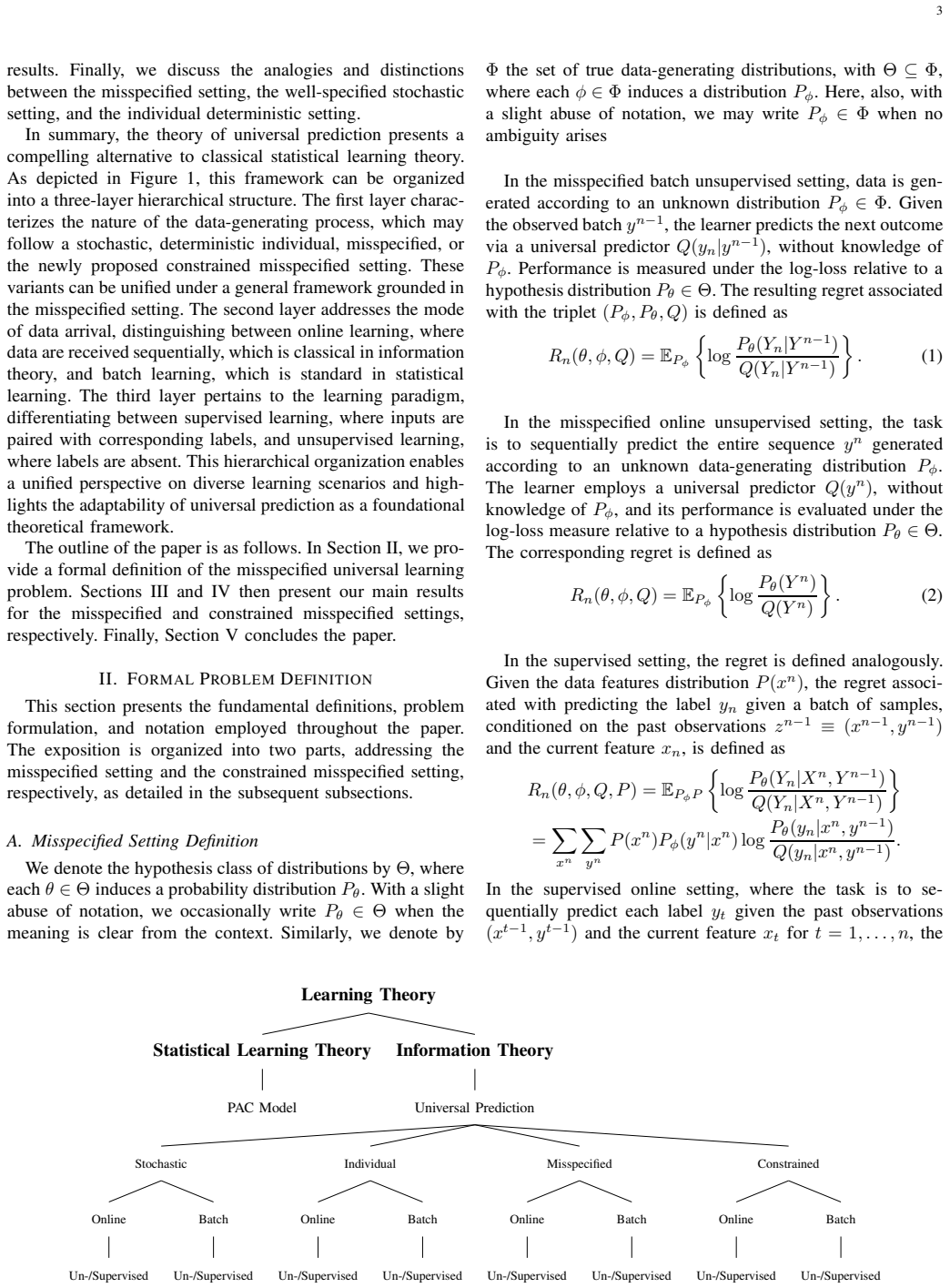
Extending these foundations, we analyze the minimax regret in the misspecified setting and derive the corresponding optimal universal learner. We propose this formulation as a unified framework for universal learning, applicable to any form of uncertainty in the data-generating process, across both online and batch data arrival modes, as well as supervised and unsupervised learning tasks.
What carries the argument
Minimax regret analysis in the misspecified setting Φ ⊃ Θ under log-loss, yielding the optimal universal learner.
Load-bearing premise
The minimax regret analysis and optimal learner from the well-specified case extend directly to the misspecified case without new technical obstacles or additional assumptions on Θ and Φ.
What would settle it
A calculation or simulation showing that the proposed optimal learner fails to achieve the minimax regret in a concrete misspecified example would falsify the claim.
Figures




read the original abstract
This paper addresses the problem of universal learning under model misspecification with log-loss. In this setting, the learner operates with a hypothesis class of models denoted by $\Theta$, while the true data-generating process belongs to a broader class $\Phi \supset \Theta$, and may lie outside the assumed hypothesis space. Classical approaches have characterized the minimax regret and identified optimal universal learners in both the well-specified stochastic and individual deterministic frameworks. The misspecified setting has received comparatively less attention, although several important results have emerged in recent years. Extending these foundations, we analyze the minimax regret in the misspecified setting and derive the corresponding optimal universal learner. We propose this formulation as a unified framework for universal learning, applicable to any form of uncertainty in the data-generating process, across both online and batch data arrival modes, as well as supervised and unsupervised learning tasks.
Editorial analysis
A structured set of objections, weighed in public.
Referee Report
Summary. The paper addresses universal learning under model misspecification with log-loss. The learner uses hypothesis class Θ while the true process is in Φ ⊃ Θ. It extends minimax regret analysis from well-specified stochastic and individual deterministic frameworks to the misspecified setting, derives the optimal universal learner, and proposes this as a unified framework for any uncertainty in the data-generating process, covering online and batch modes, supervised and unsupervised tasks.
Significance. If the analysis holds, this provides a valuable unified framework for universal learning that accounts for realistic model misspecification. The extension to multiple settings (online/batch, sup/unsup) is a strength, potentially allowing broader application of regret bounds and optimal learners without case-by-case derivations.
minor comments (2)
- The statement 'several important results have emerged in recent years' lacks specific citations; including 1-2 key references would better situate the contribution.
- Clarify early on whether the extension requires any additional assumptions on the relationship between Θ and Φ beyond Φ ⊃ Θ, as this is central to the unified claim.
Simulated Author's Rebuttal
We thank the referee for their positive summary, recognition of the paper's contributions, and recommendation for minor revision. No specific major comments were provided in the report.
Circularity Check
No significant circularity; extension of prior analysis is self-contained
full rationale
The paper extends classical minimax regret results and optimal universal learner constructions from the well-specified case (Θ) to the misspecified regime (Φ ⊃ Θ) under log-loss. The abstract frames this as an analytical extension applicable to online/batch and supervised/unsupervised settings, without equations or steps that reduce the new regret bounds or learner to a fit on the same data, a self-definition, or a load-bearing self-citation chain. No quoted derivation shows the output being equivalent to the input by construction. The central claim therefore retains independent analytical content and is not forced by redefinition or renaming of known patterns.
Axiom & Free-Parameter Ledger
Reference graph
Works this paper leans on
-
[1]
On learning distributions from their samples,
Sudeep Kamath, Alon Orlitsky, Dheeraj Pichapati, and An anda Theertha Suresh, “On learning distributions from their samples,” in Conference on Learning Theory , 2015, pp. 1066–1100
work page 2015
-
[2]
Introduction to statistical learning theory,
Olivier Bousquet, St´ ephane Boucheron, and G´ abor Lugosi, “Introduction to statistical learning theory,” in Advanced lectures on machine learning , pp. 169–207. Springer, 2004
work page 2004
-
[3]
An overview of statistical learning theory,
Vladimir N V apnik, “An overview of statistical learning theory,” IEEE transactions on neural networks , vol. 10, no. 5, pp. 988–999, 1999
work page 1999
-
[4]
Leslie G V aliant, “A theory of the learnable,” Communications of the ACM, vol. 27, no. 11, pp. 1134–1142, 1984
work page 1984
-
[5]
On the uniform c on- vergence of relative frequencies of events to their probabi lities,
Vladimir N V apnik and A Y a Chervonenkis, “On the uniform c on- vergence of relative frequencies of events to their probabi lities,” in Measures of complexity , pp. 11–30. Springer, 2015
work page 2015
-
[6]
Rademacher and g aussian complexities: Risk bounds and structural results,
Peter L Bartlett and Shahar Mendelson, “Rademacher and g aussian complexities: Risk bounds and structural results,” Journal of Machine Learning Research, vol. 3, no. Nov, pp. 463–482, 2002
work page 2002
-
[7]
Understanding deep learning requires rethinking generalization
Chiyuan Zhang, Samy Bengio, Moritz Hardt, Benjamin Rech t, and Oriol Vinyals, “Understanding deep learning requires rethinkin g generaliza- tion,” arXiv preprint arXiv:1611.03530 , 2016
work page internal anchor Pith review arXiv 2016
-
[8]
Neri Merhav and Meir Feder, “Universal prediction,” IEEE Transactions on Information Theory , vol. 44, no. 6, pp. 2124–2147, 1998
work page 1998
-
[9]
A source matching a pproach to finding minimax codes,
L Davisson and Alberto Leon-Garcia, “A source matching a pproach to finding minimax codes,” IEEE Transactions on Information Theory , vol. 26, no. 2, pp. 166–174, 1980
work page 1980
-
[10]
Coding of a source with unkn own but ordered probabilities,
Boris Y akovlevich Ryabko, “Coding of a source with unkn own but ordered probabilities,” Problems of Information Transmission , vol. 15, no. 2, pp. 134–138, 1979
work page 1979
-
[11]
Universal sequential coding of single messages,
Y urii Mikhailovich Shtar’kov, “Universal sequential coding of single messages,” Problemy Peredachi Informatsii , vol. 23, no. 3, pp. 3–17, 1987
work page 1987
-
[12]
On the problem of on-line le arning with log-loss,
Y aniv Fogel and Meir Feder, “On the problem of on-line le arning with log-loss,” IEEE International Symposium on Information Theory - Proceedings, pp. 2995–2999, 2017
work page 2017
-
[13]
Universal batch learning w ith log-loss,
Y aniv Fogel and Meir Feder, “Universal batch learning w ith log-loss,” 2018 IEEE International Symposium on Information Theory (I SIT), pp. 21–25, 2018
work page 2018
-
[14]
Universal supervised lear ning for individual data,
Y aniv Fogel and Meir Feder, “Universal supervised lear ning for individual data,” arXiv preprint arXiv:1812.09520 , 2018
-
[15]
Universal learning of indi vidual data,
Y aniv Fogel and Meir Feder, “Universal learning of indi vidual data,” in 2019 IEEE International Symposium on Information Theory (I SIT). IEEE, 2019, pp. 2289–2293
work page 2019
-
[16]
Deep pnml: Pred ictive normalized maximum likelihood for deep neural networks,
Y aniv Bibas Koby, Fogel and Meir Feder, “Deep pnml: Pred ictive normalized maximum likelihood for deep neural networks,” arxiv, 2020. 24
work page 2020
-
[17]
Robustly mini max codes for universal data compression,
Takeuchi Jun-ichi and Barron Andrew R., “Robustly mini max codes for universal data compression,” The 21st Symposium on Information Theory and Its Applications , 1998
work page 1998
-
[18]
Amichai Painsky and Meir Feder, “Robust universal infe rence,” entropy, vol. 23, no. 6, 2021
work page 2021
-
[19]
Sequential predictio n under log-loss and misspecification,
Y uri Polyanskiy and Meir Feder, “Sequential predictio n under log-loss and misspecification,” Machine Learning Research , vol. 134, pp. 1–28, 2021
work page 2021
-
[20]
Universal batch learnin g under the misspecification setting,
Shlomi Vituri and Meir Feder, “Universal batch learnin g under the misspecification setting,” IEEE International Symposium on Information Theory (ISIT) , 2024
work page 2024
-
[21]
Universal batch learnin g under the misspecification setting,
Shlomi Vituri and Meir Feder, “Universal batch learnin g under the misspecification setting,” arxiv, 2024
work page 2024
-
[22]
Constrained universal l earning under misspecification,
Shlomi Vituri and Meir Feder, “Constrained universal l earning under misspecification,” IEEE International Symposium on Information Theory (ISIT), 2025
work page 2025
-
[23]
Computation of channel capacity and rate-d istortion func- tions,
Blahut R., “Computation of channel capacity and rate-d istortion func- tions,” IEEE Transactions on Information Theory , vol. 18, pp. 14–20, 1972
work page 1972
-
[24]
An algorithm for computing the capacity of arbitrary discrete memoryless channels,
Arimoto S., “An algorithm for computing the capacity of arbitrary discrete memoryless channels,” IEEE Transactions on Information Theory, vol. 18, pp. 460–473, 1972
work page 1972
-
[25]
Matz G. and P . Duhame, “Information geometric formulat ion and inter- pretation of accelerated blahut-arimoto-type algorithms ,” in Information theory workshop, IEEE , 2004
work page 2004
-
[26]
Maximizing the information learned from finite data select s a simple model,
Abbott M. C. Mattingly H. H., Transtrum M. K. and Machta B . B., “Maximizing the information learned from finite data select s a simple model,” in Proceedings of the National Academy of Sciences , 2018, vol. 115 no. 8, pp. 1760–1765
work page 2018
-
[27]
Extension of the blahut-ar imoto algorithm for maximizing directed information,
Naiss I. and Permuter H. H., “Extension of the blahut-ar imoto algorithm for maximizing directed information,” IEEE Transactions on Informa- tion Theory , vol. 59 no.1, pp. 204–222, 2013
work page 2013
-
[28]
Abbott M. C. and Machta B. B., “A scaling law from discret e to continuous solutions of channel capacity problems in the lo w-noise limit,” Journal of Statistical Physics , vol. 176, pp. 214–227, 2019
work page 2019
-
[29]
Combining batch and online prediction,
Y aniv Fogel and Meir Feder, “Combining batch and online prediction,” Learn to Compress workshop, ISIT , 2024
work page 2024
-
[30]
An invariant form for the prior probabili ty in estimation problems,
H. Jeffreys, “An invariant form for the prior probabili ty in estimation problems,” Mathematical and Physical Sciences , vol. 186, pp. 453–461, 1946
work page 1946
-
[31]
Jeffreys’ prior is asymptoti- cally least favorable under entropy risk,
Bertrand S Clarke and Andrew R Barron, “Jeffreys’ prior is asymptoti- cally least favorable under entropy risk,” Journal of Statistical planning and Inference, vol. 41, no. 1, pp. 37–60, 1994
work page 1994
-
[32]
Asymptotic minimax regre t for data compression, gambling, and prediction,
Xie Qun and Barron Andrew R., “Asymptotic minimax regre t for data compression, gambling, and prediction,” IEEE Transactions on Information Theory , vol. 46, pp. 431–445, 2000
work page 2000
-
[33]
Asymptotical ly minimax regret by bayes mixtures for non-exponential families,
Takeuchi Jun-ichi and Barron Andrew R., “Asymptotical ly minimax regret by bayes mixtures for non-exponential families,” 2013 IEEE Information Theory W orkshop (ITW) , 2013
work page 2013
-
[34]
The asymptotic redundancy of bayes rul es for markov chains,
Kevin Atteson, “The asymptotic redundancy of bayes rul es for markov chains,” IEEE Transactions on Information Theory , vol. 45, no. 6, pp. 2104–2109, 1999
work page 1999
-
[35]
Prop erties of jeffreys mixture for markov sources,
Kawabata Takeuchi Jun-ichi and Barron Andrew R., “Prop erties of jeffreys mixture for markov sources,” IEEE TRANSACTIONS ON INFORMATION THEORY , vol. 59 no. 1, pp. 438–457, 2013
work page 2013
-
[36]
A generalization of b. s. clarke and a.r. barron’s asymptotics of bayes codes for fsmx sources,
Matsushima Gotoh and Hirasawa, “A generalization of b. s. clarke and a.r. barron’s asymptotics of bayes codes for fsmx sources,” IEICE Transactions on Fundamentals of Electronics Communicatio ns and Computer Sciences , 1998
work page 1998
-
[37]
On information-theore tic deter- mination of misspecified rates of convergence,
Nir Weinberger and Meir Feder, “On information-theore tic deter- mination of misspecified rates of convergence,” IEEE International Symposium on Information Theory (ISIT) , 2022
work page 2022
-
[38]
M. Iosifescu and R. Theodorescu, Random Processes and Learning , New Y ork: Springer-V erlag, 1969
work page 1969
-
[39]
Source coding with side informati on and universal coding,
Robert G. Gallager, “Source coding with side informati on and universal coding,” Unpublished manuscript; also presented at the Int ernational Symposium on Information Theory (ISIT), Oct. 1974, 1974
work page 1974
-
[40]
Batch learning in the indiv idual setting,
Y aniv Fogel and Meir Feder, “Batch learning in the indiv idual setting,” Draft, 2018
work page 2018
-
[41]
Universal batch learning w ith log-loss in the individual setting,
Y aniv Fogel and Meir Feder, “Universal batch learning w ith log-loss in the individual setting,” arxiv, 2018
work page 2018
-
[42]
Information- theoretic asymptotics of bayes methods,
Bertrand S. Clarke and Andrew R. Barron, “Information- theoretic asymptotics of bayes methods,” IEEE Transactions on Information Theory, vol. 36, no. 3, pp. 453–471, 1990
work page 1990
-
[43]
Asymptotical ly minimax regret for exponential families,
Jun’ichi Takeuchi and Andrew R. Barron, “Asymptotical ly minimax regret for exponential families,” Tech. Rep., Y ale Univers ity, 1997, Technical Report
work page 1997
-
[44]
Maurice Sion, “On general minimax theorems,” Pacific Journal of mathematics, vol. 8, no. 1, pp. 171–176, 1958
work page 1958
-
[45]
Causality, feedback and directed inf ormation,
James L. Massey, “Causality, feedback and directed inf ormation,” in Proc. Int. Symp. Information Theory and Its Applications (I SITA), 1990, pp. 303–305
work page 1990
-
[46]
thesis, University of Manitoba, Canada, 1998
Gerhard Kramer, Directed information for channels with feedback, Ph.D. thesis, University of Manitoba, Canada, 1998
work page 1998
-
[47]
The capacity of ch annels with feedback,
Sekhar Tatikonda and Sanjoy Mitter, “The capacity of ch annels with feedback,” IEEE Transactions on Information Theory , vol. 55, no. 1, pp. 323–349, 2009
work page 2009
-
[48]
Finite-state channels with time-invariant deterministic feedback,
Haim H. Permuter, Y oung-Han Kim, and Tsachy Weissman, “ Finite-state channels with time-invariant deterministic feedback,” IEEE Transactions on Information Theory , vol. 55, no. 2, pp. 644–662, 2009
work page 2009
-
[49]
Bernstein polynomials and lea rning theory,
D. Braessa and T. Sauer, “Bernstein polynomials and lea rning theory,” Journal of Approximation Theory , vol. 128, pp. 187–206, 2004
work page 2004
-
[50]
Jaouad Mourtada and St´ ephane Ga¨ ıffas, “An improper e stimator with optimal excess risk in misspecified density estimation and l ogistic regression,” Journal of Machine Learning Research , vol. 23, pp. 1–49, 2022, Introduces the SMP (Sample Minmax Predictor)
work page 2022
-
[51]
Asymptotically minimax bayesian pr edictive den- sities for multinomial models,
Fumiyasu Komaki, “Asymptotically minimax bayesian pr edictive den- sities for multinomial models,” Electronic Journal of Statistics , vol. 6, pp. 934–957, 2012
work page 2012
-
[52]
Laplace’s law of succession and universal encoding,
Rafail E Krichevskiy, “Laplace’s law of succession and universal encoding,” IEEE Transactions on information theory , vol. 44, no. 1, pp. 296–303, 1998
work page 1998
-
[53]
Marco Bondaschi and Michael Gastpar, “Batch universal prediction,” in Proceedings of the 2024 IEEE International Symposium on Inf ormation Theory (ISIT) , Athens, Greece, 2024, pp. 3552–3557, IEEE
work page 2024
-
[54]
Marco Bondaschi and Michael Gastpar, “Batch universal prediction,” 2024, Preprint
work page 2024
-
[55]
The conditional regret–capacity theorem for batch universal prediction,
Marco Bondaschi and Michael Gastpar, “The conditional regret–capacity theorem for batch universal prediction,” in Proceedings of the 2025 IEEE Information Theory W orkshop (ITW) , Sydney, Australia, Sept. 29 - Oct. 3 2025, pp. 746–751, IEEE, Also available as arXiv:250 8.10282
work page 2025
-
[56]
The conditional regret capacity theorem for batch universal prediction,
Marco Bondaschi and Michael Gastpar, “The conditional regret capacity theorem for batch universal prediction,” 2025, arXiv prepr int
work page 2025
-
[57]
Information-theoretic a symptotics of bayesian methods,
B. S. Clarke and A. R. Barron, “Information-theoretic a symptotics of bayesian methods,” IEEE Transactions on Information Theory , vol. 36, no. 3, pp. 453–471, May 1990
work page 1990
-
[58]
Fisher information and stochastic compl exity,
J. Rissanen, “Fisher information and stochastic compl exity,” IEEE Transactions on Information Theory , vol. 42, pp. 40–47, 1996
work page 1996
-
[59]
The information capacity of amplitude- and variance- constrained scalar gaussian channels,
Joel G. Smith, “The information capacity of amplitude- and variance- constrained scalar gaussian channels,” Information and Control , vol. 18, no. 3, pp. 203–219, 1971, Proves that the optimal input under amplitude constraint is discrete with finite support
work page 1971
-
[60]
Maximum likelihood estimation of miss pecified mod- els,
Halbert White, “Maximum likelihood estimation of miss pecified mod- els,” Econometrica, vol. 50, no. 1, pp. 1–25, 1982
work page 1982
-
[61]
An optimum property of regular m aximum likelihood estimation,
Vidyadhar P . Godambe, “An optimum property of regular m aximum likelihood estimation,” Annals of Mathematical Statistics , vol. 31, no. 4, pp. 1208–1211, 1960
work page 1960
-
[62]
A. W. van der V aart, Asymptotic Statistics, Cambridge University Press, 1998
work page 1998
discussion (0)
Sign in with ORCID, Apple, or X to comment. Anyone can read and Pith papers without signing in.