Recognition: 2 theorem links
· Lean TheoremPortable Active Learning for Object Detection
Pith reviewed 2026-05-12 04:47 UTC · model grok-4.3
The pith
Portable Active Learning selects data for object detectors using only inference outputs and no model changes
A machine-rendered reading of the paper's core claim, the machinery that carries it, and where it could break.
Core claim
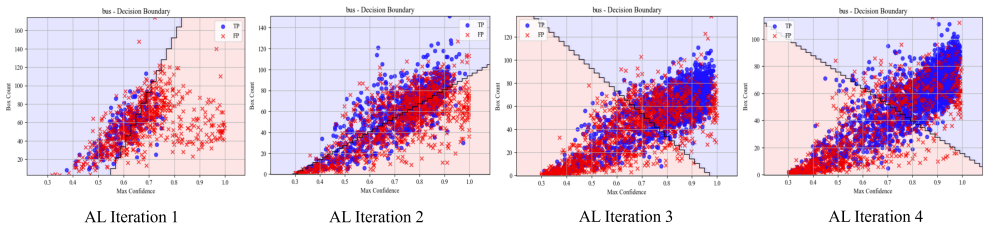
PAL is a detector-agnostic active learning framework that operates solely on inference outputs. At each round it trains lightweight class-specific logistic classifiers to distinguish true from false positives and produce entropy-based uncertainty scores for proposals. Candidate images are then refined using global image entropy, class diversity, and image similarity to form batches that are both informative and diverse. The approach requires no changes to model internals or training pipelines and yields improved label efficiency and detection accuracy on COCO, PASCAL VOC, and BDD100K compared to existing baselines.
What carries the argument
Lightweight class-specific logistic classifiers trained on inference outputs to generate entropy-based uncertainty scores, combined with global image entropy, class diversity, and similarity for batch selection
If this is right
- PAL integrates with any object detector without modifying its code or training schedule
- It produces higher detection accuracy for the same annotation budget on COCO, PASCAL VOC, and BDD100K
- Data selection jointly accounts for instance-level uncertainty, class imbalance, and image-level diversity
- The framework supports deployment where model internals remain inaccessible
Where Pith is reading between the lines
- The same output-only approach could enable active learning on proprietary detection APIs that expose only predictions
- Similar portable uncertainty estimation might transfer to related tasks such as instance segmentation
- The method's robustness could be tested on datasets with extreme class imbalance to check whether the per-class classifiers remain effective
Load-bearing premise
Lightweight class-specific logistic classifiers trained only on inference outputs can reliably separate true positives from false positives to produce useful uncertainty scores
What would settle it
If the logistic classifiers perform no better than random at distinguishing true from false positives on a held-out set and PAL then fails to beat random selection or strong baselines on label efficiency
Figures



read the original abstract
Annotating bounding boxes is costly and limits the scalability of object detection. This challenge is compounded by the need to preserve high accuracy while minimizing manual effort in real-world applications. Prior active learning methods often depend on model features or modify detector internals and training schedules, increasing integration overhead. Moreover, they rarely jointly exploit the benefits of image-level signals, class-imbalance cues, and instance-level uncertainty for comprehensive selection. We present Portable Active Learning (PAL), a detector-agnostic, easily portable framework that operates solely on inference outputs. PAL combines class-wise instance uncertainty with image-level diversity to guide data selection. At each round, PAL trains lightweight class-specific logistic classifiers to distinguish true from false positives, producing entropy-based uncertainty scores for proposals. Candidate images are then refined using global image entropy, class diversity, and image similarity, yielding batches that are both informative and diverse. PAL requires no changes to model internals or training pipelines, ensuring broad compatibility across detectors. Extensive experiments on COCO, PASCAL VOC, and BDD100K demonstrate that PAL consistently improves label efficiency and detection accuracy compared to existing active learning baselines, making it a practical solution for scalable and cost-effective deployment of object detection in real-world settings.
Editorial analysis
A structured set of objections, weighed in public.
Referee Report
Summary. The manuscript proposes Portable Active Learning (PAL), a detector-agnostic framework for active learning in object detection that operates exclusively on inference outputs without requiring access to model internals or changes to training pipelines. PAL trains lightweight class-specific logistic classifiers on proposals (matched to ground-truth labels from the labeled pool) to derive entropy-based uncertainty scores distinguishing true from false positives; these are then combined with image-level signals including global entropy, class diversity, and similarity to select informative and diverse batches. Experiments on COCO, PASCAL VOC, and BDD100K are presented as demonstrating consistent gains in label efficiency and final detection accuracy relative to existing active learning baselines.
Significance. If the empirical claims hold, the work has moderate practical significance for real-world object detection deployments where detectors are treated as black boxes (e.g., commercial APIs or fixed legacy models). By avoiding feature extraction or pipeline modifications, PAL lowers integration barriers compared with many prior active-learning methods that rely on internal activations or retraining schedules. The explicit joint use of instance uncertainty and image-level diversity metrics addresses a noted gap in the literature, and the multi-dataset evaluation provides some evidence of portability.
major comments (2)
- [§3] §3 (PAL framework description): the claim that class-specific logistic classifiers trained solely on inference outputs reliably produce useful entropy uncertainty scores rests on an untested assumption about the separability of true/false positives; no ablation is shown on classifier architecture, feature representation (e.g., box coordinates vs. scores), or training-set size, which directly affects the portability and robustness assertions.
- [§4] §4 (Experiments): while the abstract and introduction assert 'consistent improvements' across COCO, PASCAL VOC, and BDD100K, the reported results lack explicit quantitative tables or figures showing mAP deltas, label-efficiency curves, and statistical significance against named baselines (e.g., uncertainty sampling, core-set, or diversity-only methods); without these numbers the central empirical claim cannot be evaluated for effect size or reproducibility.
minor comments (3)
- [§3.2] Notation for the entropy computation (Eq. 2 or equivalent) should explicitly define the input features to the logistic classifiers and the exact matching procedure between proposals and ground-truth boxes.
- [§3.3] The similarity metric used for image-level refinement is described only at a high level; a precise formulation (e.g., cosine similarity on what embedding?) would aid reproducibility.
- [§4.1] Implementation details such as the number of active-learning rounds, batch size per round, and the exact detectors (e.g., Faster R-CNN, YOLO variants) used in each experiment should be consolidated in a single table or paragraph.
Simulated Author's Rebuttal
We thank the referee for the constructive feedback on our manuscript. We address each major comment below and outline revisions to improve clarity and rigor.
read point-by-point responses
-
Referee: [§3] §3 (PAL framework description): the claim that class-specific logistic classifiers trained solely on inference outputs reliably produce useful entropy uncertainty scores rests on an untested assumption about the separability of true/false positives; no ablation is shown on classifier architecture, feature representation (e.g., box coordinates vs. scores), or training-set size, which directly affects the portability and robustness assertions.
Authors: We acknowledge that the separability assumption underlying the class-specific logistic classifiers merits explicit validation to support the portability claims. The design choice of lightweight logistic regression was motivated by its minimal requirements (only inference outputs) and computational efficiency for black-box detectors, but we agree additional evidence is needed. In the revised manuscript, we will add ablations in Section 3 comparing logistic regression to small neural networks, different feature inputs (scores alone vs. scores plus normalized box coordinates), and varying sizes of the labeled pool used for training the classifiers. These will quantify the robustness of the entropy scores and directly address the concerns about untested assumptions. revision: yes
-
Referee: [§4] §4 (Experiments): while the abstract and introduction assert 'consistent improvements' across COCO, PASCAL VOC, and BDD100K, the reported results lack explicit quantitative tables or figures showing mAP deltas, label-efficiency curves, and statistical significance against named baselines (e.g., uncertainty sampling, core-set, or diversity-only methods); without these numbers the central empirical claim cannot be evaluated for effect size or reproducibility.
Authors: We appreciate the referee highlighting the need for more transparent quantitative reporting. The manuscript presents label-efficiency curves and accuracy comparisons across the three datasets, but we agree that explicit mAP delta tables, direct comparisons to named baselines with effect sizes, and statistical significance measures were not sufficiently detailed. In the revision, we will add a summary table in Section 4 reporting mAP at multiple labeling budgets (e.g., 10%, 20%, 50%) with deltas relative to uncertainty sampling, core-set, and diversity-only baselines, include error bars or p-values where feasible, and ensure all curves are clearly labeled. This will allow readers to assess effect sizes and reproducibility more readily. revision: yes
Circularity Check
No significant circularity detected in derivation chain
full rationale
The paper describes PAL as a practical, detector-agnostic heuristic that trains lightweight logistic classifiers on inference outputs matched to ground-truth labels from the labeled pool to generate entropy uncertainty scores, then refines selections with image-level entropy, class diversity, and similarity metrics. No equations, self-definitional constructions, fitted parameters renamed as predictions, or load-bearing self-citations appear in the method. The approach relies on conventional active-learning building blocks with external validation via experiments on COCO, PASCAL VOC, and BDD100K, keeping the central claim self-contained and independent of its own inputs.
Axiom & Free-Parameter Ledger
axioms (2)
- domain assumption Logistic regression trained on detector outputs can distinguish true positives from false positives to yield useful uncertainty estimates
- ad hoc to paper Image-level signals (entropy, class diversity, similarity) complement instance uncertainty for better batch selection
invented entities (1)
-
Portable Active Learning (PAL) framework
no independent evidence
Lean theorems connected to this paper
-
IndisputableMonolith/Cost/FunctionalEquation.leanwashburn_uniqueness_aczel unclear?
unclearRelation between the paper passage and the cited Recognition theorem.
PAL trains lightweight class-specific logistic classifiers to distinguish true from false positives, producing entropy-based uncertainty scores
-
IndisputableMonolith/Foundation/BranchSelection.leanbranch_selection unclear?
unclearRelation between the paper passage and the cited Recognition theorem.
Score(I, j) = α·S_LIUS(Ij) + d·S_GUIDE(I) with weights α+d=1
What do these tags mean?
- matches
- The paper's claim is directly supported by a theorem in the formal canon.
- supports
- The theorem supports part of the paper's argument, but the paper may add assumptions or extra steps.
- extends
- The paper goes beyond the formal theorem; the theorem is a base layer rather than the whole result.
- uses
- The paper appears to rely on the theorem as machinery.
- contradicts
- The paper's claim conflicts with a theorem or certificate in the canon.
- unclear
- Pith found a possible connection, but the passage is too broad, indirect, or ambiguous to say the theorem truly supports the claim.
Reference graph
Works this paper leans on
-
[1]
Contextual diversity for active learning
Sharat Agarwal, Himanshu Arora, Saket Anand, and Chetan Arora. Contextual diversity for active learning. InComputer Vision – ECCV 2020: 16th European Conference, Glas- gow, UK, August 23–28, 2020, Proceedings, Part XVI, page 137–153, Berlin, Heidelberg, 2020. Springer-Verlag. 2, 5, 6
work page 2020
-
[2]
William H. Beluch, Tim Genewein, A. N ¨urnberger, and Jan M. K ¨ohler. The power of ensembles for active learn- ing in image classification.2018 IEEE/CVF Conference on Computer Vision and Pattern Recognition, pages 9368– 9377, 2018. 1
work page 2018
-
[3]
Javad Zolfaghari Bengar, Joost van de Weijer, Laura Lopez Fuentes, and Bogdan Raducanu. Class-balanced active learn- ing for image classification.2022 IEEE/CVF Winter Con- ference on Applications of Computer Vision (WACV), pages 3707–3716, 2021. 1, 2
work page 2022
-
[4]
Active learning for deep object detection.arXiv preprint arXiv:1809.09875, 2018
Clemens-Alexander Brust, Christoph K ¨ading, and Joachim Denzler. Active learning for deep object detection.arXiv preprint arXiv:1809.09875, 2018. doi:10.48550/arXiv.1809.09875. 2
-
[5]
MMDetection: Open MMLab Detection Toolbox and Benchmark
Kai Chen, Jiaqi Wang, Jiangmiao Pang, Yuhang Cao, Yu Xiong, Xiaoxiao Li, Shuyang Sun, Wansen Feng, Ziwei Liu, Jiarui Xu, Zheng Zhang, Dazhi Cheng, Chenchen Zhu, Tian- heng Cheng, Qijie Zhao, Buyu Li, Xin Lu, Rui Zhu, Yue Wu, Jifeng Dai, Jingdong Wang, Jianping Shi, Wanli Ouyang, Chen Change Loy, and Dahua Lin. MMDetection: Open mmlab detection toolbox and...
work page Pith review arXiv 1906
-
[6]
XGBoost: A scalable tree boosting system
Tianqi Chen and Carlos Guestrin. XGBoost: A scalable tree boosting system. InProceedings of the 22nd ACM SIGKDD International Conference on Knowledge Discovery and Data Mining, pages 785–794, New York, NY , USA, 2016. ACM. 8
work page 2016
-
[7]
Jiwoong Choi, Ismail Elezi, Hyuk-Jae Lee, Clement Fara- bet, and Jose M. Alvarez. Active learning for deep object detection via probabilistic modeling. In2021 IEEE/CVF In- ternational Conference on Computer Vision (ICCV), pages 10244–10253, 2021. 1
work page 2021
-
[8]
An image is worth 16x16 words: Transformers for image recognition at scale
Alexey Dosovitskiy, Lucas Beyer, Alexander Kolesnikov, Dirk Weissenborn, Xiaohua Zhai, Thomas Unterthiner, Mostafa Dehghani, Matthias Minderer, Georg Heigold, Syl- vain Gelly, Jakob Uszkoreit, and Neil Houlsby. An image is worth 16x16 words: Transformers for image recognition at scale. InInternational Conference on Learning Representa- tions, 2021. 5
work page 2021
-
[9]
Williams, John Winn, and Andrew Zisserman
Mark Everingham, Luc Gool, Christopher K. Williams, John Winn, and Andrew Zisserman. The pascal visual object classes (voc) challenge.Int. J. Comput. Vision, 88(2): 303–338, 2010. 6
work page 2010
-
[10]
YOLOX: Exceeding YOLO Series in 2021
Zheng Ge, Songtao Liu, Feng Wang, Zeming Li, and Jian Sun. Yolox: Exceeding yolo series in 2021.arXiv preprint arXiv:2107.08430, 2021. 6
work page internal anchor Pith review arXiv 2021
-
[11]
Deep residual learning for image recognition
Kaiming He, Xiangyu Zhang, Shaoqing Ren, and Jian Sun. Deep residual learning for image recognition. InProceed- ings of the IEEE conference on computer vision and pattern recognition, pages 770–778, 2016. 6
work page 2016
- [12]
-
[13]
Adaptive active learning for image classification
Xin Li and Yuhong Guo. Adaptive active learning for image classification. InProceedings of the IEEE Conference on Computer Vision and Pattern Recognition (CVPR), 2013. 1
work page 2013
-
[14]
Tsung-Yi Lin, Michael Maire, Serge Belongie, James Hays, Pietro Perona, Deva Ramanan, Piotr Doll ’ar, and C. Lawrence Zitnick. Microsoft coco: Common objects in context. InEuropean Conference on Computer Vision, pages 740–755. Springer International Publishing,
-
[15]
Tsung-Yi Lin, Priya Goyal, Ross Girshick, Kaiming He, and Piotr Doll ´ar. Focal loss for dense object detection.IEEE Transactions on Pattern Analysis and Machine Intelligence, 42(2):318–327, 2020. 6
work page 2020
-
[16]
Hieu T. Nguyen and Arnold Smeulders. Active learning us- ing pre-clustering. InProceedings of the Twenty-First In- ternational Conference on Machine Learning, page 79, New York, NY , USA, 2004. Association for Computing Machin- ery. 5
work page 2004
-
[17]
Dinov2: Learning robust visual features with- out supervision, 2024
Maxime Oquab, Timoth ´ee Darcet, Th ´eo Moutakanni, Huy V o, Marc Szafraniec, Vasil Khalidov, Pierre Fernandez, Daniel Haziza, Francisco Massa, Alaaeldin El-Nouby, Mah- moud Assran, Nicolas Ballas, Wojciech Galuba, Russell Howes, Po-Yao Huang, Shang-Wen Li, Ishan Misra, Michael Rabbat, Vasu Sharma, Gabriel Synnaeve, Hu Xu, Herv ´e Je- gou, Julien Mairal, ...
work page 2024
-
[18]
Learning transferable visual models from natural language supervision, 2021
Alec Radford, Jong Wook Kim, Chris Hallacy, Aditya Ramesh, Gabriel Goh, Sandhini Agarwal, Girish Sastry, Amanda Askell, Pamela Mishkin, Jack Clark, Gretchen Krueger, and Ilya Sutskever. Learning transferable visual models from natural language supervision, 2021. 8
work page 2021
-
[19]
Faster r-cnn: towards real-time object detection with region proposal networks
Shaoqing Ren, Kaiming He, Ross Girshick, and Jian Sun. Faster r-cnn: towards real-time object detection with region proposal networks. InProceedings of the 29th International Conference on Neural Information Processing Systems - Vol- ume 1, page 91–99, Cambridge, MA, USA, 2015. MIT Press. 6
work page 2015
-
[20]
Soumya Roy, Asim Unmesh, and Vinay P. Namboodiri. Deep active learning for object detection. InBritish Machine Vision Conference (BMVC), 2018. 2 9
work page 2018
-
[21]
Active learning for con- volutional neural networks: A core-set approach
Ozan Sener and Silvio Savarese. Active learning for con- volutional neural networks: A core-set approach. InInter- national Conference on Learning Representations (ICLR),
-
[22]
arXiv:1708.00489, doi:10.48550/arXiv.1708.00489. 2, 5, 6
-
[23]
Very Deep Convolutional Networks for Large-Scale Image Recognition
Karen Simonyan and Andrew Zisserman. Very deep convo- lutional networks for large-scale image recognition.CoRR, abs/1409.1556, 2014. 6
work page internal anchor Pith review Pith/arXiv arXiv 2014
-
[24]
Cspnet: A new backbone that can enhance learning capability of cnn
Chien-Yao Wang, Hong-Yuan Mark Liao, I-Hau Yeh, Yueh- Hua Wu, Ping-Yang Chen, and Jun-Wei Hsieh. Cspnet: A new backbone that can enhance learning capability of cnn. 2020 IEEE/CVF Conference on Computer Vision and Pat- tern Recognition Workshops (CVPRW), pages 1571–1580,
work page 2020
-
[25]
Soft teacher for semi-supervised object detection
Xuancheng Wang, Yifan Zhang, Zhaoyang Zeng, Yuhui Yuan, Jingdong Wang, and Chunhua Shen. Soft teacher for semi-supervised object detection. InProceedings of the IEEE/CVF International Conference on Computer Vision (ICCV), pages 16261–16270, 2021. 3
work page 2021
-
[26]
Visual transform- ers: Token-based image representation and processing for computer vision, 2020
Bichen Wu, Chenfeng Xu, Xiaoliang Dai, Alvin Wan, Peizhao Zhang, Zhicheng Yan, Masayoshi Tomizuka, Joseph Gonzalez, Kurt Keutzer, and Peter Vajda. Visual transform- ers: Token-based image representation and processing for computer vision, 2020. 5, 8
work page 2020
-
[27]
Entropy-based ac- tive learning for object detection with progressive diversity constraint
Jiaxi Wu, Jiaxin Chen, and Di Huang. Entropy-based ac- tive learning for object detection with progressive diversity constraint. InProceedings of the IEEE/CVF Conference on Computer Vision and Pattern Recognition (CVPR), 2022. doi:10.48550/arXiv.2204.07965. 2, 6, 7
-
[28]
Chenhongyi Yang, Lichao Huang, and Elliot J. Crowley. Plug and play active learning for object detection. InPro- ceedings of the IEEE/CVF Conference on Computer Vision and Pattern Recognition (CVPR), 2024. arXiv:2211.11612, doi:10.48550/arXiv.2211.11612. 1, 2, 5, 6, 7
-
[29]
Learning loss for active learning
Donggeun Yoo and In So Kweon. Learning loss for active learning. In2019 IEEE/CVF Conference on Computer Vision and Pattern Recognition (CVPR), pages 93–102, 2019. 1, 2, 7
work page 2019
-
[30]
Bdd100k: A diverse driving dataset for heterogeneous multitask learning
Fisher Yu, Haofeng Chen, Xin Wang, Wenqi Xian, Yingying Chen, Fangchen Liu, Vashisht Madhavan, and Trevor Dar- rell. Bdd100k: A diverse driving dataset for heterogeneous multitask learning. In2020 IEEE/CVF Conference on Com- puter Vision and Pattern Recognition (CVPR), pages 2633– 2642, 2018. 6
work page 2018
-
[31]
Multiple in- stance active learning for object detection
Tianning Yuan, Fang Wan, Mengying Fu, Jianzhuang Liu, Songcen Xu, Xiangyang Ji, and Qixiang Ye. Multiple in- stance active learning for object detection. InProceedings of the IEEE/CVF Conference on Computer Vision and Pattern Recognition (CVPR), 2021. 1, 2, 6, 7
work page 2021
-
[32]
State-relabeling adversarial active learning
Beichen Zhang, Liang Li, Shijie Yang, Shuhui Wang, Zheng- Jun Zha, and Qingming Huang. State-relabeling adversarial active learning. In2020 IEEE/CVF Conference on Computer Vision and Pattern Recognition (CVPR), pages 8753–8762,
-
[33]
Active teacher for semi-supervised object detection
Yifan Zhang, Xuancheng Wang, Zhaoyang Zeng, Yuhui Yuan, Jingdong Wang, and Chunhua Shen. Active teacher for semi-supervised object detection. InProceedings of the IEEE/CVF Conference on Computer Vision and Pattern Recognition (CVPR), 2022. 3
work page 2022
-
[34]
Generative Adversarial Active Learning
Jia-Jie Zhu and Jos ´e Bento. Generative adversarial ac- tive learning.arXiv preprint arXiv:1702.07956, 2017. doi:10.48550/arXiv.1702.07956. 2, 5 10
discussion (0)
Sign in with ORCID, Apple, or X to comment. Anyone can read and Pith papers without signing in.