Recognition: 2 theorem links
· Lean TheoremObfAx: Obfuscation and IP Piracy Detection in Approximate Circuits
Pith reviewed 2026-05-12 05:11 UTC · model grok-4.3
The pith
Statistical error profile comparison detects IP theft in approximate circuits even after functional mimicry by attackers.
A machine-rendered reading of the paper's core claim, the machinery that carries it, and where it could break.
Core claim
We introduce a novel adversarial threat model, approximate obfuscation, in which an attacker not only conceals the design through structural obfuscation but also introduces functional modifications to ensure that the resulting circuit exhibits nearly identical error characteristics and hardware metrics as the original IP. To counter this threat, we propose an automated framework that extracts and compares statistical error profiles of protected IP cores and suspicious circuits, enabling systematic detection of potential IP theft. Through extensive experiments on a diverse set of approximate multipliers, we analyze the resilience of different approximate multipliers against approximate obfusc
What carries the argument
The automated framework that extracts and compares statistical error profiles to distinguish protected approximate IP from obfuscated copies.
If this is right
- Approximate multipliers vary in how well their error profiles resist functional mimicry, so some designs are inherently harder to steal undetected.
- The detection method works without needing the original netlist or source code, only access to input-output error behavior.
- Interplay between structural obfuscation and approximation quality directly affects how easy it is to create a convincing fake.
- Commercial release of approximate IP cores becomes more feasible once systematic piracy checks exist.
- Hardware metrics such as area, delay, and power must be matched alongside error profiles for an attack to succeed.
Where Pith is reading between the lines
- The same profile comparison could be applied to other approximate arithmetic blocks such as adders or dividers to broaden protection.
- If error profiles prove unique across many designs, they might serve as a lightweight fingerprint for approximate hardware in supply-chain verification.
- Attackers may need to solve a joint optimization problem over both error distribution and hardware cost, which could limit practical mimicry.
- Detection success rates could guide the choice of approximation level during design, favoring profiles that remain distinctive.
Load-bearing premise
Statistical error profiles extracted from approximate circuits remain distinctive and stable enough for reliable detection even after an attacker applies functional changes meant to copy the original error behavior and hardware metrics.
What would settle it
Two unrelated approximate multiplier designs whose error statistics become indistinguishable after one is functionally modified to match the other's profile and metrics would show the framework cannot separate originals from mimics.
Figures




read the original abstract
Approximate circuits often achieve exceptional trade-offs between computational accuracy and hardware efficiency, making them attractive for deployment as reusable Intellectual Property (IP) cores. However, safeguarding such circuits against piracy is critical for enabling sustainable commercialization of approximate computing. This work addresses the emerging challenge of IP protection and piracy detection in the context of approximate hardware. We introduce a novel adversarial threat model, approximate obfuscation, in which an attacker not only conceals the design through structural obfuscation but also introduces functional modifications to ensure that the resulting circuit exhibits nearly identical error characteristics and hardware metrics as the original IP. To counter this threat, we propose an automated framework that extracts and compares statistical error profiles of protected IP cores and suspicious circuits, enabling systematic detection of potential IP theft. Through extensive experiments on a diverse set of approximate multipliers, we analyze the resilience of different approximate multipliers against approximate obfuscation. Our results provide new insights into the interplay between obfuscation, approximation, and IP protection.
Editorial analysis
A structured set of objections, weighed in public.
Referee Report
Summary. The manuscript introduces a threat model called approximate obfuscation, in which an attacker combines structural obfuscation with functional modifications to an approximate circuit so that the result matches the original IP's error characteristics and hardware metrics. It proposes an automated detection framework that extracts statistical error profiles (e.g., error distribution, mean, variance) from protected approximate IP cores and compares them to suspicious circuits. The work reports experiments on a diverse set of approximate multipliers that analyze resilience to this threat and claims to yield new insights into the interplay of obfuscation, approximation, and IP protection.
Significance. If the error-profile comparison can be shown to be robust against mimicry, the framework would address a practical gap in protecting reusable approximate-computing IP cores, whose commercial viability depends on piracy resistance. The explicit adversarial model is a useful conceptual contribution even if the detection method requires further validation.
major comments (2)
- [Abstract and Experiments section] The abstract states that 'extensive experiments on a diverse set of approximate multipliers' analyze resilience and provide 'new insights,' yet the manuscript supplies no quantitative results, baselines, error metrics (e.g., mean absolute error, variance values), or methodological details such as how profiles are extracted or compared. This absence leaves the central empirical claim without verifiable support.
- [Detection framework and Experiments section] The detection claim rests on the assumption that statistical error profiles remain sufficiently distinctive after an attacker applies functional modifications that also preserve hardware metrics. The experiments examine resilience of existing multipliers but do not test whether an unrelated base approximate multiplier can be tuned (via parameter changes or small logic alterations) to produce a statistically indistinguishable profile, which would produce false positives and undermine attribution to the original IP.
minor comments (2)
- [Introduction] The term 'approximate obfuscation' is introduced without a formal definition or comparison to prior obfuscation techniques in approximate hardware; a short related-work paragraph would clarify novelty.
- [Framework description] Notation for the statistical error profile (e.g., which moments or distribution features are used) is not specified, hindering reproducibility.
Simulated Author's Rebuttal
We thank the referee for the constructive and insightful comments on our manuscript. The feedback highlights important aspects of clarity and validation that will help strengthen the presentation of the ObfAx framework and its evaluation. We address each major comment below and describe the revisions planned for the next version of the manuscript.
read point-by-point responses
-
Referee: [Abstract and Experiments section] The abstract states that 'extensive experiments on a diverse set of approximate multipliers' analyze resilience and provide 'new insights,' yet the manuscript supplies no quantitative results, baselines, error metrics (e.g., mean absolute error, variance values), or methodological details such as how profiles are extracted or compared. This absence leaves the central empirical claim without verifiable support.
Authors: We agree that the manuscript would be strengthened by including explicit quantitative results, baselines, and methodological details to support the claims in the abstract. In the revised version, we will expand the Experiments section with tables reporting specific error metrics (including mean absolute error and variance values for each multiplier), comparison baselines, and a detailed description of the statistical profile extraction process and similarity comparison method (including any distance metrics or thresholds employed). This will make the empirical support fully verifiable. revision: yes
-
Referee: [Detection framework and Experiments section] The detection claim rests on the assumption that statistical error profiles remain sufficiently distinctive after an attacker applies functional modifications that also preserve hardware metrics. The experiments examine resilience of existing multipliers but do not test whether an unrelated base approximate multiplier can be tuned (via parameter changes or small logic alterations) to produce a statistically indistinguishable profile, which would produce false positives and undermine attribution to the original IP.
Authors: The current experiments evaluate resilience across a diverse set of approximate multipliers under the approximate obfuscation model and show that their error profiles remain distinguishable while hardware metrics are preserved. We acknowledge that an explicit test of whether an unrelated base multiplier could be tuned to produce an indistinguishable profile would provide stronger evidence against false positives. In the revision, we will add targeted experiments that apply parameter changes and small logic alterations to unrelated base multipliers while attempting to match both error profiles and hardware metrics, and we will report the resulting distinguishability outcomes. revision: yes
Circularity Check
No circularity: framework is an independent proposal with no self-referential derivations
full rationale
The paper proposes a new adversarial threat model (approximate obfuscation) and an automated detection framework based on extracting and comparing statistical error profiles from approximate circuits. No equations, predictions, or first-principles derivations are presented that reduce the detection outcome to fitted parameters, self-definitions, or self-citation chains. The central claim rests on experimental analysis of profile distinctiveness across multipliers rather than any construction that equates outputs to inputs by definition. No load-bearing self-citations or ansatzes are invoked to justify uniqueness or force results. The framework is self-contained as a methodological contribution.
Axiom & Free-Parameter Ledger
axioms (1)
- domain assumption Approximate circuits possess extractable statistical error profiles that can serve as identifying signatures even after limited functional modifications.
invented entities (1)
-
approximate obfuscation
no independent evidence
Lean theorems connected to this paper
-
IndisputableMonolith/Cost/FunctionalEquation.leanwashburn_uniqueness_aczel unclear?
unclearRelation between the paper passage and the cited Recognition theorem.
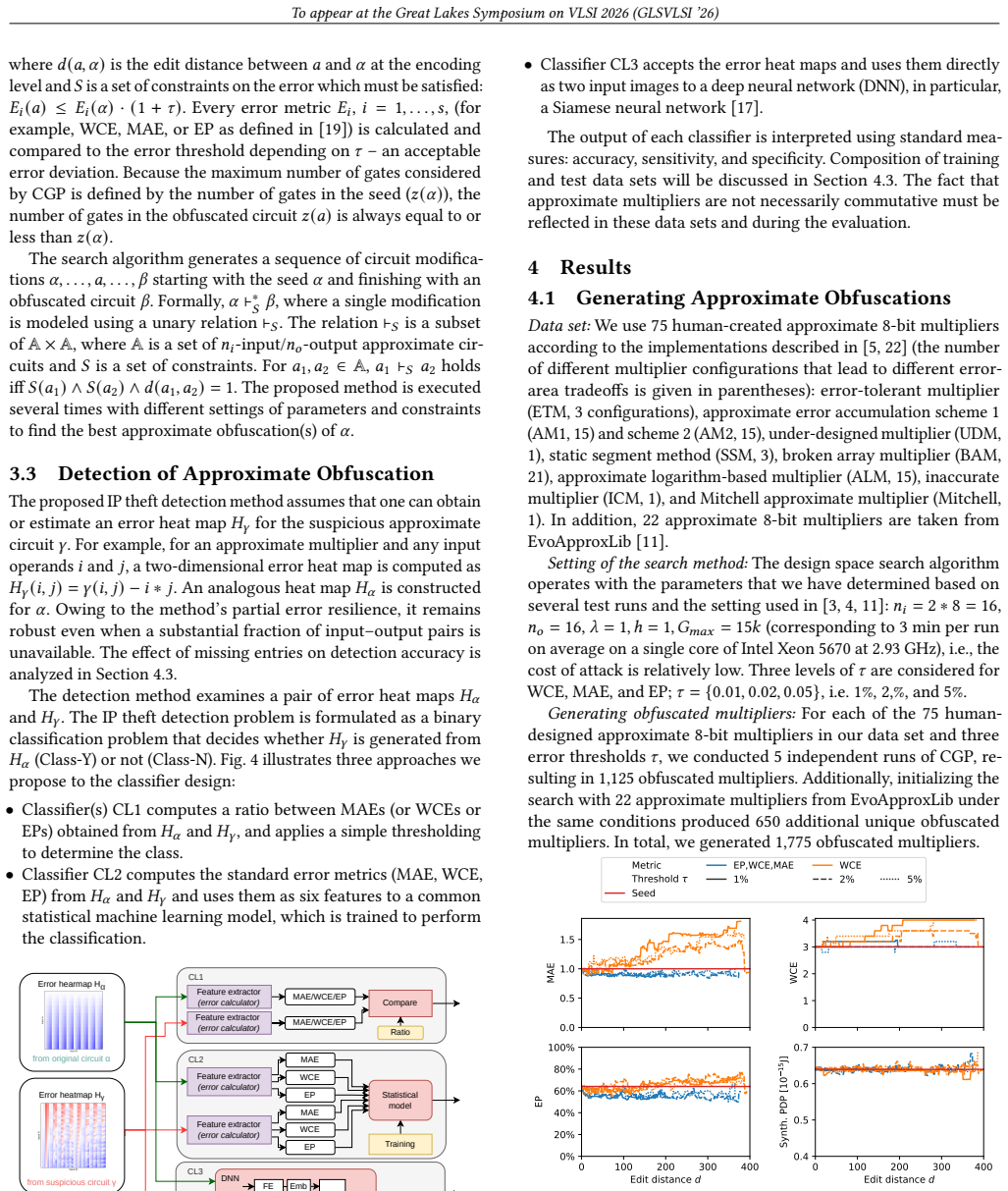
We propose an automated framework that extracts and compares statistical error profiles of protected IP cores and suspicious circuits... error heat maps... MAE, WCE, EP... Siamese neural network
-
IndisputableMonolith/Foundation/AbsoluteFloorClosure.leanreality_from_one_distinction unclear?
unclearRelation between the paper passage and the cited Recognition theorem.
approximate multipliers... EvoApproxLib... broken array multiplier (BAM)... logarithm-based multipliers
What do these tags mean?
- matches
- The paper's claim is directly supported by a theorem in the formal canon.
- supports
- The theorem supports part of the paper's argument, but the paper may add assumptions or extra steps.
- extends
- The paper goes beyond the formal theorem; the theorem is a base layer rather than the whole result.
- uses
- The paper appears to rely on the theorem as machinery.
- contradicts
- The paper's claim conflicts with a theorem or certificate in the canon.
- unclear
- Pith found a possible connection, but the passage is too broad, indirect, or ambiguous to say the theorem truly supports the claim.
Reference graph
Works this paper leans on
-
[1]
Qazi Arbab Ahmed, Muhammad Awais, and Marco Platzner. 2023. MAAS: Hiding Trojans in Approximate Circuits. In2023 24th Int. Symp. Quality Electronic Design (ISQED). 1–6. doi:10.1109/ISQED57927.2023.10129286
-
[2]
Giorgos Armeniakos, Georgios Zervakis, Dimitrios Soudris, and Jörg Henkel
-
[3]
Hardware Approximate Techniques for Deep Neural Network Accelerators: A Survey.ACM Comput. Surv.55, 4 (2023), 83:1–83:36. doi:10.1145/3527156
-
[4]
Milan Ceska, Jiri Matyas, et al. 2017. Approximating Complex Arithmetic Circuits with Formal Error Guarantees: 32-bit Multipliers Accomplished. InProc. 36th IEEE/ACM Int. Conf. On Computer Aided Design. IEEE, 416–423
work page 2017
-
[5]
Rongliang Fu, Robert Wille, and Tsung-Yi Ho. 2024. RCGP: An Automatic Syn- thesis Framework for Reversible Quantum-Flux-Parametron Logic Circuits based on Efficient Cartesian Genetic Programming. InProc. 61st ACM/IEEE Design Automation Conf. (DAC ’24). ACM. doi:10.1145/3649329.3655950
-
[6]
Honglan Jiang, Leibo Liu, Fabrizio Lombardi, and Jie Han. 2019. Approximate Arithmetic Circuits: Design and Evaluation. InApproximate Circuits, Methodolo- gies and CAD. Springer, 67–98
work page 2019
-
[7]
Honglan Jiang, Francisco Javier Hernandez Santiago, Hai Mo, Leibo Liu, and Jie Han. 2020. Approximate Arithmetic Circuits: A Survey, Characterization, and Recent Applications.Proc. IEEE108, 12 (2020), 2108–2135
work page 2020
-
[8]
Weiqiang Liu, Chongyan Gu, Máire O’Neill, Gang Qu, Paolo Montuschi, and Fabrizio Lombardi. 2020. Security in Approximate Computing and Approximate Computing for Security: Challenges and Opportunities.Proc. IEEE108, 12 (2020), 2214–2231. doi:10.1109/JPROC.2020.3030121
-
[9]
Weiqiang Liu, Jiahua Xu, et al. 2017. Design of Approximate Logarithmic Mul- tipliers. InProc. Great Lakes Symposium on VLSI (GLSVLSI ’17). ACM, 47–52. doi:10.1145/3060403.3060409
-
[10]
H. R. Mahdiani, A. Ahmadi, et al. 2010. Bio-Inspired Imprecise Computational Blocks for Efficient VLSI Implementation of Soft-Computing Applications.IEEE Trans. Circ. Systems I: Regular Papers57, 4 (2010), 850–862
work page 2010
-
[11]
Julian F. Miller. 2011.Cartesian Genetic Programming. Springer-Verlag
work page 2011
-
[12]
Vojtech Mrazek, Radek Hrbacek, et al. 2017. EvoApprox8b: Library of Approxi- mate Adders and Multipliers for Circuit Design and Benchmarking of Approxi- mation Methods. InDesign, Aut. & Test in Europe Conf. (DATE)
work page 2017
-
[13]
Francesco Regazzoni, Cesare Alippi, and Ilia Polian. 2018. Security: The Dark Side of Approximate Computing?. In2018 IEEE/ACM Int. Conf. Computer-Aided Design (ICCAD). 1–6. doi:10.1145/3240765.3243497
-
[14]
Masoud Rostami, Farinaz Koushanfar, and Ramesh Karri. 2014. A Primer on Hardware Security: Models, Methods, and Metrics.Proc. IEEE102, 8 (2014), 1283–1295. doi:10.1109/JPROC.2014.2335155
-
[15]
Ilaria Scarabottolo, Giovanni Ansaloni, et al. 2020. Approximate Logic Synthesis: A Survey.Proc. IEEE108, 12 (2020), 2195–2213. doi:10.1109/JPROC.2020.3014430
-
[16]
M. Shafique, R. Hafiz, et al. 2016. Invited: Cross-layer approximate computing: From logic to architectures. InProc. of DAC’16. 1–6
work page 2016
-
[17]
Phillip Stanley-Marbell, Armin Alaghi, et al. 2020. Exploiting Errors for Efficiency: A Survey from Circuits to Applications.ACM Comput. Surv.53, 3 (2020), 39 pages
work page 2020
-
[18]
Yaniv Taigman, Ming Yang, Marc’Aurelio Ranzato, and Lior Wolf. 2014. DeepFace: Closing the Gap to Human-Level Performance in Face Verification. In2014 IEEE Conf. Comp. Vision and Pattern Recognition. 1701–1708
work page 2014
-
[19]
Salim Ullah, Sanjeev Sripadraj Murthy, and Akash Kumar. 2018. SMApproxlib: Library of FPGA-Based Approximate Multipliers. InProc. 55th Annual Design Automation Conference. ACM, New York, NY, USA, Article 157, 6 pages
work page 2018
-
[20]
Zdenek Vasicek. 2019. Formal Methods for Exact Analysis of Approximate Circuits.IEEE Access7, 1 (2019), 177309–177331
work page 2019
-
[21]
Arunkumar Vijayakumar, Vinay C. Patil, et al. 2017. Physical Design Obfusca- tion of Hardware: A Comprehensive Investigation of Device and Logic-Level Techniques.IEEE Trans. Inf. Forensics Security12, 1 (2017), 64–77
work page 2017
-
[22]
Linus Witschen, Hassan G. Mohammadi, et al. 2019. Jump Search: A Fast Tech- nique for the Synthesis of Approximate Circuits. InProc. 2019 Great Lakes Sym- posium on VLSI, GLSVLSI. ACM, 153–158
work page 2019
-
[23]
Ying Wu, Chuangtao Chen, et al . 2024. A Survey on Approximate Multiplier Designs for Energy Efficiency: From Algorithms to Circuits.ACM Trans. Des. Autom. Electron. Syst.29, 1 (Jan. 2024), 37 pages. doi:10.1145/3610291
-
[24]
Yang Xie and Ankur Srivastava. 2019. Anti-SAT: Mitigating SAT Attack on Logic Locking.IEEE Trans. Comput.-Aided Design Integr. Circuits Syst.38, 2 (2019), 199–207. doi:10.1109/TCAD.2018.2801220
-
[25]
Rozhin Yasaei, Shih-Yuan Yu, et al. 2021. GNN4IP: Graph Neural Network for Hardware Intellectual Property Piracy Detection. In58th ACM/IEEE Design Au- tomation Conference (DAC). 217–222. doi:10.1109/DAC18074.2021.9586150
-
[26]
Pruthvy Yellu and Qiaoyan Yu. 2023. Securing Approximate Computing Systems via Obfuscating Approximate-Precise Boundary.IEEE Trans. Comput.-Aided Design Integr. Circuits Syst.42, 1 (2023), 27–40. doi:10.1109/TCAD.2022.3168261
-
[27]
Sipei Yi, Weichuan Zuo, et al. 2025. GPTAC: Domain-Specific Generative Pre- Trained Model for Approximate Circuit Design Exploration.IEEE J. Emerging Selected Topics in Circ. and Systems15, 2 (2025), 349–360. 7
work page 2025
discussion (0)
Sign in with ORCID, Apple, or X to comment. Anyone can read and Pith papers without signing in.