Recognition: no theorem link
DREAMS: Modelling Support for Research into Engineering and Artistic Design
Pith reviewed 2026-05-12 05:17 UTC · model grok-4.3
The pith
DREAMS is a prototype tool that reduces time and effort in creating and revising DRM Reference and Impact Models compared to manual methods.
A machine-rendered reading of the paper's core claim, the machinery that carries it, and where it could break.
Core claim
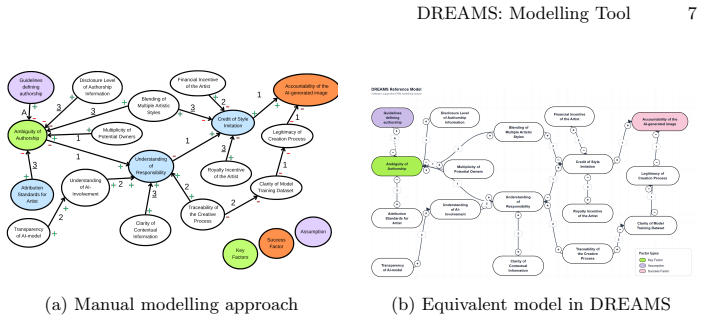
DREAMS enables users to construct typed causal models using DRM-relevant elements, define signed causal relationships, and attach assumptions, experiential inputs, and references directly to causal links. It also provides layout support and search functions to improve readability, modifiability, and retrieval of supporting information. A preliminary comparative evaluation with four DRM users was conducted against manual modelling practice. The results indicate reductions in model creation time, revision time, repositioning effort, edge crossings, and evidence retrieval time when using DREAMS.
What carries the argument
DREAMS, a modeling environment for typed causal models aligned with DRM elements that attaches supporting information directly to links and supplies layout and search aids.
If this is right
- Model creation and revision take less time because assumptions and references attach directly to causal links.
- Repositioning effort and edge crossings decrease with built-in layout support.
- Evidence retrieval becomes faster through integrated search functions.
- Models remain more readable and modifiable as complexity increases.
Where Pith is reading between the lines
- The same attachment and layout features could help maintain traceability in other causal diagramming tasks outside strict DRM use.
- If scaled, the tool might lower entry barriers for researchers combining engineering and artistic design studies.
- Direct evidence linking could be tested for error reduction in assumption tracking over long research projects.
Load-bearing premise
The time and effort reductions observed with only four DRM users in a preliminary comparison will hold for typical users and more complex models in real DRM-based research.
What would settle it
A larger controlled study with more DRM users working on intricate models that finds no significant reductions in creation time, revision time, or evidence retrieval would show the tool lacks the claimed practical benefits.
Figures


read the original abstract
Design Research Methodology (DRM) supports systematic design research through representations such as Reference Models and Impact Models. However, the practical construction and maintenance of these models often remains manual, requiring repeated redrawing, layout adjustment, and separate handling of assumptions, references, and supporting evidence. This can make DRM modelling time-consuming, visually cluttered, and difficult to revise as models increase in complexity. This paper presents DREAMS, an early-stage prototype modelling environment developed to support the creation and maintenance of DRM Reference Models and Impact Models. The tool enables users to construct typed causal models using DRM-relevant elements, define signed causal relationships, and attach assumptions, experiential inputs, and references directly to causal links. It also provides layout support and search functions to improve readability, modifiability, and retrieval of supporting information. A preliminary comparative evaluation with four DRM users was conducted against manual modelling practice. The results indicate reductions in model creation time, revision time, repositioning effort, edge crossings, and evidence retrieval time when using DREAMS. These findings are interpreted as early evidence of practical potential rather than full validation. The contribution of the paper lies in identifying requirements for DRM-aligned modelling support, presenting the design and implementation of DREAMS, and demonstrating its potential to reduce modelling effort and improve traceability in DRM-based research.
Editorial analysis
A structured set of objections, weighed in public.
Referee Report
Summary. The paper introduces DREAMS, an early-stage prototype modeling environment for Design Research Methodology (DRM) that supports construction of typed causal Reference and Impact Models, signed causal links, attachment of assumptions/experiential inputs/references to links, automated layout assistance, and search for improved readability and traceability. It reports a preliminary comparative user study with four DRM practitioners against manual modeling, claiming reductions in model creation time, revision time, repositioning effort, edge crossings, and evidence retrieval time, presented as early evidence of practical potential rather than full validation.
Significance. If the reported efficiency gains prove robust, the work could lower barriers to systematic DRM application in engineering and design research by addressing manual overhead in model maintenance and evidence handling. The explicit requirements analysis for DRM-aligned tooling is a constructive step, and the prototype's focus on causal typing and direct evidence attachment offers a targeted contribution over generic diagramming tools.
major comments (2)
- [Evaluation / Results section] The preliminary comparative evaluation (described in the results and discussion sections) relies on only four participants and provides no details on study design elements such as task standardization, model complexity metrics, timing protocols, participant experience levels or demographics, counterbalancing of conditions, or any statistical analysis. These omissions make it impossible to evaluate whether the observed reductions in creation time, revision time, repositioning, edge crossings, and retrieval time are attributable to DREAMS rather than confounds or learning effects, weakening support for even the 'early evidence' interpretation.
- [Discussion / Conclusion] The generalization claim that benefits 'will hold for typical users and more complex models' (implied in the interpretation of results) is unsupported because the study tasks, measurement objectivity, and participant representativeness are not described; without these, the load-bearing step from n=4 observations to practical potential cannot be assessed.
minor comments (2)
- [Abstract / Introduction] The abstract and introduction could more clearly distinguish the novel requirements identified for DRM modeling support from the implementation choices in DREAMS.
- [Figures / Tables] Figure captions and table descriptions (if present) should explicitly note whether screenshots or metrics are from the prototype or the user study sessions.
Simulated Author's Rebuttal
We thank the referee for the constructive and detailed feedback on our manuscript. We address each major comment point by point below, with a focus on clarifying the preliminary nature of the work while strengthening the presentation of its limitations.
read point-by-point responses
-
Referee: [Evaluation / Results section] The preliminary comparative evaluation (described in the results and discussion sections) relies on only four participants and provides no details on study design elements such as task standardization, model complexity metrics, timing protocols, participant experience levels or demographics, counterbalancing of conditions, or any statistical analysis. These omissions make it impossible to evaluate whether the observed reductions in creation time, revision time, repositioning, edge crossings, and retrieval time are attributable to DREAMS rather than confounds or learning effects, weakening support for even the 'early evidence' interpretation.
Authors: We agree that the evaluation is preliminary and that additional methodological details would improve transparency. The study was intentionally small-scale and exploratory to assess initial usability of the DREAMS prototype against manual methods. In the revised manuscript we will expand the description to include: participant recruitment criteria and self-reported DRM experience levels; the specific modeling tasks used (including model size and complexity); the timing and observation protocol; and the absence of counterbalancing or statistical tests due to the n=4 sample. We will also add an explicit statement that the results are indicative only and subject to potential learning effects or individual differences. This revision will better support the 'early evidence' framing without overstating robustness. revision: partial
-
Referee: [Discussion / Conclusion] The generalization claim that benefits 'will hold for typical users and more complex models' (implied in the interpretation of results) is unsupported because the study tasks, measurement objectivity, and participant representativeness are not described; without these, the load-bearing step from n=4 observations to practical potential cannot be assessed.
Authors: We did not intend a strong generalization. The manuscript already qualifies the results as 'early evidence of practical potential rather than full validation.' Nevertheless, we accept that certain phrasing in the discussion could be read as implying broader applicability. In the revision we will reword the relevant paragraphs to remove any such implication, explicitly noting that larger, more controlled studies with diverse participants and complex models are required before claims about typical users can be made. This change will align the text more precisely with the preliminary scope of the reported work. revision: yes
Circularity Check
No significant circularity detected in derivation chain
full rationale
The paper presents requirements for DRM modeling support, describes the design and implementation of the DREAMS prototype tool, and reports observations from a preliminary comparative user study with four participants against manual practice. No mathematical equations, fitted parameters, predictions, ansatzes, or uniqueness theorems are present that reduce any claim to prior inputs by construction. The evaluation results (time reductions, etc.) are framed as early empirical observations rather than derived outputs, and the paper does not rely on self-citations for load-bearing premises or smuggle in prior results via citation chains. The central contribution remains self-contained as a tool description plus independent study data.
Axiom & Free-Parameter Ledger
Reference graph
Works this paper leans on
-
[1]
Blessing, L. T. M., & Chakrabarti, A. (2009).DRM: A Design Research Method- ology. Springer. https://doi.org/10.1007/978-1-84882-587-1
-
[2]
Dorst, K., & Cross, N. (2001). Creativity in the design process: Co-evolution of problem-solution.Design Studies, 22(5), 425–437. https://doi.org/10.1016/ S0142-694X(01)00009-6
work page 2001
-
[3]
Purchase, H. C. (1997). Which aesthetic has the greatest effect on human un- derstanding? In G. Di Battista (Ed.),Graph Drawing (GD 1997)(pp. 248–261). Springer. https://doi.org/10.1007/3-540-63938-1 67 10 Apala Chakrabarti
-
[4]
Gansner, E. R., Koutsofios, E., North, S. C., & Vo, K.-P. (1993). A technique for drawing directed graphs.IEEE Transactions on Software Engineering, 19(3), 214–230. https://doi.org/10.1109/32.221135
-
[5]
Ellson, J., Gansner, E., Koutsofios, E., North, S. C., & Woodhull, G. (2002). Graphviz—Open source graph drawing tools. InGraph Drawing(pp. 483–484). Springer. https://doi.org/10.1007/3-540-45848-4 57
-
[6]
Bastian, M., Heymann, S., & Jacomy, M. (2009). Gephi: An open source soft- ware for exploring and manipulating networks. InProceedings of the International AAAI Conference on Web and Social Media, 3(1), 361–362. https://gephi.org/ publications/gephi-bastian-feb09.pdf
work page 2009
-
[7]
https://www.yworks.com/products/yed
yWorks GmbH (2023).yEd Graph Editor. https://www.yworks.com/products/yed
work page 2023
-
[8]
Maher, M. L., Poon, J., & Boulanger, S. (1996). Modeling design exploration as co-evolution.Microcomputers in Civil Engineering, 11(3), 195–209. https://doi. org/10.1111/j.1467-8667.1996.tb00323.x
-
[9]
Sweller, J., Ayres, P., & Kalyuga, S. (2011).Cognitive Load Theory. Springer. https://doi.org/10.1007/978-1-4419-8126-4
-
[10]
(2007).Engineering De- sign: A Systematic Approach(3rd ed.)
Pahl, G., Beitz, W., Feldhusen, J., & Grote, K.-H. (2007).Engineering De- sign: A Systematic Approach(3rd ed.). Springer. https://doi.org/10.1007/ 978-1-84628-319-2
work page 2007
discussion (0)
Sign in with ORCID, Apple, or X to comment. Anyone can read and Pith papers without signing in.