Recognition: no theorem link
Pulse, polarization and topology shaping of polariton fuids
Pith reviewed 2026-05-12 02:52 UTC · model grok-4.3
The pith
Polariton fluids enable ultrafast polarization sweeping and spiraling topological vortices through two-pulse control and Rabi oscillations.
A machine-rendered reading of the paper's core claim, the machinery that carries it, and where it could break.
Core claim
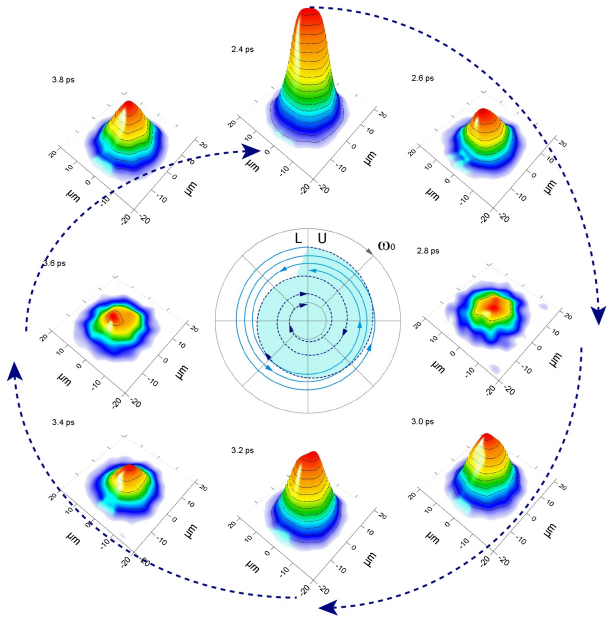
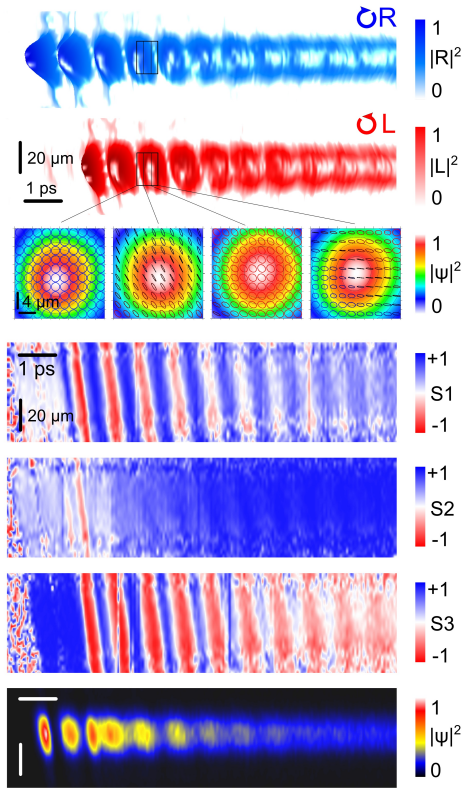
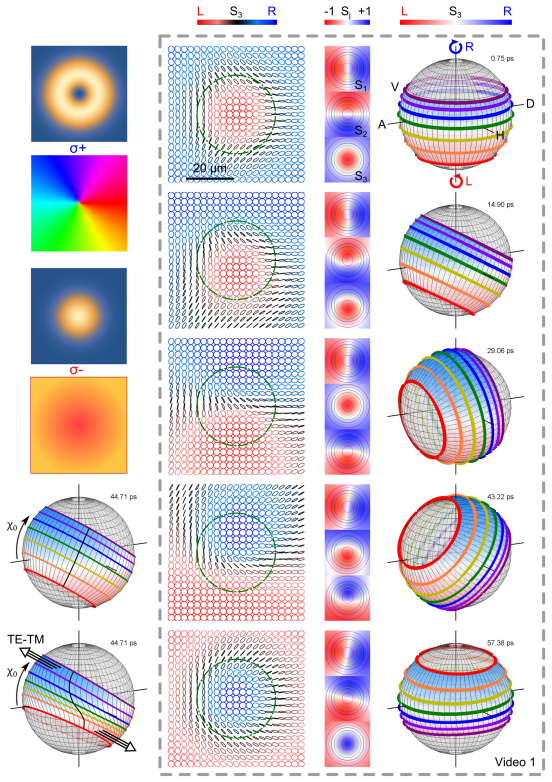
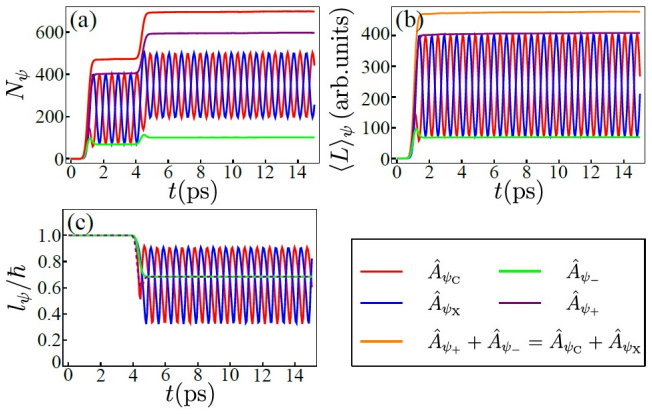
By rooting different polarization and topological states into the sub-picosecond Rabi oscillations of polariton fluids and using coherent control with two resonant pulses that exploit the four-component features of the two normal modes combined with two polarization degrees, the work achieves coherent control of the polariton state on the Bloch sphere, an ultrafast polarization sweeping of the Poincaré sphere, the dynamical twist of full Poincaré states such as the skyrmion, and a new kind of ultrafast swirling vortices characterized by one or more inner phase singularity tubes which spiral around the axis of propagation, arising from the splitting of the vortex into upper and lower polarit,
What carries the argument
The splitting of a vortex into upper and lower polaritons that produces an oscillatory exchange of energy and angular momentum.
If this is right
- The polariton state can be coherently controlled on the Bloch sphere via two-pulse excitation.
- Polarization states can be ultrafast swept across the Poincaré sphere.
- Full Poincaré states such as skyrmions can undergo dynamical twist on sub-picosecond scales.
- New oscillating topology states with spiraling inner phase singularity tubes are realized by adding angular momentum.
- The process emits time- and space-structured photonic packets from the polariton fluid.
Where Pith is reading between the lines
- The same two-pulse scheme might be adapted to generate higher-order topological structures by tuning pulse delays or amplitudes.
- The emitted structured photonic packets could be tested for use in ultrafast optical information encoding if the oscillation periods prove stable.
- Analogous splitting and exchange dynamics could appear in other coupled bosonic systems such as exciton-polariton lattices or magnon condensates.
- Extending the angular-momentum degree of freedom to multi-pulse sequences might produce more complex spiraling topologies for study.
Load-bearing premise
The observed dynamical twist of Poincaré states and the spiraling phase singularity tubes arise specifically from the splitting of the vortex into upper and lower polaritons with oscillatory exchange of energy and angular momentum, rather than from other fluid or imaging effects.
What would settle it
Time-resolved measurements that show no oscillatory exchange of energy or angular momentum between the upper and lower polariton branches, or phase singularities that remain static rather than spiraling under the two-pulse excitation, would falsify the mechanism.
Figures



read the original abstract
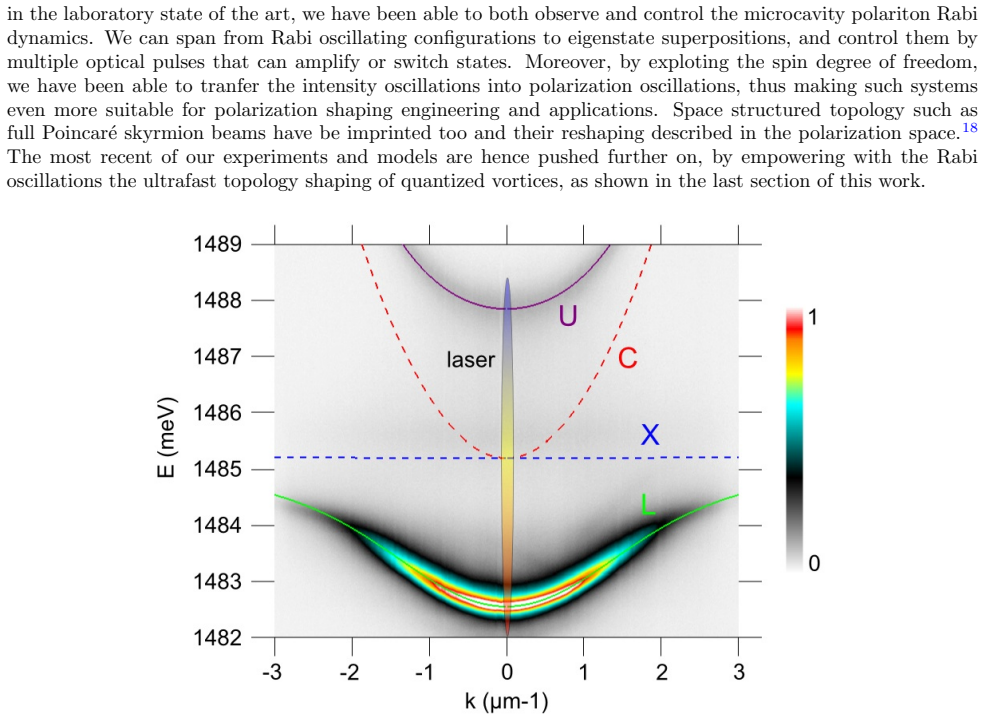
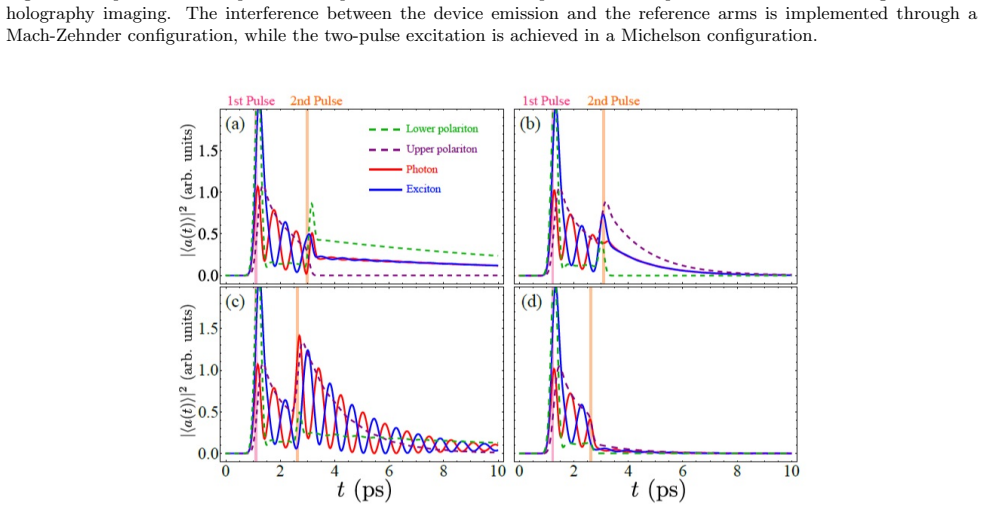
Here we present different approaches to ultrafast pulse and polarization shaping, based on a ``quantum fluid'' platform of polaritons. Indeed we exploit the normal modes of two dimensional polariton fluids made of strong coupled quantum well excitons and microcavity photons, by rooting different polarization and topological states into their sub-picosecond Rabi oscillations. Coherent control of two resonant excitation pulses allows us to prepare the desired state of the polariton, taking benefit from its four-component features given by the combination of the two normal modes with the two degrees of polarization. An ultrafast imaging based on the digital off-axis holography technique is implemented to study the polariton complex wavefunction with time and space resolution. We show in order coherent control of the polariton state on the Bloch sphere, an ultrafast polarization sweeping of the Poincar\'{e} sphere, and the dynamical twist of full Poincar\'{e} states such as the skyrmion on the sphere itself. Finally, we realize a new kind of ultrafast swirling vortices by adding the angular momentum degree of freedom to the two-pulse scheme. These oscillating topology states are characterized by one or more inner phase singularities tubes which spirals around the axis of propagation. The mechanism is devised in the splitting of the vortex into the upper and lower polaritons, resulting in an oscillatory exchange of energy and angular momentum and in the emitted time and space structured photonic packets.
Editorial analysis
A structured set of objections, weighed in public.
Referee Report
Summary. The manuscript demonstrates experimental approaches to ultrafast pulse, polarization, and topology shaping in polariton fluids using coherent control with two resonant excitation pulses and digital off-axis holography for time- and space-resolved imaging of the complex wavefunction. Key results include coherent control on the Bloch sphere, ultrafast polarization sweeping on the Poincaré sphere, dynamical twist of full Poincaré states such as skyrmions, and the creation of oscillating topology states characterized by spiraling inner phase singularity tubes, attributed to vortex splitting between upper and lower polariton branches enabling oscillatory exchange of energy and angular momentum.
Significance. If the central claims regarding the mechanism of the swirling vortices and the dynamical topological states are substantiated with quantitative evidence, this work would represent a significant advance in ultrafast control of structured light and topological polaritonics by leveraging Rabi oscillations and angular momentum degrees of freedom. The use of polariton fluids as a platform for such shaping could have implications for photonic devices and quantum fluid studies. However, the current lack of detailed quantitative comparisons and controls limits the immediate impact assessment.
major comments (1)
- [Abstract] Abstract (final paragraph): The claim that the spiraling phase singularity tubes arise specifically from the splitting of the vortex into upper and lower polaritons, resulting in oscillatory exchange of energy and angular momentum, is presented without quantitative support such as component-resolved intensity or phase maps separating upper and lower branches, measured oscillation periods matched to the Rabi frequency, or control experiments ruling out cavity propagation, polarization-dependent dispersion, or off-axis holography reconstruction artifacts. This attribution is load-bearing for the interpretation of the new ultrafast swirling vortices as a distinct topological phenomenon.
minor comments (1)
- [Abstract] The abstract and main text would benefit from explicit statements of the observed Rabi period, error bars on phase maps, and a dedicated methods subsection detailing the holography reconstruction procedure to allow independent assessment of potential artifacts.
Simulated Author's Rebuttal
We thank the referee for their careful reading of our manuscript and for the constructive feedback on the interpretation of the oscillating topological states. We address the single major comment below and outline the revisions we will implement to strengthen the quantitative support for our claims.
read point-by-point responses
-
Referee: [Abstract] Abstract (final paragraph): The claim that the spiraling phase singularity tubes arise specifically from the splitting of the vortex into upper and lower polaritons, resulting in oscillatory exchange of energy and angular momentum, is presented without quantitative support such as component-resolved intensity or phase maps separating upper and lower branches, measured oscillation periods matched to the Rabi frequency, or control experiments ruling out cavity propagation, polarization-dependent dispersion, or off-axis holography reconstruction artifacts. This attribution is load-bearing for the interpretation of the new ultrafast swirling vortices as a distinct topological phenomenon.
Authors: We agree that the abstract presents a concise interpretive claim and that explicit quantitative anchors would improve clarity. The main text already contains time-resolved complex-field reconstructions from off-axis holography that exhibit periodic spiraling of the phase singularities with a temporal period matching the independently measured Rabi frequency of the microcavity system. The four-component (upper/lower branch × TE/TM polarization) structure of the polariton fluid underpins the proposed splitting mechanism, and the observed energy and angular-momentum exchange is inferred from the joint temporal and spatial dynamics. Nevertheless, we acknowledge that branch-specific intensity/phase maps, a direct period-to-Rabi-frequency comparison, and explicit artifact controls are not highlighted as prominently as they should be. In the revised manuscript we will: (i) add a brief clause to the abstract referencing the supporting observations, (ii) include supplementary component-resolved maps obtained by temporal gating around the Rabi oscillation, (iii) insert a quantitative comparison of the measured oscillation period to the Rabi frequency, and (iv) expand the discussion section to address possible cavity-propagation, dispersion, and reconstruction artifacts with available control data. These changes will be incorporated in the next version. revision: partial
Circularity Check
No circularity: experimental imaging of polariton dynamics with no self-referential derivation
full rationale
The manuscript is an experimental report on two-pulse coherent control and off-axis holographic imaging of polariton wavefunctions in a microcavity. All central claims (ultrafast polarization sweeping, dynamical twist of Poincaré states, spiraling phase singularity tubes) are presented as direct observations of the complex field rather than as outputs of a closed mathematical derivation. No equations, fitted parameters, or self-citations are invoked in a load-bearing way that would make a stated prediction equivalent to its own input by construction. The interpretive attribution to upper/lower polariton splitting is offered as a physical mechanism consistent with the data, not as a theorem derived from prior self-cited results. This is the standard non-circular case for an optics experiment.
Axiom & Free-Parameter Ledger
axioms (1)
- domain assumption Strong coupling regime produces well-defined upper and lower polariton normal modes with Rabi oscillations
Reference graph
Works this paper leans on
-
[1]
Exciton-polariton condensates,
Byrnes, T., Kim, N. Y., and Yamamoto, Y., “Exciton-polariton condensates,”Nat. Phys.10(11), 803–813 (2014)
work page 2014
-
[2]
Bose-Einstein condensation of exciton polaritons.,
Kasprzak, J., Richard, M., Kundermann, S., Baas, A., Jeambrun, P., Keeling, J. M. J., Marchetti, F. M., Szyma´ nska, M. H., Andr´ e, R., Staehli, J. L., Savona, V., Littlewood, P. B., Deveaud, B., and Dang, L. S., “Bose-Einstein condensation of exciton polaritons.,”Nature443(7110), 409–414 (2006)
work page 2006
-
[3]
Bose-Einstein condensation of microcavity polaritons in a trap,
Balili, R., Hartwell, V., Snoke, D., Pfeiffer, L., and West, K., “Bose-Einstein condensation of microcavity polaritons in a trap,”Science316(5827), 1007–1010 (2007)
work page 2007
-
[4]
Polariton pattern formation and its statistical properties in a semiconductor microcavity,
Whittaker, C. E., Dzurnak, B., Egorov, O. A., Buonaiuto, G., Walker, P. M., Cancellieri, E., Whittaker, D. M., Clarke, E., Gavrilov, S. S., Skolnick, M. S., and Krizhanovskii, D. N., “Polariton pattern formation and its statistical properties in a semiconductor microcavity,”arXiv:1612.03048 [cond-mat](2016). arXiv: 1612.03048
-
[5]
Real-space collapse of a polariton condensate,
Dominici, L., Petrov, M., Matuszewski, M., Ballarini, D., De Giorgi, M., Colas, D., Cancellieri, E., Silva Fern´ andez, B., Bramati, A., Gigli, G., Kavokin, A., Laussy, F., and Sanvitto, D., “Real-space collapse of a polariton condensate,”Nat. Commun.6, 8993 (2015)
work page 2015
-
[6]
Coupled counterrotating polariton condensates in optically defined annular potentials,
Dreismann, A., Cristofolini, P., Balili, R., Christmann, G., Pinsker, F., Berloff, N. G., Hatzopoulos, Z., Savvidis, P. G., and Baumberg, J. J., “Coupled counterrotating polariton condensates in optically defined annular potentials,”Proc. Natl. Acad. Sci.111(24), 8770–8775 (2014)
work page 2014
-
[7]
Power-law decay of the spatial correlation function in exciton-polariton condensates,
Roumpos, G., Lohse, M., Nitsche, W. H., Keeling, J., Szyma´ nska, M. H., Littlewood, P. B., L¨ offler, A., H¨ ofling, S., Worschech, L., Forchel, A., and Yamamoto, Y., “Power-law decay of the spatial correlation function in exciton-polariton condensates,”Proc. Natl. Acad. Sci.109(17), 6467–6472 (2012)
work page 2012
-
[8]
Polariton superfluids reveal quantum hydrody- namic solitons.,
Amo, A., Pigeon, S., Sanvitto, D., Sala, V. G., Hivet, R., Carusotto, I., Pisanello, F., Lem´ enager, G., Houdr´ e, R., Giacobino, E., Ciuti, C., and Bramati, A., “Polariton superfluids reveal quantum hydrody- namic solitons.,”Science332(6034), 1167–1170 (2011)
work page 2011
-
[9]
Hydrodynamic nucleation of vortices and solitons in a resonantly excited polariton superfluid,
Pigeon, S., Carusotto, I., and Ciuti, C., “Hydrodynamic nucleation of vortices and solitons in a resonantly excited polariton superfluid,”Phys. Rev. B83(14), 144513 (2011)
work page 2011
-
[10]
Persistent currents and quantized vortices in a polariton superfluid,
Sanvitto, D., Marchetti, F. M., Szyma´ nska, M. H., Tosi, G., Baudisch, M., Laussy, F. P., Krizhanovskii, D. N., Skolnick, M. S., Marrucci, L., Lemaˆ ıtre, A., Bloch, J., Tejedor, C., and Vi˜ na, L., “Persistent currents and quantized vortices in a polariton superfluid,”Nat. Phys.6(7), 527–533 (2010)
work page 2010
-
[11]
Superfluidity of polaritons in semiconductor microcavities,
Amo, A., Lefr` ere, J., Pigeon, S., Adrados, C., Ciuti, C., Carusotto, I., Houdr´ e, R., Giacobino, E., and Bra- mati, A., “Superfluidity of polaritons in semiconductor microcavities,”Nat. Phys.5(11), 805–810 (2009)
work page 2009
-
[12]
Quantized vortices in an exciton-polariton condensate,
Lagoudakis, K. G., Wouters, M., Richard, M., Baas, A., Carusotto, I., Andr´ e, R., Dang, L. S., and Deveaud-Pl´ edran, B., “Quantized vortices in an exciton-polariton condensate,”Nat. Phys.4(9), 706–710 (2008)
work page 2008
-
[13]
Spin-to-orbital angular momentum conversion in semiconductor microcavities,
Manni, F., Lagoudakis, K. G., Para¨ ıso, T. K., Cerna, R., L´ eger, Y., Liew, T. C. H., Shelykh, I. A., Kavokin, A. V., Morier-Genoud, F., and Deveaud-Pl´ edran, B., “Spin-to-orbital angular momentum conversion in semiconductor microcavities,”Phys. Rev. B83, 241307 (2011)
work page 2011
-
[14]
Warping and interactions of vortices in exciton-polariton condensates,
Toledo-Solano, M., Mora-Ramos, M. E., Figueroa, A., and Rubo, Y. G., “Warping and interactions of vortices in exciton-polariton condensates,”Phys. Rev. B89, 035308 (2014)
work page 2014
-
[15]
Topological stability of the half-vortices in spinor exciton-polariton condensates,
Flayac, H., Shelykh, I. A., Solnyshkov, D. D., and Malpuech, G., “Topological stability of the half-vortices in spinor exciton-polariton condensates,”Phys. Rev. B81, 045318 (2010)
work page 2010
-
[16]
Ultrafast control and Rabi oscillations of polaritons,
Dominici, L., Colas, D., Donati, S., Restrepo Cuartas, J. P., De Giorgi, M., Ballarini, D., Guirales, G., L´ opez Carre´ no, J. C., Bramati, A., Gigli, G., del Valle, E., Laussy, F. P., and Sanvitto, D., “Ultrafast control and Rabi oscillations of polaritons,”Phys. Rev. Lett.113, 226401 (2014)
work page 2014
-
[17]
Polarization shaping of Poincar´ e beams by polariton oscillations,
Colas, D., Dominici, L., Donati, S., Pervishko, A. A., Liew, T. C., Shelykh, I. A., Ballarini, D., De Giorgi, M., Bramati, A., Gigli, G., Valle, E. d., Laussy, F. P., Kavokin, A. V., and Sanvitto, D., “Polarization shaping of Poincar´ e beams by polariton oscillations,”Light Sci. Appl.4(11), e350 (2015)
work page 2015
-
[18]
Twist of generalized skyrmions and spin vortices in a polariton superfluid,
Donati, S., Dominici, L., Dagvadorj, G., Ballarini, D., De Giorgi, M., Bramati, A., Gigli, G., Rubo, Y. G., Szyma´ nska, M. H., and Sanvitto, D., “Twist of generalized skyrmions and spin vortices in a polariton superfluid,”Proc. Natl. Acad. Sci.113(52), 14926–14931 (2016)
work page 2016
- [19]
-
[20]
Nielsen, M. A. and Chuang, I. L., [Quantum computation and quantum information], Cambridge University Press (2000)
work page 2000
-
[21]
Spreeuw, R. and Woerdman, J., “Optical atoms,”Progress in Optics31, 263 (1993)
work page 1993
-
[22]
Coherent control of a classical nanomechanical two-level system,
Faust, T., Rieger, J., Seitner, M. J., Kotthaus, J. P., and Weig, E. M., “Coherent control of a classical nanomechanical two-level system,”Nat. Phys.9, 485 (2013)
work page 2013
-
[23]
Zhu, Y., Gauthier, D. J., Morin, S. E., Wu, Q., Carmichael, H. J., and Mossberg, T. W., “Vacuum Rabi splitting as a feature of linear-dispersion theory: Analysis and experimental observations,”Phys. Rev. Lett.64, 2499 (1990)
work page 1990
-
[24]
Vacuum Rabi splitting in semicon- ductors,
Khitrova, G., Gibbs, H. M., Kira, M., Koch, S. W., and Scherer, A., “Vacuum Rabi splitting in semicon- ductors,”Nat. Phys.2, 81 (2006)
work page 2006
-
[25]
Watching a superfluid untwist itself: Recurrence of Rabi oscillations in a Bose–Einstein condensate,
Matthews, M. R., Anderson, B. P., Haljan, P. C., Hall, D. S., Holland, M. J., Williams, J. E., Wieman, C. E., and Cornell, E. A., “Watching a superfluid untwist itself: Recurrence of Rabi oscillations in a Bose–Einstein condensate,”Phys. Rev. Lett.83, 3358 (1999)
work page 1999
-
[26]
Vasa, P., Wang, W., Pomraenke, R., Lammers, M., Maiuri, M., Manzoni, C., Cerullo, G., and Lienau, C., “Real-time observation of ultrafast Rabi oscillations between excitons and plasmons in metal nanostructures with J-aggregates,”Nat. Photon.7, 128 (2013)
work page 2013
-
[27]
A classical analogy of entanglement,
Spreeuw, R. J. C., “A classical analogy of entanglement,”Found. Phys.28, 361 (1998)
work page 1998
-
[28]
and Dragoman, M., [Quantum-Classical Analogies], The Frontiers Collection, Springer (2004)
Dragoman, D. and Dragoman, M., [Quantum-Classical Analogies], The Frontiers Collection, Springer (2004)
work page 2004
-
[29]
Classical realization of a strongly driven two-level system,
Spreeuw, R. J. C., van Druten, N. J., Beijersbergen, M. W., Eliel, E. R., and Woerdman, J. P., “Classical realization of a strongly driven two-level system,”Phys. Rev. Lett.65, 2642 (1990)
work page 1990
-
[30]
Coherent phonon manipulation in coupled mechanical resonators,
Okamoto, H., Gourgout, A., Chang, C.-Y., Onomitsu, K., Mahboob, I., Chang, E. Y., and Yamaguchi, H., “Coherent phonon manipulation in coupled mechanical resonators,”Nat. Phys.9, 480 (2013)
work page 2013
-
[31]
J., Malpuech, G., and Laussy, F
Kavokin, A., Baumberg, J. J., Malpuech, G., and Laussy, F. P., [Microcavities], Oxford University Press, 2 ed. (2011)
work page 2011
-
[32]
Quantum nature of a strongly coupled single quantum dot–cavity system,
Hennessy, K., Badolato, A., Winger, M., Gerace, D., Atature, M., Gulde, S., F˘ alt, S., Hu, E. L., and ˘Imamo¯ glu, A., “Quantum nature of a strongly coupled single quantum dot–cavity system,”Nature445, 896 (2007)
work page 2007
-
[33]
Observation of the coupled exciton-photon mode splitting in a semiconductor quantum microcavity,
Weisbuch, C., Nishioka, M., Ishikawa, A., and Arakawa, Y., “Observation of the coupled exciton-photon mode splitting in a semiconductor quantum microcavity,”Phys. Rev. Lett.69, 3314 (1992)
work page 1992
-
[34]
Carusotto, I. and Ciuti, C., “Quantum fluids of light,”Rev. Mod. Phys.85, 299 (2013)
work page 2013
-
[35]
Bose–Einstein condensation of exciton polaritons,
Kasprzak, J., Richard, M., Kundermann, S., Baas, A., Jeambrun, P., Keeling, J. M. J., Marchetti, F. M., Szymanska, M. H., Andr´ e, R., Staehli, J. L., Savona, V., Littlewood, P. B., Deveaud, B., and Le Si Dang, “Bose–Einstein condensation of exciton polaritons,”Nature443, 409 (2006)
work page 2006
-
[36]
Collective fluid dynamics of a polariton condensate in a semiconductor microcavity,
Amo, A., Sanvitto, D., Laussy, F. P., Ballarini, D., del Valle, E., Martin, M. D., Lemaˆ ıtre, A., Bloch, J., Krizhanovskii, D. N., Skolnick, M. S., Tejedor, C., and Vi˜ na, L., “Collective fluid dynamics of a polariton condensate in a semiconductor microcavity,”Nature457, 291 (2009)
work page 2009
-
[37]
Optical circuits based on polariton neurons in semiconductor microcavities,
Liew, T. C. H., Kavokin, A. V., and Shelykh, I. A., “Optical circuits based on polariton neurons in semiconductor microcavities,”Phys. Rev. Lett.101, 016402 (2008)
work page 2008
-
[38]
Exciton-polariton spin switches,
Amo, A., Liew, T. C. H., Adrados, C., Houdr´ e, R., Giacobino, E., Kavokin, A. V., and Bramati, A., “Exciton-polariton spin switches,”Nat. Photon.4, 361 (2010)
work page 2010
-
[39]
Spontaneous polarization buildup in a room-temperature polariton laser,
Baumberg, J. J., Kavokin, A. V., Christopoulos, S., Grundy, A. J. D., Butt´ e, R., Christmann, G., Sol- nyshkov, D. D., Malpuech, G., von H¨ ogersthal, G. B. H., Feltin, E., Carlin, J.-F., and Grandjean, N., “Spontaneous polarization buildup in a room-temperature polariton laser,”Phys. Rev. Lett.101, 136409 (2008)
work page 2008
-
[40]
An electrically pumped polariton laser,
Schneider, C., Rahimi-Iman, A., Kim, N. Y., Fischer, J., Savenko, I. G., Amthor, M., Lermer, M., Wolf, A., Worschech, L., Kulakovskii, V. D., Shelykh, I. A., Kamp, M., Reitzenstein, S., Forchel, A., Yamamoto, Y., and H¨ ofling, S., “An electrically pumped polariton laser,”Nature497, 348 (2013)
work page 2013
-
[41]
All-optical polariton transistor.,
Ballarini, D., De Giorgi, M., Cancellieri, E., Houdr´ e, R., Giacobino, E., Cingolani, R., Bramati, A., Gigli, G., and Sanvitto, D., “All-optical polariton transistor.,”Nat. Commun.4, 1778 (2013)
work page 2013
-
[42]
Time-resolved vacuum Rabi oscillations in a semiconductor quantum microcavity,
Norris, T., Rhee, J.-K., Sung, C.-Y., Arakawa, Y., Nishioka, M., and Weisbuch, C., “Time-resolved vacuum Rabi oscillations in a semiconductor quantum microcavity,”Phys. Rev. B50, 14663 (1994)
work page 1994
-
[43]
Savona, V. and Weisbuch, C., “Theory of time-resolved light emission from polaritons in a semiconductor microcavity under resonant excitation,”Phys. Rev. B54, 10835 (1996)
work page 1996
-
[44]
Coherent oscillations in semiconductor microcavities,
Wang, H., Shah, J., Damen, T. C., Jan, W. Y., Cunningham, J. E., Hong, M., and Mannaerts, J. P., “Coherent oscillations in semiconductor microcavities,”Phys. Rev. B51, 14713 (1995)
work page 1995
-
[45]
Coherent control of exciton polaritons in a semiconductor microcavity,
Marie, X., Renucci, P., Dubourg, S., Amand, T., Jeune, P. L., Barrau, J., Bloch, J., and Planel, R., “Coherent control of exciton polaritons in a semiconductor microcavity,”Phys. Rev. B59, 2494(R) (1999)
work page 1999
-
[46]
Coherent dynamics of microcavity polaritons in the nonlinear regime,
Huynh, A., Tignon, J., Roussignol, P., Delalande, C., Andr´ e, R., Romestain, R., and D. Le Si Dang, “Coherent dynamics of microcavity polaritons in the nonlinear regime,”Physica E13, 427 (2002)
work page 2002
-
[47]
Observation of spin beats at the Rabi frequency in microcavities,
Brunetti, A., Vladimirova, M., Scalbert, D., Nawrocki, M., Kavokin, A. V., Shelykh, I. A., and Bloch, J., “Observation of spin beats at the Rabi frequency in microcavities,”Phys. Rev. B74, 241101(R) (2006)
work page 2006
-
[48]
All Optical Switch of Vacuum Rabi Oscillations: The Ultrafast Quantum Eraser,
Ridolfo, A., Vilardi, R., Di Stefano, O., Portolan, S., and Savasta, S., “All Optical Switch of Vacuum Rabi Oscillations: The Ultrafast Quantum Eraser,”Phys. Rev. Lett.106, 013601 (2011)
work page 2011
-
[49]
Polariton-generated intensity squeezing in semiconductor micropillars,
Boulier, T., Bamba, M., Amo, A., Adrados, C., Lemaˆ ıtre, A., Galopin, E., Sagnes, I., Bloch, J., Ciuti, C., Giacobino, E., and Bramati, A., “Polariton-generated intensity squeezing in semiconductor micropillars,” Nat. Commun.5(2014)
work page 2014
-
[50]
Entangling a polariton with one photon: effect of interactions at the single-particle level,
Cuevas, A., Silva, B., Carre˜ no, J. C. L., De Giorgi, M., Mu˜ noz, C. S., Fieramosca, A., Forero, D. G. S., Cardano, F., Marrucci, L., Tasco, V., Biasiol, G., del Valle, E., Dominici, L., Ballarini, D., Gigli, G., Mataloni, P., Laussy, F. P., Sciarrino, F., and Sanvitto, D., “Entangling a polariton with one photon: effect of interactions at the single-pa...
-
[51]
Hydrody- namic nucleation of quantized vortex pairs in a polariton quantum fluid,
Nardin, G., Grosso, G., L´ eger, Y., Pi¸ etka, B., Morier-Genoud, F., and Deveaud-Pl´ edran, B., “Hydrody- namic nucleation of quantized vortex pairs in a polariton quantum fluid,”Nat. Phys.7, 635–641 (2011)
work page 2011
-
[52]
Role of supercurrents on vortices formation in polariton condensates,
Ant´ on, C., Tosi, G., Mart´ ın, M. D., Vi˜ na, L., Lemaˆ ıtre, A., and Bloch, J., “Role of supercurrents on vortices formation in polariton condensates,”Opt. Express20(15), 16366 (2012)
work page 2012
-
[53]
and J¨ uptner, W., [Digital Holography], Springer Berlin Heidelberg (2005)
Schnars, U. and J¨ uptner, W., [Digital Holography], Springer Berlin Heidelberg (2005)
work page 2005
-
[54]
Femtosecond polarization pulse shaping,
Brixner, T. and Gerber, G., “Femtosecond polarization pulse shaping,”Opt. Lett.26(8), 557 (2001)
work page 2001
-
[55]
Polarization controller using nematic liquid crystals,
Zhuang, Z., Suh, S.-W., and Patel, J. S., “Polarization controller using nematic liquid crystals,”Opt. Lett.24(10), 694 (1999)
work page 1999
-
[56]
Quantum Control by Ultrafast Polarization Shaping,
Brixner, T., Krampert, G., Pfeifer, T., Selle, R., Gerber, G., Wollenhaupt, M., Graefe, O., Horn, C., Liese, D., and Baumert, T., “Quantum Control by Ultrafast Polarization Shaping,”Phys. Rev. Lett.92(20) (2004)
work page 2004
-
[57]
Adaptive subwavelength control of nano-optical fields,
Aeschlimann, M., Bauer, M., Bayer, D., Brixner, T., Garc´ ıa de Abajo, F. J., Pfeiffer, W., Rohmer, M., Spindler, C., and Steeb, F., “Adaptive subwavelength control of nano-optical fields,”Nature446(7133), 301–304 (2007)
work page 2007
-
[58]
Zeptosecond precision pulse shaping,
K¨ ohler, J., Wollenhaupt, M., Bayer, T., Sarpe, C., and Baumert, T., “Zeptosecond precision pulse shaping,” Opt. Express19(12), 11638 (2011)
work page 2011
-
[59]
Rodr´ ıguez-Fortu˜ no, F. J., Puerto, D., Griol, A., Bellieres, L., Mart´ ı, J., and Mart´ ınez, A., “Universal method for the synthesis of arbitrary polarization states radiated by a nanoantenna: Synthezising arbitrary polarization states with a single nanoantenna,”Laser Photon. Rev.8, L27–L31 (May 2014)
work page 2014
-
[60]
Parallel Polarization State Generation,
She, A. and Capasso, F., “Parallel Polarization State Generation,”Sci. Rep.6, 26019 (May 2016)
work page 2016
-
[61]
Beckley, A. M., Brown, T. G., and Alonso, M. A., “Full Poincar´ e beams,”Opt. Express18(10), 10777 (2010)
work page 2010
-
[62]
Long- range ballistic motion and coherent flow of long-lifetime polaritons,
Steger, M., Liu, G., Nelsen, B., Gautham, C., Snoke, D. W., Balili, R., Pfeiffer, L., and West, K., “Long- range ballistic motion and coherent flow of long-lifetime polaritons,”Phys. Rev. B88, 235314 (2013)
work page 2013
-
[63]
Kavokin, A., Malpuech, G., and Glazov, M., “Optical spin Hall effect,”Phys. Rev. Lett.95, 136601 (Sep 2005)
work page 2005
-
[64]
Observation of the optical spin Hall effect,
Leyder, C., Romanelli, M., Karr, J. P., Giacobino, E., Liew, T. C. H., Glazov, M. M., Kavokin, A. V., Malpuech, G., and Bramati, A., “Observation of the optical spin Hall effect,”Nat. Phys.3, 628–631 (Sept. 2007)
work page 2007
-
[65]
Nonlinear optical spin Hall effect and long-range spin transport in polariton lasers,
Kammann, E., Liew, T. C. H., Ohadi, H., Cilibrizzi, P., Tsotsis, P., Hatzopoulos, Z., Savvidis, P. G., Kavokin, A. V., and Lagoudakis, P. G., “Nonlinear optical spin Hall effect and long-range spin transport in polariton lasers,”Phys. Rev. Lett.109, 036404 (Jul 2012)
work page 2012
-
[66]
Half-skyrmion spin textures in polariton microcavities,
Cilibrizzi, P., Sigurdsson, H., Liew, T. C. H., Ohadi, H., Askitopoulos, A., Brodbeck, S., Schneider, C., Shelykh, I. A., H¨ ofling, S., Ruostekoski, J., and Lagoudakis, P., “Half-skyrmion spin textures in polariton microcavities,”Phys. Rev. B94, 045315 (Jul 2016)
work page 2016
-
[67]
Cilibrizzi, P., Sigurdsson, H., Liew, T. C. H., Ohadi, H., Wilkinson, S., Askitopoulos, A., Shelykh, I. A., and Lagoudakis, P. G., “Polariton spin whirls,”Phys. Rev. B92, 155308 (Oct 2015)
work page 2015
-
[68]
Huge splitting of polariton states in microcavities under stress,
Balili, R., Nelsen, B., Snoke, D. W., Reid, R. H., Pfeiffer, L., and West, K., “Huge splitting of polariton states in microcavities under stress,”Phys. Rev. B81(Mar. 2010)
work page 2010
-
[69]
Optical anisotropy and pinning of the linear polarization of light in semiconductor microcavi- ties,
Klopotowski, L., Mart´ ın, M., Amo, A., Vi˜ na, L., Shelykh, I., Glazov, M., Malpuech, G., Kavokin, A., and Andr´ e, R., “Optical anisotropy and pinning of the linear polarization of light in semiconductor microcavi- ties,”Solid State Commun.139, 511–515 (Sept. 2006)
work page 2006
-
[70]
Cardano, F., Karimi, E., Slussarenko, S., Marrucci, L., de Lisio, C., and Santamato, E., “Polarization pattern of vector vortex beams generated by q-plates with different topological charges,”Appl. Opt.51, C1–C6 (Apr 2012)
work page 2012
-
[71]
Vortex and half-vortex dynamics in a nonlinear spinor quantum fluid,
Dominici, L., Dagvadorj, G., Fellows, J. M., Ballarini, D., De Giorgi, M., Marchetti, F. M., Piccirillo, B., Marrucci, L., Bramati, A., Gigli, G., Szyma´ nska, M. H., and Sanvitto, D., “Vortex and half-vortex dynamics in a nonlinear spinor quantum fluid,”Sci. Adv.1(11), e1500807 (2015)
work page 2015
-
[72]
Integrated multi vector vortex beam generator,
Schulz, S. A., Machula, T., Karimi, E., and Boyd, R. W., “Integrated multi vector vortex beam generator,” Opt. Express21(13), 16130 (2013)
work page 2013
-
[73]
Polarization Shaping for Control of Nonlinear Propagation,
Bouchard, F., Larocque, H., Yao, A. M., Travis, C., De Leon, I., Rubano, A., Karimi, E., Oppo, G.-L., and Boyd, R. W., “Polarization Shaping for Control of Nonlinear Propagation,”Phys. Rev. Lett.117(23) (2016)
work page 2016
-
[74]
Half vortices in exciton polariton condensates,
Rubo, Y. G., “Half vortices in exciton polariton condensates,”Phys. Rev. Lett.99, 106401 (Sept. 2007)
work page 2007
-
[75]
Vortices in high-temperature superconductors,
Blatter, G., Feigel’man, M. V., Geshkenbein, V. B., Larkin, A. I., and Vinokur, V. M., “Vortices in high-temperature superconductors,”Rev. Mod. Phys.66(4), 1125–1388 (1994)
work page 1994
-
[76]
Leggett, A. J., “Superfluidity,”Rev. Mod. Phys.71(2), S318–S323 (1999)
work page 1999
-
[77]
Vortices in a Bose–Einstein condensate,
Matthews, M. R., Anderson, B. P., Haljan, P. C., Hall, D. S., Wieman, C. E., and Cornell, E. A., “Vortices in a Bose–Einstein condensate,”Phys. Rev. Lett.83, 2498 (1999)
work page 1999
-
[78]
Spontaneous vortices in the formation of Bose-Einstein condensates,
Weiler, C. N., Neely, T. W., Scherer, D. R., Bradley, A. S., Davis, M. J., and Anderson, B. P., “Spontaneous vortices in the formation of Bose-Einstein condensates,”Nature455(7215), 948–951 (2008)
work page 2008
-
[79]
Characterization of reconnecting vortices in superfluid helium,
Bewley, G. P., Paoletti, M. S., Sreenivasan, K. R., and Lathrop, D. P., “Characterization of reconnecting vortices in superfluid helium,”Proc. Natl. Acad. Sci.105(37), 13707–13710 (2008)
work page 2008
-
[80]
Observation of Vortex Lattices in Bose- Einstein Condensates,
Abo-Shaeer, J. R., Raman, C., Vogels, J. M., and Ketterle, W., “Observation of Vortex Lattices in Bose- Einstein Condensates,”Science292(5516), 476–479 (2001)
work page 2001
discussion (0)
Sign in with ORCID, Apple, or X to comment. Anyone can read and Pith papers without signing in.