Recognition: 2 theorem links
· Lean TheoremGeometrically Approximated Modeling for Emitter-Centric Ray-Triangle Filtering in Arbitrarily Dynamic LiDAR Simulation
Pith reviewed 2026-05-12 04:54 UTC · model grok-4.3
The pith
GRCA inverts the ray-triangle query by determining per triangle which rays from a spinning LiDAR can hit it, using geometric emitter models to avoid acceleration structures in dynamic scenes.
A machine-rendered reading of the paper's core claim, the machinery that carries it, and where it could break.
Core claim
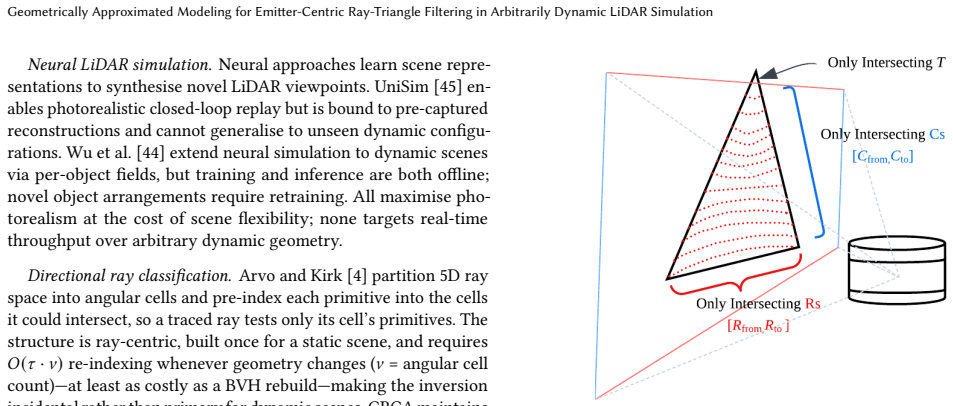
The paper establishes that geometrically approximating spinning LiDAR emitters as rotation-traced cones or planes enables an emitter-centric apparent area culling strategy. This strategy determines per triangle which sensor channels and rays within them can reach it, eliminating the need for acceleration structures and their associated rebuild costs in arbitrarily dynamic scenes. GRCA is presented as a general-purpose ray-casting algorithm applicable whenever ray origins are known in advance.
What carries the argument
Emitter-centric apparent area culling based on rotation-traced cone or plane approximations of LiDAR emitters.
If this is right
- The need to rebuild acceleration structures every frame is eliminated for dynamic geometry.
- High-resolution multi-LiDAR simulations become practical even with millions of moving triangles.
- Independent extensions such as range culling and hybrid static-dynamic pipelines provide additional performance improvements.
- The approach applies beyond LiDAR to any ray casting scenario with known emitter positions.
Where Pith is reading between the lines
- This inversion could inspire similar per-object filtering in other ray-based simulations like audio or light propagation in dynamic settings.
- If the approximation holds across more sensor types, it might simplify real-time sensor fusion in autonomous systems testing.
- Extending the geometric model to include more complex emitter motions could broaden its use in non-spinning sensor simulations.
Load-bearing premise
The rotation-traced cone and plane models of the LiDAR emitter accurately capture all possible ray directions without missing intersections or introducing too many false positives.
What would settle it
A test scene containing a triangle that the approximation culls away from all rays but that a real spinning emitter ray would intersect.
Figures



read the original abstract
Real-time Light Detection And Ranging (LiDAR) simulation must find, per emitted ray, the closest intersecting triangle even in dynamic scenes containing large numbers of moving and deformable objects. Dominant acceleration-structure approaches require rebuilding each frame for dynamic geometry -- a cost that compounds directly with scene dynamics and cannot be amortized regardless of how little actually changed. This paper presents the Gajmer Ray-Casting Algorithm (GRCA), which inverts the question: instead of asking what does each ray hit? it asks which rays can each triangle possibly hit? GRCA geometrically models spinning LiDAR emitters as rotation-traced cones or planes and uses each triangle's emitter-centric apparent area to cull, per triangle, which channels and the rays within those channels can possibly reach it -- without any acceleration structure. GRCA is compute-based and vendor-agnostic by design, targeting highly dynamic, high-resolution simultaneous multi-sensor simulation. At its core, GRCA is a general-purpose ray-casting algorithm: the emitter-centric inversion applies to any setting where rays originate from a known position, not only LiDAR. Benchmarks evaluate 2-8 simultaneous 128x4096-ray LiDARs (360deg/180deg) over complex dynamic scenes -- with just two sensors casting ~1M rays per frame. With range culling inactive, GRCA reaches up to 7.97x over hardware-accelerated OptiX (GPU) and 14.55x over Embree (CPU). Two independent extensions further boost performance even in the most complex scene (~22M triangles, ~9M of which are dynamic, 8 LiDARs): range culling at realistic deployment ranges (10-100m) reaches up to 7.02x GPU and 9.33x CPU; a hybrid pipeline -- GRCA for dynamic geometry, OptiX/Embree for static -- reaches up to 10.5x GPU and 19.2x CPU.
Editorial analysis
A structured set of objections, weighed in public.
Referee Report
Summary. The paper introduces the Gajmer Ray-Casting Algorithm (GRCA) for real-time LiDAR simulation in arbitrarily dynamic scenes. Instead of per-ray traversal with rebuilt acceleration structures, GRCA inverts the problem to per-triangle emitter-centric culling: spinning LiDAR emitters are modeled geometrically as rotation-traced cones or planes, and each triangle's apparent area from the emitter is used to determine which sensor channels and rays within them can possibly intersect it. The method is compute-based and vendor-agnostic, with no acceleration structure required. Benchmarks on scenes up to ~22M triangles (9M dynamic) with 2-8 simultaneous 128x4096-ray LiDARs report speedups of up to 7.97x over OptiX (GPU) and 14.55x over Embree (CPU) without range culling; further gains to 10.5x GPU / 19.2x CPU are claimed with range culling and a hybrid static/dynamic pipeline.
Significance. If the culling predicate is a sound over-approximation that guarantees zero false negatives across all tested configurations, GRCA would represent a meaningful advance for high-resolution, multi-sensor dynamic LiDAR simulation by amortizing costs away from per-frame rebuilds. The explicit focus on dynamic geometry, simultaneous sensors, and a general ray-casting formulation (not LiDAR-specific) strengthens the potential impact for robotics and autonomous-systems testing pipelines.
major comments (3)
- [Abstract] Abstract and performance claims: the headline speedups (7.97x GPU / 14.55x CPU without range culling; up to 19.2x with hybrid pipeline) are load-bearing for the contribution, yet the manuscript provides no details on measurement methodology, baseline fairness (e.g., OptiX/Embree configuration, build flags, hardware), error metrics for culling accuracy, or handling of edge cases such as grazing rays and non-rigid deformation. Without these, the reported factors cannot be independently verified.
- [GRCA algorithm description] Core GRCA geometric construction (emitter-centric cone/plane approximation + apparent-area culling): the central correctness invariant—that the per-triangle bounds are a sound over-approximation producing no false negatives—is asserted but not supported by a formal proof, exhaustive edge-case enumeration, or machine-checked verification. This invariant is load-bearing for all performance claims, as any missed intersection would invalidate the replacement of full traversal.
- [Benchmarks] Dynamic-scene evaluation: the most complex benchmark (~22M triangles, ~9M dynamic, 8 LiDARs) is used to support the hybrid-pipeline gains, but no breakdown is given of how rapidly deforming meshes or sensor overlap affect the culling predicate tightness or false-positive rate.
minor comments (2)
- [Algorithm] Notation for rotation-traced cones/planes and apparent-area projection should be introduced with explicit equations and a diagram showing the emitter-centric coordinate frame.
- [Abstract] The abstract states GRCA is 'general-purpose' for any known-origin rays, but the evaluation remains LiDAR-specific; a short non-LiDAR example would clarify the scope.
Simulated Author's Rebuttal
We thank the referee for the thoughtful and detailed report. The comments highlight important aspects of reproducibility, correctness justification, and evaluation depth. We address each major comment below and have prepared revisions to strengthen the manuscript where the concerns are valid.
read point-by-point responses
-
Referee: [Abstract] Abstract and performance claims: the headline speedups (7.97x GPU / 14.55x CPU without range culling; up to 19.2x with hybrid pipeline) are load-bearing for the contribution, yet the manuscript provides no details on measurement methodology, baseline fairness (e.g., OptiX/Embree configuration, build flags, hardware), error metrics for culling accuracy, or handling of edge cases such as grazing rays and non-rigid deformation. Without these, the reported factors cannot be independently verified.
Authors: We agree that the original manuscript lacked sufficient methodological detail for independent verification. In the revised version we have added a new subsection (Experiments, 5.1) that specifies: hardware (Intel Xeon Gold 6248R CPU, NVIDIA RTX 3090 GPU), compiler and build flags for both baselines, OptiX 7.5 and Embree 3.13.0 configuration parameters (including BVH build quality settings), timing protocol (CUDA events and RDTSC with 10 warm-up frames followed by 100 averaged runs), and culling accuracy metrics (zero false negatives confirmed by exhaustive comparison against full ray-traversal oracles on all scenes). Edge-case handling for grazing rays is now illustrated with explicit diagrams showing conservative cone expansion; non-rigid deformation is supported natively because per-frame triangle positions are used without rigidity assumptions. revision: yes
-
Referee: [GRCA algorithm description] Core GRCA geometric construction (emitter-centric cone/plane approximation + apparent-area culling): the central correctness invariant—that the per-triangle bounds are a sound over-approximation producing no false negatives—is asserted but not supported by a formal proof, exhaustive edge-case enumeration, or machine-checked verification. This invariant is load-bearing for all performance claims, as any missed intersection would invalidate the replacement of full traversal.
Authors: The geometric construction is designed to be a conservative over-approximation: rotation-traced cones and planes enclose every possible ray direction emitted during a full sensor rotation, and apparent-area culling uses the maximum projected solid angle, guaranteeing inclusion of any intersecting ray. We have added an informal soundness argument (Section 4.3) that walks through the inclusion properties for both cone and plane emitters, together with an enumerated set of edge cases (grazing incidence, partial sensor overlap, and per-frame non-rigid vertex motion) that are covered by the bounds. While we do not supply a machine-checked formal proof, the argument is now presented with sufficient rigor to allow readers to verify the invariant for the supported emitter models. revision: partial
-
Referee: [Benchmarks] Dynamic-scene evaluation: the most complex benchmark (~22M triangles, ~9M dynamic, 8 LiDARs) is used to support the hybrid-pipeline gains, but no breakdown is given of how rapidly deforming meshes or sensor overlap affect the culling predicate tightness or false-positive rate.
Authors: We have inserted a new analysis subsection (5.4) and accompanying figure that reports culling predicate tightness and false-positive overhead for the 22 M-triangle scene under controlled deformation rates (0–100 % vertex displacement per frame) and varying sensor overlap (2–8 simultaneous LiDARs). The data show that false-positive rates remain below 18 % even at the highest deformation speeds tested, and that the hybrid pipeline still delivers the reported speedups because GRCA’s per-triangle cost scales with dynamic triangle count rather than total scene size. revision: yes
- A fully formal, machine-checked proof of the culling invariant
Circularity Check
No circularity: GRCA is a direct geometric construction whose performance claims derive from external benchmarks, not self-referential fits or definitions.
full rationale
The paper presents GRCA as an emitter-centric inversion of ray-triangle intersection using rotation-traced cones/planes and apparent-area culling, derived from first-principles geometry rather than any fitted parameters or self-citations. Reported speedups (up to 7.97x–19.2x) are obtained by direct runtime comparison against OptiX and Embree on concrete dynamic scenes; no equation reduces these measurements to quantities defined from the same data. The zero-false-negative claim is an empirical invariant tested across scenes, not a definitional tautology or load-bearing self-citation. The derivation chain therefore remains self-contained against external benchmarks.
Axiom & Free-Parameter Ledger
axioms (2)
- domain assumption Spinning LiDAR emitters can be accurately modeled as rotation-traced cones or planes for culling purposes.
- domain assumption Emitter-centric apparent area computation correctly identifies all possible intersecting rays without false negatives.
Reference graph
Works this paper leans on
-
[1]
Timo Aila and Samuli Laine. 2009. Understanding the Efficiency of Ray Traversal on GPUs. InProceedings of the Conference on High Performance Graphics. 145–149. doi:10.1145/1572769.1572792
-
[2]
John Amanatides. 1984. Ray Tracing with Cones.ACM SIGGRAPH Computer Graphics18, 3 (1984), 129–135. doi:10.1145/964965.808589
-
[3]
James Arvo. 1986. Backward Ray Tracing. InSIGGRAPH ’86 Developments in Ray Tracing (Course Notes). 259–263
work page 1986
-
[4]
James Arvo and David B. Kirk. 1987. Fast Ray Tracing by Ray Classification. In Proceedings of the 14th Annual Conference on Computer Graphics and Interactive Techniques (SIGGRAPH). 55–64. doi:10.1145/37401.37409
-
[5]
Leon Denis, Remco Royen, Quentin Bolsée, Nicolas Vercheval, Aleksandra Pižurica, and Adrian Munteanu. 2023. GPU Rasterization-Based 3D LiDAR Simulation for Deep Learning.Sensors23, 19 (2023), 8130. doi:10.3390/s23198130
-
[6]
Alexey Dosovitskiy, German Ros, Felipe Codevilla, Antonio Lopez, and Vladlen Koltun. 2017. CARLA: An Open Urban Driving Simulator. InProceedings of the 1st Annual Conference on Robot Learning (CoRL). 1–16. https://proceedings.mlr. press/v78/dosovitskiy17a.html
work page 2017
-
[7]
David Eberly. 2025. Geometric Tools. https://www.geometrictools.com Technical documentation library for geometric algorithms
work page 2025
-
[8]
2004.Real-Time Collision Detection
Christer Ericson. 2004.Real-Time Collision Detection. Morgan Kaufmann
work page 2004
- [9]
-
[10]
Cindy M. Goral, Kenneth E. Torrance, Donald P. Greenberg, and Bennett Battaile
-
[11]
Modeling the Interaction of Light Between Diffuse Surfaces. InProceedings of the 11th Annual Conference on Computer Graphics and Interactive Techniques (SIGGRAPH). 213–222. doi:10.1145/800031.808601
-
[12]
Trajectory Optimization and Following for a Three Degrees of Freedom Overactuated Floating Platform
Benoit Guillard, Sai Vemprala, Jayesh K. Gupta, Ondrej Miksik, Vibhav Vineet, Pascal Fua, and Ashish Kapoor. 2022. Learning to Simulate Realistic LiDARs. In 2022 IEEE/RSJ International Conference on Intelligent Robots and Systems (IROS). 8173–8180. doi:10.1109/IROS47612.2022.9981120
-
[13]
François Guthmann. 2023. Occupancy Explained. https://gpuopen.com/learn/ occupancy-explained/ AMD GPUOpen
work page 2023
-
[14]
Paul S. Heckbert and Pat Hanrahan. 1984. Beam Tracing Polygonal Objects. In Proceedings of the 11th Annual Conference on Computer Graphics and Interactive Techniques (SIGGRAPH). 119–127. doi:10.1145/800031.808588
-
[15]
Wouter Jansen and Jan Steckel. 2026. Hardware-Accelerated Geometrical Simu- lation of Biological and Engineered In-Air Ultrasonic Systems. arXiv:2602.19652. doi:10.48550/arXiv.2602.19652
-
[16]
Henrik Wann Jensen. 1996. Global Illumination Using Photon Maps. InProceed- ings of the Eurographics Workshop on Rendering. 21–30. doi:10.1007/978-3-7091- 7484-5_3
-
[17]
Tero Karras. 2012. Maximizing Parallelism in the Construction of BVHs, Octrees, and 𝑘-d Trees. InProceedings of the Fourth ACM SIGGRAPH / Eurographics Con- ference on High-Performance Graphics. 33–37. doi:10.2312/EGGH/HPG12/033-037
-
[18]
Alexander Keller. 1997. Instant Radiosity. InProceedings of the 24th Annual Conference on Computer Graphics and Interactive Techniques (SIGGRAPH). 49–56. doi:10.1145/258734.258769
-
[19]
Khronos Group. 2022. Vulkan 1.3 Specification. https://registry.khronos.org/ vulkan/specs/1.3/html/vkspec.html
work page 2022
-
[20]
Juhyeon Kim, Wojciech Jarosz, Ioannis Gkioulekas, and Adithya Pediredla. 2023. Doppler Time-of-Flight Rendering.ACM Transactions on Graphics42, 6 (2023), 271:1–271:18. doi:10.1145/3618335
-
[21]
Nathan Koenig and Andrew Howard. 2004. Design and Use Paradigms for Gazebo, an Open-Source Multi-Robot Simulator. InProceedings of the IEEE/RSJ International Conference on Intelligent Robots and Systems (IROS). 2149–2154. doi:10.1109/IROS.2004.1389727
-
[22]
Daniel Kopta, Thiago Ize, Josef Spjut, Erik Brunvand, Al Davis, and Andrew Kensler. 2012. Fast, Effective BVH Updates for Animated Scenes. InProceedings of the ACM SIGGRAPH Symposium on Interactive 3D Graphics and Games (I3D). 197–204. doi:10.1145/2159616.2159649
-
[23]
Eric P. Lafortune and Yves D. Willems. 1993. Bi-Directional Path Tracing. In Proceedings of CompuGraphics. 145–153. 18 Geometrically Approximated Modeling for Emitter-Centric Ray-Triangle Filtering in Arbitrarily Dynamic LiDAR Simulation
work page 1993
-
[24]
Samuli Laine, Tero Karras, and Timo Aila. 2013. Megakernels Considered Harmful: Wavefront Path Tracing on GPUs. InProceedings of the Fifth ACM SIGGRAPH / Eurographics Conference on High-Performance Graphics. 137–144. doi:10.1145/2492045.2492060
-
[25]
Alfonso López Ruiz, Carlos Ogáyar, Juan M. Jurado, and Francisco Feito. 2022. A GPU-accelerated framework for simulating LiDAR scanning.IEEE Transactions on Geoscience and Remote Sensing60 (2022), 1–18. doi:10.1109/TGRS.2022.3165746
-
[26]
Sivabalan Manivasagam, Shenlong Wang, Kelvin Wong, Wenyuan Zeng, Mikita Sazanovich, Shuhan Tan, Bin Yang, Wei-Chiu Ma, and Raquel Urtasun. 2020. LiDARsim: Realistic LiDAR Simulation by Leveraging the Real World. InPro- ceedings of the IEEE/CVF Conference on Computer Vision and Pattern Recognition (CVPR). 11167–11176. doi:10.1109/CVPR42600.2020.01119
-
[27]
Morgan McGuire. 2017. Computer Graphics Archive. https://casual-effects.com/ data
work page 2017
-
[28]
Alexander Mock, Martin Magnusson, and Joachim Hertzberg. 2025. RadaRays: Real-Time Simulation of Rotating FMCW Radar for Mobile Robotics via Hardware-Accelerated Ray Tracing.IEEE Robotics and Automation Letters10, 3 (2025), 2470–2477. doi:10.1109/LRA.2025.3531689
-
[29]
Tomas Möller and Ben Trumbore. 1997. Fast, Minimum Storage Ray-Triangle Intersection.Journal of Graphics Tools2, 1 (1997), 21–28. doi:10.1080/10867651. 1997.10487468
-
[30]
NVIDIA. 2017. ORCA: Open Research Content Archive. https://developer.nvidia. com/orca
work page 2017
-
[31]
NVIDIA. 2023. Isaac Sim: Robotics Simulation and Synthetic Data Generation. https://developer.nvidia.com/isaac/sim
work page 2023
-
[32]
Steven G. Parker, James Bigler, Andreas Dietrich, Heiko Friedrich, Jared Hobe- rock, David Luebke, David McAllister, Morgan McGuire, Keith Morley, Austin Robison, and Martin Stich. 2010. OptiX: A General Purpose Ray Tracing Engine. ACM Transactions on Graphics29, 4 (2010), 66:1–66:13. doi:10.1145/1778765. 1778803
-
[33]
Robotec.AI. 2023. RobotecGPULidar: GPU-accelerated LiDAR simulation using OptiX. https://github.com/RobotecAI/RobotecGPULidar
work page 2023
-
[34]
Guodong Rong, Byung Hyun Shin, Hadi Tabatabaee, Qiang Lu, Steve Lemke, Mařa Mozeňič, Eric Li, Taylor Sprinkle, and Mani Ramanagopal. 2020. LGSVL Simulator: A High Fidelity Simulator for Autonomous Driving. In2020 IEEE 23rd International Conference on Intelligent Transportation Systems (ITSC). 1–6. doi:10.1109/ITSC45102.2020.9294422
-
[35]
Markus Schütz, Lukas Lipp, Elias Kristmann, and Michael Wimmer. 2026. CuRast: CUDA-Based Software Rasterization for Billions of Triangles. arXiv:2604.21749. doi:10.48550/arXiv.2604.21749
work page internal anchor Pith review Pith/arXiv arXiv doi:10.48550/arxiv.2604.21749 2026
-
[36]
Shital Shah, Debadeepta Dey, Chris Lovett, and Ashish Kapoor. 2017. AirSim: High-Fidelity Visual and Physical Simulation for Autonomous Vehicles. InField and Service Robotics (FSR). 621–635. doi:10.1007/978-3-319-67361-5_40
-
[37]
TIER IV. 2023. AWSIM: Open Source Autonomous Driving Simulator. https: //github.com/tier4/AWSIM
work page 2023
-
[38]
Máté Tóth, Péter Kovács, Réka Bencses, Balázs Teréki, Zoltán Bendefy, Zoltán Hortsin, and Tamás Matuszka. 2025. Hybrid Rendering for Multi- modal Autonomous Driving: Merging Neural and Physics-Based Simulation. arXiv:2503.09464. doi:10.48550/arXiv.2503.09464
-
[39]
1997.Robust Monte Carlo Methods for Light Transport Simulation
Eric Veach. 1997.Robust Monte Carlo Methods for Light Transport Simulation. Ph. D. Dissertation. Stanford University. doi:10.5555/927297
-
[40]
Ingo Wald. 2007. On fast Construction of SAH-based Bounding Volume Hierar- chies. InIEEE Symposium on Interactive Ray Tracing. 33–40. doi:10.1109/RT.2007. 4342588
-
[41]
Ingo Wald, Solomon Boulos, and Peter Shirley. 2007. Ray Tracing Deformable Scenes Using Dynamic Bounding Volume Hierarchies.ACM Transactions on Graphics26, 1 (2007), 6:1–6:18. doi:10.1145/1189762.1206075 Also SCI Technical Report UUSCI-2006-023, University of Utah
-
[42]
Ingo Wald, Sven Woop, Carsten Benthin, Gregory S. Johnson, and Manfred Ernst
-
[43]
Embree: A Kernel Framework for Efficient CPU Ray Tracing. InACM SIGGRAPH 2014 Papers. 143:1–143:8. doi:10.1145/2601097.2601199
-
[44]
Bruce Walter, Sebastian Fernandez, Adam Arbree, Kavita Bala, Michael Donikian, and Donald P. Greenberg. 2005. Lightcuts: A Scalable Approach to Illumination. InACM SIGGRAPH 2005 Papers. 1098–1107. doi:10.1145/1186822.1073318
-
[45]
Turner Whitted. 1980. An Improved Illumination Model for Shaded Display. Commun. ACM23, 6 (1980), 343–349. doi:10.1145/358876.358882
-
[46]
Hanfeng Wu, Xingxing Zuo, Stefan Leutenegger, Or Litany, Konrad Schindler, and Shengyu Huang. 2024. Dynamic LiDAR Re-simulation Using Compositional Neural Fields. InProceedings of the IEEE/CVF Conference on Computer Vision and Pattern Recognition (CVPR). 19988–19998. doi:10.1109/CVPR52733.2024.01889
-
[47]
Ze Yang, Yun Chen, Jingkang Wang, Sivabalan Manivasagam, Wei-Chiu Ma, Anqi Joyce Yang, and Raquel Urtasun. 2023. UniSim: A Neural Closed-Loop Sensor Simulator. InProceedings of the IEEE/CVF Conference on Computer Vision and Pattern Recognition (CVPR). 1389–1399. doi:10.1109/CVPR52729.2023.00140 A Appendix A.1 Memory Usage GRCA carries no BVH; Embree and O...
discussion (0)
Sign in with ORCID, Apple, or X to comment. Anyone can read and Pith papers without signing in.