Recognition: 1 theorem link
· Lean TheoremInfluence of pump size on pattern formation in exciton-polaritonic Bose-Einstein condensates in the non-Markovian regime
Pith reviewed 2026-05-13 07:09 UTC · model grok-4.3
The pith
Expanding the pump spot in non-Markovian exciton-polariton condensates produces spatial structures whose form depends on memory duration.
A machine-rendered reading of the paper's core claim, the machinery that carries it, and where it could break.
Core claim
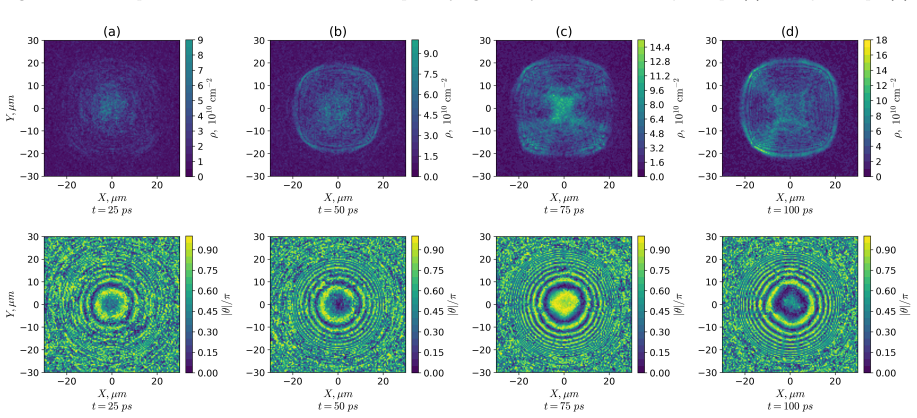
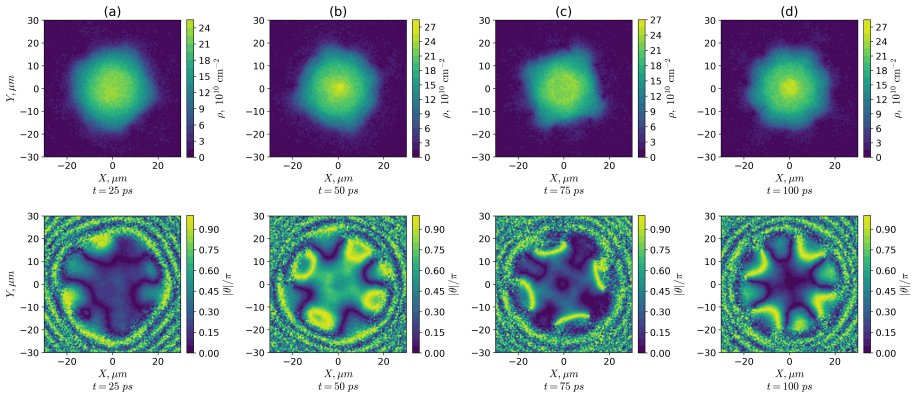
Using the non-Markovian stochastic Gross-Pitaevskii equation with the pseudo-differential dispersion term that represents the lower polariton branch, increasing the area of the incoherent pumping spot leads to the appearance of various spatial structures whose properties depend on the duration of the dynamical memory. In the short-memory regime the condensate forms an extended state that spans outside the pumping area; this onset is tied to the specific form of the dispersion term that produces a traffic-jam effect. In the long-memory regime enhanced condensate formation occurs and angular structures appear that partially suppress the emission of matter waves from the pumping area.
What carries the argument
The non-Markovian stochastic Gross-Pitaevskii equation equipped with a pseudo-differential dispersion term for the lower polariton branch, which encodes finite memory time and controls spatial extension or angular patterning.
If this is right
- Larger pumping spots enable extended condensate states that propagate beyond the illuminated region when memory is short.
- Long memory favors angular condensate patterns that remain localized and reduce outward particle emission.
- The traffic-jam effect arising from the chosen dispersion relation is responsible for the spatial extension observed at short memory times.
- Pattern morphology can be switched between extended and angular forms simply by changing the memory duration at fixed pump size.
Where Pith is reading between the lines
- Pump-spot size and memory time together could serve as practical control knobs for directing polariton flow in microcavity devices.
- The same dispersion-driven traffic-jam mechanism may appear in other driven-dissipative systems whose dispersion is similarly non-parabolic.
- Varying the pump radius while monitoring real-space density and momentum-space emission would provide a direct experimental test of the memory-dependent transition.
- The reported suppression of matter-wave emission at long memory suggests a route to increasing local condensate density without increasing total pump power.
Load-bearing premise
The pseudo-differential dispersion term accurately captures the lower polariton branch and the relevant memory effects across the parameter regimes examined.
What would settle it
Numerical or experimental runs that show no extended condensate outside the pump for short memory times, or no angular structures and no suppression of emission for long memory times when the pump spot is enlarged, would falsify the reported dependence.
Figures



read the original abstract
Dynamics of exciton-polaritonic condensate under incoherent pumping is studied using the non-Markovian stochastic Gross-Pitaevskii equation with the pseudo-differential dispersion term. This term corresponds to the lower energy branch of polaritons. It is shown that an increasing of the pumping spot area leads to the appearance of various spatial structures whose properties depend on the duration of the dynamical memory. In the regime of short memory time, condensate can form an extended state that spans outside the pumping area. We conclude that onset of such extended states is related to the specific form of the dispersion term causing the ``traffic jam'' effect. The case of long memory time corresponds to enhanced condensate formation, when increasing of the pumping area leads to appearance of angular condensate structures which partially suppress emission of matter waves from the pumping area.
Editorial analysis
A structured set of objections, weighed in public.
Referee Report
Summary. The paper examines dynamics of exciton-polaritonic condensates under incoherent pumping via the non-Markovian stochastic Gross-Pitaevskii equation incorporating a pseudo-differential dispersion term for the lower polariton branch. It reports that increasing the pumping spot area produces distinct spatial structures whose character depends on dynamical memory duration: short-memory regimes yield extended condensate states spanning outside the pump region, attributed to a dispersion-induced 'traffic jam' effect, while long-memory regimes produce angular structures that partially suppress matter-wave emission.
Significance. If the numerical observations hold after controls, the work would illustrate how non-Markovian memory and the specific form of polariton dispersion jointly control pattern formation and condensate extent, offering a route to engineer extended or structured states via pump geometry. The approach extends standard Markovian treatments and could guide experiments on memory effects in polariton systems.
major comments (3)
- [Results (short-memory regime)] Results section (short-memory regime): the attribution of extended states outside the pumping area to a 'traffic jam' effect caused by the pseudo-differential dispersion lacks isolation. No control simulations are reported that replace the pseudo-differential term with a parabolic dispersion (or other form) while holding pump size, memory duration, and stochastic driving fixed; without these, the interpretation cannot be distinguished from generic effects of the non-Markovian kernel or pumping geometry.
- [Model / Methods] Model section: the pseudo-differential dispersion term is stated to correspond to the lower polariton branch, but the manuscript provides neither the explicit functional form nor an analytic derivation or sensitivity test confirming that it accurately captures the branch and memory effects across the studied pump sizes and memory times.
- [Results (long-memory regime)] Results section (long-memory regime): the claim that angular structures suppress emission of matter waves is supported only by visual inspection of density plots; quantitative diagnostics (e.g., integrated flux outside the pump or angular Fourier components) are not presented to substantiate the suppression.
minor comments (2)
- [Abstract] Abstract: 'an increasing of the pumping spot area' should read 'an increase in the pumping spot area'.
- [Figures] Figure captions: parameters such as the specific memory duration values, pump radii, and noise strength should be stated explicitly rather than referred to generically.
Simulated Author's Rebuttal
We thank the referee for the careful reading of our manuscript and the constructive comments. We address each major comment below and will revise the manuscript to incorporate the suggested improvements.
read point-by-point responses
-
Referee: Results section (short-memory regime): the attribution of extended states outside the pumping area to a 'traffic jam' effect caused by the pseudo-differential dispersion lacks isolation. No control simulations are reported that replace the pseudo-differential term with a parabolic dispersion (or other form) while holding pump size, memory duration, and stochastic driving fixed; without these, the interpretation cannot be distinguished from generic effects of the non-Markovian kernel or pumping geometry.
Authors: We agree that additional controls are needed to isolate the role of the dispersion. In the revised manuscript, we will include new simulations that replace the pseudo-differential dispersion with a standard parabolic form while keeping pump size, memory duration, and stochastic driving fixed. These results will be presented alongside the original data to allow direct comparison and to clarify the contribution of the specific polariton dispersion to the extended states. revision: yes
-
Referee: Model section: the pseudo-differential dispersion term is stated to correspond to the lower polariton branch, but the manuscript provides neither the explicit functional form nor an analytic derivation or sensitivity test confirming that it accurately captures the branch and memory effects across the studied pump sizes and memory times.
Authors: We thank the referee for noting this omission. The pseudo-differential term is the standard representation of the lower polariton branch dispersion. In the revised manuscript, we will add the explicit functional form of the term in the Model section together with a concise analytic derivation from the two-component polariton Hamiltonian. We will also include a sensitivity test demonstrating that the main results remain robust under small variations of the dispersion parameters for the pump sizes and memory times studied. revision: yes
-
Referee: Results section (long-memory regime): the claim that angular structures suppress emission of matter waves is supported only by visual inspection of density plots; quantitative diagnostics (e.g., integrated flux outside the pump or angular Fourier components) are not presented to substantiate the suppression.
Authors: We acknowledge that quantitative diagnostics would strengthen the claim. In the revised manuscript, we will add the integrated matter-wave flux outside the pump region as a function of pump size and the angular Fourier components of the density. These metrics will be shown in the Results section to provide quantitative support for the partial suppression of emission in the long-memory regime. revision: yes
Circularity Check
Numerical evolution of the non-Markovian sGPE yields structures without reduction to fitted inputs or self-citations
full rationale
The paper derives its claims on pump-size-dependent spatial structures (extended states for short memory, angular patterns for long memory) exclusively through direct numerical integration of the stated non-Markovian stochastic Gross-Pitaevskii equation that includes the pseudo-differential dispersion term as an explicit model input. No parameters are fitted to subsets of data and then relabeled as predictions; no uniqueness theorems or ansatzes are imported via self-citation to force the observed outcomes; and the 'traffic jam' interpretation is presented as a post-hoc reading of the simulation results rather than a definitional equivalence. The derivation chain therefore remains independent of its own outputs.
Axiom & Free-Parameter Ledger
free parameters (1)
- dynamical memory duration
axioms (1)
- domain assumption The pseudo-differential dispersion term corresponds to the lower energy branch of polaritons.
Lean theorems connected to this paper
-
IndisputableMonolith/Cost/FunctionalEquation.leanwashburn_uniqueness_aczel unclearnon-Markovian stochastic Gross-Pitaevskii equation with the pseudo-differential dispersion term... ELP(k) = E0 + 1/2 [Ecav(k) - sqrt(Ecav(k)^2 + 4 ħ² Ω²)]
Reference graph
Works this paper leans on
-
[1]
T. Guillet and C. Brimont, Polariton condensates at room temperature, Comp. Rend. Phys. 17 (2016) 946. https://doi.org/10.1016/j.crhy.2016.07.002
-
[2]
G. Lerario, A. Fieramosca, F. Barachati, D. Ballarini, K.S. Daskalakis, L. Dominci, M. De Giorgi, S. A. Maier, 7 G. Gigli, S. Kéna-Cohen, and D. Sanvitto, Room- temperature superfluidity in a polariton condensate, Nature Physics 13 (2017) 837. https://doi.org/10.1038/ nphys4147
work page 2017
-
[3]
R. Su, J. Wang, J. Zhao, J. Xing, W. Zhao, C. Diederichs, T. C. H. Liew, Q. Xiong, Room temperature long-range coherent exciton polariton condensate flow in lead halide perovskites, Science Advances 4 (2018) eaau0244. https://doi.org/10.1126/sciadv.aau0244
-
[4]
A. V. Zasedatelev, A. V. Baranikov, D. Urbonas, F. Scafirimuto, U. Scherf, T. Stöferle, R. F. Mahrt, and P. G. Lagoudakis, A room-temperature organic polariton transistor, Nature Photonics 13 (2019) 378. https://doi. org/10.1038/s41566-019-0392-8
-
[5]
A. Fieramosca, L. Polimeno, V. Ardizzone, L. De Marco, M. Pugliese, V. Maiorano, M. de Giorgi, G. Gigli, D. Gerace, D. Ballarini, D. Sanvitto, Two- dimensional hybrid perovskites sustaining strong po- lariton interactions at room temperature, Science Ad- vances 5 (2019) aav9967 (2019). https://doi.org/10. 1126/sciadv.aav9967
work page 2019
-
[6]
M. Dusel, S. Betzold, O. A. Egorov, S. Klembt, J. Ohmer, U. Fischer, S. H0̈fling, and C. Schneider, Room temperature organic exciton–polariton condensate in a lattice, Nature Communications 11 (2020) 2863. https: //doi.org/10.1038/s41467-020-16656-0
-
[7]
R. Su, S. Ghosh, J. Wang, S. Liu, C. Diederichs, T. C. H. Liew, and Q. Xiong, Observation of exciton polariton condensation in a perovskite lattice at room tempera- ture, Nature Physics 16 (2020) 301. https://doi.org/10. 1038/s41567-019-0764-5
work page 2020
-
[8]
M. D. Kolker, I. I. Krasionov, A. D. Putintsev, E. D. Grayfer, T. Cookson, D. Tatarinov, A. P. Pushkarev, D. A. Sannikov, P. G. Lagoudakis Room temperature broadband polariton lasing from a CsPbBr3 perovskite plate, Adv. Optic. Mater.13 (2024) 2402543. https:// doi.org/10.1002/adom.202402543
-
[9]
X. Wu, S. Zhang, J. Song, X. Deng, W. Du, X. Zeng, Y. Zhang, Z. Zhang, Y. Chen, Y. Wang, C. Jiang, Y. Zhong, B. Wu, Z. Zhu, Y. Liang, Q. Zhang, Q. Xiong, and X. Liu, Exciton polariton condensation from bound states in the continuum at room temperature, Nature Commun. 15 (2024) 3345. https://doi.org/10. 1038/s41467-024-47669-8
work page 2024
-
[10]
J. Song, S. Ghosh, X. Deng, C. Li, Q. Shang, X. Liu, Y. Wang, X. Gao, W. Yang, X. Wang, Room-temperature continuous-wave pumped exciton polariton condensa- tion in a perovskite microcavity, Sci. Adv. 11 (2025) eadr1652. https://doi.org/10.1126/sciadv.adr1652
-
[11]
I, Georgakilas, D. Tiede, D. Urbonas, R. Mirek, C. Bujalance, L. Cali0́, V. Oddi, R. Tao, D. N. Dirin, G. Rain0́, S. C. Boehme, J. F. Galisteo-López, R. F. Mahrt, M. V. Kovalenko, H. Miguez, and T Stöferle, Room-temperature cavity exciton-polariton condensation in perovskite quantum dots, Nature Com- mun. 16 (2025) 5228 (2025). https://doi.org/10.1038/ s4...
work page 2025
-
[12]
J. Dong, Y. Wu, R. Wang, L. Wang, J. Wang, Y. Zhang, Y. Wang, X. Wang, S. Shen, and H. Zhu, Low-threshold colloidal quantum dot polariton lasing via a strong cou- pling microcavity at room temperature, Nanoscale 17 (2025) 10187. https://doi.org/10.1039/d4nr05185h
-
[13]
B. R. Fabricante, M. Król, M. Wurdack, M. Pieczarka, M. Steger, D. W. Snoke, K. West, L. N. Pfeiffer, A. G. Truscott, E. A. Ostrovskaya, and E. Estrecho, Narrow- linewidth exciton-polariton laser, Optica 11 (2024) 838. https://doi.org/10.1364/OPTICA.525961
-
[14]
L.S. Ricco, I.A. Shelykh, and A. Kavokin, Qubit gate operations in elliptically trapped polariton conden- sates, Sci. Rep. 14 (2024) 4211. https://doi.org/10. 1038/s41598-024-54543-6
work page 2024
-
[15]
Liew, The future of quantum in polariton sys- tems: opinion, Opt
T.C.H. Liew, The future of quantum in polariton sys- tems: opinion, Opt. Mater. Express 13 (2023) 2085. https://doi.org/10.1364/OME.492503
-
[16]
I. De Vega, D. Alonso, Dynamics of non-Markovian open quantum systems, Rev. Mod. Phys. 89 (2017) 015001. https://doi.org/10.1103/RevModPhys.89. 015001
-
[17]
Y. Brune, E. Rozas, K. West, K. Baldwin, L. N. Pfeif- fer, J. Beaumariage, H. Alnatah, D. W. Snoke, and M. Aßmann, Quantum coherence of a long-lifetime exciton- polariton condensate, Commun. Mater. 6 (2025) 1. https://doi.org/10.1038/s43246-025-00848-6
-
[18]
A. Kavokin, T. C. H. Liew, C. Schneider, P. G. Lagoudakis, S. Klembt, and S. Hoefling, Polariton con- densates for classical and quantum computing, Nat. Rev. Phys. 4 (2022) 435. https://doi.org/10.1038/ s42254-022-00447-1
work page 2022
-
[19]
D. Novokreschenov, A. Kudlis, and A.V. Kavokin, Clas- sical and single photon memory devices based on po- lariton lasers, arXiv preprint (2025), https://arxiv.org/ abs/2509.20569
-
[20]
N.A. Asriyan, A.A. Elistratov, and A.V. Kavokin, Gen- erating entangled polaritonic condensates by pumping with entangled pairs of photons, arXiv preprint (2026), https://arxiv.org/abs/2602.22778
-
[21]
A.A. Elistratov, Yu.E. Lozovik, Polariton Bose conden- sate in an open system: Ab initio approach, Phys. Rev. B 97 (2018) 014525. https://doi.org/10.1038/ s41467-025-60553-3
work page 2018
-
[22]
D.V. Makarov, A.A. Elistratov, Yu.E. Lozovik, Non- Markovian effects in dynamics of exciton-polariton Bose condensates, Phys. Lett. A 384 (2020) 126942. https: //doi.org/10.1016/j.physleta.2020.126942
-
[24]
A.D. Alliluev, D.V. Makarov, N.A. Asriyan, A.A. Elistratov, Yu.E. Lozovik, Non-Markovian stochastic Gross–Pitaevskii equation for the exciton–polariton Bose–Einstein condensate, J. Low Temp. Phys. 214 (2024) 331. https: //doi.org/10.1007/s10909-023-03027-4
-
[25]
N. V. Kuznetsova, D. V. Makarov, N. A. Asriyan, A. A. Elistratov, Yu. E. Lozovik, Spatial coherence of exciton–polariton Bose–Einstein condensates, Bull. Russ. Acad. Phys. 88 (2024) 847, https://doi.org/10. 1134/S106287382470672X
work page 2024
-
[26]
N.V. Kuznetsova, D.V. Makarov, N.A. Asriyan, A.A. Elistratov, Phase alignment in a lattice of exciton- polaritonic Bose-Einstein condensates, Phys. Lett. A 568 (2026) 131221. https://doi.org/10.1016/j.physleta. 2025.131221
-
[27]
N.A. Asriyan, A.A. Elistratov, Yu.E. Lozovik, Mean field study of 2D quasiparticle condensate formation in presence of strong decay, Quantum 7 (2023) 1144 (2023). https://doi.org/10.22331/q-2023-10-16-1144
-
[28]
O. I. Utesov, M. Park, D. Choi, S. Choi, S. I. Park, 8 S. Kang, J. D. Song, A. N. Osipov, A. V. Yulin, Y.- H. Cho, H. Choi, I. S. Aranson, and S. V. Koniakhin, Communications Physics 8 (2025) 286 (2025). https:// doi.org/10.1038/s42005-025-02198-8
-
[29]
X. Li, Markovian embedding procedures for non- Markovian stochastic Schrödinger equations, Phys. Lett. A 387 (2021) 127036. https://doi.org/10.1016/j. physleta.2020.127036
work page doi:10.1016/j 2021
-
[30]
A.D. Alliluev, D.V. Makarov, Dynamics of a nonlin- ear quantum oscillator under non-Markovian pumping, J. Russ. Laser Res. 43 (2022) 71. https://doi.org/10. 1007/s10946-022-10024-7
work page 2022
-
[31]
G. Christmann, G. Tosi, N. G. Berloff, P. Tsotsis, P. S. Eldridge, Z. Hatzopoulos, P. G. Savvidis, and J. J. Baumberg, Polariton ring condensates and sunflower ripples in an expanding quantum liquid, Phys. Rev. B 85 (2012) 235303. https://doi.org/10.1103/PhysRevB. 85.235303
-
[32]
Q. Fontaine, D. Squizzato, F. Baboux, I. Amelio, A. Lemaitre, M. Morassi, I. Sagnes, L.L. Gratiet, A. Harouri, M. Wouters, I. Carusotto, A. Amo, M. Richard., A. Minguzzi, L. Canet, S. Ravets, J. Bloch, Kardar–Parisi–Zhang universality in a one-dimensional polariton condensate, Nature 608 (2022) 687. https: //doi.org/10.1038/s41586-022-05001-8. 9
discussion (0)
Sign in with ORCID, Apple, or X to comment. Anyone can read and Pith papers without signing in.