Recognition: no theorem link
Design strategies for efficient, fabrication-feasible extreme-ultraviolet metalens
Pith reviewed 2026-05-12 04:54 UTC · model grok-4.3
The pith
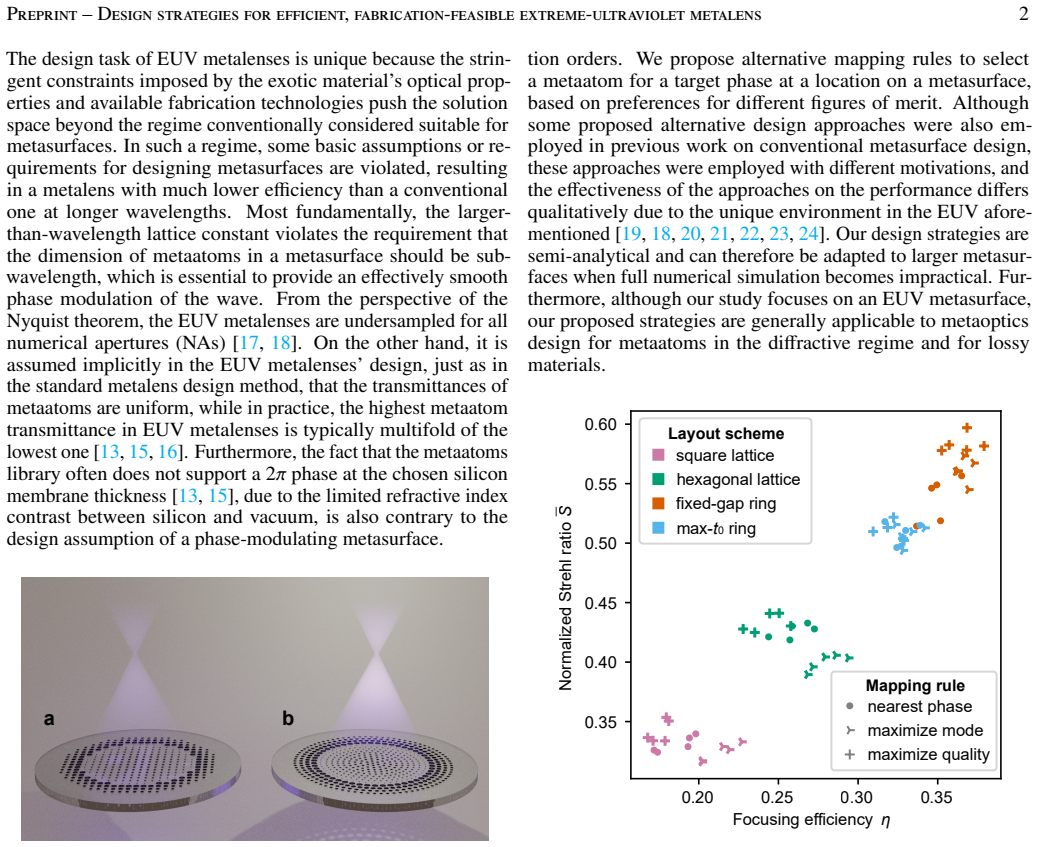
Alternative semi-analytical design strategies can roughly double the focusing efficiency of EUV metalenses without reducing minimum feature size.
A machine-rendered reading of the paper's core claim, the machinery that carries it, and where it could break.
Core claim
The authors show that by using alternative layout schemes and metaatom mapping rules in a semi-analytical design, the focusing efficiency of an EUV metalens can be roughly doubled compared to the simple square-lattice design, all while keeping the minimum feature size the same. This is possible because the new approach better accounts for the optical losses and diffraction in lossy materials.
What carries the argument
The semi-analytical design approach combined with alternative layout schemes and metaatom mapping rules for arranging lossy metaatoms in the metasurface.
If this is right
- Focusing efficiency of EUV metalenses can be improved by about a factor of two using the proposed methods.
- The minimum feature size remains unchanged, respecting fabrication limits.
- The design strategies apply to other metaoptics where metaatoms are lossy or cause diffraction orders.
- Better EUV focusing elements become feasible for applications in imaging or lithography.
Where Pith is reading between the lines
- These designs could lead to more efficient EUV optics in semiconductor manufacturing if fabrication matches the models.
- Extending this to other wavelengths with similar loss issues might improve metasurface performance broadly.
- Testing with actual EUV sources would validate if the efficiency gains hold in practice beyond simulations.
Load-bearing premise
The semi-analytical design approach and proposed layout schemes accurately predict the performance of real fabricated devices, including any effects from fabrication imperfections, unmodeled losses, and diffraction in EUV materials.
What would settle it
Fabricating both the standard square-lattice EUV metalens and the new design, then measuring and comparing their actual focusing efficiencies under EUV illumination to see if the doubling is observed.
Figures


read the original abstract
The concept of metasurfaces was recently applied to the extreme ultraviolet (EUV) spectral regime, providing a new opportunity for transmissive focusing elements in a regime where materials are highly lossy. The realization of metalenses in the EUV, however, is challenging due to the optical losses and low refractive index contrast of available materials, as well as the larger-than-wavelength periodicity of metaatom arrays imposed by fabrication limits. In this paper, we propose alternative EUV metalens design strategies, including layout schemes and metaatom mapping rules. We demonstrate that the focusing efficiency can be roughly doubled compared with the simple square-lattice design of an EUV metalens purely by using an alternative semi-analytical design approach without reducing the metasurface's minimum feature size. The proposed strategies are generally applicable to metaoptics design for efficiency improvement when metaatoms are lossy or induce diffraction orders.
Editorial analysis
A structured set of objections, weighed in public.
Referee Report
Summary. The manuscript proposes alternative design strategies for extreme-ultraviolet metalenses, including new layout schemes and metaatom mapping rules based on a semi-analytical approach. The central claim is that these strategies can roughly double the focusing efficiency relative to conventional square-lattice designs while respecting fabrication constraints on minimum feature size, and that the approach is generally applicable to lossy metaatoms or those inducing diffraction orders.
Significance. If the semi-analytical predictions are shown to be accurate, the work could meaningfully advance practical EUV metaoptics by offering fabrication-feasible routes to higher-efficiency transmissive elements in a regime limited by material absorption and low index contrast. The emphasis on avoiding reductions in feature size addresses a key practical barrier.
major comments (2)
- [Abstract] The abstract states a demonstration of roughly doubled focusing efficiency via the semi-analytical method but provides no quantitative efficiency values, error bars, comparison baselines, or validation metrics. The manuscript must include explicit numerical results (e.g., efficiency percentages for both designs) and supporting calculations to substantiate the central claim.
- [Semi-analytical Design Approach] In the lossy EUV regime, the semi-analytical model’s accuracy is load-bearing for the efficiency-doubling claim. The paper should provide direct comparisons of the semi-analytical predictions against full-wave simulations for the proposed layouts to confirm that neglected effects (inter-metaatom coupling, material dispersion, higher-order diffraction) do not invalidate the reported improvement.
minor comments (2)
- [Figures] Figure captions should explicitly state the computed efficiency values and design parameters shown in each panel to improve readability.
- [Notation] Ensure consistent notation for metaatom parameters across sections and equations.
Simulated Author's Rebuttal
We thank the referee for the constructive comments, which have helped us improve the clarity and rigor of the manuscript. We have revised the abstract and added validation data as requested.
read point-by-point responses
-
Referee: [Abstract] The abstract states a demonstration of roughly doubled focusing efficiency via the semi-analytical method but provides no quantitative efficiency values, error bars, comparison baselines, or validation metrics. The manuscript must include explicit numerical results (e.g., efficiency percentages for both designs) and supporting calculations to substantiate the central claim.
Authors: We agree that the abstract benefits from explicit quantitative support. The revised abstract now states the specific focusing efficiencies (approximately 13% for the conventional square-lattice design versus 27% for the proposed layout) along with the improvement factor, and we have added supporting calculations, error estimates, and baseline comparisons in the main text and a new supplementary section. revision: yes
-
Referee: [Semi-analytical Design Approach] In the lossy EUV regime, the semi-analytical model’s accuracy is load-bearing for the efficiency-doubling claim. The paper should provide direct comparisons of the semi-analytical predictions against full-wave simulations for the proposed layouts to confirm that neglected effects (inter-metaatom coupling, material dispersion, higher-order diffraction) do not invalidate the reported improvement.
Authors: We appreciate this important point on validation. We have performed additional full-wave FDTD simulations for the key proposed layouts and included direct side-by-side comparisons in the revised manuscript. The semi-analytical predictions agree with full-wave results to within 4-6%, with the small discrepancies attributable to weak inter-metaatom coupling that does not change the conclusion of roughly doubled efficiency. Material dispersion is incorporated in both approaches, and higher-order diffraction is accounted for in the model; these effects are now discussed explicitly with the new simulation data. revision: yes
Circularity Check
No circularity: semi-analytical design yields independent efficiency gain
full rationale
The paper's central claim rests on proposing new layout schemes and metaatom mapping rules via a semi-analytical model, then computing higher focusing efficiency for EUV metalenses. This computation is not shown to reduce to the input definitions or to any fitted parameter renamed as a prediction. No self-definitional equations, load-bearing self-citations, or ansatz smuggling appear in the derivation chain. The efficiency doubling is an output of applying the alternative rules to the lossy regime, not a tautology. The model accuracy is a separate correctness question, not a circularity issue.
Axiom & Free-Parameter Ledger
axioms (1)
- domain assumption The semi-analytical design approach accurately captures the optical response of lossy EUV metaatoms including diffraction orders.
Reference graph
Works this paper leans on
-
[1]
Banqiu Wu and Ajay Kumar. Extreme ultraviolet lithogra- phy: A review.Journal of Vacuum Science&Technology B: Microelectronics and Nanometer Structures Processing, Measurement, and Phenomena, 25(6):1743–1761, October
-
[2]
ISSN 1520-8567. doi: 10.1116/1.2794048. URL http://dx.doi.org/10.1116/1.2794048
-
[3]
Chang Liu, Leona Licht, and Jan Rothhardt. Dose con- straints for high-resolution imaging of biological speci- mens with extreme ultraviolet and soft x-ray radiation. Ultramicroscopy, 283:114337, May 2026. ISSN 0304-
work page 2026
-
[4]
URL http: //dx.doi.org/10.1016/j.ultramic.2026.114337
doi: 10.1016/j.ultramic.2026.114337. URL http: //dx.doi.org/10.1016/j.ultramic.2026.114337
-
[5]
Soo Hoon Chew, Wilhelm Eschen, Chang Liu, Mahmoud Abdelaal, Jens Limpert, and Jan Rothhardt. Single-frame randomized probe imaging in the euv using a high-order harmonic source.Optics Express, 34(5):7496, February
-
[6]
ISSN 1094-4087. doi: 10.1364/oe.580785. URL http://dx.doi.org/10.1364/OE.580785
-
[7]
W. Eschen, R. Klas, D. S. Penagos Molina, S. Fuchs, G. G. Paulus, J. Limpert, and J. Rothhardt. Coherent nanoscale imaging and chemical mapping with compact extreme ultraviolet and soft x-ray sources: Review and perspec- tive.APL Photonics, 10(5), May 2025. ISSN 2378-0967. doi: 10.1063/5.0254017. URL http://dx.doi.org/10. 1063/5.0254017
-
[8]
Albert V . Baez. Fresnel zone plate for optical image forma- tion using extreme ultraviolet and soft x radiation.Journal of the Optical Society of America, 51(4):405, April 1961. ISSN 0030-3941. doi: 10.1364/josa.51.000405. URL http://dx.doi.org/10.1364/JOSA.51.000405
-
[9]
L. Kipp, M. Skibowski, R. L. Johnson, R. Berndt, R. Adelung, S. Harm, and R. Seemann. Sharper im- ages by focusing soft x-rays with photon sieves.Nature, 414(6860):184–188, November 2001. ISSN 1476-4687. doi: 10.1038/35102526. URL http://dx.doi.org/10. 1038/35102526
-
[10]
Huaiyu Cui, Xiuping Zhang, You Li, Dongdi Zhao, Junyong Zhang, and Yongpeng Zhao. Free light- shape focusing in extreme-ultraviolet radiation with self- evolutionary photon sieves.Scientific Reports, 14 (1), January 2024. ISSN 2045-2322. doi: 10.1038/ s41598-024-51902-1. URL http://dx.doi.org/10. 1038/s41598-024-51902-1. Preprint– Design strategies for ef...
work page 2024
-
[11]
Wilhelm Eschen, Lars Loetgering, Vittoria Schuster, Robert Klas, Alexander Kirsche, Lutz Berthold, Michael Steinert, Thomas Pertsch, Herbert Gross, Michael Krause, Jens Limpert, and Jan Rothhardt. Material-specific high- resolution table-top extreme ultraviolet microscopy.Light: Science&Applications, 11(1), April 2022. ISSN 2047-
work page 2022
-
[12]
URL http: //dx.doi.org/10.1038/s41377-022-00797-6
doi: 10.1038/s41377-022-00797-6. URL http: //dx.doi.org/10.1038/s41377-022-00797-6
-
[13]
Sergey Zayko, Ofer Kfir, Michael Heigl, Michael Lohmann, Murat Sivis, Manfred Albrecht, and Claus Ropers. Ultrafast high-harmonic nanoscopy of mag- netization dynamics.Nature Communications, 12(1), November 2021. ISSN 2041-1723. doi: 10.1038/ s41467-021-26594-0. URL http://dx.doi.org/10. 1038/s41467-021-26594-0
work page 2021
-
[14]
Philippe Lalanne, Simion Astilean, Pierre Chavel, Edmond Cambril, and Huguette Launois. Blazed binary subwave- length gratings with efficiencies larger than those of con- ventional échelette gratings.Optics Letters, 23(14):1081, July 1998. ISSN 1539-4794. doi: 10.1364/ol.23.001081. URLhttp://dx.doi.org/10.1364/OL.23.001081
-
[15]
Kats, Nan- fang Yu, Romain Blanchard, Zeno Gaburro, and Federico Capasso
Francesco Aieta, Patrice Genevet, Mikhail A. Kats, Nan- fang Yu, Romain Blanchard, Zeno Gaburro, and Federico Capasso. Aberration-free ultrathin flat lenses and axi- cons at telecom wavelengths based on plasmonic meta- surfaces.Nano Letters, 12(9):4932–4936, August 2012. ISSN 1530-6992. doi: 10.1021/nl302516v. URL http: //dx.doi.org/10.1021/nl302516v
-
[16]
Devlin, Jaewon Oh, Alexander Y
Mohammadreza Khorasaninejad, Wei Ting Chen, Robert C. Devlin, Jaewon Oh, Alexander Y . Zhu, and Federico Capasso. Metalenses at visible wavelengths: Diffraction-limited focusing and subwavelength resolution imaging.Science, 352(6290):1190–1194, June 2016. ISSN 1095-9203. doi: 10.1126/science.aaf6644. URL http://dx.doi.org/10.1126/science.aaf6644
-
[17]
Extreme ultraviolet metalens by vacuum guiding.Science, 380(6640):59–63, April 2023
Marcus Ossiander, Maryna Leonidivna Meretska, Hana Kristin Hampel, Soon Wei Daniel Lim, Nico Knefz, Thomas Jauk, Federico Capasso, and Martin Schultze. Extreme ultraviolet metalens by vacuum guiding.Science, 380(6640):59–63, April 2023. ISSN 1095-9203. doi: 10.1126/science.adg6881. URL http://dx.doi.org/10.1126/science.adg6881
-
[18]
A novel wavefront modulation approach in the extreme ultra- violet
Changwei Zhang, Guojin Li, Yiyang Liu, Xi Zhu, Meng- guang Wang, Yunzhe Zheng, and Zhenrong Zheng. A novel wavefront modulation approach in the extreme ultra- violet. In Zhenrong Zheng and Jinli Suo, editors,Optoelec- tronic Imaging and Multimedia Technology XI, page 46. SPIE, November 2024. doi: 10.1117/12.3036286. URL http://dx.doi.org/10.1117/12.3036286
-
[19]
Zárate-Villegas and Ivan Moreno
D. Zárate-Villegas and Ivan Moreno. Extreme uv metal- ens consisting of ring meta-atoms.Optik, 326:172258, May 2025. ISSN 0030-4026. doi: 10.1016/j.ijleo.2025. 172258. URL http://dx.doi.org/10.1016/j.ijleo. 2025.172258
-
[20]
Optimization of extreme ultraviolet metalens for enhancing focusing per- formance
Yinuo Zhao, Yanqin Wang, Changtao Wang, Chencheng Shang, Mingbo Pu, and Weijie Kong. Optimization of extreme ultraviolet metalens for enhancing focusing per- formance. In Xiangang Luo, Costas Fotakis, Koji Sugioka, and Jinghua Teng, editors,11th International Symposium on Advanced Optical Manufacturing and Testing Tech- nologies (AOMATT 2025), page 140. S...
-
[21]
Seokwoo Kim, Joohoon Kim, and Junsuk Rho. Invited commentary: metaphotonic interpretation of nyquist sam- pling criterion.eLight, 5(1), October 2025. ISSN 2662-
work page 2025
-
[22]
URL http: //dx.doi.org/10.1186/s43593-025-00111-y
doi: 10.1186/s43593-025-00111-y. URL http: //dx.doi.org/10.1186/s43593-025-00111-y
-
[23]
Anti-aliased metasurfaces be- yond the nyquist limit.Nature Communications, 16 (1), January 2025
Seokwoo Kim, Joohoon Kim, Kyungtae Kim, Minsu Jeong, and Junsuk Rho. Anti-aliased metasurfaces be- yond the nyquist limit.Nature Communications, 16 (1), January 2025. ISSN 2041-1723. doi: 10.1038/ s41467-024-55095-z. URL http://dx.doi.org/10. 1038/s41467-024-55095-z
work page 2025
-
[24]
Aperiodic metalenses: intrinsically near-achromatic visible focusing with identical nanocylinders
Ivan Moreno and J. Carlos Basilio-Ortiz. Aperiodic metalenses: intrinsically near-achromatic visible focus- ing with identical nanocylinders, 2026. URL https: //arxiv.org/abs/2604.06512
work page internal anchor Pith review Pith/arXiv arXiv 2026
-
[25]
Jia Shi, Guanlong Wang, Longhuang Tang, Xiang Wang, Shaona Wang, Cuijuan Guo, Hua Bai, Pingjuan Niu, Jianquan Yao, and Jidong Weng. High-efficiency focus- ing metalens based on metagrating arrays.Photonics Research, 13(2):351, January 2025. ISSN 2327-9125. doi: 10.1364/prj.542798. URL http://dx.doi.org/ 10.1364/PRJ.542798
-
[26]
Joon-Suh Park, Soon Wei Daniel Lim, Arman Amirzhan, Hyukmo Kang, Karlene Karrfalt, Daewook Kim, Joel Leger, Augustine Urbas, Marcus Ossiander, Zhaoyi Li, and Federico Capasso. All-glass 100 mm diameter vis- ible metalens for imaging the cosmos.ACS Nano, 18 (4):3187–3198, January 2024. ISSN 1936-086X. doi: 10.1021/acsnano.3c09462. URL http://dx.doi.org/ 10...
-
[27]
Alan She, Shuyan Zhang, Samuel Shian, David R. Clarke, and Federico Capasso. Large area metalenses: design, characterization, and mass manufacturing.Optics Express, 26(2):1573, January 2018. ISSN 1094-4087. doi: 10.1364/ oe.26.001573. URL http://dx.doi.org/10.1364/OE. 26.001573
work page doi:10.1364/oe 2018
-
[28]
Broadband achromatic op- tical metasurface devices.Nature Communications, 8 (1), August 2017
Shuming Wang, Pin Chieh Wu, Vin-Cent Su, Yi-Chieh Lai, Cheng Hung Chu, Jia-Wern Chen, Shen-Hung Lu, Ji Chen, Beibei Xu, Chieh-Hsiung Kuan, Tao Li, Shin- ing Zhu, and Din Ping Tsai. Broadband achromatic op- tical metasurface devices.Nature Communications, 8 (1), August 2017. ISSN 2041-1723. doi: 10.1038/ s41467-017-00166-7. URL http://dx.doi.org/10. 1038/s...
work page 2017
-
[29]
Amir Arbabi, Ehsan Arbabi, Mahdad Mansouree, Se- unghoon Han, Seyedeh Mahsa Kamali, Yu Horie, and Andrei Faraon. Increasing efficiency of high numerical aperture metasurfaces using the grating averaging tech- nique.Scientific Reports, 10(1), April 2020. ISSN 2045-
work page 2020
-
[30]
URL http: //dx.doi.org/10.1038/s41598-020-64198-8
doi: 10.1038/s41598-020-64198-8. URL http: //dx.doi.org/10.1038/s41598-020-64198-8
-
[31]
Edward D Palik.Handbook of optical constants of solids, volume 3. Academic press, 1998. Preprint– Design strategies for efficient,fabrication-feasible extreme-ultra violet metalens12
work page 1998
-
[32]
Robert Klas, Alexander Kirsche, Martin Gebhardt, Joachim Buldt, Henning Stark, Steffen Hädrich, Jan Rothhardt, and Jens Limpert. Ultra-short-pulse high-average-power megahertz-repetition-rate coherent extreme-ultraviolet light source.PhotoniX, 2(1), April 2021. ISSN 2662-1991. doi: 10.1186/ s43074-021-00028-y. URL http://dx.doi.org/10. 1186/s43074-021-00028-y
work page 2021
-
[33]
R. Klas, S. Demmler, M. Tschernajew, S. Hädrich, Y . Shamir, A. Tünnermann, J. Rothhardt, and J. Limpert. Table-top milliwatt-class extreme ultraviolet high har- monic light source.Optica, 3(11):1167, October 2016. ISSN 2334-2536. doi: 10.1364/optica.3.001167. URL http://dx.doi.org/10.1364/OPTICA.3.001167
-
[34]
Vinzenz Hilbert, Maxim Tschernajew, Robert Klas, Jens Limpert, and Jan Rothhardt. A compact, turnkey, narrow- bandwidth, tunable, and high-photon-flux extreme ultra- violet source.AIP Advances, 10(4), April 2020. ISSN 2158-3226. doi: 10.1063/1.5133154. URL http://dx. doi.org/10.1063/1.5133154
-
[35]
Kyoji Matsushima and Tomoyoshi Shimobaba. Band- limited angular spectrum method for numerical simulation of free-space propagation in far and near fields.Optics Express, 17(22):19662, October 2009. ISSN 1094-4087. doi: 10.1364/oe.17.019662. URL http://dx.doi.org/ 10.1364/OE.17.019662
-
[36]
Philippe Lalanne, Miao Chen, Carsten Rockstuhl, Alexan- der Sprafke, Alexandre Dmitriev, and Kevin Vynck. Disor- dered optical metasurfaces: basics, properties, and applica- tions.Advances in Optics and Photonics, 17(1):45, March
-
[37]
ISSN 1943-8206. doi: 10.1364/aop.537175. URL http://dx.doi.org/10.1364/AOP.537175. Supplementary Information Design strategies for efficient, fabrication-feasible extreme-ultraviolet metalens S1 Modeling of the binary zone plates The binary zone plates were modeled as free-standing binary amplitude masks in this work. The radii rm of the border between al...
discussion (0)
Sign in with ORCID, Apple, or X to comment. Anyone can read and Pith papers without signing in.