Recognition: no theorem link
Observational Properties of Nonthermal Emission from Relativistic Jets Escaping Active Galactic Nucleus Disks
Pith reviewed 2026-05-12 04:47 UTC · model grok-4.3
The pith
Relativistic jets from compact objects in AGN disks produce detectable multi-wavelength nonthermal emission that outshines the AGN background, with delays under 10^6 seconds to gravitational wave signals.
A machine-rendered reading of the paper's core claim, the machinery that carries it, and where it could break.
Core claim
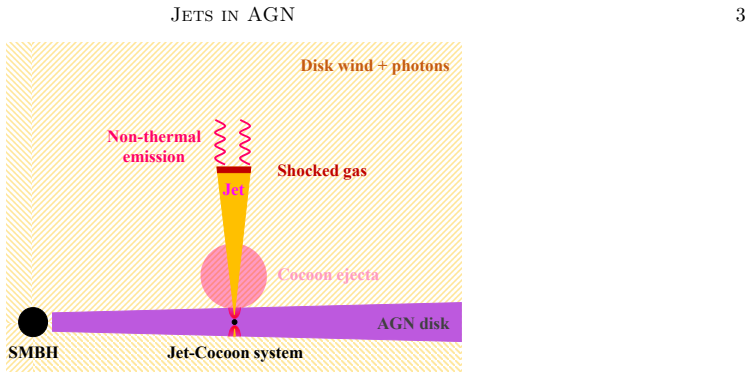
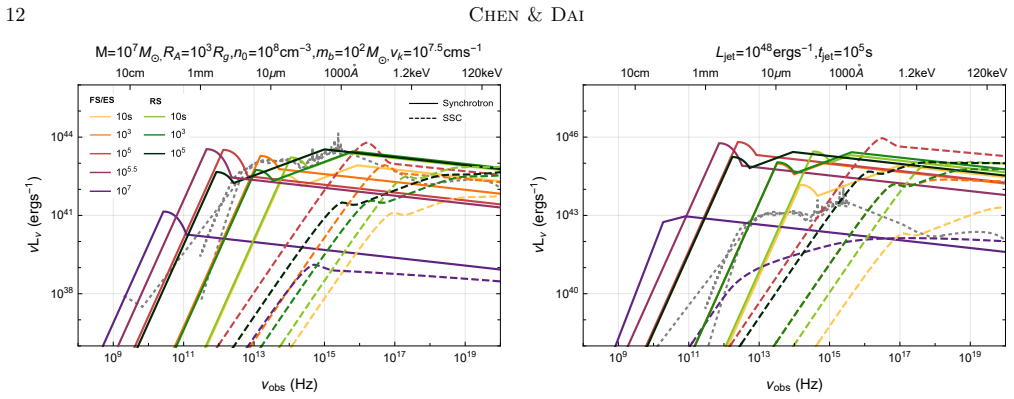
Relativistic jets launched from stellar-mass compact objects embedded in the accretion disk of an active galactic nucleus can produce nonthermal emission upon successfully breaking out of the disk. In the AGN environment modeled as wind outflows, this produces two distinct features: rapid deceleration of the jet ejecta accompanied by a prompt downshift of the emission spectral energy distribution, and persistently strong synchrotron self-absorption giving rise to a prominent quasi-thermal hump. Both gamma-ray burst jets and jets powered by accreting binary black hole merger remnants can produce detectable multi-wavelength emissions that substantially outshine the AGN background, with short,
What carries the argument
The AGN environment modeled as wind outflows, which sets the density structure governing jet deceleration, radiation transfer, and the resulting rapid spectral downshift plus quasi-thermal hump from synchrotron self-absorption.
If this is right
- Detectable multi-wavelength nonthermal emissions from both gamma-ray burst jets and jets powered by accreting binary black hole merger remnants that substantially outshine the AGN background.
- Short time delays between gravitational wave triggers and electromagnetic counterparts, typically less than 10^6 seconds, that greatly facilitate secure multi-messenger associations.
- Interaction-induced radiation from these jet systems offers a diagnostic probe of the spatial distribution, density structure, and physical properties of the AGN medium.
Where Pith is reading between the lines
- Targeted searches in AGN fields for quasi-thermal humps could reveal previously hidden jet activity from embedded compact objects.
- Multi-messenger follow-up campaigns could focus observations on AGN hosts within 10^6 seconds after gravitational wave detections to catch the predicted counterparts.
- The same wind-interaction signatures might appear in other dense environments, such as jets in star clusters or galactic nuclei with similar outflow structures.
Load-bearing premise
The AGN environment is realistically modeled as wind outflows whose density structure governs jet deceleration and radiation transfer.
What would settle it
Observation of candidate AGN-embedded jet systems showing no rapid deceleration, no spectral downshift, and no quasi-thermal hump in multi-wavelength data after gravitational wave triggers would indicate the wind outflow prescription does not hold.
Figures




read the original abstract
Relativistic jets launched from stellar-mass compact objects embedded in the accretion disk of an active galactic nucleus (AGN) can produce nonthermal emission upon successfully breaking out of the disk. In this paper, we present a comprehensive study of the long-term propagation dynamics and broadband nonthermal radiation signatures of such jets in a realistic AGN environment, explicitly modeled as wind outflows. Our modeling reveals two distinct features imprinted by the high-density AGN medium: rapid deceleration of the jet ejecta, accompanied by a prompt downshift of the emission spectral energy distribution, and persistently strong synchrotron self-absorption, giving rise to a prominent quasi-thermal hump in the emission spectrum. Crucially, both gamma-ray burst jets and jets powered by accreting binary black hole merger remnants can produce detectable multi-wavelength emissions that substantially outshine the AGN background. Moreover, the short time delays between gravitational wave triggers and these electromagnetic counterparts--typically less than 106 s--greatly facilitate secure multi-messenger associations. Besides, our findings highlight that interaction-induced radiation from AGN-embedded jet systems offers a powerful diagnostic probe of the spatial distribution,density structure, and physical properties of the AGN medium.
Editorial analysis
A structured set of objections, weighed in public.
Referee Report
Summary. The paper models the long-term propagation and broadband nonthermal emission of relativistic jets from stellar-mass compact objects embedded in AGN accretion disks, treating the AGN environment explicitly as wind outflows. It identifies two key imprints of the dense medium—rapid jet deceleration with prompt spectral downshift and persistently strong synchrotron self-absorption producing a quasi-thermal hump—and argues that both GRB jets and jets from accreting BBH merger remnants can generate detectable multi-wavelength emission that outshines the AGN background, with typical GW-to-EM delays below 10^6 s that aid secure multi-messenger associations. The work further positions such interaction-induced radiation as a diagnostic of AGN medium properties.
Significance. If the hydrodynamic and radiative-transfer results prove robust, the study would supply concrete, observationally testable predictions for electromagnetic counterparts to gravitational-wave events occurring inside AGN disks, strengthening multi-messenger astronomy. The reported spectral features (downshift and quasi-thermal hump) could serve as direct probes of AGN density structure, an area where current observations are limited.
major comments (3)
- [Abstract/Methods] Abstract and Methods: the abstract states results from 'our modeling' yet supplies no quantitative information on the hydrodynamic scheme (e.g., whether 1D/2D relativistic hydro or analytic breakout model), radiation-transfer method (synchrotron emissivity, self-absorption optical depth calculation), adopted parameters (jet luminosity, Lorentz factor, wind mass-loss rate, density normalization), or any comparison to existing jet-in-disk simulations. Without these, the claimed rapid deceleration, spectral downshift, and quasi-thermal hump cannot be assessed for robustness.
- [Modeling of AGN environment] AGN environment modeling: the density structure is taken as wind outflows whose radial profile governs both jet deceleration and radiation transfer. No validation against AGN disk simulations or observational constraints is presented; if the actual vertical/radial gradient is steeper, clumpy, or set by disk scale height rather than the assumed wind, the breakout time, synchrotron self-absorption turnover, and resulting multi-wavelength luminosities would shift, directly affecting the outshining and delay claims.
- [Results on time delays] Multi-messenger timing claim: the assertion that GW-to-EM delays are 'typically less than 10^6 s' is load-bearing for the secure-association argument, yet no explicit calculation, parameter scan, or dependence on wind density is shown. A sensitivity test demonstrating that the delay remains below this threshold across plausible wind parameters is required.
minor comments (2)
- [Abstract] Abstract: 'less than 106 s' should read 'less than 10^6 s'.
- [Abstract] Abstract: the sentence beginning 'Besides, our findings...' is awkwardly phrased and could be integrated more smoothly into the preceding paragraph.
Simulated Author's Rebuttal
We thank the referee for the constructive and detailed comments. We address each major comment below and have revised the manuscript to improve the presentation of our methods, assumptions, and results.
read point-by-point responses
-
Referee: [Abstract/Methods] Abstract and Methods: the abstract states results from 'our modeling' yet supplies no quantitative information on the hydrodynamic scheme (e.g., whether 1D/2D relativistic hydro or analytic breakout model), radiation-transfer method (synchrotron emissivity, self-absorption optical depth calculation), adopted parameters (jet luminosity, Lorentz factor, wind mass-loss rate, density normalization), or any comparison to existing jet-in-disk simulations. Without these, the claimed rapid deceleration, spectral downshift, and quasi-thermal hump cannot be assessed for robustness.
Authors: We agree that the abstract was too concise. The Methods section describes our 1D relativistic hydrodynamics scheme and the synchrotron radiation transfer including emissivity and self-absorption calculations, along with the adopted parameters. To make these elements immediately accessible, we have expanded the abstract with key quantitative details on the modeling approach and parameters. We have also added an explicit comparison to prior jet-in-disk simulations in the revised Methods section. revision: yes
-
Referee: [Modeling of AGN environment] AGN environment modeling: the density structure is taken as wind outflows whose radial profile governs both jet deceleration and radiation transfer. No validation against AGN disk simulations or observational constraints is presented; if the actual vertical/radial gradient is steeper, clumpy, or set by disk scale height rather than the assumed wind, the breakout time, synchrotron self-absorption turnover, and resulting multi-wavelength luminosities would shift, directly affecting the outshining and delay claims.
Authors: The adopted wind-outflow density profile follows standard observational and theoretical prescriptions for AGN winds. We acknowledge that more complex features such as clumpiness or disk-scale-height effects are not included and could alter quantitative outcomes. In the revision we have added a dedicated discussion of these assumptions, supporting references to AGN disk simulations, and a limited sensitivity test varying the radial gradient to demonstrate that the primary conclusions on deceleration and spectral features remain robust. revision: partial
-
Referee: [Results on time delays] Multi-messenger timing claim: the assertion that GW-to-EM delays are 'typically less than 10^6 s' is load-bearing for the secure-association argument, yet no explicit calculation, parameter scan, or dependence on wind density is shown. A sensitivity test demonstrating that the delay remains below this threshold across plausible wind parameters is required.
Authors: The quoted delay bound is obtained directly from the jet propagation times in our hydrodynamic runs. To address the request for transparency, we have added an explicit parameter scan and a new figure in the revised manuscript that shows the GW-to-EM delay as a function of wind mass-loss rate and density normalization, confirming that the delay stays below 10^6 s over the explored range of plausible AGN wind parameters. revision: yes
Circularity Check
No significant circularity; modeling outputs are independent of inputs
full rationale
The paper presents results from explicit physical modeling of jet propagation and nonthermal radiation in a wind-outflow AGN density profile. Claims about rapid deceleration, spectral downshift, quasi-thermal humps, outshining luminosities, and GW-EM delays <10^6 s are derived from the assumed density structure and radiative transfer calculations rather than being redefined or fitted to match the target observables. No equations or sections in the provided text reduce predictions to self-citations, fitted subsets renamed as forecasts, or ansatzes smuggled via prior work by the same authors. The wind prescription is stated as an explicit modeling choice, leaving the derivation self-contained against external benchmarks.
Axiom & Free-Parameter Ledger
axioms (1)
- domain assumption The AGN environment is explicitly modeled as wind outflows
Reference graph
Works this paper leans on
-
[1]
G., Abouelfettouh, I., Acernese, F., et al
Abac, A. G., Abouelfettouh, I., Acernese, F., et al.\ 2025, , 993, 1, L25. doi:10.3847/2041-8213/ae0c9c
-
[2]
2017, PhRvL, 119, 161101, doi: 10.1103/PhysRevLett.119.161101
Abbott, B. P., Abbott, R., Abbott, T. D., et al.\ 2017a, , 119, 16, 161101. doi:10.1103/PhysRevLett.119.161101
-
[3]
Abbott, B. P., Abbott, R., Abbott, T. D., et al.\ 2017b, , 848, 2, L12. doi:10.3847/2041-8213/aa91c9
-
[4]
Abbottet al.[LIGO Scientific and Virgo], Phys
Abbott, R., Abbott, T. D., Abraham, S., et al.\ 2020, , 125, 10, 101102. doi:10.1103/PhysRevLett.125.101102
-
[5]
2026, ApJL, 996, L44, doi:10.3847/2041-8213/ae2bff
Bartos, I. & Haiman, Z.\ 2026, , 996, 2, L44. doi:10.3847/2041-8213/ae2bff
-
[6]
Begelman, M. C. & Cioffi, D. F.\ 1989, , 345, L21. doi:10.1086/185542
-
[7]
Bellm, E.\ 2014, The Third Hot-wiring the Transient Universe Workshop, 27. doi:10.48550/arXiv.1410.8185
-
[8]
& Piran, T.\ 2013, , 769, 1, 69
Beniamini, P. & Piran, T.\ 2013, , 769, 1, 69. doi:10.1088/0004-637X/769/1/69
-
[9]
doi:10.1088/0004-637X/740/2/100
Bromberg, O., Nakar, E., Piran, T., et al.\ 2011, , 740, 2, 100. doi:10.1088/0004-637X/740/2/100
-
[10]
& Dai, Z.-G.\ 2025, , 987, 2, 214
Chen, K. & Dai, Z.-G.\ 2025, , 987, 2, 214. doi:10.3847/1538-4357/addb48
-
[11]
& Dai, Z.-G.\ 2024, , 961, 2, 206
Chen, K. & Dai, Z.-G.\ 2024, , 961, 2, 206. doi:10.3847/1538-4357/ad0dfd
-
[12]
Chen, K., Ren, J., & Dai, Z.-G.\ 2023, , 948, 2, 136. doi:10.3847/1538-4357/acc45f
-
[13]
Delfavero, V., Ford, K. E. S., McKernan, B., et al.\ 2025, , 989, 1, 67. doi:10.3847/1538-4357/ade4c1
-
[14]
J., Cantiello, M., & Jermyn, A
Dittmann, A. J., Cantiello, M., & Jermyn, A. S.\ 2021, , 916, 1, 48. doi:10.3847/1538-4357/ac042c
-
[15]
J., Cantiello, M., et al.\ 2025, , 981, 1, 16
Fabj, G., Dittmann, A. J., Cantiello, M., et al.\ 2025, , 981, 1, 16. doi:10.3847/1538-4357/ada896
-
[16]
Ford, K. E. S. & McKernan, B.\ 2025, , arXiv:2506.08801. doi:10.48550/arXiv.2506.08801
-
[17]
Gao, H., Lei, W.-H., Wu, X.-F., et al.\ 2013, , 435, 3, 2520. doi:10.1093/mnras/stt1461
-
[18]
doi:10.1016/j.newar.2013.10.001
Gao, H., Lei, W.-H., Zou, Y.-C., et al.\ 2013, , 57, 6, 141. doi:10.1016/j.newar.2013.10.001
-
[19]
W., & Svensson, R.\ 1988, , 334, L5
Ghisellini, G., Guilbert, P. W., & Svensson, R.\ 1988, , 334, L5. doi:10.1086/185300
-
[20]
Giustini, M. & Proga, D.\ 2019, , 630, A94. doi:10.1051/0004-6361/201833810
-
[21]
Gottlieb, O., Nakar, E., & Bromberg, O.\ 2021, , 500, 3, 3511. doi:10.1093/mnras/staa3501
-
[22]
Graham, M. J., Ford, K. E. S., McKernan, B., et al.\ 2020, , 124, 25, 251102. doi:10.1103/PhysRevLett.124.251102
-
[23]
B., et al.\ 2006, , 638, 1, 391
Granot, J., Ramirez-Ruiz, E., Taylor, G. B., et al.\ 2006, , 638, 1, 391. doi:10.1086/497680
-
[24]
& Sari, R.\ 2002, , 568, 2, 820
Granot, J. & Sari, R.\ 2002, , 568, 2, 820. doi:10.1086/338966
-
[25]
2025b, arXiv e-prints, arXiv:2511.05144 10
He, L., Zhu, L.-G., Liu, Z.-Y., et al.\ 2025, , arXiv:2511.05144. doi:10.48550/arXiv.2511.05144
-
[26]
Huang, B.-Q., Liu, T., Li, X.-Y., et al.\ 2024, , 967, 1, 67. doi:10.3847/1538-4357/ad3d54
-
[27]
Huang, Y. F. & Cheng, K. S.\ 2003, , 341, 1, 263. doi:10.1046/j.1365-8711.2003.06430.x
-
[28]
Huang, Y. F., Gou, L. J., Dai, Z. G., et al.\ 2000, , 543, 1, 90. doi:10.1086/317076
-
[29]
& Gr \"o bner, M.\ 2024, , 529, 2, 883
Ishibashi, W. & Gr \"o bner, M.\ 2024, , 529, 2, 883. doi:10.1093/mnras/stae569
-
[30]
Jermyn, A. S., Dittmann, A. J., Cantiello, M., et al.\ 2021, , 914, 2, 105. doi:10.3847/1538-4357/abfb67
-
[31]
Kaaz, N., Murguia-Berthier, A., Chatterjee, K., et al.\ 2023, , 950, 1, 31. doi:10.3847/1538-4357/acc7a1
-
[32]
D., Perna, R., Lazzati, D., et al.\ 2025, The Open Journal of Astrophysics, 8, 23
Kang, H. D., Perna, R., Lazzati, D., et al.\ 2025, The Open Journal of Astrophysics, 8, 23. doi:10.33232/001c.131902
-
[33]
R., et al.\ 2024, , 972, 1, 101
Kathirgamaraju, A., Li, H., Ryan, B. R., et al.\ 2024, , 972, 1, 101. doi:10.3847/1538-4357/ad63a3
-
[34]
Kato, S., Fukue, J., & Mineshige, S.\ 2008,
work page 2008
-
[35]
Kim, Y. & Most, E. R.\ 2025, , 111, 8, 083025. doi:10.1103/PhysRevD.111.083025
-
[36]
King, A. & Pounds, K.\ 2015, , 53, 115. doi:10.1146/annurev-astro-082214-122316
-
[37]
Kobayashi, S., M \'e sz \'a ros, P., & Zhang, B.\ 2004, , 601, 1, L13. doi:10.1086/381733
-
[38]
& Zhang, B.\ 2003, , 582, 2, L75
Kobayashi, S. & Zhang, B.\ 2003, , 582, 2, L75. doi:10.1086/367691
-
[39]
S., Reeves, J., et al.\ 2021, Nature Astronomy, 5, 13
Laha, S., Reynolds, C. S., Reeves, J., et al.\ 2021, Nature Astronomy, 5, 13. doi:10.1038/s41550-020-01255-2
-
[40]
Lazzati, D., Soares, G., & Perna, R.\ 2022, , 938, 2, L18. doi:10.3847/2041-8213/ac98ad
-
[41]
Lei, L., Zhu, Q.-F., Kong, X., et al.\ 2023, Research in Astronomy and Astrophysics, 23, 3, 035013. doi:10.1088/1674-4527/acb877
-
[42]
Lyu, J. & Rieke, G. H.\ 2017, , 841, 2, 76. doi:10.3847/1538-4357/aa7051
-
[43]
Matzner, C. D.\ 2003, , 345, 2, 575. doi:10.1046/j.1365-8711.2003.06969.x
-
[44]
McKernan, B., Ford, K. E. S., Cook, H. E., et al.\ 2025, , 990, 2, 217. doi:10.3847/1538-4357/adf114
-
[45]
McKernan, B., Ford, K. E. S., & O'Shaughnessy, R.\ 2020, , 498, 3, 4088. doi:10.1093/mnras/staa2681
-
[46]
Metzger, B. D., Giannios, D., & Mimica, P.\ 2012, , 420, 4, 3528. doi:10.1111/j.1365-2966.2011.20273.x
-
[47]
McPike, E., Perna, R., Ford, K. E. S., et al.\ 2026, arXiv:2602.04135. doi:10.48550/arXiv.2602.04135
-
[48]
& Ioka, K.\ 2013, , 777, 2, 162
Mizuta, A. & Ioka, K.\ 2013, , 777, 2, 162. doi:10.1088/0004-637X/777/2/162
-
[49]
& Piran, T.\ 2017, , 834, 1, 28
Nakar, E. & Piran, T.\ 2017, , 834, 1, 28. doi:10.3847/1538-4357/834/1/28
-
[50]
& Sari, R.\ 2012, , 747, 2, 88
Nakar, E. & Sari, R.\ 2012, , 747, 2, 88. doi:10.1088/0004-637X/747/2/88
-
[51]
Nakar, E., Piran, T., & Sari, R.\ 2005, , 635, 1, 516. doi:10.1086/497296
-
[52]
& Dai, Z.-G.\ 2024, , 977, 1, 123
Pang, S.-L. & Dai, Z.-G.\ 2024, , 977, 1, 123. doi:10.3847/1538-4357/ad9007
-
[53]
Perna, R., Tagawa, H., Haiman, Z., et al.\ 2021z, , 915, 1, 10. doi:10.3847/1538-4357/abfdb4
-
[54]
Perna, R., Lazzati, D., & Cantiello, M.\ 2021b, , 906, 2, L7. doi:10.3847/2041-8213/abd319
-
[55]
Proga, D., Stone, J. M., & Kallman, T. R.\ 2000, , 543, 2, 686. doi:10.1086/317154
-
[56]
M., Granot, J., & Beniamini, P.\ 2025, , 988, 2, L68
Rahaman, S. M., Granot, J., & Beniamini, P.\ 2025, , 988, 2, L68. doi:10.3847/2041-8213/aded07
-
[57]
Ray, M., Lazzati, D., & Perna, R.\ 2023, , 521, 3, 4233. doi:10.1093/mnras/stad816
-
[58]
Risaliti, G. & Elvis, M.\ 2010, , 516, A89. doi:10.1051/0004-6361/200912579
-
[59]
Rodr \' guez-Ram \' rez, J. C., Bom, C. R., Fraga, B., et al.\ 2024, , 527, 3, 6076. doi:10.1093/mnras/stad3575
-
[60]
Rossi, E. M., Lodato, G., Armitage, P. J., et al.\ 2010, , 401, 3, 2021. doi:10.1111/j.1365-2966.2009.15802.x
-
[61]
Rowan, C., Whitehead, H., & Kocsis, B.\ 2025, , 544, 4, 4576. doi:10.1093/mnras/staf1896
-
[62]
Rybicki, G. B. & Lightman, A. P.\ 1979,
work page 1979
-
[63]
doi:10.1088/0004-637X/785/1/29
Santana, R., Barniol Duran, R., & Kumar, P.\ 2014, , 785, 1, 29. doi:10.1088/0004-637X/785/1/29
-
[64]
Sari, R. & Esin, A. A.\ 2001, , 548, 2, 787. doi:10.1086/319003
-
[65]
& Piran, T.\ 1999, , 520, 2, 641
Sari, R. & Piran, T.\ 1999, , 520, 2, 641. doi:10.1086/307508
-
[66]
1998, ApJL, 497, L17, doi: 10.1086/311269
Sari, R., Piran, T., & Narayan, R.\ 1998, , 497, 1, L17. doi:10.1086/311269
-
[67]
& Piran, T.\ 1995, , 455, L143
Sari, R. & Piran, T.\ 1995, , 455, L143. doi:10.1086/309835
-
[68]
Salvesen, G., Simon, J. B., Armitage, P. J., et al.\ 2016, , 457, 1, 857. doi:10.1093/mnras/stw029
-
[69]
Shang, Z., Brotherton, M. S., Wills, B. J., et al.\ 2011, , 196, 1, 2. doi:10.1088/0067-0049/196/1/2
-
[70]
Shen, R.-F. & Zhang, B.\ 2009, , 398, 4, 1936. doi:10.1111/j.1365-2966.2009.15212.x
-
[71]
Sirko, E. & Goodman, J.\ 2003, , 341, 2, 501. doi:10.1046/j.1365-8711.2003.06431.x
-
[72]
doi:10.1088/0004-637X/771/1/54
Sironi, L., Spitkovsky, A., & Arons, J.\ 2013, , 771, 1, 54. doi:10.1088/0004-637X/771/1/54
-
[73]
Symeonidis, M., Giblin, B. M., Page, M. J., et al.\ 2016, , 459, 1, 257. doi:10.1093/mnras/stw667
-
[74]
Electromagnetic Flares from Compact-Object Mergers in AGN Disks: Signatures and Predictions
Tagawa, H., Haiman, Z., Kimura, S. S., et al.\ 2026, arXiv:2604.05020. doi:10.48550/arXiv.2604.05020
work page internal anchor Pith review Pith/arXiv arXiv doi:10.48550/arxiv.2604.05020 2026
-
[75]
S., Haiman, Z., et al.\ 2024, , 966, 1, 21
Tagawa, H., Kimura, S. S., Haiman, Z., et al.\ 2024, , 966, 1, 21. doi:10.3847/1538-4357/ad2e0b
-
[76]
S., Haiman, Z., et al.\ 2023, , 950, 1, 13
Tagawa, H., Kimura, S. S., Haiman, Z., et al.\ 2023, , 950, 1, 13. doi:10.3847/1538-4357/acc4bb
-
[77]
2020, ApJ, 898, 25, doi: 10.3847/1538-4357/ab9b8c
Tagawa, H., Haiman, Z., & Kocsis, B.\ 2020, , 898, 1, 25. doi:10.3847/1538-4357/ab9b8c
-
[78]
C., et al.\ 2021, , 916, 2, L17
Wang, J.-M., Liu, J.-R., Ho, L. C., et al.\ 2021, , 916, 2, L17. doi:10.3847/2041-8213/ac0b46
-
[79]
Wang, X.-G., Zhang, B., Liang, E.-W., et al.\ 2015, , 219, 1, 9. doi:10.1088/0067-0049/219/1/9
-
[80]
doi:10.1016/j.jheap.2025.100490
Wang, Y., Chen, C., & Zhang, B.\ 2026, Journal of High Energy Astrophysics, 50, 100490. doi:10.1016/j.jheap.2025.100490
discussion (0)
Sign in with ORCID, Apple, or X to comment. Anyone can read and Pith papers without signing in.