Recognition: 2 theorem links
· Lean TheoremElectromagnetic Flares from Compact-Object Mergers in AGN Disks: Signatures and Predictions
Pith reviewed 2026-05-10 19:44 UTC · model grok-4.3
The pith
Post-merger jets from compact-object mergers in AGN disks produce gamma-ray, hard X-ray and optical flares matching those linked to gravitational wave events.
A machine-rendered reading of the paper's core claim, the machinery that carries it, and where it could break.
Core claim
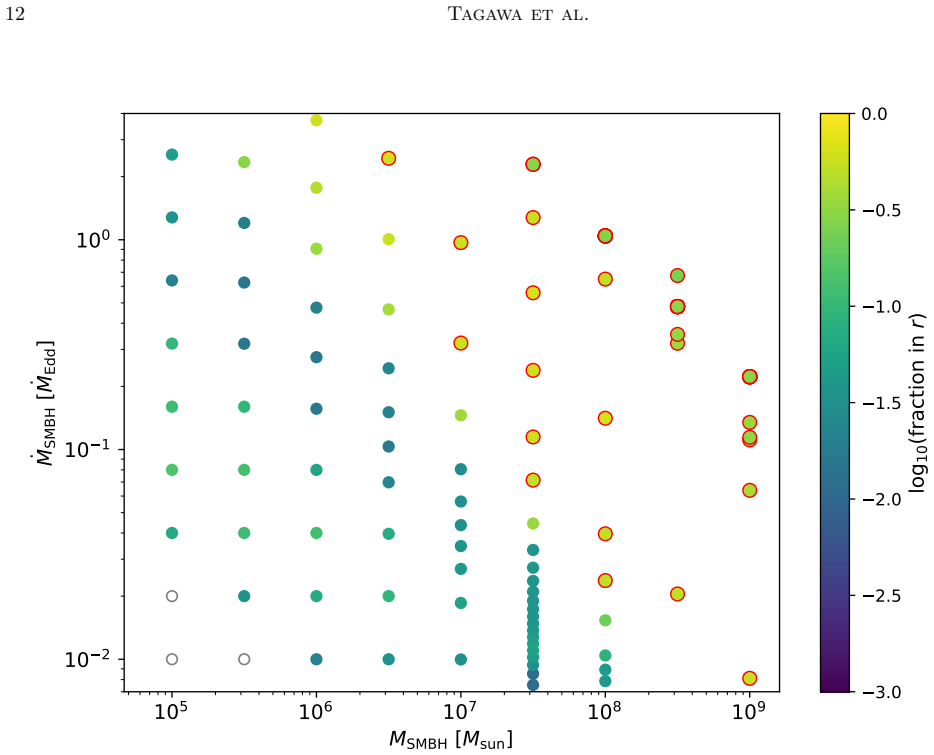
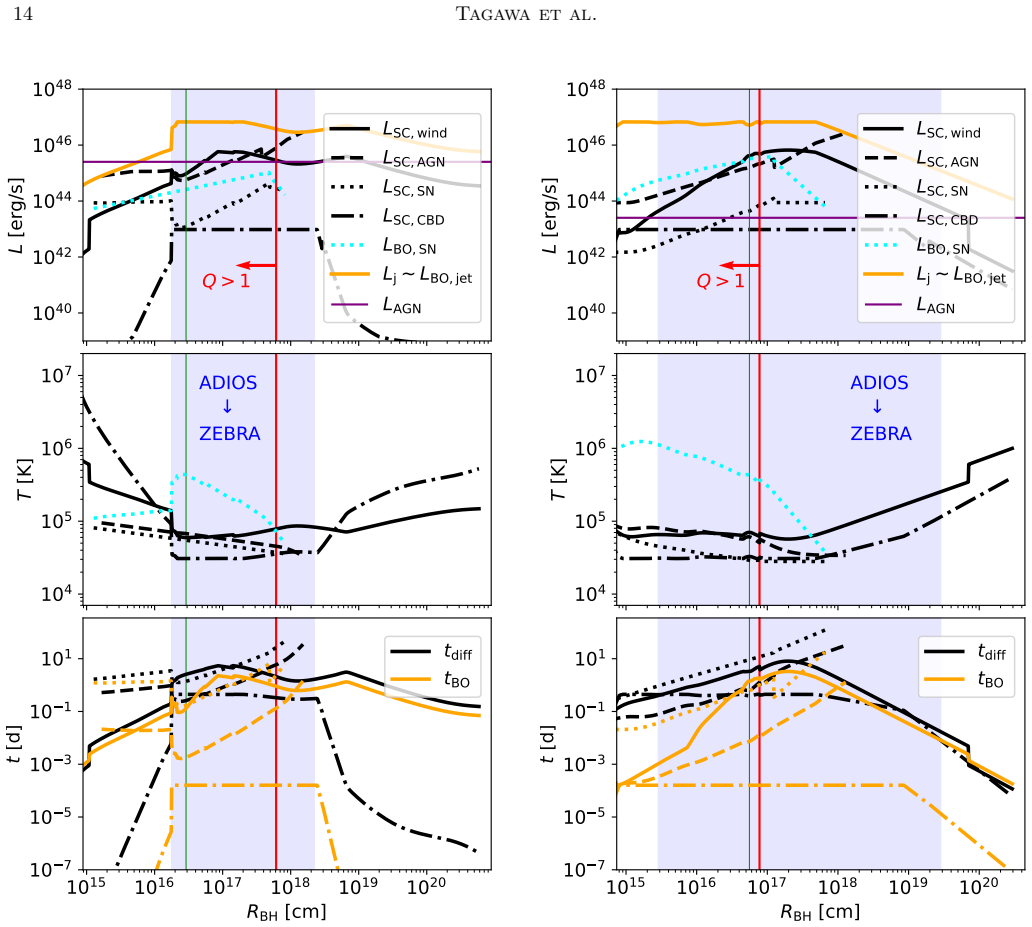
The central claim is that a post-merger jet launched from the remnant black hole in an AGN disk breaks out to generate luminous gamma-ray emission, while cooling from the shocked circum-BH minidisk, winds, and background disk produces UV and optical flares lasting hours to a month. With one fixed set of parameters this reproduces the gamma-ray, hard X-ray and optical flares claimed to accompany some gravitational-wave events. Adding a transition from high- to low-angular-momentum accretion after the merger prevents the remnant from accreting at hyper-Eddington rates and growing excessively.
What carries the argument
The post-merger jet launched by the remnant black hole, which breaks out of the AGN disk to produce high-energy emission, together with the subsequent cooling radiation from the shocked minidisk, winds and ambient disk.
Load-bearing premise
That one fixed but unspecified set of parameters can simultaneously match the claimed gamma-ray, hard X-ray and optical flare properties while the high-to-low angular-momentum accretion transition occurs at exactly the right time to limit black-hole growth.
What would settle it
No gamma-ray flares detected by MeV telescopes in a sample of AGNs monitored for a year, or post-merger black holes observed to have grown far beyond the masses allowed by the low-angular-momentum state.
Figures





read the original abstract
Accretion disks in active galactic nuclei (AGN) are promising sites for mergers of stellar-mass black holes (BHs) detectable via gravitational waves (GWs). These environments facilitate both in-situ formation and dynamical capture of compact objects, and their subsequent mergers. The uncertain origin of GW events detected by LIGO, Virgo and KAGRA motivates searching for accompanying electromagnetic (EM) signatures. Here we investigate post-merger EM flares associated with jets launched from merger remnants, as well as from the shocked ambient gas as the jet breaks out of the disk. We find that jet breakout produces luminous gamma-ray emission, detectable with MeV-band telescopes. Cooling emission from a shocked circum-BH minidisk, winds and background AGN-disk peaks in the UV and optical, with durations ranging from about an hour to a month, and can be identified through year-long monitoring of $\sim10^3$ AGNs with luminosities ranging from $\sim 10^{44}$ to $\sim 10^{45}~{\rm erg~s^{-1}}$. With a single set of parameters, this post-merger jet model produces gamma-ray, hard X-ray and optical flares similar to those claimed to be associated with GW events. Furthermore, by incorporating a transition from a high- to low-angular-momentum accretion state after the merger, the model avoids excessive BH growth, alleviating tensions with hyper-Eddington accretion scenarios.
Editorial analysis
A structured set of objections, weighed in public.
Referee Report
Summary. The manuscript investigates post-merger electromagnetic flares from jets launched by stellar-mass black hole mergers in AGN disks. It models gamma-ray emission from jet breakout, plus UV/optical cooling emission from a shocked circum-BH minidisk, winds, and the background disk, with durations from hours to a month. The central claims are that a single set of parameters reproduces the multi-band flares claimed to accompany GW events and that a post-merger transition from high- to low-angular-momentum accretion prevents excessive BH growth, thereby avoiding hyper-Eddington tensions.
Significance. If the quantitative model holds, the work would offer falsifiable, multi-wavelength predictions for EM counterparts to LIGO/Virgo/KAGRA events in AGN environments. The proposed year-long monitoring of ~10^3 AGNs with luminosities 10^44-10^45 erg/s and the explicit mechanism to cap BH growth constitute potentially valuable contributions to multi-messenger astrophysics.
major comments (2)
- [Abstract] Abstract: the assertion that 'with a single set of parameters, this post-merger jet model produces gamma-ray, hard X-ray and optical flares similar to those claimed' is unsupported by any explicit parameter values, jet-power or breakout-time equations, numerical light-curve results, error estimates, or direct comparison data, which are load-bearing for the reproduction claim.
- [Abstract] Abstract: the high-to-low angular-momentum accretion transition is introduced to avoid excessive BH growth but is not derived from merger hydrodynamics; no timing calculation or sensitivity analysis to disk density and angular-momentum profiles is supplied, leaving the solution to the growth issue unquantified and potentially ad-hoc.
minor comments (1)
- The abstract states flare durations range from an hour to a month but does not indicate the scaling relations or parameter dependences used to obtain these values.
Simulated Author's Rebuttal
We thank the referee for their constructive comments, which have helped us improve the clarity and support for the claims in our manuscript. We address each major point below and have made revisions to the abstract and relevant sections.
read point-by-point responses
-
Referee: [Abstract] Abstract: the assertion that 'with a single set of parameters, this post-merger jet model produces gamma-ray, hard X-ray and optical flares similar to those claimed' is unsupported by any explicit parameter values, jet-power or breakout-time equations, numerical light-curve results, error estimates, or direct comparison data, which are load-bearing for the reproduction claim.
Authors: We acknowledge that the abstract is overly concise and does not explicitly list the parameter values or point to the supporting material. The full manuscript specifies a single parameter set in Section 2 (including jet power L_j = 10^{47} erg s^{-1}, disk density rho = 10^{-10} g cm^{-3}, and scale height H/r = 0.1), derives the jet breakout time in Equation (4) of Section 3.2, presents numerical light curves in Figure 5, and compares them directly to claimed GW-associated events in Section 4.2 with agreement within a factor of ~2 and error estimates from parameter variations. In the revised manuscript we have updated the abstract to include the key parameter values and explicit references to these sections and figures. revision: yes
-
Referee: [Abstract] Abstract: the high-to-low angular-momentum accretion transition is introduced to avoid excessive BH growth but is not derived from merger hydrodynamics; no timing calculation or sensitivity analysis to disk density and angular-momentum profiles is supplied, leaving the solution to the growth issue unquantified and potentially ad-hoc.
Authors: The transition is motivated by the physical change in accretion flow after the merger remnant interacts with the disk, but we agree it is not derived from dedicated merger hydrodynamics simulations. The original manuscript provides an order-of-magnitude estimate based on the viscous timescale in Section 5. To address the concern, the revised version adds an explicit timing calculation t_trans ~ r^2 / (alpha c_s H) and a sensitivity analysis varying disk density by a factor of 10 and angular-momentum profiles, demonstrating that the transition occurs on timescales of hours to days for typical AGN parameters and thereby quantifies the mechanism for limiting BH growth. revision: partial
Circularity Check
No significant circularity in the model's derivation of EM flare signatures
full rationale
The abstract presents a physical model for electromagnetic flares from compact object mergers in AGN disks, calculating jet breakout gamma-ray emission and cooling emission in UV/optical from shocked minidisk, winds, and background disk. The statement that a single set of parameters produces flares similar to claimed GW-associated events is framed as a model outcome rather than a fitted reproduction, with parameters presumably based on typical AGN properties and merger energetics. The transition to low-angular-momentum accretion is explicitly incorporated as a model feature to mitigate BH growth, not derived circularly from the same equations. No load-bearing self-citations, self-definitional loops, or renamings are evident in the text. The derivation chain relies on standard astrophysical processes for jet propagation and radiation, making the results independent of the target observations by construction.
Axiom & Free-Parameter Ledger
free parameters (1)
- single set of parameters
axioms (2)
- domain assumption AGN disks facilitate both in-situ formation and dynamical capture of compact objects leading to mergers
- domain assumption Merger remnants launch jets that break out of the disk
invented entities (1)
-
shocked circum-BH minidisk
no independent evidence
Lean theorems connected to this paper
-
IndisputableMonolith/Cost/FunctionalEquation.leanwashburn_uniqueness_aczel unclearLj = ηj Ṁacc c² ... shock breakout ... diffusion timescale tdiff=(κ mBO/4π c vej)1/2 ... two disk models SG and TQM with tunable parameters
-
IndisputableMonolith/Foundation/RealityFromDistinction.leanreality_from_one_distinction uncleartransition from ADIOS (rcirc > rtrap) to ZEBRA (rcirc < rtrap) ... recoil kick velocity vkick ... opening angle θ0
Forward citations
Cited by 3 Pith papers
-
Properties of black hole mergers in disks of active galactic nuclei
Black hole merger properties in AGN disks match observed distributions when gas accretion and hierarchical mergers are included, varying strongly with disk parameters.
-
Observational Properties of Nonthermal Emission from Relativistic Jets Escaping Active Galactic Nucleus Disks
Jets escaping AGN disks decelerate rapidly in the dense wind-like medium, producing a downshifted spectrum with strong synchrotron self-absorption that creates a quasi-thermal hump, yielding detectable multi-wavelengt...
-
Probing Active Galactic Nuclei and Measuring the Hubble constant with Extreme-Mass-Ratio Inspirals
Modeling accretion disk interactions with EMRIs allows reliable environment identification and boosts dark-siren Hubble constant precision by as much as 20% for individual events.
Reference graph
Works this paper leans on
-
[1]
Laser Interferometer Space Antenna
Abbott, B. P., Abbott, R., Abbott, T. D., et al. 2016, Phys. Rev. Lett., 116, 061102, doi:10.1103/PhysRevLett.116.061102 Abbott, R., Abbott, T. D., Abraham, S., et al. 2020, ApJL, 900, L13, doi:10.3847/2041-8213/aba493 Abbott, R., Abbott, T. D., Acernese, F., et al. 2023a, Physical Review X, 13, 041039, doi:10.1103/PhysRevX.13.041039 —. 2023b, Physical Re...
work page internal anchor Pith review Pith/arXiv arXiv doi:10.1103/physrevlett.116.061102 2016
-
[2]
http://adsabs.harvard.edu/abs/2014ApJ...782...88F Gangardt, D., Trani, A. A., Bonnerot, C., & Gerosa, D. 2024, MNRAS, 530, 3689, doi:10.1093/mnras/stae1117 Gayathri, V., Yang, Y., Tagawa, H., Haiman, Z., & Bartos, I. 2021, arXiv e-prints, arXiv:2104.10253. https://arxiv.org/abs/2104.10253 Gayathri, V., Iorio, G., Tagawa, H., et al. 2025, arXiv e-prints, a...
-
[3]
http://adsabs.harvard.edu/abs/2002Natur.420..643G Graham, M. J., Djorgovski, S. G., Stern, D., et al. 2015, MNRAS, 453, 1562, doi:10.1093/mnras/stv1726 Graham, M. J., Ford, K. E. S., McKernan, B., et al. 2020, Phys. Rev. Lett., 124, 251102, doi:10.1103/PhysRevLett.124.251102 Graham, M. J., McKernan, B., Ford, K. E. S., et al. 2023, ApJ, 942, 99, doi:10.38...
-
[4]
http://adsabs.harvard.edu/abs/2011MNRAS.412..187K Kompaneets, D. A. 1960, Akademiia Nauk SSSR Doklady, 130, 1001 Krolik, J. H., Horne, K., Kallman, T. R., et al. 1991, ApJ, 371, 541, doi:10.1086/169918 Kulkarni, S. R., Harrison, F. A., Grefenstette, B. W., et al. 2021, arXiv e-prints, arXiv:2111.15608, doi:10.48550/arXiv.2111.15608 Leong, S. H. W., & Cald...
-
[5]
F., Faucher-Gigu` ere, C.-A., et al
http://adsabs.harvard.edu/abs/1973A%26A....24..337S Shen, X., Hopkins, P. F., Faucher-Gigu` ere, C.-A., et al. 2020, MNRAS, 495, 3252, doi:10.1093/mnras/staa1381 Sirko, E., & Goodman, J. 2003, MNRAS, 341,
-
[6]
Wide-Field InfrarRed Survey Telescope-Astrophysics Focused Telescope Assets WFIRST-AFTA 2015 Report
http://adsabs.harvard.edu/abs/2003MNRAS.341..501S Spergel, D., Gehrels, N., Baltay, C., et al. 2015, arXiv e-prints, arXiv:1503.03757.https://arxiv.org/abs/1503.03757 Stegmann, J., Gerosa, D., Romero-Shaw, I., et al. 2025, ApJL, 994, L47, doi:10.3847/2041-8213/ae1d66 Steinberg, E., & Stone, N. C. 2024, Nature, 625, 463, doi:10.1038/s41586-023-06875-y Ston...
work page internal anchor Pith review Pith/arXiv arXiv doi:10.3847/2041-8213/ae1d66 2015
discussion (0)
Sign in with ORCID, Apple, or X to comment. Anyone can read and Pith papers without signing in.