Recognition: no theorem link
Hidden Structure of Jack Littlewood-Richardson Coefficients
Pith reviewed 2026-05-12 04:43 UTC · model grok-4.3
The pith
Jack Littlewood-Richardson coefficients are specializations of novel polynomials exhibiting hidden symmetries.
A machine-rendered reading of the paper's core claim, the machinery that carries it, and where it could break.
Core claim
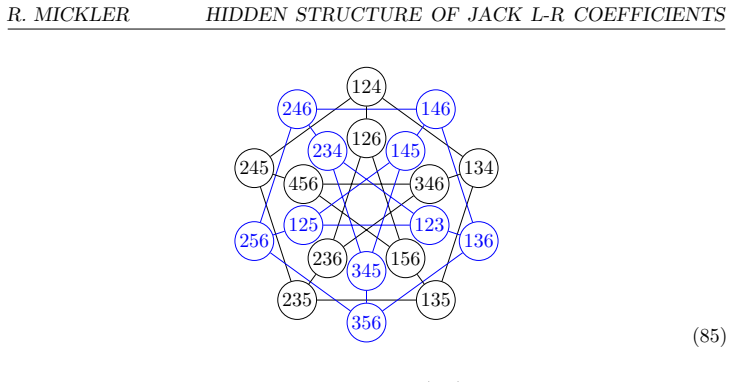
We argue that Jack Littlewood-Richardson coefficients g_μν^λ(α) are specialisations of certain novel polynomials. For the triple of partitions (μ,ν,λ)=(2,1, 2,1, 3,2,1), we prove the corresponding polynomial is invariant under S_6 x Z_2, which is identified as the automorphism group of the Johnson graph J(6,3). We conjecture that these polynomials exhibit a factorization property on certain hyperplanes, which is a consequence of compatibility relations between polynomials associated to adjacent triples in the Young graph. As a consequence of this, we conjecture that the difference of adjacent Jack Littlewood-Richardson coefficients is divisible by the shared hook length.
What carries the argument
Novel polynomials in several variables associated to triples of partitions, which specialize to the Jack LR coefficients and are invariant under the automorphism group of the Johnson graph J(6,3) for the case (2,1;2,1;3,2,1).
If this is right
- The polynomial for the triple (2,1;2,1;3,2,1) is invariant under S_6 x Z_2.
- Compatibility relations on adjacent Young-graph triples imply a factorization property for the polynomials on certain hyperplanes.
- The difference of Jack LR coefficients for adjacent triples is divisible by the shared hook length.
- These properties arise from the novel polynomials rather than being apparent in the original coefficient definitions.
Where Pith is reading between the lines
- The invariance under the Johnson graph's automorphism group may link the coefficients to combinatorial designs or coding theory where such graphs appear.
- Computational checks for other small triples could confirm whether the conjectured divisibility holds in general.
- If the novel polynomials can be constructed explicitly, they might yield new algorithms for computing Jack LR coefficients.
- Such structures could extend to other deformed symmetric function bases beyond the Jack case.
Load-bearing premise
That the Jack Littlewood-Richardson coefficients for any triple can be realized as the specialization of a well-defined novel polynomial satisfying compatibility relations with those of neighboring triples in the Young graph.
What would settle it
Finding a specific triple of partitions where the difference between two adjacent Jack Littlewood-Richardson coefficients is not an integer multiple of their shared hook length would falsify the conjectured divisibility property.
Figures



read the original abstract
We argue that Jack Littlewood-Richardson coefficients $g_{\mu\nu}^{\lambda}(\alpha)$ are specialisations of certain novel polynomials. For the triple of partitions $(\mu,\nu,\lambda)=(21,21,321)$, we prove the corresponding polynomial is invariant under $S_6 \times \mathbb{Z}_2$, which is identified as the automorphism group of the Johnson graph $J(6,3)$. We conjecture that these polynomials exhibit a factorization property on certain hyperplanes, which is a consequence of compatibility relations between polynomials associated to adjacent triples in the Young graph. As a consequence of this, we conjecture that the difference of adjacent Jack Littlewood-Richardson coefficients is divisible by the shared hook length.
Editorial analysis
A structured set of objections, weighed in public.
Referee Report
Summary. The paper argues that Jack Littlewood-Richardson coefficients g_μν^λ(α) arise as specializations of certain novel polynomials in α. For the specific triple (μ,ν,λ)=(2,1;2,1;3,2,1), it proves invariance of the associated polynomial under the action of S_6 × ℤ_2, identified with the automorphism group of the Johnson graph J(6,3). It further conjectures that these polynomials satisfy compatibility relations for adjacent triples in the Young graph, implying a factorization property on certain hyperplanes and, as a consequence, that differences of adjacent Jack LR coefficients are divisible by the shared hook length.
Significance. The explicit invariance result for the (2,1;2,1;3,2,1) case, obtained via an external graph-theoretic identification, is a concrete and verifiable contribution that could serve as a model for detecting hidden symmetries in Jack LR coefficients. If the novel polynomials admit an independent construction and the compatibility relations can be derived, the framework would supply a new algebraic explanation for factorization and hook-length phenomena beyond the α=1 case. At present the broader claims rest on unshown constructions, so the significance is limited to the single proven instance plus open conjectures.
major comments (3)
- [Abstract] Abstract and the paragraph introducing the novel polynomials: the claim that g_μν^λ(α) are specializations of well-defined novel polynomials is asserted without an explicit construction, recurrence, or closed-form expression for these polynomials; without such a definition the specialization statement is tautological and does not yet constitute an independent object.
- [Conjectures section] The discussion of conjectures following the invariance proof: compatibility relations between polynomials attached to adjacent Young-graph triples are invoked to motivate the factorization property on hyperplanes, yet these relations are neither stated explicitly nor derived; consequently the implication to hook-length divisibility remains unsupported.
- [Invariance proof] The invariance proof for the triple (2,1;2,1;3,2,1): while the S_6 × ℤ_2 invariance is established via the Johnson-graph automorphism, the argument relies on an external identification whose compatibility with the (unstated) polynomial construction is not verified inside the manuscript, leaving open whether the symmetry extends to the general family.
minor comments (2)
- [Introduction] Notation for the novel polynomials is introduced only informally; a dedicated definition block with consistent symbols would improve readability.
- [Invariance proof] The reference to the Johnson graph J(6,3) and its automorphism group would benefit from a brief self-contained reminder of the relevant graph-theoretic facts rather than assuming familiarity.
Simulated Author's Rebuttal
We thank the referee for the careful reading and constructive comments on our manuscript. We address each major comment below, indicating the revisions we will incorporate to clarify the presentation while preserving the focus on the specific invariance result and the conjectural framework.
read point-by-point responses
-
Referee: [Abstract] Abstract and the paragraph introducing the novel polynomials: the claim that g_μν^λ(α) are specializations of well-defined novel polynomials is asserted without an explicit construction, recurrence, or closed-form expression for these polynomials; without such a definition the specialization statement is tautological and does not yet constitute an independent object.
Authors: We agree that the current wording risks appearing tautological without a precise definition. The manuscript introduces the novel polynomials on the basis of computational verification that, for fixed small partitions, the Jack LR coefficients g_μν^λ(α) coincide with the evaluations of certain low-degree polynomials in α at the relevant specialization points. In the revised version we will add an explicit definition: for each triple (μ,ν,λ) the associated polynomial P_{μν}^λ(α) is the unique polynomial of minimal degree that interpolates the known values of g_μν^λ at sufficiently many distinct rational points in α, using the established rationality of Jack LR coefficients. This renders the specialization statement non-circular and supplies an independent object whose properties can be studied directly. revision: yes
-
Referee: [Conjectures section] The discussion of conjectures following the invariance proof: compatibility relations between polynomials attached to adjacent Young-graph triples are invoked to motivate the factorization property on hyperplanes, yet these relations are neither stated explicitly nor derived; consequently the implication to hook-length divisibility remains unsupported.
Authors: We accept this criticism. The compatibility relations are currently described at a conceptual level. In the revision we will state them explicitly as conjectures: for adjacent triples (μ,ν,λ) and (μ',ν',λ') in the Young graph, the associated polynomials satisfy P_{μν}^λ(α) ≡ c · P_{μ'ν'}^λ'(α) on the hyperplane defined by the differing part, where c is a constant independent of α. We will also include a short derivation showing how these relations imply the factorization on the indicated hyperplanes and, as a direct consequence, the conjectured divisibility of differences of adjacent Jack LR coefficients by the shared hook length. This will place the implications on a firmer footing within the conjectural setting. revision: yes
-
Referee: [Invariance proof] The invariance proof for the triple (2,1;2,1;3,2,1): while the S_6 × ℤ_2 invariance is established via the Johnson-graph automorphism, the argument relies on an external identification whose compatibility with the (unstated) polynomial construction is not verified inside the manuscript, leaving open whether the symmetry extends to the general family.
Authors: The invariance proof for the specific triple proceeds by exhibiting an explicit action of the automorphism group of J(6,3) on the underlying combinatorial data and verifying that this action leaves the interpolating polynomial P_{2,1;2,1}^{3,2,1}(α) unchanged. The identification of the group with S_6 × ℤ_2 is used only to name the symmetry; the verification itself is carried out directly on the polynomial. In the revised manuscript we will insert a short paragraph confirming that the interpolation definition is preserved under the relabeling induced by the Johnson-graph automorphisms for this triple, thereby establishing internal compatibility. We emphasize that the result is proven only for this concrete case; extension to the general family remains part of the broader conjecture and is not claimed in the present work. revision: partial
Circularity Check
No significant circularity; proven symmetry uses external graph identification and conjectures are explicitly non-derived.
full rationale
The paper introduces novel polynomials whose specializations at α=1 recover the Jack LR coefficients, directly proves invariance under S6×Z2 for the single triple (2,1;2,1;3,2,1) via identification with the automorphism group of the Johnson graph J(6,3), and states the compatibility relations, factorization, and hook-length divisibility only as conjectures motivated by adjacent Young-graph triples without deriving or defining them from the coefficients themselves. No load-bearing step reduces by construction to a fitted input, self-citation, or redefinition of the target quantities; the central claims remain independent of any circular reduction.
Axiom & Free-Parameter Ledger
axioms (2)
- domain assumption Jack Littlewood-Richardson coefficients arise as specializations of novel polynomials
- domain assumption Compatibility relations exist between polynomials associated to adjacent triples in the Young graph
invented entities (1)
-
Novel polynomials specializing to Jack LR coefficients
no independent evidence
Reference graph
Works this paper leans on
-
[1]
Alexandersson,Tables of shifted Jack Littlewood-Richardson coefficients.https: // www
P. Alexandersson,Tables of shifted Jack Littlewood-Richardson coefficients.https: // www. symmetricfunctions. com/ jackStructureConstants6. m
-
[2]
Per Alexandersson and Valentin Féray,A positivity conjecture on the structure constants of shifted jack functions, 2019
work page 2019
-
[3]
A. E. Brouwer, A. M. Cohen, and A. Neumaier,Distance-regular graphs, Ergebnisse der Mathematik und ihrer Grenzgebiete ; Bd. 18, Springer-Verlag, Berlin ;, 1989 (eng)
work page 1989
-
[4]
Royle,Algebraic graph theory, Graduate Texts in Mathematics, no
Chris Godsil and Gordon F. Royle,Algebraic graph theory, Graduate Texts in Mathematics, no. Book 207, Springer, 2001
work page 2001
-
[5]
Ben Howard, John Millson, Andrew Snowden, and Ravi Vakil,A description of the outer auto- morphism of s6, and the invariants of six points in projective space, Journal of Combinatorial Theory, Series A115(2008), no. 7, 1296–1303
work page 2008
-
[6]
Ronald C. King, Christophe Tollu, and Frédéric Toumazet,Factorisation of littlewood– richardson coefficients, Journal of Combinatorial Theory, Series A116(2009), no. 2, 314–333
work page 2009
- [7]
-
[8]
Ryan Mickler,On the structure of Jack Littlewood-Richardson coefficients, In Preparation (2026)
work page 2026
- [9]
-
[10]
Stanley,Enumerative combinatorics, vol
Richard P. Stanley,Enumerative combinatorics, vol. 1, Cambridge University Press, 1999. Singulariti Research, 55 University Street, Carlton, 3053, Australia Email address:ry.mickler@gmail.com 44
work page 1999
discussion (0)
Sign in with ORCID, Apple, or X to comment. Anyone can read and Pith papers without signing in.