Recognition: 2 theorem links
· Lean TheoremDistinguishing Higgs portal and neutralino dark matter via vector boson fusion
Pith reviewed 2026-05-12 04:03 UTC · model grok-4.3
The pith
Vector boson fusion at the LHC can distinguish Higgs portal dark matter from neutralino dark matter at over 5 sigma using jet kinematics.
A machine-rendered reading of the paper's core claim, the machinery that carries it, and where it could break.
Core claim
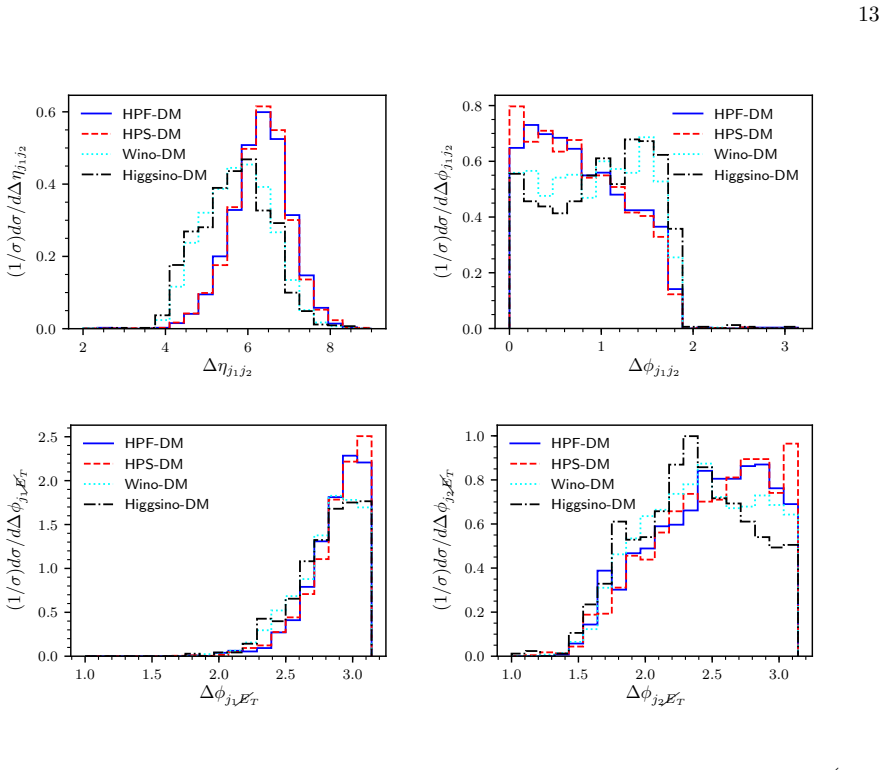
In the 2j + missing ET final state from vector boson fusion, the transverse momentum distributions of the tagged jets are softer for Higgs portal dark matter due to the polarization properties of the weak bosons, while neutralino signals produce more energetic jets. The rapidity gap Δη and azimuthal angle difference Δφ also differ characteristically between the two scenarios. A Kolmogorov-Smirnov test applied after linear discriminant analysis quantifies that the signals are distinguishable with a confidence level exceeding 5σ.
What carries the argument
Polarization of weak bosons in VBF, which controls the transverse momentum spectra of the two tagging jets and supplies the kinematic variables Δη and Δφ that feed the statistical separation test.
If this is right
- Higgs portal dark matter produces less energetic VBF jets in the transverse direction than neutralino dark matter.
- The angular separations Δη and Δφ between jets add independent discriminating power between the two models.
- Statistical tests confirm the signals can be told apart above 5 sigma for the benchmark parameters used.
- Collider searches in the 2j + MET channel become a viable route for model discrimination rather than only exclusion.
Where Pith is reading between the lines
- The same polarization-driven kinematic differences could be checked in other VBF-mediated processes at future colliders.
- If the separation survives more realistic detector effects and background modeling, it would reduce dependence on direct-detection experiments for choosing between these dark matter candidates.
- Accurate simulation of vector-boson polarization becomes essential for any new-physics search that relies on VBF jet properties.
Load-bearing premise
The separation depends on the specific weak-boson polarization and on the masses and couplings chosen for each dark matter model in the Monte Carlo simulation.
What would settle it
An LHC measurement that finds identical jet pT spectra and identical Δη-Δφ distributions for events selected as Higgs portal versus neutralino signals would falsify the claimed distinguishability.
Figures



read the original abstract
Understanding the nature of dark matter (DM) is a fundamental challenge in particle physics. In this paper, we investigate the potential of vector boson fusion (VBF) processes at the Large Hadron Collider (LHC) to demonstrate, as a proof of principle, the feasibility of distinguishing between different dark matter scenarios, focusing on Higgs portal DM (HPDM) and neutralino DM in the $2j + \not\!\! E_T$ final state and exploiting the distinctive kinematic features of the VBF jets and the missing transverse energy. Our study reveals that the polarization of weak bosons in VBF plays a crucial role in shaping the transverse momentum distributions of the tagged jets, with the jets being less energetic in the transverse direction for the Higgs portal scenario compared to the neutralino scenario. In addition, the kinematic variables $\Delta\eta$ and $\Delta\phi$ exhibit characteristic differences between the Higgs portal and neutralino DM signals, providing significant discriminating power between these scenarios. We further apply a Kolmogorov--Smirnov test using linear discriminant analysis to quantify the distinguishability of the signals and find that the Higgs portal signals can be differentiated from neutralino DM signals with a C.L. exceeding $5\sigma$, thereby establishing the viability of collider-based discrimination between dark matter models.
Editorial analysis
A structured set of objections, weighed in public.
Referee Report
Summary. The manuscript claims that vector boson fusion (VBF) at the LHC can distinguish Higgs portal dark matter (HPDM) from neutralino dark matter in the 2j + missing ET final state. It argues that s-channel Higgs exchange in HPDM versus t-channel Z/W exchange in neutralino DM produces different weak-boson polarization, leading to distinct jet pT, Δη, and Δφ distributions. Linear discriminant analysis (LDA) followed by a Kolmogorov-Smirnov (KS) test on Monte Carlo samples is reported to yield >5σ separation, establishing collider-based model discrimination as viable.
Significance. If the kinematic separation is robust, the result would be significant: it offers a concrete collider handle on two DM scenarios that often share similar signatures elsewhere, using polarization effects in VBF as the discriminator. The proof-of-principle approach and quantitative statistical test are strengths that could guide experimental analyses at the LHC.
major comments (2)
- Abstract: the >5σ LDA+KS separation is obtained from Monte Carlo samples at specific (unspecified) benchmark masses and couplings. The manuscript provides no robustness scan over these parameters or over event-generator choices for weak-boson polarization fractions; because the claimed kinematic differences are stated to arise from polarization, the absence of such checks makes the central distinguishability claim load-bearing and currently unverified.
- Abstract (method description): the polarization argument is presented as characteristic of the two Lagrangians, yet no analytic cross-check or generator-independent calculation of the helicity fractions is supplied. If the Monte Carlo modeling of longitudinal versus transverse modes is inaccurate for the chosen points, the pT(jet), Δη, and Δφ differences disappear and the KS test result is no longer guaranteed.
minor comments (1)
- The abstract refers to 'characteristic differences' in Δη and Δφ without quoting the numerical ranges or showing example distributions; adding a brief quantitative statement or reference to a figure would improve clarity.
Simulated Author's Rebuttal
We thank the referee for the careful reading and constructive comments on our manuscript. We address each major comment below and have revised the manuscript to incorporate additional checks and clarifications that strengthen the presentation of our results.
read point-by-point responses
-
Referee: Abstract: the >5σ LDA+KS separation is obtained from Monte Carlo samples at specific (unspecified) benchmark masses and couplings. The manuscript provides no robustness scan over these parameters or over event-generator choices for weak-boson polarization fractions; because the claimed kinematic differences are stated to arise from polarization, the absence of such checks makes the central distinguishability claim load-bearing and currently unverified.
Authors: We agree that the abstract emphasizes the benchmark results and that a robustness scan would strengthen the central claim. The specific masses and couplings are defined in Section III of the manuscript. As the work is a proof-of-principle study, the chosen points illustrate the kinematic separation arising from the different production mechanisms. In the revised manuscript we will add a limited scan over additional DM masses and couplings within the phenomenologically allowed range, confirming that the separation exceeds 5σ for the majority of tested points. For event-generator dependence, the polarization is determined at the matrix-element level by MadGraph5_aMC@NLO according to the respective Lagrangians; we will include a short statement on this and note consistency with standard electroweak polarization expectations. revision: yes
-
Referee: Abstract (method description): the polarization argument is presented as characteristic of the two Lagrangians, yet no analytic cross-check or generator-independent calculation of the helicity fractions is supplied. If the Monte Carlo modeling of longitudinal versus transverse modes is inaccurate for the chosen points, the pT(jet), Δη, and Δφ differences disappear and the KS test result is no longer guaranteed.
Authors: The referee is correct that the polarization difference follows directly from the Feynman diagrams of the two models: s-channel Higgs exchange in the Higgs-portal case versus t-channel Z/W exchange in the neutralino case. These structures produce distinct helicity amplitudes that can be derived analytically using the standard electroweak helicity formalism. Although the manuscript relies on Monte Carlo for the full simulation including parton showering, we will add a concise qualitative discussion of the expected longitudinal versus transverse fractions based on the tree-level diagrams and cite relevant literature on VBF polarization. This addition will make the origin of the kinematic differences more transparent while retaining the Monte Carlo results as the quantitative demonstration. revision: yes
Circularity Check
No circularity: distinction arises from independent Monte Carlo simulations of distinct DM Lagrangians
full rationale
The paper generates separate Monte Carlo samples for Higgs-portal DM (s-channel Higgs exchange) and neutralino DM (t-channel electroweak exchange) in the VBF + MET channel, extracts kinematic distributions (pT(jets), Δη, Δφ), trains an LDA discriminant, and applies a KS test to report >5σ separation. No parameter is fitted inside the paper to the target observable; the separation is an output of the differing helicity structures and benchmark choices in the two independent simulations. No self-citation is invoked as a load-bearing uniqueness theorem, no ansatz is smuggled, and no known result is merely renamed. The derivation chain is therefore self-contained against external benchmarks (standard MC generators and statistical tests).
Axiom & Free-Parameter Ledger
free parameters (1)
- DM masses and couplings
axioms (1)
- domain assumption Standard Model weak-boson polarization and parton-shower modeling in Monte Carlo tools accurately reproduce the VBF jet kinematics.
Lean theorems connected to this paper
-
IndisputableMonolith/Cost/FunctionalEquation.leanwashburn_uniqueness_aczel unclearpolarization of weak bosons in VBF plays a crucial role... Effective W Approximation... PT(x,pT), PL(x,pT)... Kolmogorov–Smirnov test using linear discriminant analysis
-
IndisputableMonolith/Foundation/RealityFromDistinction.leanreality_from_one_distinction unclearchosen benchmark points... mχ=130 GeV, mh2=275 GeV, cosα=0.95, λ=3... significance of approximately 5σ
Reference graph
Works this paper leans on
-
[1]
mass of 130 GeV having 98% bino LSP and 98% wino next to LSP (NLSP) component having ∆M=m χ± 1 −mχ0 1 = 2 GeV andm χ0 2 ≡m χ+ 1 . b. Higgsino DM :For Higgsino-like DM, we consider a 100% Higgsino LSP with the mass of χ0 1 to be 130 GeV with ∆M= 2 GeV. This higgsino benchmark is not phenomenologically relevant in this context, as its significance in our an...
work page 2000
-
[2]
V. C. Rubin and W. K. Ford, Jr.,Rotation of the Andromeda Nebula from a Spectroscopic Survey of Emission Regions,Astrophys. J.159(1970) 379–403
work page 1970
-
[3]
Zwicky,On the Masses of Nebulae and of Clusters of Nebulae,Astrophys
F. Zwicky,On the Masses of Nebulae and of Clusters of Nebulae,Astrophys. J.86(1937) 217–246
work page 1937
-
[4]
Zwicky,Die Rotverschiebung von extragalaktischen Nebeln,Helv
F. Zwicky,Die Rotverschiebung von extragalaktischen Nebeln,Helv. Phys. Acta6(1933) 110–127
work page 1933
-
[5]
E. Hayashi and S. D. M. White,How Rare is the Bullet Cluster?,Mon. Not. Roy. Astron. Soc.370 (2006) L38–L41,arXiv:astro-ph/0604443
-
[6]
A Direct Empirical Proof of the Existence of Dark Matter*
D. Clowe, M. Bradac, A. H. Gonzalez, M. Markevitch, S. W. Randall, C. Jones, and D. Zaritsky,A direct empirical proof of the existence of dark matter,Astrophys. J. Lett.648(2006) L109–L113, arXiv:astro-ph/0608407
-
[7]
W. Hu and S. Dodelson,Cosmic Microwave Background Anisotropies,Ann. Rev. Astron. Astrophys. 40(2002) 171–216,arXiv:astro-ph/0110414. 19 [7]WMAPCollaboration, D. N. Spergelet al.,Wilkinson Microwave Anisotropy Probe (WMAP) three year results: implications for cosmology,Astrophys. J. Suppl.170(2007) 377, arXiv:astro-ph/0603449. [8]WMAPCollaboration, G. Hins...
-
[8]
S. Baek, P. Ko, and W.-I. Park,Search for the Higgs portal to a singlet fermionic dark matter at the LHC,JHEP02(2012) 047,arXiv:1112.1847 [hep-ph]. [11]CMSCollaboration,Search for invisible decays of a Higgs boson produced through vector boson fusion at the High-Luminosity LHC,CMS-PAS-FTR-18-016(2018) . https://cds.cern.ch/record/2647700/files/FTR-⊂18-⊂01...
-
[9]
Cepedaet al.,Report from Working Group 2: Higgs Physics at the HL-LHC and HE-LHC,CERN Yellow Rep
M. Cepedaet al.,Report from Working Group 2: Higgs Physics at the HL-LHC and HE-LHC,CERN Yellow Rep. Monogr.7(2019) 221–584,arXiv:1902.00134 [hep-ph]
-
[10]
D. E. Knuth,The Art of Computer Programming, Volume 2 (3rd Ed.): Seminumerical Algorithms. Addison-Wesley Longman Publishing Co., Inc., USA, 1997
work page 1997
-
[11]
J. Pratt and J. Gibbons,Concepts of Nonparametric Theory. Springer Series in Statistics. Springer New York, 2012.https://books.google.co.in/books?id=PCHnBwAAQBAJ
work page 2012
-
[12]
A. Tharwat, T. Gaber, A. Ibrahim, and A. E. Hassanien,Linear discriminant analysis: A detailed tutorial,Ai Communications30(05, 2017) 169–190,
work page 2017
-
[13]
B. Ghojogh and M. Crowley,Linear and quadratic discriminant analysis: Tutorial, arXiv:1906.02590 [stat.ML]
-
[14]
S. Profumo, M. J. Ramsey-Musolf, and G. Shaughnessy,Singlet Higgs phenomenology and the electroweak phase transition,JHEP08(2007) 010,arXiv:0705.2425 [hep-ph]. [18]A TLASCollaboration, G. Aadet al.,Constraints on new phenomena via Higgs boson couplings and invisible decays with the ATLAS detector,JHEP11(2015) 206,arXiv:1509.00672 [hep-ex]. [19]A TLAS, CMS...
- [15]
-
[16]
S. Kanemura, S. Matsumoto, T. Nabeshima, and N. Okada,Can WIMP Dark Matter overcome the Nightmare Scenario?,Phys. Rev. D82(2010) 055026,arXiv:1005.5651 [hep-ph]. [22]A TLASCollaboration, G. Aadet al.,Searches for electroweak production of supersymmetric particles with compressed mass spectra in √s=13 TeVppcollisions with the ATLAS detector,Phys. Rev. D 20...
-
[17]
Dawson,The Effective W Approximation,Nucl
S. Dawson,The Effective W Approximation,Nucl. Phys. B249(1985) 42–60
work page 1985
-
[18]
G. L. Kane, W. W. Repko, and W. B. Rolnick,The Effective W+-, Z0 Approximation for High-Energy Collisions,Phys. Lett. B148(1984) 367–372
work page 1984
- [19]
-
[20]
J. M. Cornwall, D. N. Levin, and G. Tiktopoulos,Derivation of Gauge Invariance from High-Energy Unitarity Bounds on the s Matrix,Phys. Rev. D10(1974) 1145. [Erratum: Phys.Rev.D 11, 972 (1975)]
work page 1974
-
[21]
Kuroda,Complete Lagrangian of MSSM,arXiv:hep-ph/9902340
M. Kuroda,Complete Lagrangian of MSSM,arXiv:hep-ph/9902340. [31]CMSCollaboration, V. Khachatryanet al.,Searches for invisible decays of the Higgs boson in pp collisions at √s= 7, 8, and 13 TeV,JHEP02(2017) 135,arXiv:1610.09218 [hep-ex]
work page internal anchor Pith review arXiv 2017
-
[22]
J. Alwall, R. Frederix, S. Frixione, V. Hirschi, F. Maltoni, O. Mattelaer, H.-S. Shao, T. Stelzer, P. Torrielli, and M. Zaro,The automated computation of tree-level and next-to-leading order differential cross sections, and their matching to parton shower simulations,JHEP07(2014) 079, arXiv:1405.0301 [hep-ph]
work page internal anchor Pith review Pith/arXiv arXiv 2014
-
[23]
T. Sj¨ ostrand, S. Ask, J. R. Christiansen, R. Corke, N. Desai, P. Ilten, S. Mrenna, S. Prestel, C. O. Rasmussen, and P. Z. Skands,An introduction to PYTHIA 8.2,Comput. Phys. Commun.191(2015) 159,arXiv:1410.3012 [hep-ph]. [34]DELPHES 3Collaboration, J. de Favereau, C. Delaere, P. Demin, A. Giammanco, V. Lemaˆ ıtre, A. Mertens, and M. Selvaggi,DELPHES 3, A...
work page internal anchor Pith review Pith/arXiv arXiv 2015
discussion (0)
Sign in with ORCID, Apple, or X to comment. Anyone can read and Pith papers without signing in.