Recognition: 3 theorem links
· Lean TheoremNetwork-Normative Belief Updating in High-Dimensional Ideological Space
Pith reviewed 2026-05-12 04:26 UTC · model grok-4.3
The pith
People's bundles of attitudes on many issues shift toward empirically common configurations more than several null models predict, but the excess is visible only at fine grid resolutions.
A machine-rendered reading of the paper's core claim, the machinery that carries it, and where it could break.
Core claim
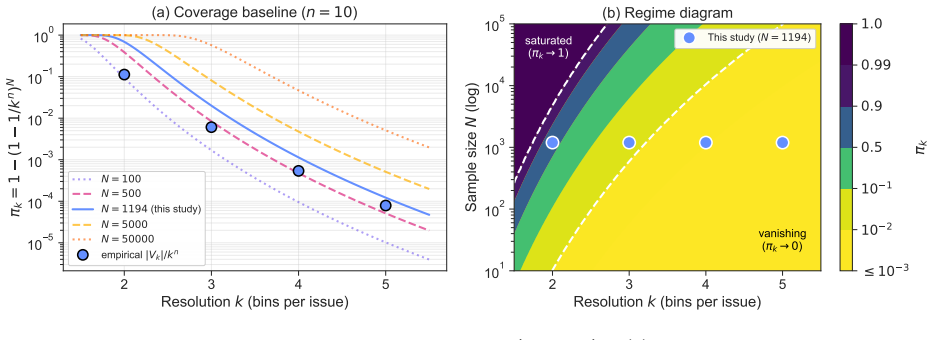
Continuous attitude profiles in [0,1]^n are discretised onto regular grids of resolution k; occupied positions form a network whose edges are single-issue unit moves. Densely populated regions are treated as network-normative. Against a coverage baseline, a one- or two-hop random walk, and a marginal permutation null that preserves per-issue change distributions, the observed fraction of moves landing inside these regions exceeds the baseline by a factor of 36 at k=3, exceeds the two-hop walk by ~0.30, and exceeds the permutation null by ~0.04. The permutation gap widens from near zero at k=2 to ~0.14 at k=5, so coupled cross-issue updating appears only at fine resolutions.
What carries the argument
A network whose nodes are discretised attitude profiles on a k-resolution grid and whose edges connect profiles differing by one unit on a single issue; network-normative regions are the densely occupied nodes, tested against a hierarchy of null models that isolate cross-issue coupling.
If this is right
- Belief updating is coupled across issues rather than independent, so change on one policy predicts change on others through shared normative regions.
- The apparent strength of this coupling depends on grid resolution, remaining invisible at coarse scales and growing at finer ones.
- Standard scalar or low-dimensional models of opinion dynamics miss the high-dimensional geometry that shapes movement toward common bundles.
- The hierarchy of null models supplies a practical test for whether any given panel exhibits representation-contingent normative attraction.
Where Pith is reading between the lines
- The same discretisation approach could be used to track how normative regions themselves move or split when more than two waves are available.
- If real attitude space contains curved or correlated dimensions rather than a flat grid, the detected coupling might partly reflect that mismatch.
- Interventions aimed at one issue could produce spillover shifts on linked issues by steering respondents toward or away from the same normative bundles.
Load-bearing premise
Single-issue unit steps on a regular grid faithfully represent the geometry of possible attitude changes, and the marginal permutation null correctly isolates cross-issue coupling without introducing its own artifacts.
What would settle it
A new two-wave panel in which the inside-rate gap versus the marginal permutation null stays near zero even at k=5 would falsify the claim that coupled cross-issue updating is detectable at fine resolutions.
Figures


read the original abstract
Most mathematical models of opinion dynamics treat attitudes as scalar quantities or positions on a low-dimensional ideological axis. Empirical attitudes, however, are bundles of positions across many policy issues, and the geometry of the resulting high-dimensional belief space is non-trivial. This paper develops a network-theoretic framework for analysing how individuals move through such a space between two measurement waves. Continuous attitude profiles in $[0,1]^n$ are discretised onto regular grids of resolution $k$, occupied positions form a network whose adjacency is defined by single-issue unit moves, and densely populated regions are interpreted as network-normative: empirically common configurations of attitudes in the population. We introduce a hierarchy of null models against which observed movement can be benchmarked: a closed-form coverage baseline requiring no behavioural parameters; a local random-walk that retains each respondent's baseline position and asks whether destinations are over-represented in occupied regions relative to a uniform 1- or 2-step move; and a marginal permutation null model that preserves per-issue change distributions while disrupting within-respondent cross-issue coupling. Applying the framework to a two-wave panel of $N=1194$ respondents on $n=10$ issues, we find that the observed inside rate exceeds the coverage baseline by a factor of 36 at the focal resolution $k=3$, exceeds the two-hop random-walk null model by $\sim 0.30$, and exceeds the perturbation null model by $\sim 0.04$; only the one-hop random walk is competitive. The perturbation gap grows from near zero at $k=2$ to $\sim 0.14$ at $k=5$, indicating that coupled cross-issue updating is detectable only at fine resolutions. Network-normative attraction is therefore real but representation-contingent: which null model is exceeded, and by how much, changes systematically with $k$.
Editorial analysis
A structured set of objections, weighed in public.
Referee Report
Summary. The paper develops a network-theoretic framework for belief updating in high-dimensional ideological space: continuous attitudes in [0,1]^n are discretized onto k-resolution grids, occupied positions form a network with edges for single-issue unit moves, and dense regions are labeled network-normative. A hierarchy of null models (coverage baseline, 1-/2-hop random walks, marginal permutation) is used to benchmark observed movements. In a two-wave panel (N=1194, n=10 issues), the observed inside rate exceeds the coverage baseline by a factor of 36 at k=3, the two-hop walk by ~0.30, and the perturbation null by ~0.04; the perturbation gap grows with k (near zero at k=2 to ~0.14 at k=5), interpreted as evidence for detectable cross-issue coupling only at fine resolutions.
Significance. If the null implementations are free of boundary artifacts, the work supplies a concrete, resolution-dependent test for non-independent attitude change that goes beyond scalar or low-dimensional models. The hierarchy of nulls and the falsifiable claim that coupling appears only above a certain k are strengths; the approach could be extended to other panel datasets and would strengthen empirical foundations for high-dimensional opinion dynamics.
major comments (2)
- [Methods (marginal permutation null)] § on marginal permutation null (Methods): no description is given of how out-of-bound values are treated when independently reassigning per-issue deltas within the bounded [0,1]^n cube. A respondent near 0.95 receiving a +0.2 delta produces an invalid position; without documented clipping, rejection, or reflection, the null hit rate on occupied bins is biased, especially under the extreme sparsity at k=3 (3^10=59049 bins, N=1194). This directly affects the load-bearing ~0.04 excess and its growth to 0.14 at k=5.
- [Results (perturbation gap)] Results, perturbation comparison: the claim that the perturbation gap isolates cross-issue coupling assumes the null correctly preserves geometry on the discrete grid. The competitiveness of the one-hop walk is noted but does not test coupling; the reported excess therefore rests on the unverified boundary handling in the permutation step.
minor comments (2)
- [Abstract] Abstract: the phrase 'only the one-hop random walk is competitive' is used without stating the exact statistical criterion or effect-size threshold applied.
- [Notation and definitions] Notation: the precise definition of 'inside rate' and the density threshold used to designate network-normative regions should be stated explicitly in the main text rather than deferred to supplementary material.
Simulated Author's Rebuttal
We thank the referee for the careful and constructive review. The comments correctly identify an important omission in the description of the marginal permutation null model. We address both points below and have revised the manuscript to document the boundary procedure, add robustness checks, and clarify the distinct roles of the null models in the hierarchy.
read point-by-point responses
-
Referee: [Methods (marginal permutation null)] § on marginal permutation null (Methods): no description is given of how out-of-bound values are treated when independently reassigning per-issue deltas within the bounded [0,1]^n cube. A respondent near 0.95 receiving a +0.2 delta produces an invalid position; without documented clipping, rejection, or reflection, the null hit rate on occupied bins is biased, especially under the extreme sparsity at k=3 (3^10=59049 bins, N=1194). This directly affects the load-bearing ~0.04 excess and its growth to 0.14 at k=5.
Authors: We agree this was an omission. In the implementation, out-of-bound values after independent delta reassignment were handled by reflection (if a coordinate exceeds 1 it is reflected as 2 minus the value; similarly for values below 0). This choice preserves the marginal change distributions as closely as possible without rejection sampling. We have added an explicit description of the reflection procedure, together with pseudocode, to the Methods section of the revised manuscript. We also re-ran the null model with clipping as a sensitivity check; the perturbation gap remains essentially unchanged (~0.04 at k=3, increasing to ~0.14 at k=5). The new robustness analysis appears in the supplementary materials. These additions directly address the potential bias concern under the reported sparsity. revision: yes
-
Referee: [Results (perturbation gap)] Results, perturbation comparison: the claim that the perturbation gap isolates cross-issue coupling assumes the null correctly preserves geometry on the discrete grid. The competitiveness of the one-hop walk is noted but does not test coupling; the reported excess therefore rests on the unverified boundary handling in the permutation step.
Authors: The marginal permutation null is constructed precisely to isolate cross-issue coupling: it preserves the empirical per-issue delta distributions while destroying within-respondent correlations among those deltas. The one-hop random walk, although competitive, retains each respondent’s original position and only samples local grid moves; it therefore does not permute the observed changes and cannot serve as a test of coupling. With the reflection boundary rule now documented and shown to be robust under clipping, the geometry on the discrete grid is preserved in the sense required by the null. We have expanded the Results and Discussion sections to articulate the complementary roles of the null models and to note that the perturbation gap grows with resolution, consistent with coupling becoming detectable only at finer discretizations. revision: yes
Circularity Check
No significant circularity; derivation relies on explicit null-model benchmarks rather than tautological reduction
full rationale
The paper defines network-normative regions from empirical density at each resolution k and measures the fraction of observed t1-to-t2 moves landing inside those regions. It then compares this rate to a hierarchy of null models (coverage baseline, 1-/2-hop random walks, and marginal-permutation model) that are constructed to preserve selected marginal statistics while breaking others. Because the null models are not identical to the observed joint distribution, the reported excesses (e.g., factor of 36 over coverage, ~0.04 over perturbation at k=3) constitute independent empirical content rather than a definitional identity. No equation equates the target quantity to a fitted parameter or prior self-citation by construction, and the analysis contains no load-bearing self-citation chain. The derivation is therefore self-contained against its own benchmarks.
Axiom & Free-Parameter Ledger
free parameters (1)
- grid resolution k
axioms (2)
- domain assumption Attitude profiles in [0,1]^n can be meaningfully discretized onto regular grids without distorting the underlying geometry of belief updating.
- domain assumption Movement between waves occurs via single-issue unit steps on the grid.
invented entities (1)
-
network-normative regions
no independent evidence
Lean theorems connected to this paper
-
IndisputableMonolith/Cost/FunctionalEquation.leanwashburn_uniqueness_aczel unclear?
unclearRelation between the paper passage and the cited Recognition theorem.
Continuous attitude profiles in [0,1]^n are discretised onto regular grids of resolution k, occupied positions form a network whose adjacency is defined by single-issue unit moves... marginal permutation null model that preserves per-issue change distributions while disrupting within-respondent cross-issue coupling.
-
IndisputableMonolith/Foundation/AlexanderDuality.leanalexander_duality_circle_linking unclear?
unclearRelation between the paper passage and the cited Recognition theorem.
The three nulls form a hierarchy of increasing realism... coverage baseline π_k = 1-(1-1/k^n)^N
-
IndisputableMonolith/Foundation/RealityFromDistinction.leanreality_from_one_distinction unclear?
unclearRelation between the paper passage and the cited Recognition theorem.
observed inside rate ˆp_3 ≈ 0.73 exceeds the coverage baseline π_3 ≈ 0.02 by a factor of 36
What do these tags mean?
- matches
- The paper's claim is directly supported by a theorem in the formal canon.
- supports
- The theorem supports part of the paper's argument, but the paper may add assumptions or extra steps.
- extends
- The paper goes beyond the formal theorem; the theorem is a base layer rather than the whole result.
- uses
- The paper appears to rely on the theorem as machinery.
- contradicts
- The paper's claim conflicts with a theorem or certificate in the canon.
- unclear
- Pith found a possible connection, but the passage is too broad, indirect, or ambiguous to say the theorem truly supports the claim.
Reference graph
Works this paper leans on
-
[1]
Opinions and social pressure.Scientific American, 193(5):31–35, 1955
Solomon Asch. Opinions and social pressure.Scientific American, 193(5):31–35, 1955
work page 1955
-
[2]
David Bikhchandani, Sushil, Hirshleifer, , and Ivo Welch. A theory of fads, fashion, custom, and cultural change as informational cascades.Journal of Political Economy, 100(5):992–1026, 1992
work page 1992
-
[3]
Rod Bond and Peter B. Smith. Culture and Conformity: A Meta-Analysis of Studies Using Asch’s (1952b, 1956) Line Judgement Task.Psychological Bulletin, 119(I):111– 137, 1996. 22
work page 1956
-
[4]
Somdeep Chatterjee and Jai Kamal. Voting for the underdog or jumping on the band- wagon? evidence from india’s exit poll ban.Public Choice, 188(3-4):431–453, 2021
work page 2021
-
[5]
Daniel W. Fleitas. Bandwagon and underdog effects in minimal-information elections. American Political Science Review, 65(2):434–438, 1971
work page 1971
-
[6]
Patrick J. Kenney and Tom W. Rice. The psychology of political momentum.Political Research Quarterly, 47, 1996
work page 1996
- [7]
-
[8]
Helen Margetts, Peter John, Scott Hale, and Taha Yasseri. Political turbulence. In Political Turbulence. Princeton University Press, 2015
work page 2015
-
[9]
Back on the bandwagon: The effect of opinion polls on public opinion
Catherine Marsh. Back on the bandwagon: The effect of opinion polls on public opinion. British Journal of Political Science, 15(1):51–74, 1985
work page 1985
-
[10]
Albert Mehrabian. Effects of poll reports on voter preferences.Journal of Applied Social Psychology, 28:2119–2130, 1999
work page 1999
-
[11]
Diana C Mutz. Mass media and the depoliticization of personal experience.American Journal of Political Science, pages 483–508, 1992
work page 1992
-
[12]
Richard Nadeau, Edouard Cloutier, and J-H Guay. New evidence about the existence of a bandwagon effect in the opinion formation process.International Political Science Review, 14(2):203–213, 1993
work page 1993
-
[13]
Myrto Pantazi, Chico Camargo, Helen Margetts, Peter John, and Scott Hale. How public opinion shapes individual policy preferences: do the conformists constrain the contrarians?
-
[14]
Duncan J Watts, Peter Sheridan Dodds, and Peter Sheridan Dodds. Influentials, net- works, and public opinion formation.Journal of Consumer Research, 34(4):441–458, 2007. 23
work page 2007
discussion (0)
Sign in with ORCID, Apple, or X to comment. Anyone can read and Pith papers without signing in.