Recognition: no theorem link
Lyapunov Exponents as Duality-Invariant Signatures of Critical States
Pith reviewed 2026-05-12 04:46 UTC · model grok-4.3
The pith
Critical eigenstates are characterized by zero Lyapunov exponents in both real space and momentum space.
A machine-rendered reading of the paper's core claim, the machinery that carries it, and where it could break.
Core claim
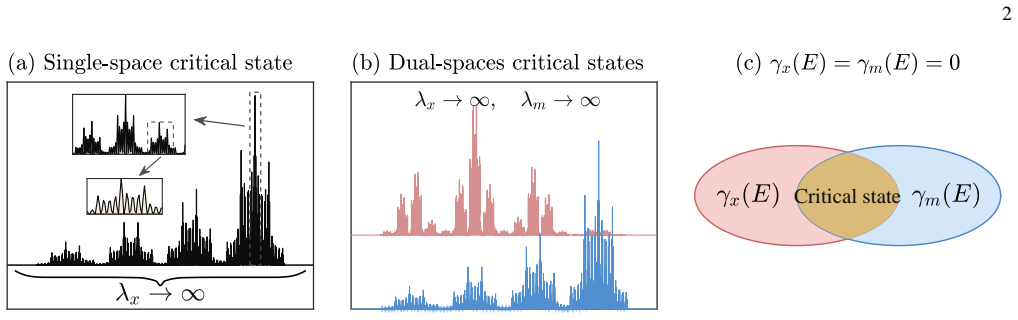
We prove a Fourier exclusion principle: exponential localization in one representation is incompatible with exponential localization in its Fourier-dual representation. Consequently, a critical state is defined by the simultaneous absence of exponential confinement in real and momentum space, expressed by the condition that both position-space and momentum-space Lyapunov exponents vanish. This length-scale statement is invariant under bounded local gauge transformations of the transfer matrix and yields exact critical sets in quasiperiodic and non-Hermitian models.
What carries the argument
The Fourier exclusion principle, which shows that exponential localization cannot hold simultaneously in a space and its Fourier dual, turning the Liu-Xia condition on dual Lyapunov exponents into a rigorous characterization of criticality.
If this is right
- The dual Lyapunov condition produces closed-form critical lines in quasiperiodic models.
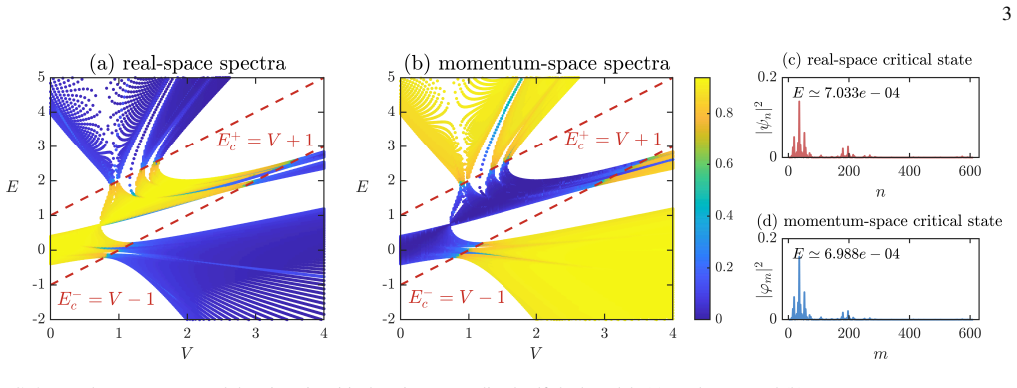
- It locates an exact finite critical region that includes an additional critical branch.
- It predicts a complex critical surface in the spectrum of non-Hermitian non-self-dual models.
- The criterion remains compatible with conventional single-space multifractal diagnostics.
Where Pith is reading between the lines
- The same dual-length-scale logic could be applied to other representations beyond Fourier space in systems with additional symmetries.
- Numerical searches for criticality in non-integrable models might be simplified by computing only the dual Lyapunov exponents rather than full wavefunction statistics.
- The gauge invariance suggests the diagnostic is robust to local redefinitions of the basis or phase factors.
Load-bearing premise
The Fourier exclusion principle holds for the transfer matrices of the quasiperiodic and non-Hermitian models, and bounded local gauge transformations leave the zero-exponent characterization unchanged.
What would settle it
An eigenstate identified as critical by multifractal analysis that nevertheless exhibits a nonzero Lyapunov exponent in either real space or momentum space would contradict the exclusion principle.
Figures


read the original abstract
Critical eigenstates are usually identified through wave-function geometry in a chosen basis, such as participation ratios, multifractal spectra, or finite-size scaling. Here we formulate criticality instead as a dual-space Lyapunov property. We prove a Fourier exclusion principle: exponential localization in one representation is incompatible with exponential localization in its Fourier-dual representation. This turns the Liu--Xia condition, \(\gamma_x(E)=\gamma_m(E)=0\), from a phenomenological criterion into a rigorous length-scale statement: a critical state is characterized by the simultaneous absence of exponential confinement in real and momentum space. The criterion is invariant under bounded local gauge transformations of the transfer matrix and remains compatible with conventional single-space multifractal diagnostics. More importantly, it is exactly predictive. In analytically tractable quasiperiodic models, the same condition yields closed-form critical lines, an exact finite critical region with an additional critical branch, and a complex critical surface in a non-Hermitian non-self-dual spectrum. Thus the Liu--Xia condition provides not only a diagnostic of critical states, but an exact solvability principle for locating critical sets across distinct microscopic structures.
Editorial analysis
A structured set of objections, weighed in public.
Referee Report
Summary. The manuscript claims that critical eigenstates are rigorously characterized by the simultaneous absence of exponential localization in real and momentum space, via a proved Fourier exclusion principle showing that exponential localization in one basis precludes it in the Fourier dual. This converts the Liu-Xia condition γ_x(E)=γ_m(E)=0 into an exact, duality-invariant length-scale criterion compatible with multifractal diagnostics, and yields closed-form critical lines, an exact finite critical region with an additional branch, and a complex critical surface in quasiperiodic and non-Hermitian non-self-dual models.
Significance. If the exclusion principle and gauge invariance hold as stated for the transfer matrices considered, the work provides a significant unification of wave-function geometry and Lyapunov analysis, turning a phenomenological diagnostic into an exact solvability tool for locating critical sets across microscopic structures. The explicit predictions for non-Hermitian spectra represent a concrete advance beyond fitting-based approaches.
major comments (3)
- [§2] §2 (Fourier exclusion principle): the derivation that exponential localization in one representation precludes it in the Fourier dual is asserted to apply to transfer matrices of non-Hermitian models with complex spectra, but the proof steps do not explicitly address how the argument extends when eigenvalues are complex or when self-duality is absent; this is load-bearing for the claim that the criterion is exactly predictive across distinct models.
- [§3.2] §3.2, around the gauge transformation discussion: the invariance of the Lyapunov spectrum under bounded local gauge transformations is stated to preserve the zero-exponent characterization, yet no explicit calculation is given showing that the spectrum (including its complex parts) remains unchanged for the non-self-dual non-Hermitian transfer matrices; without this, the exact solvability for critical surfaces does not follow rigorously.
- [§5] Results for the non-Hermitian model (section 5): the closed-form critical surface is presented as following directly from γ_x=γ_m=0, but the manuscript does not include a direct comparison of the analytic boundary against numerically computed Lyapunov exponents with error bars, leaving open whether the match is exact or requires additional assumptions.
minor comments (3)
- [Introduction] The notation for the dual momentum-space transfer matrix could be introduced earlier with an explicit definition to aid readability.
- [Figures] Figure captions for the critical lines should specify the system size and disorder strength used in any numerical overlays.
- [§2] A brief remark on how the Fourier exclusion principle reduces to known results in the Hermitian self-dual limit would strengthen the presentation.
Simulated Author's Rebuttal
We thank the referee for the careful reading and constructive comments. The points raised concern the explicitness of our derivations for non-Hermitian and non-self-dual cases. We respond to each major comment below and will incorporate clarifications and additional calculations in the revised manuscript.
read point-by-point responses
-
Referee: [§2] §2 (Fourier exclusion principle): the derivation that exponential localization in one representation precludes it in the Fourier dual is asserted to apply to transfer matrices of non-Hermitian models with complex spectra, but the proof steps do not explicitly address how the argument extends when eigenvalues are complex or when self-duality is absent; this is load-bearing for the claim that the criterion is exactly predictive across distinct models.
Authors: The Fourier exclusion principle follows from the fact that exponential decay of amplitudes in one basis is incompatible with exponential decay in the Fourier-dual basis, using only the definition of localization via decay rates and properties of the Fourier transform; this holds for complex-valued functions without requiring real eigenvalues. The transfer-matrix growth rates are defined via norms that remain valid for complex matrices. Self-duality of the model is not invoked in the proof, which concerns only the position-momentum duality. We will revise §2 to insert explicit intermediate steps showing the extension to complex spectra (via modulus estimates on the wave-function decay) and to state that self-duality is not required. revision: yes
-
Referee: [§3.2] §3.2, around the gauge transformation discussion: the invariance of the Lyapunov spectrum under bounded local gauge transformations is stated to preserve the zero-exponent characterization, yet no explicit calculation is given showing that the spectrum (including its complex parts) remains unchanged for the non-self-dual non-Hermitian transfer matrices; without this, the exact solvability for critical surfaces does not follow rigorously.
Authors: We agree that an explicit verification strengthens the claim. Lyapunov exponents are invariant under similarity transformations, and bounded local gauge transformations correspond to such transformations that leave the asymptotic growth rates (logarithms of the moduli of the singular values or eigenvalues of the limiting product) unchanged. We will add in the revised §3.2 an explicit calculation for the non-self-dual non-Hermitian transfer matrices, confirming that both real and complex parts of the spectrum are preserved. revision: yes
-
Referee: [§5] Results for the non-Hermitian model (section 5): the closed-form critical surface is presented as following directly from γ_x=γ_m=0, but the manuscript does not include a direct comparison of the analytic boundary against numerically computed Lyapunov exponents with error bars, leaving open whether the match is exact or requires additional assumptions.
Authors: We accept that a direct numerical comparison with error bars would make the validation more complete. The analytic boundary is derived exactly from the condition γ_x=γ_m=0 under the model's transfer-matrix assumptions, but we will add to the revised section 5 a figure comparing the closed-form critical surface against numerically computed Lyapunov exponents (with error bars obtained from finite-size scaling and ensemble averages) to confirm the agreement. revision: yes
Circularity Check
Derivation self-contained via independent proof of Fourier exclusion principle
full rationale
The paper explicitly claims to prove a new Fourier exclusion principle that converts the prior Liu-Xia condition into a rigorous length-scale statement without reducing the proof to a redefinition or fit of the condition itself. No equations or steps in the provided derivation chain equate the output (critical-state characterization and exact solvability) to the input by construction, nor do they rename known results or smuggle ansatze via self-citation. The invariance under bounded local gauge transformations and compatibility with multifractal diagnostics are asserted as consequences of the new principle rather than tautological inputs. The central claim therefore retains independent mathematical content and is not forced by self-referential definitions or fitted parameters.
Axiom & Free-Parameter Ledger
axioms (2)
- domain assumption Fourier transform interchanges real-space and momentum-space localization properties for the eigenstates considered
- domain assumption Bounded local gauge transformations of the transfer matrix preserve the zero-Lyapunov-exponent property
Reference graph
Works this paper leans on
-
[1]
Quantal Phase Factors Accompanying Adiabatic Changes,
M. V . Berry, “Quantal Phase Factors Accompanying Adiabatic Changes,” Proceedings of the Royal Society of London A392, 45–57 (1984)
work page 1984
-
[2]
Quantized Hall Conductance in a Two-Dimensional Periodic Potential,
D. J. Thouless, M. Kohmoto, M. P. Nightingale, M. den Nijs, “Quantized Hall Conductance in a Two-Dimensional Periodic Potential,” Phys. Rev. Lett.49, 405–408 (1982)
work page 1982
-
[3]
The Renormalization Group: Critical Phenom- ena and the Kondo Problem,
K. G. Wilson, “The Renormalization Group: Critical Phenom- ena and the Kondo Problem,” Rev. Mod. Phys.47, 773–840 (1975)
work page 1975
-
[4]
Absence of Diffusion in Certain Random Lat- tices,
P. W. Anderson, “Absence of Diffusion in Certain Random Lat- tices,” Phys. Rev.109, 1492–1505 (1958)
work page 1958
-
[5]
D. J. Thouless, “A Relation Between the Density of States and Range of Localization for One Dimensional Random Systems,” J. Phys. C: Solid State Phys.5, 77–81 (1973)
work page 1973
-
[6]
Electrons in Disordered Systems and the The- ory of Localization,
D. J. Thouless, “Electrons in Disordered Systems and the The- ory of Localization,” Phys. Rep.13, 93–142 (1974)
work page 1974
-
[7]
Scaling Theory of Localization: Absence of Quantum Diffusion in Two Dimensions,
E. Abrahams, P. W. Anderson, D. C. Licciardello, T. V . Ramakr- ishnan, “Scaling Theory of Localization: Absence of Quantum Diffusion in Two Dimensions,” Phys. Rev. Lett.42, 673–676 (1979)
work page 1979
-
[8]
One-Parameter Scaling of Local- ization Length and Conductance in Disordered Systems,
A. MacKinnon, B. Kramer, “One-Parameter Scaling of Local- ization Length and Conductance in Disordered Systems,” Z. Phys. B53, 1–13 (1983)
work page 1983
-
[9]
Localization: Theory and Experi- ment,
B. Kramer, A. MacKinnon, “Localization: Theory and Experi- ment,” Rep. Prog. Phys.56, 1469–1564 (1993)
work page 1993
-
[10]
Scaling Analysis of Quasiperiodic Systems: Generalized Harper Model,
H. Hiramoto, M. Kohmoto, “Scaling Analysis of Quasiperiodic Systems: Generalized Harper Model,” Phys. Rev. B40, 8225– 8234 (1989)
work page 1989
-
[11]
Fibonacci-modulation-induced multiple topolog- ical Anderson insulators,
R. Ji, Z. Xu, “Fibonacci-modulation-induced multiple topolog- ical Anderson insulators,” Commun. Phys.8, 336 (2025)
work page 2025
-
[12]
F. Evers, A. D. Mirlin, “Anderson Transitions,” Rev. Mod. Phys. 80, 1355–1417 (2008)
work page 2008
-
[13]
Ex- act Relations Between Multifractal Exponents at the Anderson Transition,
A. D. Mirlin, Y . V . Fyodorov, A. Mildenberger, F. Evers, “Ex- act Relations Between Multifractal Exponents at the Anderson Transition,” Phys. Rev. Lett.97, 046803 (2006)
work page 2006
-
[14]
Predicted Critical State Based on Invariance of the Lyapunov Exponent in Dual Spaces,
T. Liu, X. Xia, “Predicted Critical State Based on Invariance of the Lyapunov Exponent in Dual Spaces,” Chin. Phys. Lett.41, 017102 (2024)
work page 2024
-
[15]
Scaling of the bulk polarization in extended and localized phases of a quasiperiodic model,
B. Het ´enyi, “Scaling of the bulk polarization in extended and localized phases of a quasiperiodic model,” Phys. Rev. B110, 6 125124 (2024)
work page 2024
-
[16]
Energy Levels and Wave Functions of Bloch Electrons in Rational and Irrational Magnetic Fields,
D. R. Hofstadter, “Energy Levels and Wave Functions of Bloch Electrons in Rational and Irrational Magnetic Fields,” Phys. Rev. B14, 2239–2249 (1976)
work page 1976
-
[17]
Analyticity Breaking and Anderson Lo- calization in Incommensurate Lattices,
S. Aubry, G. Andr ´e, “Analyticity Breaking and Anderson Lo- calization in Incommensurate Lattices,” Ann. Isr. Phys. Soc.3, 133–164 (1980)
work page 1980
-
[18]
Critical states and anomalous mobility edges in two-dimensional diagonal quasicrystals,
C. W. Duncan, “Critical states and anomalous mobility edges in two-dimensional diagonal quasicrystals,” Phys. Rev. B109, 014210 (2024)
work page 2024
-
[19]
One-Dimensional Schr ¨odinger Equation with an Almost Periodic Potential,
S. Ostlund, R. Pandit, D. Rand, H. J. Schellnhuber, E. D. Sig- gia, “One-Dimensional Schr ¨odinger Equation with an Almost Periodic Potential,” Phys. Rev. Lett.50, 1873–1876 (1983)
work page 1983
-
[20]
Nearest Neighbor Tight Binding Models with an Exact Mobility Edge in One Di- mension,
S. Ganeshan, J. H. Pixley, S. Das Sarma, “Nearest Neighbor Tight Binding Models with an Exact Mobility Edge in One Di- mension,” Phys. Rev. Lett.114, 146601 (2015)
work page 2015
-
[21]
One-Dimensional Quasiperiodic Mosaic Lat- tice with Exact Mobility Edges,
Y . Wang, X. Xia, L. Zhang, H. Yao, S. Chen, J. You, Q. Zhou, X.-J. Liu, “One-Dimensional Quasiperiodic Mosaic Lat- tice with Exact Mobility Edges,” Phys. Rev. Lett.125, 196604 (2020)
work page 2020
-
[22]
Critical Phase Dualities in 1D Exactly Solvable Quasiperiodic Models,
M. Gonc ¸alves, B. Amorim, E. Castro, P. Ribeiro, “Critical Phase Dualities in 1D Exactly Solvable Quasiperiodic Models,” Phys. Rev. Lett.131, 186303 (2023)
work page 2023
-
[23]
Phase Diagram of a Non-Abelian Aubry-Andr´e-Harper Model with p-Wave Super- fluidity,
J. Wang, X.-J. Liu, Xianlong Gao, H. Hu, “Phase Diagram of a Non-Abelian Aubry-Andr´e-Harper Model with p-Wave Super- fluidity,” Phys. Rev. B93, 104504 (2016)
work page 2016
-
[24]
General Approach to the Critical Phase with Coupled Quasiperiodic Chains,
X. Lin, X. Chen, G.-C. Guo, M. Gong, “General Approach to the Critical Phase with Coupled Quasiperiodic Chains,” Phys. Rev. B108, 174206 (2023)
work page 2023
-
[25]
Metal-Insulator Phase Transition in a Non- Hermitian Aubry-Andr ´e-Harper Model,
S. Longhi, “Metal-Insulator Phase Transition in a Non- Hermitian Aubry-Andr ´e-Harper Model,” Phys. Rev. B100, 125157 (2019)
work page 2019
-
[26]
Y . Liu, Y . Wang, Z. Zheng, S. Chen, “Exact Non-Hermitian Mobility Edges in One-Dimensional Quasicrystal Lattice with Exponentially Decaying Hopping and Its Dual Lattice,” Phys. Rev. B103, 134208 (2021)
work page 2021
-
[27]
Metal-Insulator Transition and Scaling for Incommensurate Systems,
M. Kohmoto, “Metal-Insulator Transition and Scaling for Incommensurate Systems,” Phys. Rev. Lett.51, 1198–1201 (1983)
work page 1983
-
[28]
Zero Measure Spectrum for the Almost Mathieu Op- erator,
Y . Last, “Zero Measure Spectrum for the Almost Mathieu Op- erator,” Commun. Math. Phys.164, 421–432 (1994)
work page 1994
-
[29]
Crit- ical Behavior and Fractality in Shallow One-Dimensional Quasiperiodic Potentials,
H. Yao, H. Khouldi, L. Bresque, L. Sanchez-Palencia, “Crit- ical Behavior and Fractality in Shallow One-Dimensional Quasiperiodic Potentials,” Phys. Rev. Lett.123, 070405 (2019)
work page 2019
-
[30]
Multifractal-enriched mobility edges and emergent quantum phases in Rydberg atomic arrays,
S.-Z. Li, Y .-C. Zhang, Y . Wang, S. Zhang, S.-L. Zhu, Z. Li, “Multifractal-enriched mobility edges and emergent quantum phases in Rydberg atomic arrays,” Sci. China Phys. Mech. As- tron.69, 217212 (2026)
work page 2026
-
[31]
Lyapunov Exponents as Duality- Invariant Signatures of Critical States
Supplemental material for “Lyapunov Exponents as Duality- Invariant Signatures of Critical States” (2026), includes Sec. I: Gauge invariance of the Lyapunov exponent; Sec. II: Strict proof of duality-invariant Lyapunov exponents for critical states; Sec. III: Generalized self-dual quasiperiodic model; Sec. IV: Class-dual decorated-chain model and M¨obius–...
work page 2026
-
[32]
Anderson Localization of a Non-Interacting Bose–Einstein Condensate,
G. Roati, C. D’Errico, L. Fallani, M. Fattori, C. Fort, M. Za- ccanti, G. Modugno, M. Modugno, M. Inguscio, “Anderson Localization of a Non-Interacting Bose–Einstein Condensate,” Nature453, 895–898 (2008)
work page 2008
-
[33]
Global Theory of One-Frequency Schr¨odinger Oper- ators,
A. Avila, “Global Theory of One-Frequency Schr¨odinger Oper- ators,” Acta Math.215, 1–54 (2015)
work page 2015
-
[34]
Sharp Phase Transitions for the Almost Mathieu Operator,
A. Avila, J. You, Q. Zhou, “Sharp Phase Transitions for the Almost Mathieu Operator,” Duke Math. J.166, 2697–2718 (2017)
work page 2017
-
[35]
Localization Transitions in Non- Hermitian Quantum Mechanics,
N. Hatano, D. R. Nelson, “Localization Transitions in Non- Hermitian Quantum Mechanics,” Phys. Rev. Lett.77, 570–573 (1996)
work page 1996
-
[36]
Edge States and Topological Invariants of Non-Hermitian Systems,
S. Yao, Z. Wang, “Edge States and Topological Invariants of Non-Hermitian Systems,” Phys. Rev. Lett.121, 086803 (2018)
work page 2018
-
[37]
L. V . Ahlfors,Complex Analysis, 3rd ed. (McGraw–Hill, New York, 1979)
work page 1979
-
[38]
D. M. Basko, I. L. Aleiner, B. L. Altshuler, “Metal–Insulator Transition in a Weakly Interacting Many-Electron System with Localized Single-Particle States,” Ann. Phys.321, 1126–1205 (2006)
work page 2006
-
[39]
On Many-Body Localization for Quantum Spin Chains,
J. Z. Imbrie, “On Many-Body Localization for Quantum Spin Chains,” J. Stat. Phys.163, 998–1048 (2016)
work page 2016
-
[40]
Many-Body Localization and Thermalization in Quantum Statistical Mechanics,
R. Nandkishore, D. A. Huse, “Many-Body Localization and Thermalization in Quantum Statistical Mechanics,” Annu. Rev. Condens. Matter Phys.6, 15–38 (2015)
work page 2015
-
[41]
Many-Body Localization: An Intro- duction and Selected Topics,
F. Alet, N. Laflorencie, “Many-Body Localization: An Intro- duction and Selected Topics,” C. R. Phys.19, 498–525 (2018)
work page 2018
-
[42]
Obser- vation of Many-Body Localization of Interacting Fermions in a Quasirandom Optical Lattice,
M. Schreiber, S. S. Hodgman, P. Bordia, H. P. L ¨uschen, M. H. Fischer, R. V osk, E. Altman, U. Schneider, I. Bloch, “Obser- vation of Many-Body Localization of Interacting Fermions in a Quasirandom Optical Lattice,” Science349, 842–845 (2015)
work page 2015
-
[43]
Exploring the Many-Body Localization Transition in Two Dimensions,
J.-y. Choi, S. Hild, J. Zeiher, P. Schauß, A. Rubio-Abadal, T. Yefsah, V . Khemani, D. A. Huse, I. Bloch, C. Gross, “Exploring the Many-Body Localization Transition in Two Dimensions,” Science352, 1547–1552 (2016)
work page 2016
-
[44]
H. P. L ¨uschen, P. Bordia, S. Scherg, F. Alet, E. Altman, U. Schneider, I. Bloch, “Observation of Slow Dynamics near the Many-Body Localization Transition in One-Dimensional Quasiperiodic Systems,” Phys. Rev. Lett.119, 260401 (2017)
work page 2017
discussion (0)
Sign in with ORCID, Apple, or X to comment. Anyone can read and Pith papers without signing in.