Recognition: 2 theorem links
· Lean TheoremTINS: Test-time ID-prototype-separated Negative Semantics Learning for OOD Detection
Pith reviewed 2026-05-12 03:57 UTC · model grok-4.3
The pith
Learning sample-specific negative text embeddings separated from ID prototypes at test time improves OOD detection.
A machine-rendered reading of the paper's core claim, the machinery that carries it, and where it could break.
Core claim
TINS learns sample-specific negative text embeddings via image-to-text modality inversion and introduces ID-prototype-separated regularization to keep them separated from ID semantics. To further stabilize negative semantics expansion, TINS employs group-wise aggregation scoring and a buffer update strategy. Extensive experiments across Four-OOD, OpenOOD, Temporal-shift, and Various ID settings show consistent improvements over strong baselines.
What carries the argument
ID-prototype-separated regularization applied to sample-specific negative text embeddings obtained through image-to-text modality inversion.
Load-bearing premise
The regularization successfully keeps learned negative embeddings away from ID semantics without losing useful diversity or creating new overlap problems when OOD samples are close to the ID set.
What would settle it
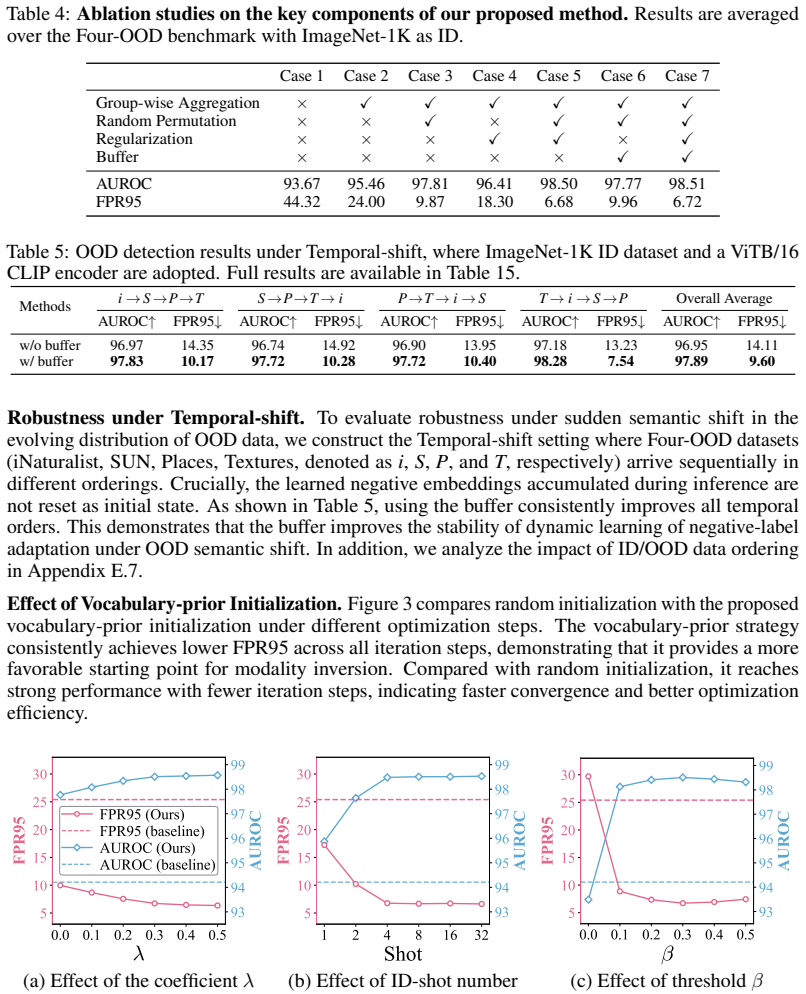
Measure whether removing the ID-prototype-separated regularization causes the average FPR95 on the Four-OOD benchmark with ImageNet-1K to rise back toward the 14 percent baseline.
Figures




read the original abstract
Vision-language models enable OOD detection by comparing image alignment with ID labels and negative semantics. Existing negative-label-based methods mainly rely on static negative labels constructed before inference, limiting their ability to cover diverse and evolving OOD concepts. Although test-time expansion provides a natural solution, naively learning negative semantics from potential OOD samples may introduce hard ID contamination. To address this issue, we propose a \textbf{T}est-time \textbf{I}D-prototype-separated \textbf{N}egative \textbf{S}emantics learning method, termed \textbf{TINS}. TINS learns sample-specific negative text embeddings via image-to-text modality inversion and introduces ID-prototype-separated regularization to keep them separated from ID semantics. To further stabilize negative semantics expansion, TINS employs group-wise aggregation scoring and a buffer update strategy. Extensive experiments across Four-OOD, OpenOOD, Temporal-shift, and Various ID settings show consistent improvements over strong baselines. Notably, on the Four-OOD benchmark with ImageNet-1K as ID, TINS reduces the average FPR95 from 14.04\% to 6.72\%. Our code is available at https://github.com/zxk1212/tins.
Editorial analysis
A structured set of objections, weighed in public.
Referee Report
Summary. The paper claims to introduce TINS, a test-time ID-prototype-separated negative semantics learning method for OOD detection in vision-language models. It learns sample-specific negative text embeddings via image-to-text modality inversion and applies ID-prototype-separated regularization to prevent hard ID contamination from potential OOD samples. It further uses group-wise aggregation scoring and a buffer update strategy for stability. Experiments across Four-OOD, OpenOOD, Temporal-shift, and Various ID settings show consistent gains over baselines, notably reducing average FPR95 from 14.04% to 6.72% on the Four-OOD benchmark with ImageNet-1K as ID.
Significance. If the central mechanism holds, the work advances test-time OOD detection by dynamically generating tailored negative semantics without pre-fixed static labels, addressing coverage of diverse and evolving OOD concepts. The public code release supports reproducibility. The reported benchmark improvements are concrete and span multiple settings. Significance is tempered by the need to confirm the separation regularization drives the gains rather than the inversion or aggregation steps alone.
major comments (3)
- [§3] §3 (ID-prototype-separated regularization): The regularization is presented as preventing hard ID contamination while preserving negative semantics diversity, but the manuscript provides no direct verification such as embedding visualizations, diversity metrics (e.g., variance or intra-group distances), or before/after comparisons. This is load-bearing for the central claim, as gains could stem from modality inversion or group-wise aggregation instead.
- [§4.2] §4.2 (Four-OOD results): The FPR95 reduction from 14.04% to 6.72% is reported without ablation isolating the separation term's contribution, hyperparameter sensitivity analysis for the regularization strength, or statistical significance (e.g., mean and std over multiple seeds). This leaves open whether the claimed mechanism is responsible.
- [§4.3] §4.3 (ablation and analysis): No examination of potential new failure modes, such as overly generic or low-variance negative embeddings on near-boundary samples when regularization is strong, or residual contamination when weak. This directly addresses the weakest assumption in the method's design.
minor comments (2)
- [Abstract] Abstract: 'Four-OOD' is referenced without a short parenthetical listing of its constituent datasets, which would improve immediate clarity for readers.
- [§3] Notation: The precise formulation of the ID-prototype separation loss (including how prototypes are computed and the weighting hyperparameter) could be stated more explicitly with an equation number for easier reference.
Simulated Author's Rebuttal
We thank the referee for the constructive and detailed feedback. The comments correctly identify areas where additional evidence is needed to substantiate the contribution of the ID-prototype-separated regularization. We address each major comment below and will revise the manuscript to incorporate the suggested analyses, ablations, and visualizations.
read point-by-point responses
-
Referee: [§3] §3 (ID-prototype-separated regularization): The regularization is presented as preventing hard ID contamination while preserving negative semantics diversity, but the manuscript provides no direct verification such as embedding visualizations, diversity metrics (e.g., variance or intra-group distances), or before/after comparisons. This is load-bearing for the central claim, as gains could stem from modality inversion or group-wise aggregation instead.
Authors: We agree that direct empirical verification of the regularization is necessary to support the central claim. In the revised manuscript, we will add t-SNE visualizations of negative text embeddings before and after applying the ID-prototype-separated regularization. We will also report quantitative metrics including average cosine similarity to ID prototypes (to show separation) and intra-group embedding variance (to show preserved diversity). These will be presented alongside the existing results to isolate the regularization's effect. revision: yes
-
Referee: [§4.2] §4.2 (Four-OOD results): The FPR95 reduction from 14.04% to 6.72% is reported without ablation isolating the separation term's contribution, hyperparameter sensitivity analysis for the regularization strength, or statistical significance (e.g., mean and std over multiple seeds). This leaves open whether the claimed mechanism is responsible.
Authors: We acknowledge the need for isolating experiments and statistical reporting. In the revision, Section 4.2 will include an ablation study disabling only the separation regularization term while keeping modality inversion and group-wise aggregation fixed, to quantify its isolated contribution to the FPR95 reduction. We will also add a sensitivity analysis over the regularization strength hyperparameter and report all main results as mean ± std over 5 random seeds. revision: yes
-
Referee: [§4.3] §4.3 (ablation and analysis): No examination of potential new failure modes, such as overly generic or low-variance negative embeddings on near-boundary samples when regularization is strong, or residual contamination when weak. This directly addresses the weakest assumption in the method's design.
Authors: We appreciate the suggestion to examine failure modes. The revised Section 4.3 will include targeted analysis on near-OOD samples, measuring negative embedding variance and similarity to ID prototypes across a range of regularization strengths. We will discuss observed cases of overly generic embeddings (strong regularization) and residual contamination (weak regularization), and provide practical guidance on hyperparameter selection to balance these trade-offs. revision: yes
Circularity Check
No significant circularity: claims rest on external benchmark experiments rather than self-referential fits or definitions
full rationale
The paper proposes TINS as a test-time method using image-to-text modality inversion plus ID-prototype-separated regularization, with performance gains (e.g., FPR95 reduction on Four-OOD) demonstrated via experiments on independent benchmarks including OpenOOD and Temporal-shift. No load-bearing step reduces by construction to its own inputs: the regularization is a design choice whose effectiveness is measured externally rather than derived tautologically from fitted parameters or prior self-citations. The derivation chain is self-contained against external data and does not invoke uniqueness theorems, ansatzes smuggled via self-citation, or renaming of known results as novel predictions.
Axiom & Free-Parameter Ledger
axioms (1)
- domain assumption Vision-language models produce embeddings that allow meaningful image-to-text inversion for distinguishing ID from OOD concepts.
Lean theorems connected to this paper
-
IndisputableMonolith/Cost/FunctionalEquation.leanwashburn_uniqueness_aczel unclearL_ours(t−,v) = 1−cos(t−,v) +λ·1C∑c=1C(1+cos(t−,μc)) ... ID-prototype-separated regularization to keep them separated from ID semantics
-
IndisputableMonolith/Foundation/AlexanderDuality.leanalexander_duality_circle_linking uncleargroup-wise aggregation scoring ... Theorem 1 on balanced grouping of negative activations
Reference graph
Works this paper leans on
-
[1]
Muhammad Asad, Ihsan Ullah, Ganesh Sistu, and Michael G Madden. Towards robust au- tonomous driving: Out-of-distribution object detection in bird’s eye view space.IEEE Open Journal of Vehicular Technology, 2025
work page 2025
-
[2]
Id-like prompt learning for few-shot out-of-distribution detection
Yichen Bai, Zongbo Han, Bing Cao, Xiaoheng Jiang, Qinghua Hu, and Changqing Zhang. Id-like prompt learning for few-shot out-of-distribution detection. InConference on Computer Vision and Pattern Recognition, pages 17480–17489, 2024
work page 2024
-
[3]
In or out? fixing imagenet out- of-distribution detection evaluation
Julian Bitterwolf, Maximilian Müller, and Matthias Hein. In or out? fixing imagenet out- of-distribution detection evaluation. InProceedings of the 40th International Conference on Machine Learning, pages 2471–2506, 2023
work page 2023
-
[4]
Food-101–mining discriminative components with random forests
Lukas Bossard, Matthieu Guillaumin, and Luc Van Gool. Food-101–mining discriminative components with random forests. InEuropean conference on computer vision, pages 446–461. Springer, 2014
work page 2014
-
[5]
Envisioning outlier exposure by large language models for out-of-distribution detection
Chentao Cao, Zhun Zhong, Zhanke Zhou, Yang Liu, Tongliang Liu, and Bo Han. Envisioning outlier exposure by large language models for out-of-distribution detection. InInternational Conference on Machine Learning, 2024
work page 2024
-
[6]
Conjugated semantic pool improves OOD detection with pre-trained vision-language models
Mengyuan Chen, Junyu Gao, and Changsheng Xu. Conjugated semantic pool improves OOD detection with pre-trained vision-language models. InAnnual Conference on Neural Information Processing Systems, pages 82560–82593, 2024
work page 2024
-
[7]
Describing textures in the wild
Mircea Cimpoi, Subhransu Maji, Iasonas Kokkinos, Sammy Mohamed, and Andrea Vedaldi. Describing textures in the wild. InProceedings of the IEEE conference on computer vision and pattern recognition, pages 3606–3613, 2014
work page 2014
-
[8]
Imagenet: A large- scale hierarchical image database
Jia Deng, Wei Dong, Richard Socher, Li-Jia Li, Kai Li, and Li Fei-Fei. Imagenet: A large- scale hierarchical image database. In2009 IEEE conference on computer vision and pattern recognition, pages 248–255. Ieee, 2009
work page 2009
-
[9]
Li Deng. The mnist database of handwritten digit images for machine learning research [best of the web].IEEE signal processing magazine, 29(6):141–142, 2012
work page 2012
-
[10]
Extremely simple activation shaping for out-of-distribution detection
Andrija Djurisic, Nebojsa Bozanic, Arjun Ashok, and Rosanne Liu. Extremely simple activation shaping for out-of-distribution detection. InThe Eleventh International Conference on Learning Representations
-
[11]
An image is worth 16x16 words: Transformers for image recognition at scale
Alexey Dosovitskiy, Lucas Beyer, Alexander Kolesnikov, Dirk Weissenborn, Xiaohua Zhai, Thomas Unterthiner, Mostafa Dehghani, Matthias Minderer, Georg Heigold, Sylvain Gelly, et al. An image is worth 16x16 words: Transformers for image recognition at scale. InInternational Conference on Learning Representations
-
[12]
SIREN: shaping representations for detecting out-of-distribution objects
Xuefeng Du, Gabriel Gozum, Yifei Ming, and Yixuan Li. SIREN: shaping representations for detecting out-of-distribution objects. InAnnual Conference on Neural Information Processing Systems, pages 20434–20449, 2022
work page 2022
-
[13]
Xuefeng Du, Zhaoning Wang, Mu Cai, and Yixuan Li. V os: Learning what you don’t know by virtual outlier synthesis.Proceedings of the International Conference on Learning Representa- tions, 2022. 10
work page 2022
-
[14]
Clipscope: Enhancing zero-shot ood detection with bayesian scoring
Hao Fu, Naman Patel, Prashanth Krishnamurthy, et al. Clipscope: Enhancing zero-shot ood detection with bayesian scoring. InProceedings of the Winter Conference on Applications of Computer Vision, pages 5346–5355, 2025
work page 2025
-
[15]
Boyu Han, Qianqian Xu, Zhiyong Yang, Shilong Bao, Peisong Wen, Yangbangyan Jiang, and Qingming Huang. Aucseg: Auc-oriented pixel-level long-tail semantic segmentation.Advances in Neural Information Processing Systems, 37:126863–126907, 2024
work page 2024
-
[16]
Deep residual learning for image recognition
Kaiming He, Xiangyu Zhang, Shaoqing Ren, and Jian Sun. Deep residual learning for image recognition. InProceedings of the IEEE conference on computer vision and pattern recognition, pages 770–778, 2016
work page 2016
-
[17]
Dan Hendrycks and Kevin Gimpel. A baseline for detecting misclassified and out-of-distribution examples in neural networks.Proceedings of International Conference on Learning Represen- tations, 2017
work page 2017
-
[18]
Dan Hendrycks, Mantas Mazeika, and Thomas Dietterich. Deep anomaly detection with outlier exposure.Proceedings of the International Conference on Learning Representations, 2019
work page 2019
-
[19]
Dan Hendrycks, Mantas Mazeika, Saurav Kadavath, and Dawn Song. Using self-supervised learning can improve model robustness and uncertainty.Advances in neural information processing systems, 32, 2019
work page 2019
-
[20]
Augmix: A simple data processing method to improve robustness and uncertainty
Dan Hendrycks, Norman Mu, Ekin D Cubuk, Barret Zoph, Justin Gilmer, and Balaji Lakshmi- narayanan. Augmix: A simple data processing method to improve robustness and uncertainty. arXiv preprint arXiv:1912.02781, 2019
-
[21]
The many faces of robustness: A critical analysis of out-of-distribution generalization
Dan Hendrycks, Steven Basart, Norman Mu, Saurav Kadavath, Frank Wang, Evan Dorundo, Rahul Desai, Tyler Zhu, Samyak Parajuli, Mike Guo, et al. The many faces of robustness: A critical analysis of out-of-distribution generalization. InProceedings of the IEEE/CVF international conference on computer vision, pages 8340–8349, 2021
work page 2021
-
[22]
Pixmix: Dreamlike pictures comprehensively improve safety measures
Dan Hendrycks, Andy Zou, Mantas Mazeika, Leonard Tang, Bo Li, Dawn Song, and Jacob Steinhardt. Pixmix: Dreamlike pictures comprehensively improve safety measures. InProceed- ings of the IEEE/CVF Conference on Computer Vision and Pattern Recognition (CVPR), pages 16783–16792, June 2022
work page 2022
-
[23]
Mos: Towards scaling out-of-distribution detection for large semantic space
Rui Huang and Yixuan Li. Mos: Towards scaling out-of-distribution detection for large semantic space. InProceedings of the IEEE/CVF Conference on Computer Vision and Pattern Recognition, pages 8710–8719, 2021
work page 2021
-
[24]
Rui Huang, Andrew Geng, and Yixuan Li. On the importance of gradients for detecting distributional shifts in the wild.Advances in Neural Information Processing Systems, 34: 677–689, 2021
work page 2021
-
[25]
Negative label guided ood detection with pretrained vision-language models
Xue Jiang, Feng Liu, Zhen Fang, Hong Chen, Tongliang Liu, Feng Zheng, and Bo Han. Negative label guided ood detection with pretrained vision-language models. InThe Twelfth International Conference on Learning Representations, 2024
work page 2024
-
[26]
Opengan: Open-set recognition via open data generation
Shu Kong and Deva Ramanan. Opengan: Open-set recognition via open data generation. In Proceedings of the IEEE/CVF International Conference on Computer Vision, pages 813–822, 2021
work page 2021
-
[27]
Learning multiple layers of features from tiny images
Alex Krizhevsky, Geoffrey Hinton, et al. Learning multiple layers of features from tiny images. 2009
work page 2009
-
[28]
Tiny imagenet visual recognition challenge.CS 231N, 7(7):3, 2015
Ya Le and Xuan Yang. Tiny imagenet visual recognition challenge.CS 231N, 7(7):3, 2015
work page 2015
-
[29]
Kimin Lee, Kibok Lee, Honglak Lee, and Jinwoo Shin. A simple unified framework for detecting out-of-distribution samples and adversarial attacks.Advances in neural information processing systems, 31, 2018
work page 2018
-
[30]
Enhancing the reliability of out-of-distribution image detection in neural networks
Shiyu Liang, Yixuan Li, and R Srikant. Enhancing the reliability of out-of-distribution image detection in neural networks. InInternational Conference on Learning Representations, 2018. 11
work page 2018
-
[31]
Weitang Liu, Xiaoyun Wang, John Owens, and Yixuan Li. Energy-based out-of-distribution detection.Advances in neural information processing systems, 33:21464–21475, 2020
work page 2020
-
[32]
Gen: Pushing the limits of softmax-based out-of-distribution detection
Xixi Liu, Yaroslava Lochman, and Christopher Zach. Gen: Pushing the limits of softmax-based out-of-distribution detection. InProceedings of the IEEE/CVF conference on computer vision and pattern recognition, pages 23946–23955, 2023
work page 2023
-
[33]
Wordnet: a lexical database for english.Communications of the ACM, 38(11): 39–41, 1995
George A Miller. Wordnet: a lexical database for english.Communications of the ACM, 38(11): 39–41, 1995
work page 1995
-
[34]
Yifei Ming, Ziyang Cai, Jiuxiang Gu, Yiyou Sun, Wei Li, and Yixuan Li. Delving into out-of- distribution detection with vision-language representations.Advances in neural information processing systems, 35:35087–35102, 2022
work page 2022
-
[35]
Yifei Ming, Yiyou Sun, Ousmane Dia, and Yixuan Li. How to exploit hyperspherical embed- dings for out-of-distribution detection?arXiv preprint arXiv:2203.04450, 2022
-
[36]
Cross the gap: Exposing the intra-modal misalignment in clip via modality inversion
M Mistretta, A Baldrati, L Agnolucci, M Bertini, AD Bagdanov, et al. Cross the gap: Exposing the intra-modal misalignment in clip via modality inversion. In13th International Conference on Learning Representations, ICLR 2025, pages 90437–90458. International Conference on Learning Representations, ICLR, 2025
work page 2025
-
[37]
Locoop: Few-shot out-of-distribution detection via prompt learning
Atsuyuki Miyai, Qing Yu, Go Irie, and Kiyoharu Aizawa. Locoop: Few-shot out-of-distribution detection via prompt learning. InAnnual Conference on Neural Information Processing Systems, pages 76298–76310, 2023
work page 2023
-
[38]
Reading digits in natural images with unsupervised feature learning
Yuval Netzer, Tao Wang, Adam Coates, Alessandro Bissacco, Bo Wu, and Andrew Y Ng. Reading digits in natural images with unsupervised feature learning. 2011
work page 2011
-
[39]
Out- of-distribution detection with negative prompts
Jun Nie, Yonggang Zhang, Zhen Fang, Tongliang Liu, Bo Han, and Xinmei Tian. Out- of-distribution detection with negative prompts. InInternational Conference on Learning Representations, pages 1–20, 2024
work page 2024
-
[40]
Learning transferable visual models from natural language supervision
Alec Radford, Jong Wook Kim, Chris Hallacy, Aditya Ramesh, Gabriel Goh, Sandhini Agarwal, Girish Sastry, Amanda Askell, Pamela Mishkin, Jack Clark, et al. Learning transferable visual models from natural language supervision. InInternational conference on machine learning, pages 8748–8763. PmLR, 2021
work page 2021
-
[41]
Benjamin Recht, Rebecca Roelofs, Ludwig Schmidt, and Vaishaal Shankar. Do imagenet classifiers generalize to imagenet? InInternational conference on machine learning, pages 5389–5400. PMLR, 2019
work page 2019
-
[42]
Out-of-domain detection based on generative adversarial network
Seonghan Ryu, Sangjun Koo, Hwanjo Yu, and Gary Geunbae Lee. Out-of-domain detection based on generative adversarial network. InProceedings of the 2018 Conference on Empirical Methods in Natural Language Processing, pages 714–718, 2018
work page 2018
-
[43]
Ssd: A unified framework for self-supervised outlier detection.arXiv preprint arXiv:2103.12051, 2021
Vikash Sehwag, Mung Chiang, and Prateek Mittal. Ssd: A unified framework for self-supervised outlier detection.arXiv preprint arXiv:2103.12051, 2021
-
[44]
Yiyou Sun, Chuan Guo, and Yixuan Li. React: Out-of-distribution detection with rectified activations.Advances in Neural Information Processing Systems, 34:144–157, 2021
work page 2021
-
[45]
Out-of-distribution detection with deep nearest neighbors
Yiyou Sun, Yifei Ming, Xiaojin Zhu, and Yixuan Li. Out-of-distribution detection with deep nearest neighbors. InInternational Conference on Machine Learning, pages 20827–20840. PMLR, 2022
work page 2022
-
[46]
The inaturalist species classification and detection dataset
Grant Van Horn, Oisin Mac Aodha, Yang Song, Yin Cui, Chen Sun, Alex Shepard, Hartwig Adam, Pietro Perona, and Serge Belongie. The inaturalist species classification and detection dataset. InProceedings of the IEEE conference on computer vision and pattern recognition, pages 8769–8778, 2018
work page 2018
-
[47]
Attention is all you need.Advances in neural information processing systems, 30, 2017
Ashish Vaswani, Noam Shazeer, Niki Parmar, Jakob Uszkoreit, Llion Jones, Aidan N Gomez, Łukasz Kaiser, and Illia Polosukhin. Attention is all you need.Advances in neural information processing systems, 30, 2017. 12
work page 2017
-
[48]
Maria De La Iglesia Vayá, Jose Manuel Saborit, Joaquim Angel Montell, Antonio Pertusa, Aurelia Bustos, Miguel Cazorla, Joaquin Galant, Xavier Barber, Domingo Orozco-Beltrán, Francisco García-García, et al. Bimcv covid-19+: a large annotated dataset of rx and ct images from covid-19 patients.arXiv preprint arXiv:2006.01174, 2020
-
[49]
Open-set recognition: A good closed-set classifier is all you need
Sagar Vaze, Kai Han, Andrea Vedaldi, and Andrew Zisserman. Open-set recognition: A good closed-set classifier is all you need. InInternational conference on learning representations, 2021
work page 2021
-
[50]
Haohan Wang, Songwei Ge, Zachary Lipton, and Eric P Xing. Learning robust global repre- sentations by penalizing local predictive power.Advances in neural information processing systems, 32, 2019
work page 2019
-
[51]
Vim: Out-of-distribution with virtual-logit matching
Haoqi Wang, Zhizhong Li, Litong Feng, and Wayne Zhang. Vim: Out-of-distribution with virtual-logit matching. InProceedings of the IEEE/CVF conference on computer vision and pattern recognition, pages 4921–4930, 2022
work page 2022
-
[52]
Ke Wang, Qi Ma, Chongqiang Shen, and Jianbo Lu. Application of uncertainty to out-of- distribution detection for autonomous driving perception safety.IEEE Transactions on Intelli- gent Transportation Systems, 2025
work page 2025
-
[53]
Sun database: Large-scale scene recognition from abbey to zoo
Jianxiong Xiao, James Hays, Krista A Ehinger, Aude Oliva, and Antonio Torralba. Sun database: Large-scale scene recognition from abbey to zoo. In2010 IEEE computer society conference on computer vision and pattern recognition, pages 3485–3492. IEEE, 2010
work page 2010
-
[54]
Scaling for training time and post-hoc out-of-distribution detection enhancement
Kai Xu, Rongyu Chen, Gianni Franchi, and Angela Yao. Scaling for training time and post-hoc out-of-distribution detection enhancement. InThe Twelfth International Conference on Learning Representations
-
[55]
Mind the Way You Select Negative Texts: Pursuing the Distance Consistency in OOD Detection with VLMs
Zhikang Xu, Qianqian Xu, Zitai Wang, Cong Hua, Sicong Li, Zhiyong Yang, and Qingming Huang. Mind the way you select negative texts: Pursuing the distance consistency in ood detection with vlms.arXiv preprint arXiv:2603.02618, 2026
work page internal anchor Pith review Pith/arXiv arXiv 2026
-
[56]
Oodd: Test-time out-of-distribution detection with dynamic dictionary
Yifeng Yang, Lin Zhu, Zewen Sun, Hengyu Liu, Qinying Gu, and Nanyang Ye. Oodd: Test-time out-of-distribution detection with dynamic dictionary. InProceedings of the Computer Vision and Pattern Recognition Conference, pages 30630–30639, 2025
work page 2025
-
[57]
Out-of-distribution detection using union of 1-dimensional subspaces
Alireza Zaeemzadeh, Niccolo Bisagno, Zeno Sambugaro, Nicola Conci, Nazanin Rahnavard, and Mubarak Shah. Out-of-distribution detection using union of 1-dimensional subspaces. In Proceedings of the IEEE/CVF Conference on Computer Vision and Pattern Recognition, pages 9452–9461, 2021
work page 2021
-
[58]
Jingyang Zhang, Jingkang Yang, Pengyun Wang, Haoqi Wang, Yueqian Lin, Haoran Zhang, Yiyou Sun, Xuefeng Du, Yixuan Li, Ziwei Liu, et al. Openood v1. 5: Enhanced benchmark for out-of-distribution detection. InNeurIPS 2023 Workshop on Distribution Shifts: New Frontiers with Foundation Models
work page 2023
-
[59]
Yabin Zhang and Lei Zhang. Adaneg: Adaptive negative proxy guided ood detection with vision-language models.Advances in Neural Information Processing Systems, 37:38744–38768, 2024
work page 2024
-
[60]
Lapt: Label-driven automated prompt tuning for ood detection with vision-language models
Yabin Zhang, Wenjie Zhu, Chenhang He, and Lei Zhang. Lapt: Label-driven automated prompt tuning for ood detection with vision-language models. InEuropean conference on computer vision, pages 271–288. Springer, 2024
work page 2024
-
[61]
Yabin Zhang, Maya Varma, Yunhe Gao, Jean-Benoit Delbrouck, Jiaming Liu, Chong Wang, and Curtis Langlotz. Activation matters: Test-time activated negative labels for ood detection with vision-language models.arXiv preprint arXiv:2603.25250, 2026
-
[62]
Bolei Zhou, Agata Lapedriza, Aditya Khosla, Aude Oliva, and Antonio Torralba. Places: A 10 million image database for scene recognition.IEEE transactions on pattern analysis and machine intelligence, 40(6):1452–1464, 2017
work page 2017
-
[63]
Wenjie Zhu, Yabin Zhang, Xin Jin, Wenjun Zeng, and Lei Zhang. Ants: Adaptive negative textual space shaping for ood detection via test-time mllm understanding and reasoning.arXiv preprint arXiv:2509.03951, 2025. 13 Appendices A Limitations 15 B Broader Impacts 15 C Pseudo Code 15 D Proof of Theorem 1 16 E More Detailed Results 16 E.1 Statistical Significa...
-
[64]
On CIFAR-10, our method also achieves the best performance
On CIFAR-100, our method substantially improves over InterNeg, reducing near-OOD FPR95 from 62.54% to 33.44% and far-OOD FPR95 from 20.02% to 2.90%. On CIFAR-10, our method also achieves the best performance. These results demonstrate that our method perform well beyond ImageNet-1K and remains effective across different ID label spaces. Table 8: Detailed ...
discussion (0)
Sign in with ORCID, Apple, or X to comment. Anyone can read and Pith papers without signing in.