Recognition: no theorem link
Geometry-aware Prototype Learning for Cross-domain Few-shot Medical Image Segmentation
Pith reviewed 2026-05-12 04:21 UTC · model grok-4.3
The pith
Geometric offsets from an ordinal shape branch separate anatomical structure from domain-specific appearance for better prototype matching in cross-domain few-shot medical segmentation.
A machine-rendered reading of the paper's core claim, the machinery that carries it, and where it could break.
Core claim
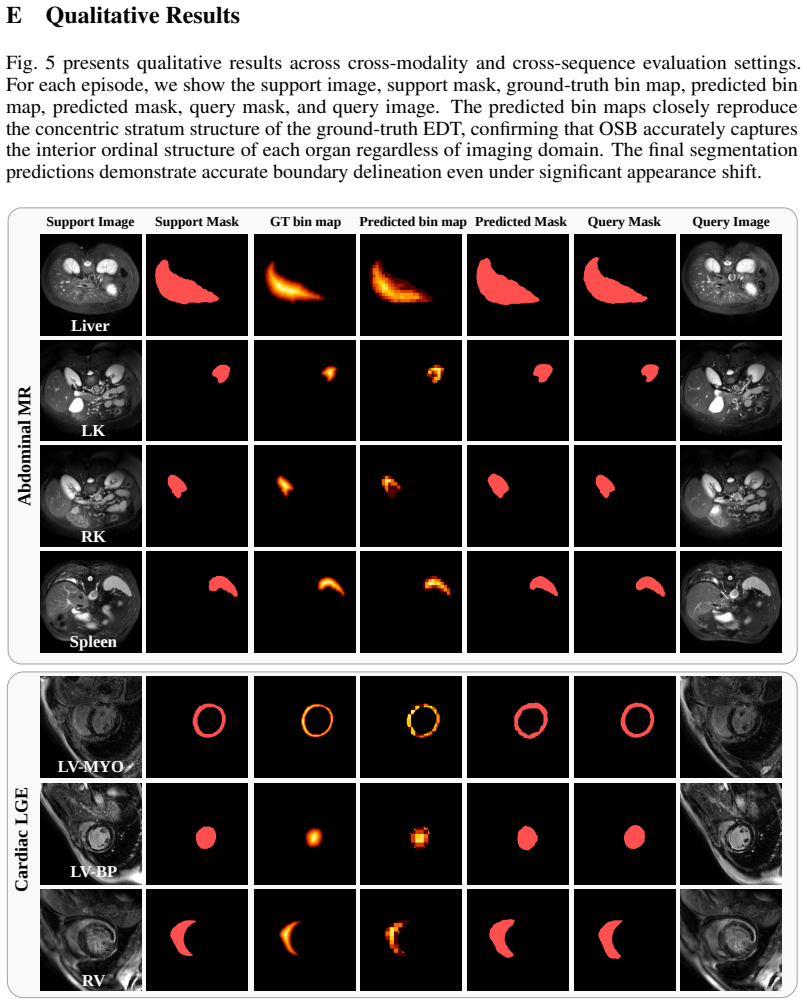
GeoProto augments each local appearance prototype with a learned geometric offset that encodes its ordinal position inside the organ's interior topology; the offset is produced by an auxiliary Ordinal Shape Branch trained under an ordinally consistent objective that requires no labels beyond standard segmentation masks, yielding state-of-the-art results on seven datasets across cross-modality, cross-sequence and cross-context settings.
What carries the argument
Geometry-Aware Prototype Enrichment (GAPE), which augments appearance prototypes with geometric offset encodings of ordinal position within organ interior topology derived from the Ordinal Shape Branch.
If this is right
- Prototypes gain invariance to appearance shifts while retaining structural cues for reliable matching.
- No extra annotations are required beyond ordinary segmentation masks.
- The same framework improves performance uniformly across cross-modality, cross-sequence and cross-context tasks.
- The method scales to seven distinct medical datasets without task-specific redesign.
Where Pith is reading between the lines
- The ordinal-shape prior could be transferred to other few-shot segmentation domains where rigid structure persists but texture varies, such as remote-sensing or industrial inspection.
- The Ordinal Shape Branch itself might serve as a lightweight unsupervised shape descriptor for downstream tasks like registration or anomaly detection.
- Replacing the current 2-D ordinal loss with a 3-D or spatio-temporal consistency term could further tighten the geometric embeddings.
Load-bearing premise
Human anatomy possesses a consistent interior geometric structure that can be captured as ordinal positions and remains transferable across imaging domains and patients.
What would settle it
Experiments on a new cross-domain few-shot benchmark in which the geometric offset module produces no accuracy gain or in which the learned embeddings fail to vary monotonically from organ boundary to center.
Figures


read the original abstract
Cross-domain few-shot medical image segmentation (CD-FSMIS) requires a model to generalise simultaneously to novel anatomical categories and unseen imaging domains from only a handful of annotated examples. Existing prototypical approaches inevitably entangle anatomical structure with domain-specific appearance variations, and thus lack a stable reference for reliable matching under domain shift. We observe that the geometric structure of human anatomy constitutes a reliable, domain-transferable prior that has been overlooked. Building on this insight, we propose GeoProto, a geometry-aware CD-FSMIS framework that enriches prototypical matching with explicit structural priors. The core component, Geometry-Aware Prototype Enrichment (GAPE), augments each local appearance prototype with a learned geometric offset encoding its ordinal position within the organ's interior topology. This offset is derived from an auxiliary Ordinal Shape Branch (OSB) trained under an ordinally consistent objective that enforces monotonic variation of geometric embeddings across interior strata, requiring no annotation beyond standard segmentation masks. Extensive experiments across seven datasets spanning three evaluation settings (cross-modality, cross-sequence, and cross-context) demonstrate that GeoProto achieves state-of-the-art performance.
Editorial analysis
A structured set of objections, weighed in public.
Referee Report
Summary. The paper proposes GeoProto, a geometry-aware framework for cross-domain few-shot medical image segmentation (CD-FSMIS). It introduces Geometry-Aware Prototype Enrichment (GAPE) to augment local appearance prototypes with learned geometric offsets encoding ordinal position within organ interior topology. These offsets are produced by an auxiliary Ordinal Shape Branch (OSB) trained with an ordinally consistent objective on standard segmentation masks only (no extra annotations). The authors evaluate across seven datasets in three settings (cross-modality, cross-sequence, cross-context) and claim state-of-the-art performance.
Significance. If the central claim holds, the work offers a concrete way to inject domain-transferable anatomical structure into prototypical few-shot segmentation, which is a persistent challenge in medical imaging. The multi-setting evaluation spanning seven datasets is a positive aspect that strengthens potential impact. The OSB design, which requires no labels beyond masks, is an interesting technical choice that could be reusable if shown to generalize.
major comments (2)
- [Abstract] Abstract: the claim of 'state-of-the-art performance' and 'extensive experiments' is asserted without any quantitative numbers, baseline comparisons, ablation results, or statistical tests. This absence prevents assessment of whether the reported gains are meaningful or whether they survive standard controls for few-shot variance.
- [Methods (Ordinal Shape Branch)] Ordinal Shape Branch (OSB) description: the ordinally consistent objective is applied only to the handful of support-set masks for each novel category. For unseen anatomical structures this risks learning instance-specific monotonic embeddings rather than a stable, cross-domain interior-stratum prior; if so, the GAPE enrichment step adds little beyond a conventional appearance prototype and the SOTA claim would not hold.
minor comments (2)
- [Abstract] Abstract: specify the shot regimes (1-shot / 5-shot) used in the reported experiments.
- [Methods] Notation: the distinction between 'geometric offset' and the output of the OSB should be clarified with an equation or diagram to avoid ambiguity in how GAPE is computed.
Simulated Author's Rebuttal
We thank the referee for the constructive feedback on our manuscript. We address each major comment in detail below, providing clarifications and indicating where revisions will be made to strengthen the paper.
read point-by-point responses
-
Referee: [Abstract] Abstract: the claim of 'state-of-the-art performance' and 'extensive experiments' is asserted without any quantitative numbers, baseline comparisons, ablation results, or statistical tests. This absence prevents assessment of whether the reported gains are meaningful or whether they survive standard controls for few-shot variance.
Authors: We agree that the abstract would benefit from including quantitative highlights to better substantiate the claims and allow immediate assessment of the results. In the revised manuscript, we will update the abstract to report key metrics such as the average Dice score improvements over the strongest baselines across the three evaluation settings and seven datasets. The main text already contains full tables with baseline comparisons, ablations, and statistical significance tests; we will ensure these are more explicitly referenced in the abstract revision. revision: yes
-
Referee: [Methods (Ordinal Shape Branch)] Ordinal Shape Branch (OSB) description: the ordinally consistent objective is applied only to the handful of support-set masks for each novel category. For unseen anatomical structures this risks learning instance-specific monotonic embeddings rather than a stable, cross-domain interior-stratum prior; if so, the GAPE enrichment step adds little beyond a conventional appearance prototype and the SOTA claim would not hold.
Authors: We thank the referee for raising this important point about potential instance-specificity. The ordinally consistent objective is formulated to enforce a general monotonic property on geometric embeddings according to ordinal position within the organ interior (e.g., boundary-to-center strata), which derives from the topological structure of anatomy rather than instance-specific appearance or texture. This prior is domain-transferable by design, as confirmed by our cross-modality, cross-sequence, and cross-context experiments where GAPE consistently improves over appearance-only prototypes. To address the concern explicitly, we will revise the Methods section with additional explanation of the objective's generalization mechanism and include a targeted ablation demonstrating the contribution of geometric offsets on held-out novel categories. revision: partial
Circularity Check
No significant circularity in derivation chain
full rationale
The paper defines new trainable components (GAPE enrichment and OSB with ordinally consistent objective) and reports empirical SOTA results across seven datasets in three cross-domain settings. No equations reduce a claimed prediction to a fitted input by construction, no self-citations are load-bearing for the central premise, and no uniqueness theorems or ansatzes are imported from prior author work. The derivation is self-contained against external benchmarks.
Axiom & Free-Parameter Ledger
axioms (1)
- domain assumption Geometric structure of human anatomy is a reliable domain-transferable prior
invented entities (2)
-
Geometry-Aware Prototype Enrichment (GAPE)
no independent evidence
-
Ordinal Shape Branch (OSB)
no independent evidence
Reference graph
Works this paper leans on
-
[1]
James S. Duncan and Nicholas Ayache. Medical image analysis: Progress over two decades and the challenges ahead.IEEE Trans. Pattern Anal. Mach. Intell., 22:85–106, 2000. URL https://api. semanticscholar.org/CorpusID:16815557
work page 2000
-
[2]
U-Net: Convolutional Networks for Biomedical Image Segmentation
Olaf Ronneberger, Philipp Fischer, and Thomas Brox. U-net: Convolutional networks for biomedical image segmentation.ArXiv, abs/1505.04597, 2015. URL https://api.semanticscholar.org/CorpusID: 3719281
work page internal anchor Pith review Pith/arXiv arXiv 2015
-
[3]
Fabian Isensee, Paul F. Jaeger, Simon A. A. Kohl, Jens Petersen, and Klaus Hermann Maier-Hein. nnu-net: a self-configuring method for deep learning-based biomedical image segmentation.Nature Methods, 18: 203 – 211, 2020. URLhttps://api.semanticscholar.org/CorpusID:227947847
work page 2020
-
[5]
Hao Tang, Xingwei Liu, Shanlin Sun, Xiangyi Yan, and Xiaohui Xie. Recurrent mask refinement for few-shot medical image segmentation.2021 IEEE/CVF International Conference on Computer Vision (ICCV), pages 3898–3908, 2021. URL https://api.semanticscholar.org/CorpusID:236772039
work page 2021
-
[6]
Yazhou Zhu, Minxian Li, Qiaolin Ye, Shidong Wang, Tong Xin, and Haofeng Zhang. Robustemd: Domain robust matching for cross-domain few-shot medical image segmentation.Artificial intelligence in medicine, 167:103197, 2024. URLhttps://api.semanticscholar.org/CorpusID:273026147
work page 2024
-
[7]
Famnet: Frequency-aware matching network for cross-domain few-shot medical image segmentation
Yuntian Bo, Yazhou Zhu, Lunbo Li, and Haofeng Zhang. Famnet: Frequency-aware matching network for cross-domain few-shot medical image segmentation. InAAAI Conference on Artificial Intelligence, 2025. URLhttps://api.semanticscholar.org/CorpusID:277755591
work page 2025
-
[8]
Mi-segnet: Mutual information-based us segmentation for unseen domain generalization
Yuanwei Bi, Zhongliang Jiang, Ricarda Clarenbach, Reza Ghotbi, Angelos Karlas, and Nassir Navab. Mi-segnet: Mutual information-based us segmentation for unseen domain generalization. InInternational Conference on Medical Image Computing and Computer-Assisted Intervention, 2023. URL https: //api.semanticscholar.org/CorpusID:257663295
work page 2023
-
[9]
Learning domain- agnostic representation for disease diagnosis
Chu ran Wang, Jing Li, Xinwei Sun, Fandong Zhang, Yizhou Yu, and Yizhou Wang. Learning domain- agnostic representation for disease diagnosis. InInternational Conference on Learning Representations,
-
[10]
URLhttps://api.semanticscholar.org/CorpusID:259298185
-
[11]
Fishman, and Alan Loddon Yuille
Yan Wang, Xu Wei, Fengze Liu, Jieneng Chen, Yuyin Zhou, Wei Shen, Elliot K. Fishman, and Alan Loddon Yuille. Deep distance transform for tubular structure segmentation in ct scans.2020 IEEE/CVF Conference on Computer Vision and Pattern Recognition (CVPR), pages 3832–3841, 2019. URL https://api. semanticscholar.org/CorpusID:208910348
work page 2020
-
[12]
Yuntian Bo, Tao Zhou, Zechao Li, Haofeng Zhang, and Ling Shao. Contrastive graph modeling for cross-domain few-shot medical image segmentation.IEEE transactions on medical imaging, PP, 2025. URLhttps://api.semanticscholar.org/CorpusID:284275872
work page 2025
-
[13]
Self-supervision with superpixels: Training few-shot medical image segmentation without annotation
Cheng Ouyang, Carlo Biffi, Chen Chen, Turkay Kart, Huaqi Qiu, and Daniel Rueckert. Self-supervision with superpixels: Training few-shot medical image segmentation without annotation. InEuropean Confer- ence on Computer Vision, 2020. URLhttps://api.semanticscholar.org/CorpusID:220646864
work page 2020
-
[14]
Few shot medical image segmentation with cross attention transformer.ArXiv, abs/2303.13867, 2023
Yi Lin, Yufan Chen, Kwang-Ting Cheng, and Hao Chen. Few shot medical image segmentation with cross attention transformer.ArXiv, abs/2303.13867, 2023. URL https://api.semanticscholar.org/ CorpusID:257757309
-
[15]
Yazhou Zhu, Shidong Wang, Tong Xin, Zheng Zhang, and Haofeng Zhang. Partition-a-medical-image: Extracting multiple representative subregions for few-shot medical image segmentation.IEEE Transactions on Instrumentation and Measurement, 73:1–12, 2023. URL https://api.semanticscholar.org/ CorpusID:262064157
work page 2023
-
[16]
Song Tang, Shaxu Yan, Xiaozhi Qi, Jianxin Gao, Mao Ye, Jianwei Zhang, and Xiatian Zhu. Few-shot medical image segmentation with high-fidelity prototypes.Medical image analysis, 100:103412, 2024. URLhttps://api.semanticscholar.org/CorpusID:270737528
work page 2024
-
[17]
Ziming Cheng, Shidong Wang, Yang Long, Tao Zhou, Haofeng Zhang, and Ling Shao. Dual interspersion and flexible deployment for few-shot medical image segmentation.IEEE Transactions on Medical Imaging, 44:2732–2744, 2025. URLhttps://api.semanticscholar.org/CorpusID:276714149. 10
work page 2025
-
[18]
Yumin Zhang, Hongliu Li, Yajun Gao, Haoran Duan, Yawen Huang, and Yefeng Zheng. Prototype correlation matching and class- relation reasoning for few-shot medical image segmentation.IEEE Transactions on Medical Imaging, 43:4041–4054, 2024. URL https://api.semanticscholar.org/ CorpusID:270357354
work page 2024
-
[19]
Wendong Huang, Jinwu Hu, Junhao Xiao, Yang Wei, Xiuli Bi, and Bin Xiao. Prototype-guided graph reasoning network for few-shot medical image segmentation.IEEE Transactions on Medical Imaging, 44: 761–773, 2024. URLhttps://api.semanticscholar.org/CorpusID:272645696
work page 2024
-
[20]
Cheng Ouyang, Carlo Biffi, Chen Chen, Turkay Kart, Huaqi Qiu, and Daniel Rueckert. Self-supervised learning for few-shot medical image segmentation.IEEE Transactions on Medical Imaging, 41:1837–1848,
-
[21]
URLhttps://api.semanticscholar.org/CorpusID:246700149
-
[22]
Ziming Cheng, Jianqin Zhao, Jingjing Deng, and Haofeng Zhang. Few-shot medical image segmentation with high-confidence prior mask.IEEE Journal of Biomedical and Health Informatics, 29:8928–8939,
-
[23]
URLhttps://api.semanticscholar.org/CorpusID:277106625
-
[24]
Stine Hansen, Srishti Gautam, Robert Jenssen, and Michael C. Kampffmeyer. Anomaly detection-inspired few-shot medical image segmentation through self-supervision with supervoxels.Medical image analysis, 78:102385, 2022. URLhttps://api.semanticscholar.org/CorpusID:246788826
work page 2022
-
[25]
Yazhou Zhu and Haofeng Zhang. Maup: Training-free multi-center adaptive uncertainty-aware prompting for cross-domain few-shot medical image segmentation. InInternational Conference on Medical Image Computing and Computer-Assisted Intervention, 2025. URL https://api.semanticscholar.org/ CorpusID:280526687
work page 2025
-
[26]
Zhang, Shaoqing Ren, and Jian Sun
Kaiming He, X. Zhang, Shaoqing Ren, and Jian Sun. Deep residual learning for image recognition.2016 IEEE Conference on Computer Vision and Pattern Recognition (CVPR), pages 770–778, 2015. URL https://api.semanticscholar.org/CorpusID:206594692
work page 2016
-
[27]
Kaixin Wang, Jun Hao Liew, Yingtian Zou, Daquan Zhou, and Jiashi Feng. Panet: Few-shot image semantic segmentation with prototype alignment.2019 IEEE/CVF International Conference on Computer Vision (ICCV), pages 9196–9205, 2019. URL https://api.semanticscholar.org/CorpusID:201070109
work page 2019
-
[28]
Few-shot medical image segmentation via a region-enhanced prototypical transformer
Yazhou Zhu, Shidong Wang, Tong Xin, and Haofeng Zhang. Few-shot medical image segmentation via a region-enhanced prototypical transformer. InInternational Conference on Medical Image Computing and Computer-Assisted Intervention, 2023. URL https://api.semanticscholar.org/CorpusID: 261681778
work page 2023
-
[29]
Ziming Cheng, Shidong Wang, Tong Xin, Tao Zhou, Haofeng Zhang, and Ling Shao. Few-shot medical image segmentation via generating multiple representative descriptors.IEEE Transactions on Medical Imaging, 43:2202–2214, 2024. URLhttps://api.semanticscholar.org/CorpusID:267210982
work page 2024
-
[30]
Cross-domain few-shot semantic segmentation
Shuo Lei, Xuchao Zhang, Jianfeng He, Fanglan Chen, Bowen Du, and Chang-Tien Lu. Cross-domain few-shot semantic segmentation. InEuropean Conference on Computer Vision, 2022. URL https: //api.semanticscholar.org/CorpusID:253448730
work page 2022
-
[31]
Hao Chen, Yonghan Dong, Zheming Lu, Yunlong Yu, and Jungong Han. Pixel matching network for cross- domain few-shot segmentation.2024 IEEE/CVF Winter Conference on Applications of Computer Vision (WACV), pages 967–976, 2024. URLhttps://api.semanticscholar.org/CorpusID:269036094
work page 2024
-
[32]
Jiahao Nie, Yun Xing, Gongjie Zhang, Pei Yan, Aoran Xiao, Yap-Peng Tan, Alex Chichung Kot, and Shijian Lu. Cross-domain few-shot segmentation via iterative support-query correspondence mining.2024 IEEE/CVF Conference on Computer Vision and Pattern Recognition (CVPR), pages 3380–3390, 2024. URLhttps://api.semanticscholar.org/CorpusID:267027623
work page 2024
-
[33]
Jintao Tong, Yixiong Zou, Yuhua Li, and Ruixuan Li. Lightweight frequency masker for cross-domain few-shot semantic segmentation.ArXiv, abs/2410.22135, 2024. URL https://api.semanticscholar. org/CorpusID:273661663
-
[34]
Segmentation outside the cranial vault challenge, 2015
harrigr. Segmentation outside the cranial vault challenge, 2015. URL https://repo-prod.prod. sagebase.org/repo/v1/doi/locate?id=syn3193805&type=ENTITY
work page 2015
-
[35]
Ali Emre Kavur, Naciye Sinem Gezer, Mustafa Mahmut Baris, Pierre-Henri Conze, Vladimir Groza, Duc Duy Pham, Soumick Chatterjee, Philipp Ernst, Savas Özkan, Bora Baydar, D. Lachinov, Shuo Han, Josef Pauli, Fabian Isensee, Matthias Perkonigg, Rachana Sathish, Ronnie Rajan, Sinem Aslan, Debdoot Sheet, Gurbandurdy Dovletov, Oliver Speck, A. Nürnberger, Klaus ...
work page 2020
-
[36]
Xiahai Zhuang, Jiahang Xu, Xinzhe Luo, Chen Chen, Cheng Ouyang, Daniel Rueckert, Víctor M. Campello, Karim Lekadir, Sulaiman Vesal, Nishant Ravikumar, Yashu Liu, Gongning Luo, Jingkun Chen, Hongwei Li, Buntheng Ly, Maxime Sermesant, Holger R. Roth, Wentao Zhu, Jiexiang Wang, Xinghao Ding, Xinyue Wang, Sen Yang, and Lei Li. Cardiac segmentation on late gad...
work page 2020
-
[37]
Multivariate mixture model for myocardial segmentation combining multi-source images
Xiahai Zhuang. Multivariate mixture model for myocardial segmentation combining multi-source images. IEEE Transactions on Pattern Analysis and Machine Intelligence, 41:2933–2946, 2016. URL https: //api.semanticscholar.org/CorpusID:17758390
work page 2016
-
[38]
Louise Dickinson, Louise Dickinson, Hashim U. Ahmed, Hashim U. Ahmed, Alex P. Kirkham, Clare Allen, Alex Freeman, Julie Barber, Richard Hindley, Tom Leslie, Tom Leslie, Chris Ogden, Raj Persad, Mathias Winkler, Mark Emberton, and Mark Emberton. A multi-centre prospective development study evaluating focal therapy using high intensity focused ultrasound fo...
work page 2013
-
[39]
Peter Choyke, Baris Turkbey, Peter Pinto, Maria Merino, and Bradford Wood. Data from PROSTATE-MRI,
-
[40]
URLhttps://doi.org/10.7937/K9/TCIA.2016.6046GUDV
-
[41]
Gayo, Qianye Yang, Zhe Min, Shaheer U
Yiwen Li, Yunguan Fu, J.M.B. Gayo, Qianye Yang, Zhe Min, Shaheer U. Saeed, Wen Yan, Yipei Wang, J. Alison Noble, Mark Emberton, Matthew J. Clarkson, Henkjan J. Huisman, Dean C. Barratt, Victor Adrian Prisacariu, and Yipeng Hu. Prototypical few-shot segmentation for cross-institution male pelvic structures with spatial registration.Medical image analysis, ...
work page 2022
-
[42]
Folio, Jenifer Siegelman, Fiona M
Stefan Jaeger, Alexandros Karargyris, Sema Candemir, Les R. Folio, Jenifer Siegelman, Fiona M. Callaghan, Zhiyun Xue, Kannappan Palaniappan, Rahul Kumar Singh, Sameer Kiran Antani, George R. Thoma, Yixiang Wang, Pu-Xuan Lu, and Clement J. McDonald. Automatic tuberculosis screen- ing using chest radiographs.IEEE Transactions on Medical Imaging, 33:233–245,...
work page 2014
-
[43]
Musco, Rahul Kumar Singh, Zhiyun Xue, Alexandros Karargyris, Sameer Kiran Antani, George R
Sema Candemir, Stefan Jaeger, Kannappan Palaniappan, Jonathan P. Musco, Rahul Kumar Singh, Zhiyun Xue, Alexandros Karargyris, Sameer Kiran Antani, George R. Thoma, and Clement J. McDonald. Lung segmentation in chest radiographs using anatomical atlases with nonrigid registration.IEEE Transac- tions on Medical Imaging, 33:577–590, 2014. URL https://api.sem...
work page 2014
-
[44]
Noel C. F. Codella, Veronica M. Rotemberg, Philipp Tschandl, M. E. Celebi, Stephen W. Dusza, David Gutman, Brian Helba, Aadi Kalloo, Konstantinos Liopyris, Michael Armando Marchetti, Harald Kittler, and Allan C. Halpern. Skin lesion analysis toward melanoma detection 2018: A challenge hosted by the international skin imaging collaboration (isic).ArXiv, ab...
work page Pith review arXiv 2018
-
[45]
Philipp Tschandl, Cliff Rosendahl, and Harald Kittler. The ham10000 dataset, a large collection of multi-source dermatoscopic images of common pigmented skin lesions.Scientific Data, 5, 2018. URL https://api.semanticscholar.org/CorpusID:263789934
work page 2018
-
[46]
Belongie, James Hays, Pietro Perona, Deva Ramanan, Piotr Dollár, and C
Tsung-Yi Lin, Michael Maire, Serge J. Belongie, James Hays, Pietro Perona, Deva Ramanan, Piotr Dollár, and C. Lawrence Zitnick. Microsoft coco: Common objects in context. InEuropean Conference on Computer Vision, 2014. URLhttps://api.semanticscholar.org/CorpusID:14113767
work page 2014
-
[47]
Qianqian Shen, Yanan Li, Jiyong Jin, and B. Liu. Q-net: Query-informed few-shot medical image segmentation. InIntelligent Systems with Applications, 2022. URL https://api.semanticscholar. org/CorpusID:251765311. 12 A Bin Map Construction Details Motivation.The Ordinal Shape Branch (OSB) requires a per-pixel geometric label that captures each foreground pi...
discussion (0)
Sign in with ORCID, Apple, or X to comment. Anyone can read and Pith papers without signing in.