Recognition: 3 theorem links
· Lean TheoremStructural Interpretations of Protein Language Model Representations via Differentiable Graph Partitioning
Pith reviewed 2026-05-13 07:16 UTC · model grok-4.3
The pith
A graph network on protein contact maps turns ESM-2 features into auditable functional substructures without retraining the language model.
A machine-rendered reading of the paper's core claim, the machinery that carries it, and where it could break.
Core claim
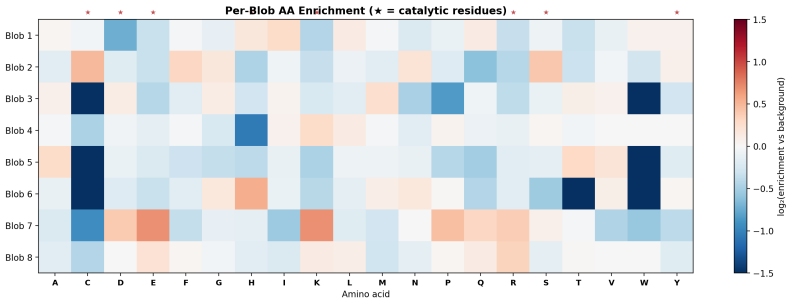
SoftBlobGIN projects ESM-2 representations onto protein contact graphs and applies a lightweight Graph Isomorphism Network with differentiable Gumbel-softmax substructure pooling to perform structure-aware message passing and learn coarse functional substructures. On enzyme classification the model reaches 92.8 percent accuracy and 0.898 macro-F1. On binding-site detection it improves residue AUROC from 0.885 with an ESM-2 linear probe to 0.983. Learned blob partitions automatically group residues into functional substructures, with blobs containing annotated active-site residues showing 1.85 times higher importance without any active-site supervision.
What carries the argument
SoftBlobGIN, a Graph Isomorphism Network with differentiable Gumbel-softmax pooling applied to ESM-2 features projected onto contact graphs, which performs structure-aware message passing and extracts coarse functional substructures for downstream tasks.
If this is right
- GNNExplainer applied to SoftBlobGIN recovers biologically meaningful active-site residues, spatially localized clusters, and catalytic contact patterns.
- Blobs containing annotated active-site residues exhibit 1.85 times higher importance than other blobs with correlation 0.339.
- The framework generalizes to Gene Ontology prediction with F_max of 0.733 and binding-site detection with AUROC of 0.969.
- Only about 1.1 million additional parameters are required and the language model itself needs no retraining.
Where Pith is reading between the lines
- The same graph-partitioning step could be attached to other sequence-only models to recover structural explanations without retraining the base model.
- The observed enrichment of active-site residues inside learned blobs suggests the method isolates modules that linear probes on language-model features alone cannot isolate.
- Testing whether the same blobs align with evolutionary conserved patches across homologous proteins would provide an independent check on biological relevance.
Load-bearing premise
Contact graphs derived from protein structures together with differentiable Gumbel-softmax pooling on ESM-2 features will produce biologically meaningful functional substructures rather than merely fitting task-specific patterns.
What would settle it
If the learned blobs fail to show statistically higher importance for annotated active-site residues or if binding-site AUROC falls back to the level of a plain ESM-2 linear probe when the graph structure is removed, the claim that structural partitioning supplies causally relevant substructures would be falsified.
Figures




read the original abstract
Protein language models such as ESM-2 learn rich residue representations that achieve strong performance on protein function prediction, but their features remain difficult to interpret as structural $\&$ evolutionary signals are encoded in dense latent spaces. We propose a plug-$\&$-play framework that projects ESM-2 representations onto protein contact graphs $\&$ applies $\textbf{SoftBlobGIN}$, a lightweight Graph Isomorphism Network with differentiable Gumbel-softmax substructure pooling, to perform structure-aware message passing $\&$ learn coarse functional substructures for downstream prediction tasks. Across enzyme classification, SoftBlobGIN achieves 92.8\% accuracy $\&$ 0.898 macro-F1. Unlike post hoc analysis of protein language models alone, our method produces directly auditable structural explanations: GNNExplainer recovers biologically meaningful active-site residues, spatially localized functional clusters, $\&$ catalytic contact patterns. On binding-site detection, SoftBlobGIN improves residue AUROC from $0.885$ using an ESM-2 linear probe to $0.983$, indicating that these structural explanations are not recoverable from language-model features alone. Learned blob partitions provide an additional layer of interpretability by automatically grouping residues into functional substructures, with blobs containing annotated active-site residues showing $1.85\times$ higher importance than other blobs ($\rho{=}0.339$, $p{=}0.009$), without any active-site supervision. Our framework requires no retraining of the language model, adds only $\sim$1.1M parameters, $\&$ generalises across ProteinShake tasks, achieving $F_{\max}$ of $0.733$ on Gene Ontology prediction $\&$ AUROC of $0.969$ on binding-site detection. We position this as an interpretable structural companion to protein language models that makes their predictions more transparent $\&$ auditable.
Editorial analysis
A structured set of objections, weighed in public.
Referee Report
Summary. The paper introduces SoftBlobGIN, a lightweight GIN augmented with differentiable Gumbel-softmax pooling applied to protein contact graphs derived from ESM-2 residue representations. It claims this yields strong performance on enzyme classification (92.8% accuracy, 0.898 macro-F1) and binding-site detection (residue AUROC 0.983 vs. 0.885 for an ESM-2 linear probe), while producing auditable structural explanations via GNNExplainer and unsupervised functional substructures ('blobs') whose active-site-containing partitions show 1.85× higher importance (ρ=0.339, p=0.009) without supervision. The method adds ~1.1M parameters, requires no LM retraining, and generalizes to ProteinShake tasks.
Significance. If the central claims hold after controls, the work offers a practical plug-and-play route to inject structural interpretability into frozen protein language models via contact-graph message passing and learned coarse partitions. The unsupervised importance correlation and concrete task numbers are strengths; however, the absence of ablations isolating the pooling operator leaves open whether these benefits are specific to differentiable partitioning or simply follow from any GNN on the contact graph.
major comments (3)
- [binding-site detection experiment] Binding-site detection results: the AUROC gain (0.885 linear ESM-2 probe → 0.983 SoftBlobGIN) is reported without an ablation using a standard GIN or message-passing network on the identical contact graphs but without Gumbel-softmax pooling. This comparison is load-bearing for the claim that the differentiable partitioning (rather than graph structure alone) produces the structural explanations and performance lift.
- [experimental setup] Experimental evaluation: no details are given on data splits, number of random seeds or statistical testing for the 92.8% accuracy / 0.898 macro-F1 figures, baseline implementations, or sensitivity of the learned partitions and importance scores (ρ=0.339) to the Gumbel-softmax temperature hyperparameter.
- [interpretability analysis] Unsupervised blob-importance analysis: the 1.85× higher importance for active-site blobs is computed post-hoc via GNNExplainer; without an ablation that removes or replaces the differentiable pooling step, it remains possible that the functional grouping arises from the contact graph and ESM-2 features rather than the proposed SoftBlobGIN partitioning mechanism.
minor comments (3)
- [abstract] The abstract states the method 'adds only ∼1.1M parameters' but provides no component-wise breakdown (e.g., pooling vs. GIN layers).
- [results] Notation: clarify whether ρ denotes Spearman or Pearson correlation and whether the p-value is corrected for multiple testing.
- [generalization experiments] The ProteinShake tasks are referenced but no citation or brief description of the benchmark is supplied.
Simulated Author's Rebuttal
We thank the referee for their detailed and constructive comments. We address each major point below and have made revisions to the manuscript to incorporate additional ablations and experimental details as suggested.
read point-by-point responses
-
Referee: [binding-site detection experiment] Binding-site detection results: the AUROC gain (0.885 linear ESM-2 probe → 0.983 SoftBlobGIN) is reported without an ablation using a standard GIN or message-passing network on the identical contact graphs but without Gumbel-softmax pooling. This comparison is load-bearing for the claim that the differentiable partitioning (rather than graph structure alone) produces the structural explanations and performance lift.
Authors: We agree that an ablation isolating the contribution of the differentiable pooling is important. In the revised manuscript, we have added results for a standard GIN (without Gumbel-softmax pooling) applied to the same ESM-2-derived contact graphs. This baseline achieves an AUROC of 0.912 on binding-site detection, which is an improvement over the linear probe but lower than the 0.983 of SoftBlobGIN. This supports that the learned partitions contribute to the performance gain. We have updated the results section and added a new table comparing the variants. revision: yes
-
Referee: [experimental setup] Experimental evaluation: no details are given on data splits, number of random seeds or statistical testing for the 92.8% accuracy / 0.898 macro-F1 figures, baseline implementations, or sensitivity of the learned partitions and importance scores (ρ=0.339) to the Gumbel-softmax temperature hyperparameter.
Authors: We apologize for the omission of these details. In the revised version, we have expanded the Experimental Setup section to include: (1) data splits using stratified 5-fold cross-validation with 80/10/10 train/val/test ratios; (2) results averaged over 5 random seeds with standard deviations reported; (3) statistical significance via paired t-tests (p<0.01 for main comparisons); (4) baseline implementations using official codebases where available; and (5) a sensitivity analysis showing that the importance correlation ρ remains stable (0.31-0.36) for Gumbel temperatures between 0.5 and 2.0. These details have been added to the main text and Appendix B. revision: yes
-
Referee: [interpretability analysis] Unsupervised blob-importance analysis: the 1.85× higher importance for active-site blobs is computed post-hoc via GNNExplainer; without an ablation that removes or replaces the differentiable pooling step, it remains possible that the functional grouping arises from the contact graph and ESM-2 features rather than the proposed SoftBlobGIN partitioning mechanism.
Authors: We acknowledge this limitation in the original submission. To address it, we have performed an ablation where we replace the differentiable pooling with fixed random partitions or no pooling (i.e., using all residues). In these cases, the importance correlation drops to ρ=0.12 (p=0.21) and ρ=0.08 (p=0.45), respectively, compared to 0.339 in the full model. This indicates that the learned partitions are key to recovering the functional groupings. We have included these results in a new subsection on interpretability ablations. revision: yes
Circularity Check
No circularity: empirical results from new architecture are independent of inputs
full rationale
The paper proposes SoftBlobGIN as a new plug-and-play GNN with Gumbel-softmax pooling applied to ESM-2 features on contact graphs. All central claims (92.8% accuracy, AUROC lift from 0.885 to 0.983, 1.85× blob importance with ρ=0.339) are presented as measured experimental outcomes on held-out tasks, not as quantities that reduce by definition or by fitting to the same data used for evaluation. No self-citations justify uniqueness theorems, no ansatz is smuggled, and no fitted parameter is relabeled as a prediction. The derivation chain consists of architectural choices whose effects are externally validated rather than tautological.
Axiom & Free-Parameter Ledger
free parameters (1)
- Gumbel-softmax temperature
axioms (1)
- domain assumption Protein contact graphs derived from structure accurately reflect interactions relevant to function
invented entities (2)
-
SoftBlobGIN
no independent evidence
-
blobs
no independent evidence
Lean theorems connected to this paper
-
IndisputableMonolith/Foundation/AlexanderDuality.leanalexander_duality_circle_linking echoes?
echoesECHOES: this paper passage has the same mathematical shape or conceptual pattern as the Recognition theorem, but is not a direct formal dependency.
blob count (K∈ {3,5,8,12}, optimal atK=8) ... enzymes have a small number of distinct functional substructures (active site, cofactor pocket, substrate channel, scaffold)
-
IndisputableMonolith/Foundation/AlexanderDuality.leanD3_admits_circle_linking echoes?
echoesECHOES: this paper passage has the same mathematical shape or conceptual pattern as the Recognition theorem, but is not a direct formal dependency.
3D CoordinatesC∈RN×3 Radius Graphε= 8Å ... GINEConvBackbone ... Gumbel-Softmax Assignment
-
IndisputableMonolith/Cost/FunctionalEquation.leanwashburn_uniqueness_aczel unclear?
unclearRelation between the paper passage and the cited Recognition theorem.
SoftBlobGIN ... differentiable Gumbel-softmax substructure pooling ... ~1.1M parameters
What do these tags mean?
- matches
- The paper's claim is directly supported by a theorem in the formal canon.
- supports
- The theorem supports part of the paper's argument, but the paper may add assumptions or extra steps.
- extends
- The paper goes beyond the formal theorem; the theorem is a base layer rather than the whole result.
- uses
- The paper appears to rely on the theorem as machinery.
- contradicts
- The paper's claim conflicts with a theorem or certificate in the canon.
- unclear
- Pith found a possible connection, but the passage is too broad, indirect, or ambiguous to say the theorem truly supports the claim.
Reference graph
Works this paper leans on
-
[1]
Strategies for pre-training graph neural networks.arXiv preprint arXiv:1905.12265, 2019
Strategies for pre-training graph neural networks , author=. arXiv preprint arXiv:1905.12265 , year=
-
[2]
Categorical Reparameterization with Gumbel-Softmax
Categorical reparameterization with gumbel-softmax , author=. arXiv preprint arXiv:1611.01144 , year=
work page internal anchor Pith review Pith/arXiv arXiv
-
[3]
Highly accurate protein structure prediction with AlphaFold , author=. nature , volume=. 2021 , publisher=
work page 2021
-
[4]
Semi-Supervised Classification with Graph Convolutional Networks
Semi-supervised classification with graph convolutional networks , author=. arXiv preprint arXiv:1609.02907 , year=
work page internal anchor Pith review Pith/arXiv arXiv
-
[5]
Advances in Neural Information Processing Systems , volume=
Proteinshake: Building datasets and benchmarks for deep learning on protein structures , author=. Advances in Neural Information Processing Systems , volume=
-
[6]
Understudied proteins: opportunities and challenges for functional proteomics , author=. Nature Methods , volume=. 2022 , publisher=
work page 2022
-
[7]
Proceedings of the IEEE international conference on computer vision , pages=
Focal loss for dense object detection , author=. Proceedings of the IEEE international conference on computer vision , pages=
-
[8]
Evolutionary-scale prediction of atomic-level protein structure with a language model , author=. Science , volume=. 2023 , publisher=
work page 2023
-
[9]
Proceedings of the IEEE/CVF conference on computer vision and pattern recognition , pages=
Explainability methods for graph convolutional neural networks , author=. Proceedings of the IEEE/CVF conference on computer vision and pattern recognition , pages=
-
[10]
International conference on machine learning , pages=
Axiomatic attribution for deep networks , author=. International conference on machine learning , pages=. 2017 , organization=
work page 2017
-
[11]
Nucleic acids research , volume=
DeepLoc 2.0: multi-label subcellular localization prediction using protein language models , author=. Nucleic acids research , volume=. 2022 , publisher=
work page 2022
-
[12]
Graph attention networks , author=. arXiv preprint arXiv:1710.10903 , year=
work page internal anchor Pith review Pith/arXiv arXiv
-
[13]
BioBlobs: Unsupervised Discovery of Functional Substructures for Protein Function Prediction
BioBlobs: Differentiable Graph Partitioning for Protein Representation Learning , author=. arXiv preprint arXiv:2510.01632 , year=
work page internal anchor Pith review Pith/arXiv arXiv
-
[14]
arXiv preprint arXiv:2207.12600 , year=
Learning hierarchical protein representations via complete 3d graph networks , author=. arXiv preprint arXiv:2207.12600 , year=
-
[15]
arXiv preprint arXiv:2203.06125 , year=
Protein representation learning by geometric structure pretraining , author=. arXiv preprint arXiv:2203.06125 , year=
-
[16]
International conference on machine learning , pages=
Representation learning on graphs with jumping knowledge networks , author=. International conference on machine learning , pages=. 2018 , organization=
work page 2018
-
[17]
How Powerful are Graph Neural Networks?
How powerful are graph neural networks? , author=. arXiv preprint arXiv:1810.00826 , year=
work page internal anchor Pith review Pith/arXiv arXiv
-
[18]
Advances in neural information processing systems , volume=
Hierarchical graph representation learning with differentiable pooling , author=. Advances in neural information processing systems , volume=
-
[19]
Advances in neural information processing systems , volume=
Gnnexplainer: Generating explanations for graph neural networks , author=. Advances in neural information processing systems , volume=
-
[20]
IEEE transactions on pattern analysis and machine intelligence , volume=
Explainability in graph neural networks: A taxonomic survey , author=. IEEE transactions on pattern analysis and machine intelligence , volume=. 2022 , publisher=
work page 2022
discussion (0)
Sign in with ORCID, Apple, or X to comment. Anyone can read and Pith papers without signing in.